Capital Group Municipal Income ETF
- Abbreviation
- CGMU
- Vehicle
- ETF
- Category
- Muni National Intermediate

MUNICIPAL BONDS
The Tax-Exempt Bond Fund of America® offers more income potential over the taxable market benchmark for high-income investors
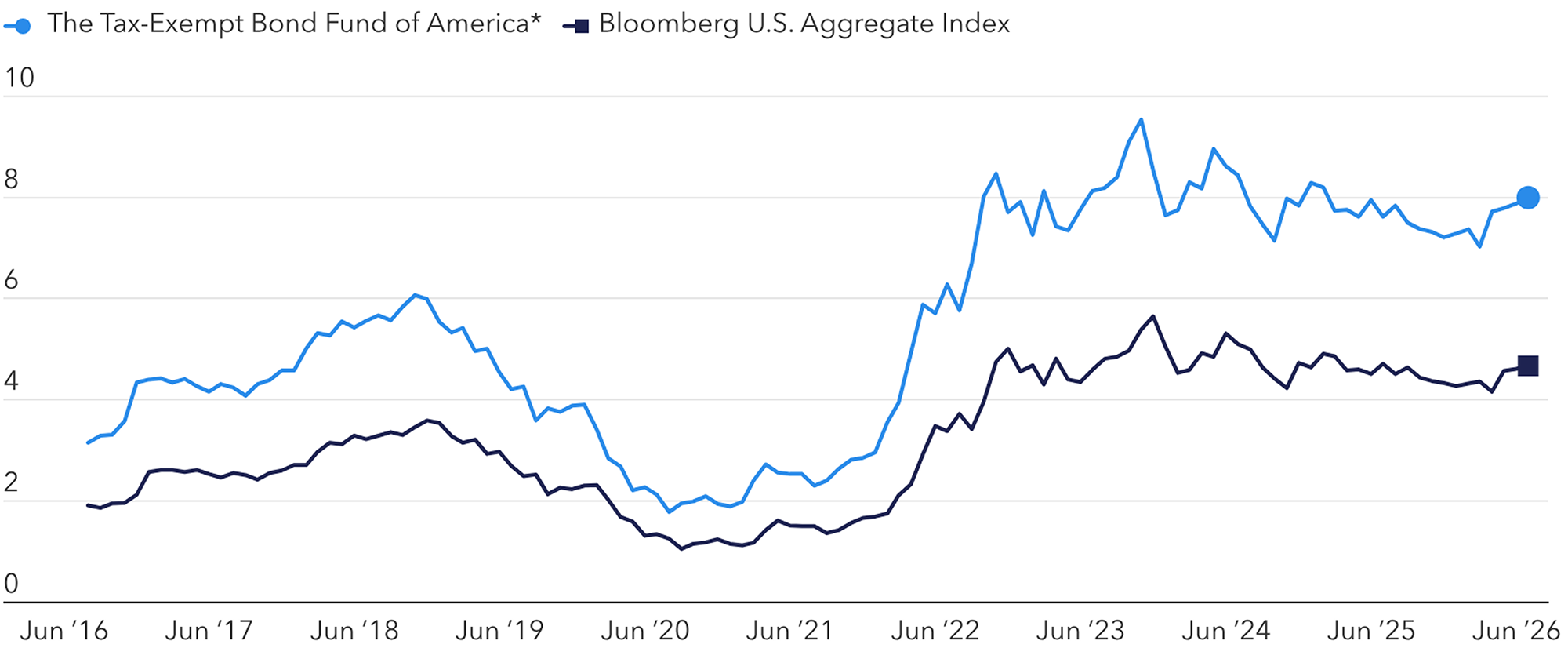
Sources: Capital Group, Bloomberg Index Services Ltd., Morningstar. As of 6/30/26.
Footnote/Important information:
* Yield shown is the tax-equivalent yield to worst.
The after-tax (or tax-equivalent) yield of a municipal bond investment is the yield a taxable bond would have to offer to equal the same amount as the tax-exempt bond. This chart uses the highest federal tax rate, assuming the 3.8% net investment income tax and a 37% top federal marginal tax rate for the current tax year, for a total federal tax rate of 40.8%. Tax-equivalent yield calculation is yield/(1 - [federal tax rate]).
PRODUCTS
Capital Group offers exchange traded funds (ETFs), mutual funds and separately managed accounts (SMAs) to fit the needs of different investors.
CGMU
Single solution core municipal bond allocation.
86%
of the fund’s holdings are rated BBB/Baa or higher, or held in cash & equivalents1
5.3
Duration
Source: Capital Group. As of 6/30/26.
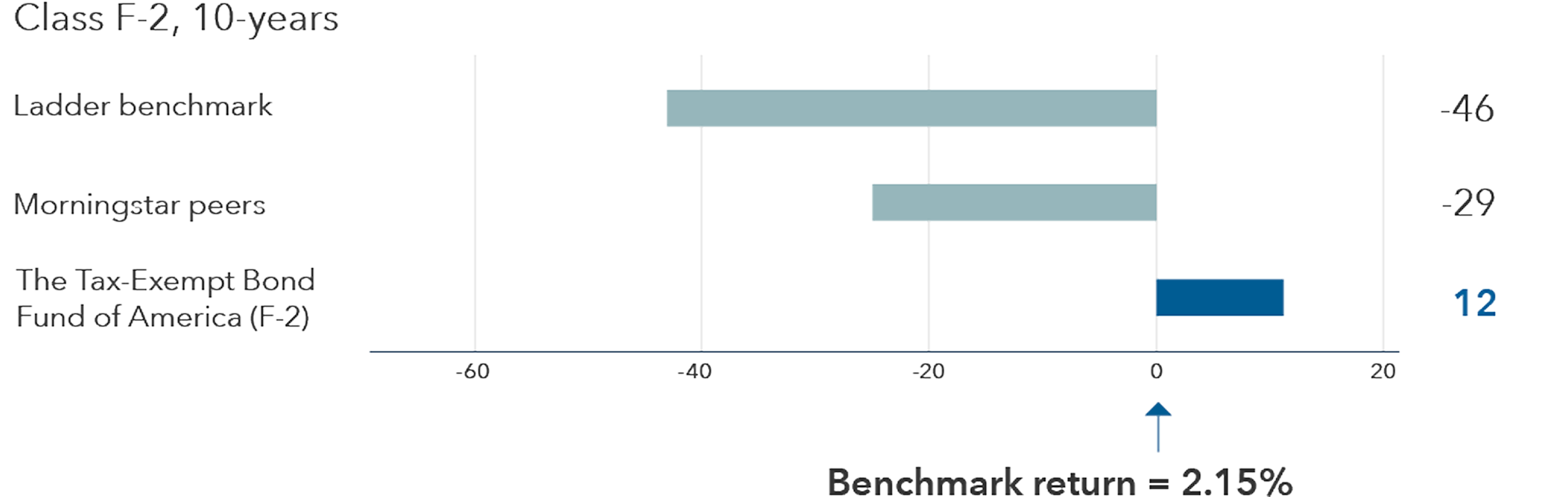
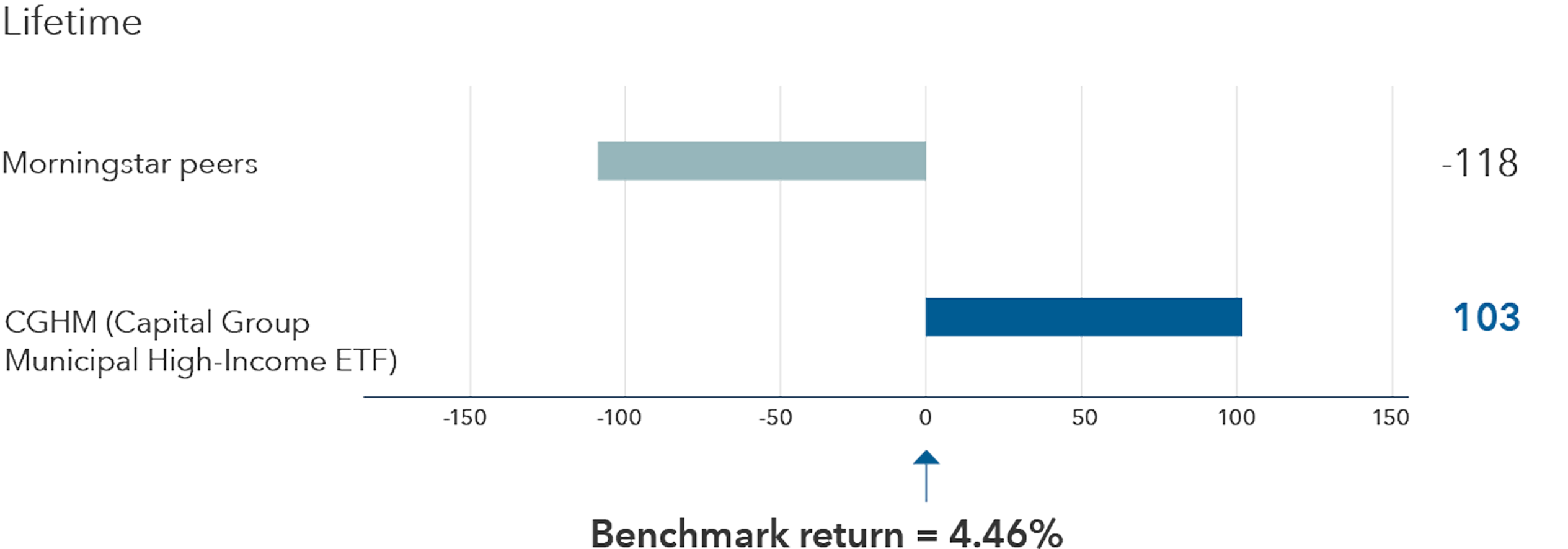
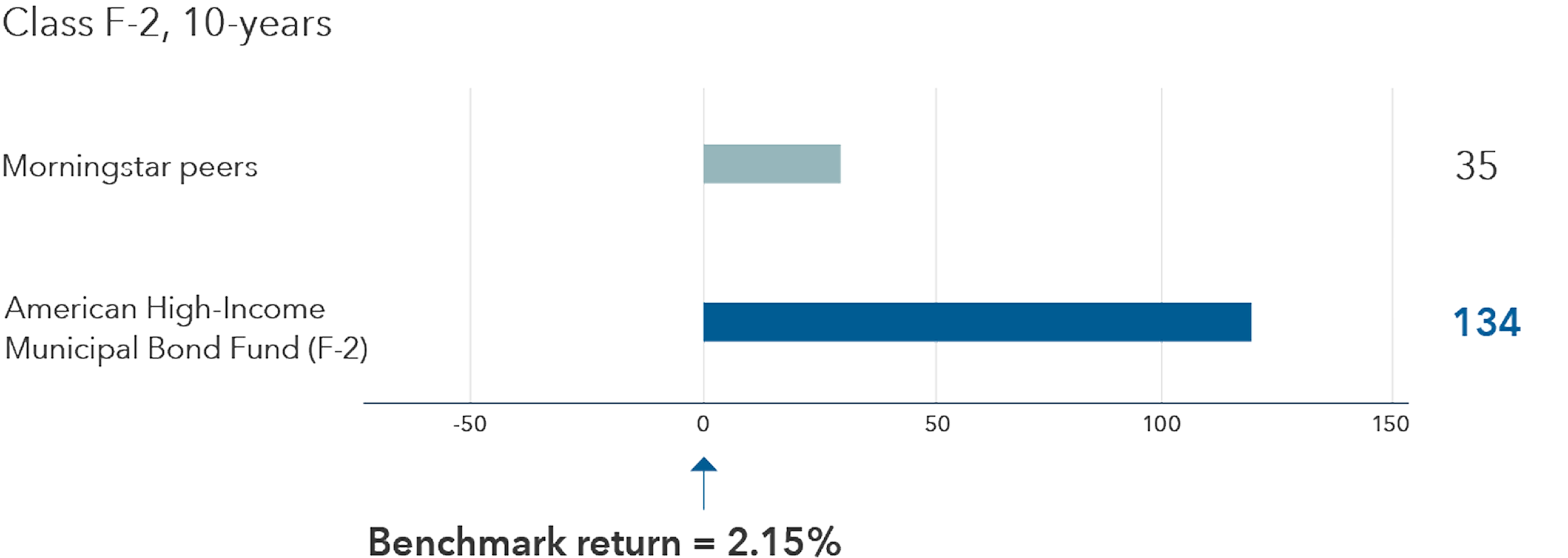
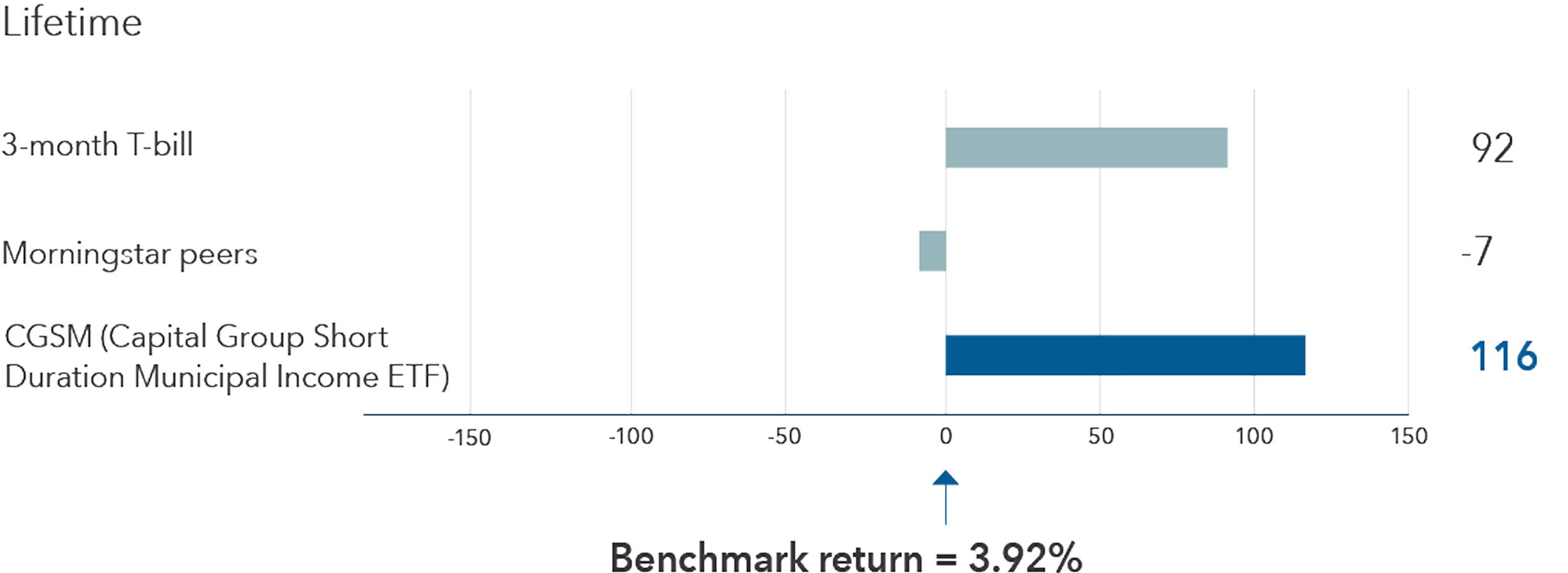
Excess annualized returns vs. benchmark in basis points (bps)
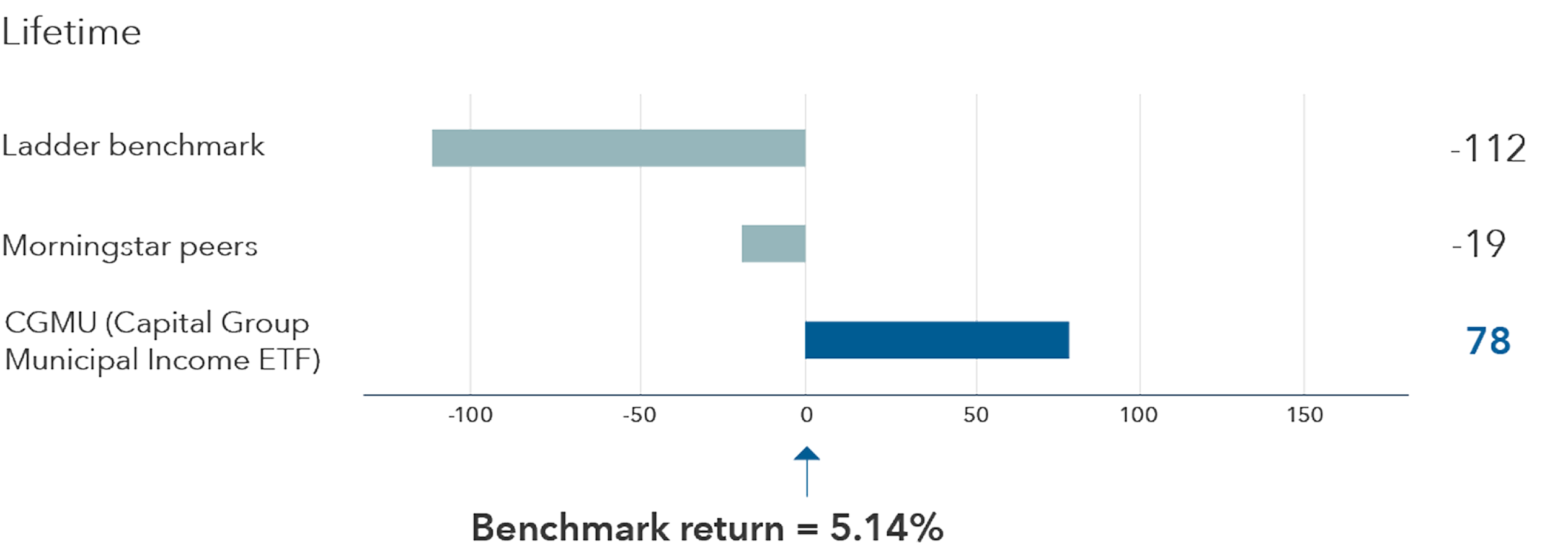
Source: Bloomberg. As of 6/30/26.
CGMU return reflects NAV. CGMU inception date 10/25/22. Benchmark is 85%/15% Bloomberg 1-15 Year Blend (1-17 Year) Municipal Bond Index/Bloomberg 1-15 Year Blend (1-17 Year) High Yield Municipal Bond Index. Ladder benchmark is Bloomberg Municipal Managed Money 1-12 Year Laddered Maturity Index. Morningstar category average is Muni National Interm. Annualized 1-year, 5-year and 10-year returns as follows: CGMU, 6.40%. The ETF does not have a history for 5- or 10-year returns. Benchmark, 5.56%, 1.54%. The benchmark does not have a history for 10-year returns. Ladder benchmark: 4.47%, 0.91%, 1.69%. Morningstar category: 6.18%, 1.09%, 1.86%.
Sources: Bloomberg, Capital Group. As of 6/30/26. The after-tax (or tax-equivalent) yield of a municipal bond investment is the yield a taxable bond would have to offer to equal the same amount as the tax-exempt bond. Highest federal tax rate assumes the 3.8% net investment income tax and a 37% top federal marginal tax rate for the current tax year, for a total federal tax rate of 40.8%. Tax-equivalent yield calculation is yield/(1 - [federal tax rate]). For New York and California additional top state tax rates of 10.9% and 12.3%, respectively, are added to the 40.8% federal rate, producing higher tax-equivalent yields.
ACCOLADES
Our investing approach has produced strong results relative to peers, earning industry accolades.
 Morningstar Medalist Rating™ Morningstar Medalist Rating™ | |
|---|---|
[100%/100%] Analyst-Driven/Data Coverage | [10%/100%] |
The Tax-Exempt Bond Fund of America2, F-2, F-3 | American Funds Tax-Exempt Fund of New York6, F-2, F-3 |
American High-Income Municipal Bond Fund3, F-2, F-3 | |
The Tax-Exempt Fund of California2, F-2, F-3 | [10%/76%] |
Limited Term Tax-Exempt Bond Fund of America4, F-2, F-3 | CGHM — Capital Group Municipal High-Income ETF6 |
CGMU — Capital Group Municipal Income ETF4 | |
Capital Group Intermediate Municipal SMA5 | |
Footnotes/Important information:
2As of 5/18/26. 3As of 5/14/26. 4As of 4/27/26. 5As of 5/11/26. 6As of 6/30/26.
The Morningstar Medalist Rating is a forward-looking assessment assigned by Morningstar’s research analysts. It reflects their qualitative evaluation of an investment strategy’s potential to outpace its category benchmark over a full market cycle on a risk-adjusted basis and net of fees. Morningstar bases its ratings on three fundamental pillars — People, Parent and Process — the Medalist Rating Price Score. The Medalist Rating does not reference a specific time period but is based on qualitative and select quantitative data as of 4/27/26, 5/11/26, 5/14/26, 5/18/26, 6/30/26, respectively. Capital Group did not compensate Morningstar for the ratings and comments contained in this material. However, the firm has paid Morningstar a licensing fee to access and publish its ratings data.
WHY CAPITAL GROUP?
Managing municipal bond funds since 1979
Our investment team combines deep market experience with in-depth research to identify compelling opportunities in the municipal bond market. We manage risk and seek value through selectivity around both credit and interest rate exposures.
AT A GLANCE
Scale, experience and specialization across the municipal bond team.
3rd
largest actively managed municipal bond fund platform
Source: Morningstar. As of 6/30/26.
$78.6 billion
Managed in municipal bonds
In AUM, as of 6/30/26.
A dedicated team of
23 investment professionals
7 portfolio managers
10 research analysts
6 traders
As of 12/31/25.
CALCULATOR
It depends on your tax rate.
Connect with one of our specialists to discuss how municipal bond strategies can help to support a portfolio
INSIGHTS
Learn more about municipal bonds.
A municipal (muni) bond is a type of fixed income bond sponsored by local or state governments or a qualified issuer to help fund public projects, such as transportation (for example, roads, airports, bridges or ports), water, electric and sewer facilities, government buildings, hospitals, senior care facilities and much more. Many “public good” projects are also funded by municipals, such as universities, schools, parks and police and fire departments. Municipal bonds can be attractive to investors because of federal tax-exempt income and sometimes exemption from state and local taxes, depending on where the investor resides.
Tax-exempt income is income that is exempt from taxes, which means investors keep more of their money. Municipal bonds are exempt from federal income tax and sometimes from state and local taxes, depending on where the investor resides.
As an example of state and local taxes, for a muni bond fund composed entirely of New York muni bonds, New York investors are eligible for income exempt from both federal and state taxes. If some of these bonds were issued by New York City, the residents of New York City would be eligible for tax-exempt income from the local bonds.
Tax-equivalent yield is the yield a taxable bond would need to offer to be equivalent to the income from a tax-free bond (a municipal bond). Tax-equivalent yield helps investors compare taxable bonds with tax-free bonds to determine which is best suited for their financial situation. For example (using the top federal marginal tax rate of 37% and net investment income tax of 3.8%), for a muni bond yielding 3.00%, a taxable bond would need to yield 5.07% to be the equivalent of the income received from the tax-exempt bond.
There are two types of municipal bonds: general obligation (GO) bonds and revenue bonds.
GOs are bonds backed by the full faith and credit of the issuing government. If needed, the government, as a taxing authority, can raise taxes to meet interest and principal obligations. For example, the government could theoretically raise property taxes, sales taxes or income taxes in an effort to meet the income and principal outflows. In contrast, revenue bonds are bonds tied to specific revenue-generating projects. The interest and principal of the bond is paid by the revenue generated by the project. Examples of this are toll road fees, hospital fees, water and/or sewer bills or electric company bills.
A municipal bond mutual fund is a pooled investment containing hundreds or thousands of municipal bonds. Investors purchase shares of the mutual fund, therefore gaining exposure to the bonds within the fund. Municipal bond mutual funds can be attractive because they tend to offer diversification from other asset classes and are generally exempt from federal income tax and sometimes state and local taxes, depending on where the investor resides.
There are several types of municipal bond mutual funds; for example, short-term, intermediate-term, long-term, investment-grade, high-yield and state-specific. Short-term funds tend to hold bonds with a duration of less than four years, intermediate-term funds tend to hold bonds with durations of four to six years, and long-term funds tend to hold bonds with durations longer than six years. Investment-grade funds tend to hold substantial assets in investment grade bonds (BBB/Baa and above). High-yield funds tend to hold substantial assets in below-investment-grade bonds (BB/Ba and below) or non-rated bonds. State-specific funds hold bonds issued by the state, and can be beneficial for investors of that state, as income from state and local municipal bonds is generally tax-exempt for state residents.
Investors have a choice of municipal bond investment vehicles, including mutual funds, exchange traded funds (ETFs) and separately managed accounts (SMAs). However, mutual funds and ETFs do not offer direct ownership of municipal bonds.
Both mutual funds and ETFs are pooled investments, holding anywhere from hundreds to thousands of municipal bonds. They can both offer diversity within the municipal market. It should be noted that mutual funds trade once, at the end of the day. An ETF has the trading flexibility of a stock, and can be traded intra-day, which provides more control over the price of execution. ETFs are also known for typically lower fees than mutual funds.
SMAs provide direct ownership of individual securities. As a result, an investor’s portfolio can be fine-tuned to reflect their tax situation, including emphasizing bonds from their state of residence. For more information, visit Separately Managed Accounts | Capital Group.
National muni strategies invest across states and are generally more diversified and flexible, with a broader opportunity set and potentially better relative value opportunities. State-specific strategies generally only invest in one state and potentially offer greater after-tax income for residents of high-tax states like California and New York. The possibility of more after-tax income comes at the cost of greater concentration risk and a smaller investment universe.
Capital Group offers state-specific municipal bond mutual funds with American Funds Tax-Exempt Fund of New York (for New York residents) and The Tax-Exempt Fund of California (for California residents).
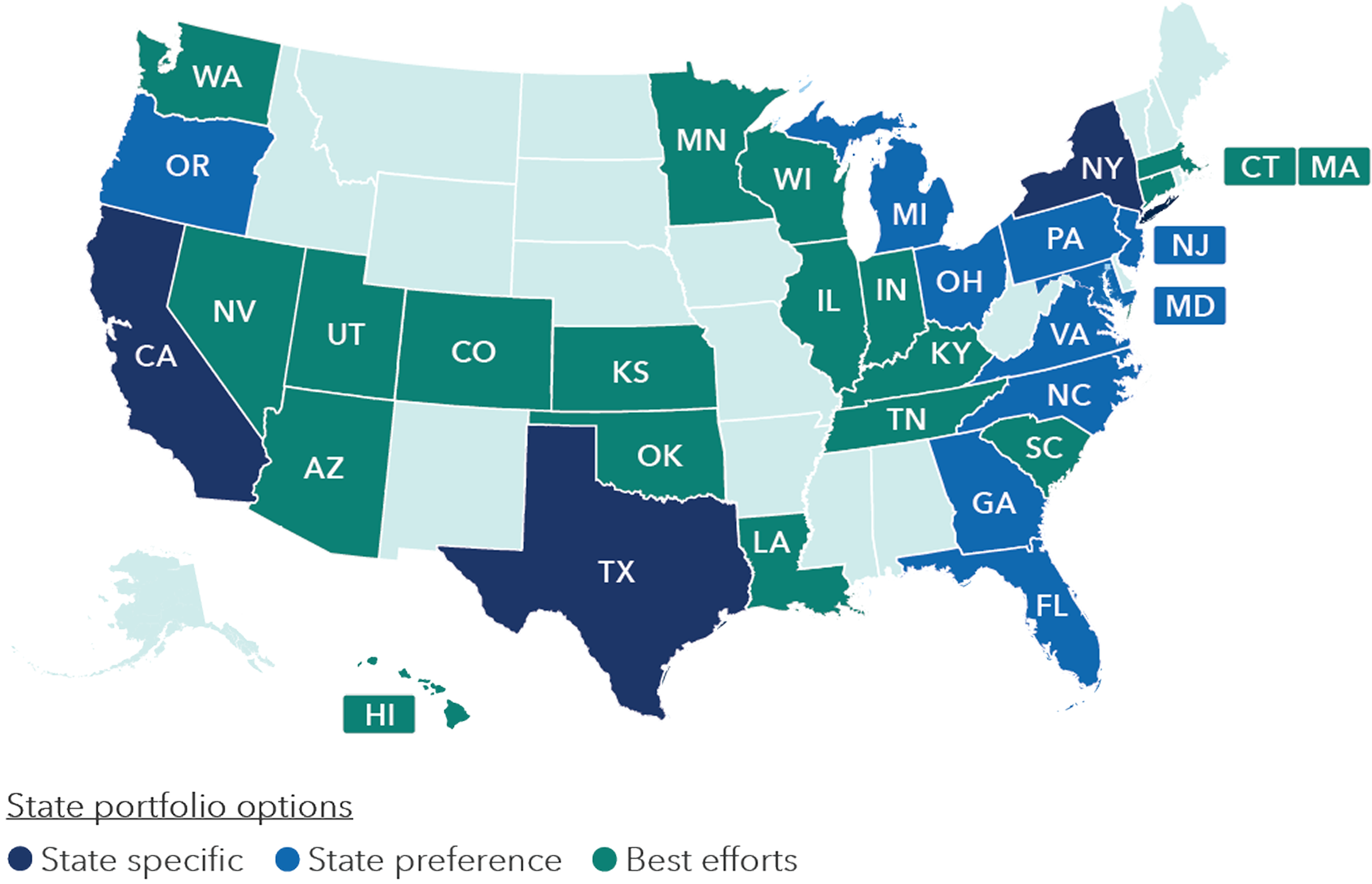
For SMAs, Capital Group offers a wide range of state-specific, state preference and best efforts portfolios. For more information, visit Muni SMA Storefront | Capital Group.
The municipal yield curve is a graphic representation of the yields of municipal bonds across maturities, starting at the short end and extending to the long end. If the municipal curve is referred to as steep, the longer end of the curve offers higher yield than the shorter end of the curve. If a curve is inverted, then shorter-term bonds offer higher yield than longer-term bonds. If a curve is flat, then shorter-term bonds offer similar yield to longer-term bonds. As a general note, the municipal yield curve often moves in the same direction as the Treasury yield curve (the graphic representation of the yields of U.S. government bonds across different maturities). However, it should be noted that, at times, the municipal curve may meaningfully differ from the Treasury curve.
The muni/Treasury ratio compares AAA GO or highest quality municipal bond yields to those of U.S. Treasuries with the same maturity. The muni/Treasury ratio is a measure of value. A lower ratio, such as below 60%, may indicate that Treasuries are more attractive than municipals, while a high ratio, such as 80% or higher, may indicate that municipals are more attractive than Treasuries when accounting for the tax-exempt nature of municipal bonds. For example, a muni/Treasury ratio of 100% or more is considered very attractive for municipals, since the investor can earn Treasury-like yields but also more income when considering the tax-exempt status of the municipals. The muni/Treasury ratio calculation is simply the municipal bond yield divided by the Treasury yield (same maturity).
Figures shown are past results and are not predictive of results in future periods. Current and future results may be lower or higher than those shown. Investing for short periods makes losses more likely. Prices and returns will vary, so investors may lose money. View mutual fund expense ratios and returns. View ETF expense ratios and returns. View current mutual fund SEC yields and tax-equivalent SEC yields.
Investments are not FDIC-insured, nor are they deposits of or guaranteed by a bank or any other entity, so they may lose value.
Investors should carefully consider investment objectives, risks, charges and expenses. This and other important information is contained in the ETF prospectuses and summary prospectuses, which can be obtained from a financial professional and should be read carefully before investing. This and other important information is contained in the mutual fund prospectuses and summary prospectuses, which can be obtained from a financial professional and should be read carefully before investing.
Capital Group exchange-traded funds (ETFs) are actively managed and do not seek to replicate a specific index. ETF shares are bought and sold through an exchange at the then current market price, not net asset value (NAV), and are not individually redeemed from the fund. Shares may trade at a premium or discount to their NAV when traded on an exchange. Brokerage commissions will reduce returns. There can be no guarantee that an active market for ETFs will develop or be maintained, or that the ETF’s listing will continue or remain unchanged.
Bond ratings, which typically range from AAA/Aaa (highest) to D (lowest), are assigned by credit rating agencies such as Standard & Poor's, Moody's and/or Fitch, as an indication of an issuer's creditworthiness. Unless otherwise noted below, if agency ratings differ, a security will be considered to have received the highest of those ratings, consistent with applicable investment policies. Securities in the Unrated category have not been rated by any of the rating agencies referenced above; however, the investment adviser performs its own credit analysis and assigns comparable ratings that are used for compliance with applicable investment policies.
For the fund(s) noted, if agency ratings differ, such securities are placed in the lowest category, consistent with applicable investment policies. (American High-Income Municipal Bond Fund)
Lower rated bonds are subject to greater fluctuations in value and risk of loss of income and principal than higher rated bonds. (Also applies to CGHM, CGMU, CGSM).
The return of principal for bond portfolios and for portfolios with significant underlying bond holdings is not guaranteed. Investments are subject to the same interest rate, inflation and credit risks associated with the underlying bond holdings. (Also applies to CGHM, CGMU, CGSM).
Income from municipal bonds may be subject to state or local income taxes and/or the federal alternative minimum tax. Certain other income, as well as capital gain distributions, may be taxable. (Also applies to CGHM, CGMU, CGSM).
As nondiversified funds, CGSM and CGHM have the ability to invest a larger percentage of assets in the securities of a smaller number of issuers than a diversified fund. As a result, poor results by a single issuer could adversely affect fund results more than if the fund were invested in a larger number of issuers. See the applicable prospectus for details.
For The Tax-Exempt Bond Fund of America, income may be subject to state or local income taxes. Certain other income, as well as capital gain distributions, may be taxable.
The Tax-Exempt Fund of California and American Funds Tax-Exempt Fund of New York are more susceptible to factors adversely affecting issuers of their state’s tax-exempt securities than a more widely diversified municipal bond fund.
The Tax-Exempt Bond Fund of America will not invest in bonds subject to the federal alternative minimum tax.
Capital Group manages equity assets through three investment groups. These groups make investment and proxy voting decisions independently. Fixed income investment professionals provide fixed income research and investment management across the Capital organization; however, for securities with equity characteristics, they act solely on behalf of one of the three equity investment groups.
When applicable, results reflect fee waivers and/or expense reimbursements, without which they would have been lower. Please see capitalgroup.com for more information.
Certain share classes were offered after the inception dates of some funds. Results for these shares prior to the dates of first sale are hypothetical based on the original share class results without a sales charge, adjusted for typical estimated expenses.
Results for certain funds with an inception date after the share class inception also include hypothetical returns because those funds' shares sold after the funds' date of first offering. Refer to dates of first sale and specific expense adjustment information.
This material does not constitute legal or tax advice. Investors should consult with their legal or tax advisors.
The Morningstar Medalist Rating is the summary expression of Morningstar's forward-looking analysis of investment strategies as offered via specific vehicles using a rating scale of Gold, Silver, Bronze, Neutral, and Negative. The Medalist Ratings indicate which investments Morningstar believes are likely to outperform their Morningstar Category average on a risk-adjusted basis over time.Investment products are evaluated on three fundamental pillars (People, Parent, and Process) and the Medalist Rating Price Score, which forms the basis for Morningstar's conviction in those products' investment merits and determines the Medalist Rating they are assigned. Pillar ratings take the form of Low (-2), Below Average (-1), Average (0), Above Average (+1), and High (+2). Pillars may be evaluated via an analyst's qualitative assessment (either directly to a vehicle the analyst covers or indirectly when the pillar ratings of a covered vehicle are mapped to a related uncovered vehicle) or using algorithmic techniques. The cost of an investment product is evaluated using the Medalist Rating Price Score, which is a continuous score running from negative 2.5 to positive 2.5 based on the percentile rank of a vehicle's expense ratio within its Morningstar Category. Morningstar combines the pillar scores and Medalist Rating Price Score using predetermined weights for actively and passively managed vehicles to calculate a weighted score. The weighted score is then compared to a set of fixed numeric thresholds employed consistently across Morningstar Categories and regions, with separate thresholds for actively and passively managed investments. Rating thresholds are reviewed at least annually. Buffers and ratings caps are employed to prevent frequent ratings changes. When analysts directly cover a vehicle, they assign the fundamental pillar ratings based on their qualitative assessment, subject to the oversight of the Analyst Rating Committee, and monitor and reevaluate them approximately once a year. When vehicles are covered either indirectly by analysts or by algorithm, the ratings are assigned monthly. For more detailed information about the Medalist Ratings, including their methodology, please visit Morningstar's website for more information. The Morningstar Medalist Ratings are not statements of fact, nor are they credit or risk ratings. The Morningstar Medalist Rating (i) should not be used as the sole basis in evaluating an investment product, (ii) involves unknown risks and uncertainties which may cause expectations not to occur or to differ significantly from what was expected, (iii) is not guaranteed to be based on complete or accurate assumptions or models when determined algorithmically, (iv) involves the risk that return targets will not be met due to unforeseen changes in management, technology, economic development, interest rate development, operating and/or material costs, competitive pressure, supervisory law, exchange rates, tax rates, or political and social conditions, and (v) should not be considered an offer or solicitation to buy or sell the investment product. A change in the fundamental factors underlying the Morningstar Medalist Rating may result in the rating no longer being accurate. Analysts do not have any other material conflicts of interest at the time of publication. Users wishing to obtain further information should contact their local Morningstar office.
Capital Group did not compensate Morningstar for the ratings and comments contained in this material. However, the firm has paid Morningstar a licensing fee to access and publish its ratings data.
Footnote/Important information:
1Cash and equivalents includes short-term securities, accrued income and other assets less liabilities. It may also include investments in money market or similar funds managed by the investment adviser or its affiliates that are not offered to the public.
This content, developed by Capital Group, home of American Funds, should not be used as a primary basis for investment decisions and is not intended to serve as impartial investment or fiduciary advice.
Important note: Compared to managed ladders, fully actively managed funds seek to generate returns in additional ways. The risks entailed are, therefore, potentially broader than investors might be exposed to in a ladder. A ladder involves buying several bonds with a specified range of (staggered) maturities, to offer regular income. When one bond in the ladder matures, proceeds can be used to buy a new bond at the ladder’s longest maturity. The Tax-Exempt Bond Fund of America has often shown a somewhat higher duration (sensitivity to prevailing interest rates) than many ladders. Favorable outcomes shown have often been accompanied by relatively higher rate risk. Investors should consult with their financial advisors about the potential tax and risk consequences of different investment vehicles.
New SMA accounts may require more than four to eight weeks to be fully invested.
Highest federal tax rate assumes the 3.8% net investment income tax and a 37% top federal marginal tax rate for the current tax year, for a total federal tax rate of 40.8%.
Bloomberg U.S. Aggregate Index represents the U.S. investment-grade fixed-rate bond market.
Bloomberg Municipal Bond Index is a market value-weighted index designed to represent the long-term investment-grade tax-exempt bond market.
Bloomberg Municipal Managed Money 1-12 Year Laddered Maturity Index is a component of the Managed Money index — a rules-based, market-value-weighted index of AA-rated tax-exempt bonds; this component is designed to represent a ladder strategy with the specified maturity profile.
Yield to worst is the lowest yield that can be realized by either calling or putting on one of the available call/put dates, or holding a bond to maturity.
Bloomberg High Yield Municipal Bond Index is a market-value-weighted index composed of municipal bonds rated below BBB/Baa.
The Bloomberg High Yield Municipal Bond Index with 5% Tobacco cap and 2% Issuer cap is a market-value-weighted index composed of municipal bonds rated below BBB/Baa.
Bloomberg Municipal BBB Index covers the USD-denominated long-term tax exempt BBB-rated bond market. The index has four main sectors: state and local general obligation bonds, revenue bonds, insured bonds and prerefunded bonds.
Bloomberg 1-15 Year Blend (1-17) Municipal Bond Index consists of a broad selection of investment-grade general obligation and revenue bonds of maturities ranging from one year to 17 years.
Bloomberg 1-15 Year Blend (1-17) High Yield Municipal Bond Index consists of a broad selection of below-investment-grade general obligation and revenue bonds of maturities ranging from one year to 17 years.
Bloomberg Municipal Short 1-5 Years Index is a market-value-weighted index that includes investment-grade tax-exempt bonds with maturities of one to five years.
Morningstar Muni National Intermediate portfolios invest in bonds issued by various state and local governments to fund public projects. The income from these bonds is generally free from federal taxes. To lower risk, these portfolios spread their assets across many states and sectors. These portfolios have durations of 4.0 to 6.0 years (or average maturities of five to 12 years). Morningstar High-Yield Muni portfolios typically invest a substantial portion of assets in high-income municipal securities that are not rated or that are rated at the level of or below BBB (considered high-yield within the municipal-bond industry) by a major ratings agency such as Standard & Poor’s or Moody’s. Morningstar Muni National Short portfolios invest in bonds issued by various state and local governments to fund public projects. The income from these bonds is generally free from federal taxes. To lower risk, these portfolios spread their assets across many states and sectors. These portfolios have durations of less than 4.5 years (or, if duration is unavailable, average maturities of less than five years).
 Morningstar Medalist Rating™