


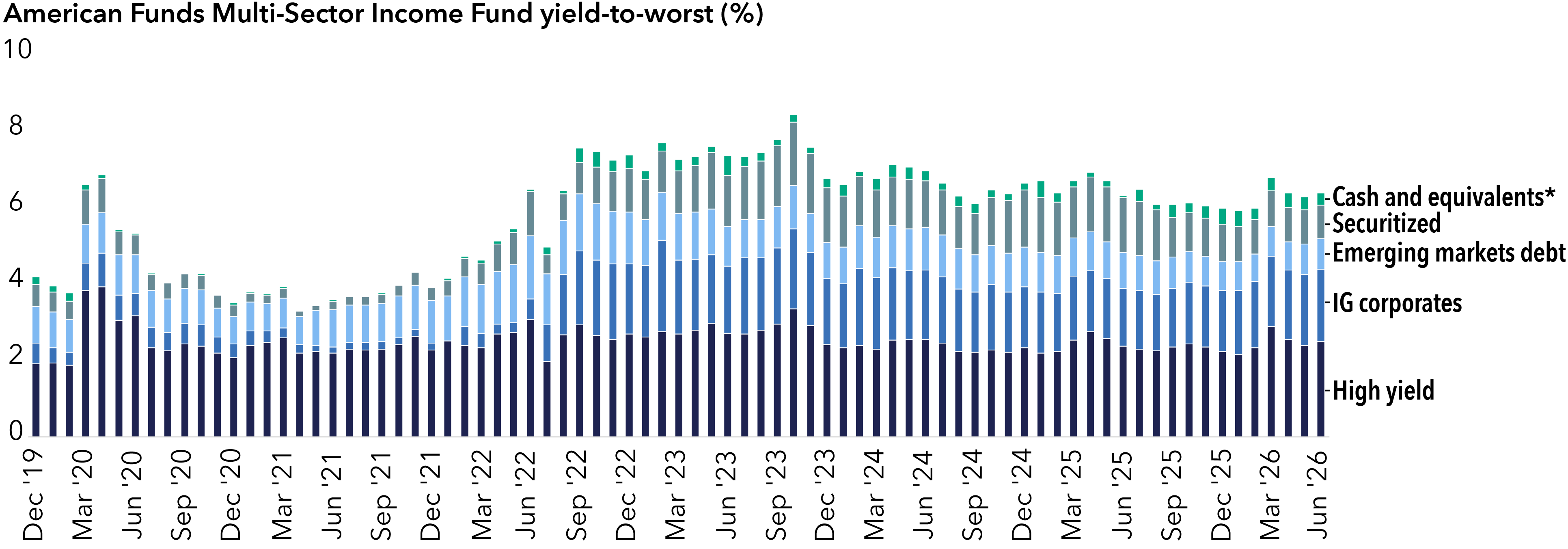
Fund tilted toward higher quality sectors
Monthly allocations since fund inception (March 22, 2019)

TODAY’S CHALLENGE
OUR STRATEGY
*Source: The New York Federal Reserve. As of 6/30/26.
OUR TAKE
Income-seeking funds offered higher distribution rates, complemented core (F-2 shares)
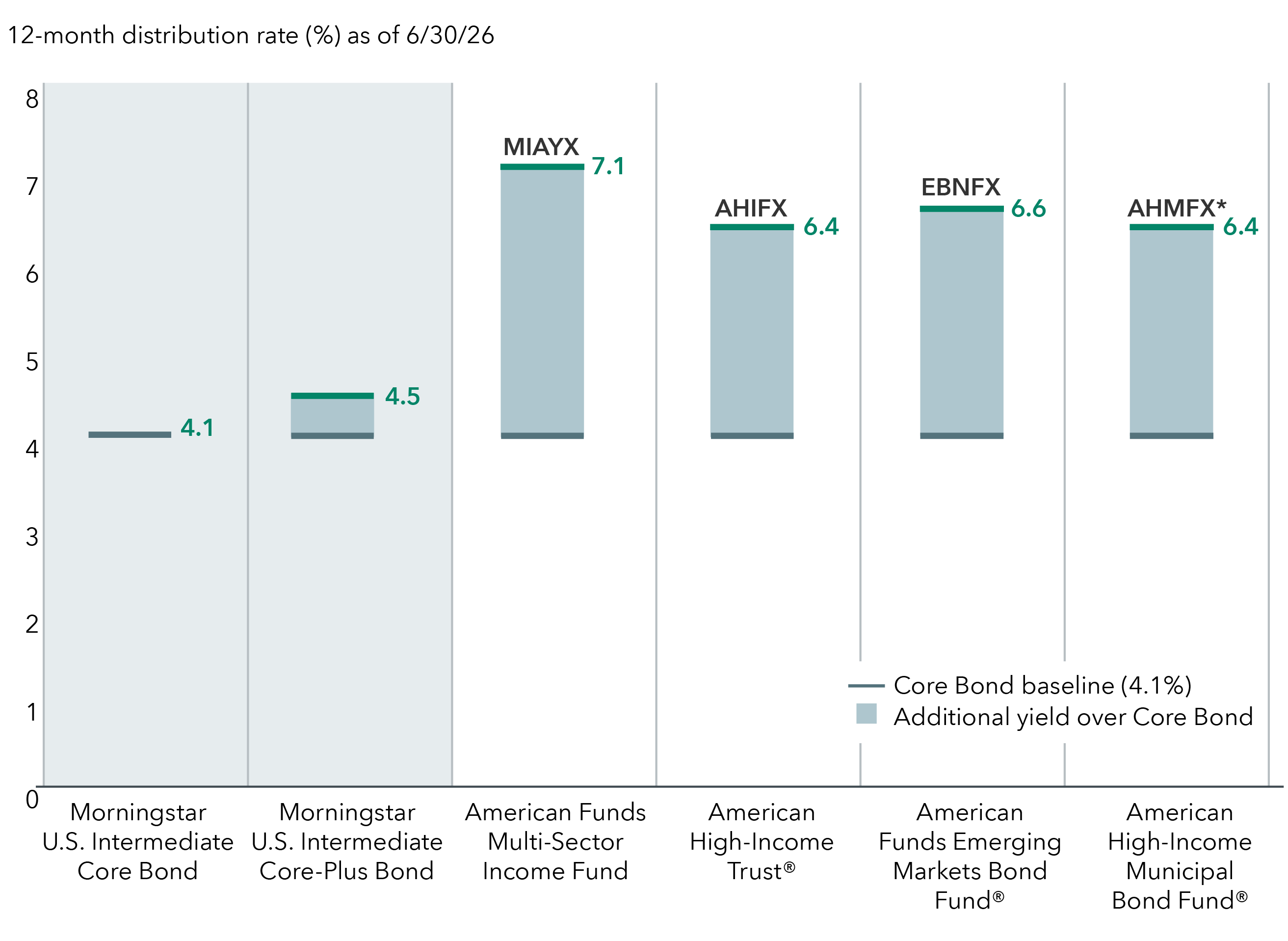
*Tax-equivalent 12-month distribution rate: Highest federal tax rate assumes the 3.8% net investment income tax and a 37% top federal marginal tax rate for the current tax year, for a total federal tax rate of 40.8%. Morningstar Intermediate Core Bond and Morningstar Intermediate Core-Plus Bond are category averages. Sources: Morningstar and Bloomberg.
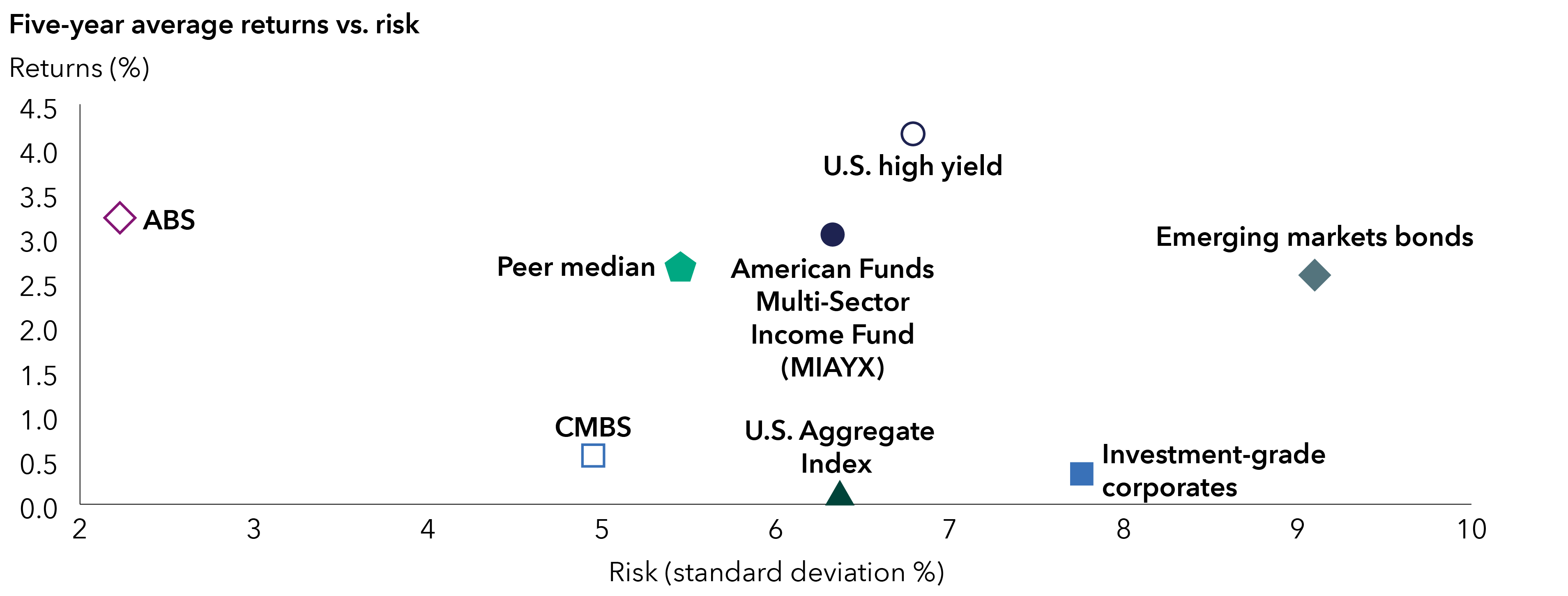
Strategic allocations to sectors such as high yield, investment-grade (BBB/Baa and above) corporates, emerging markets debt and securitized credit are combined into a single portfolio. These sectors’ unique return drivers and correlations can seek a high level of income and risk-adjusted returns.
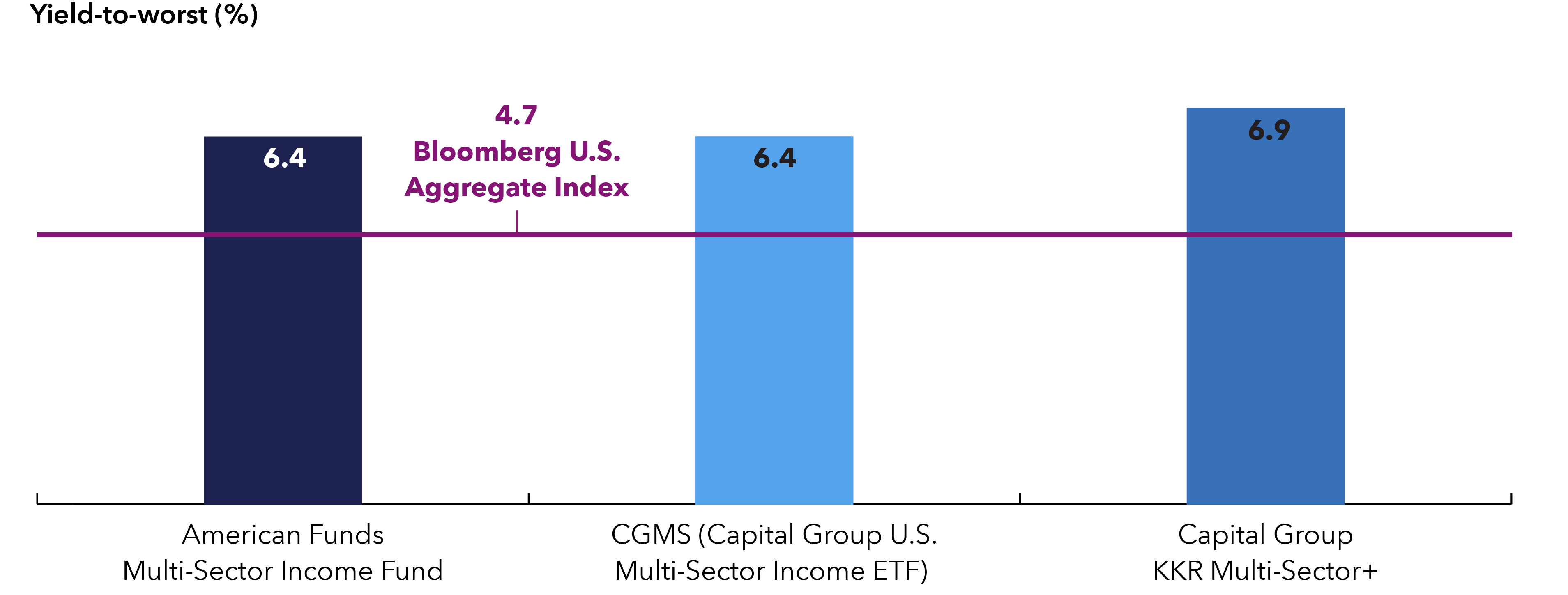
American Funds Multi-Sector Income Fund →
CGMS (Capital Group U.S. Multi-Sector Income ETF) →
Capital Group KKR Multi-Sector+ →
Source: Capital Group. As of 6/30/2026.
Fund tilted toward higher quality sectors
Monthly allocations since fund inception (March 22, 2019)
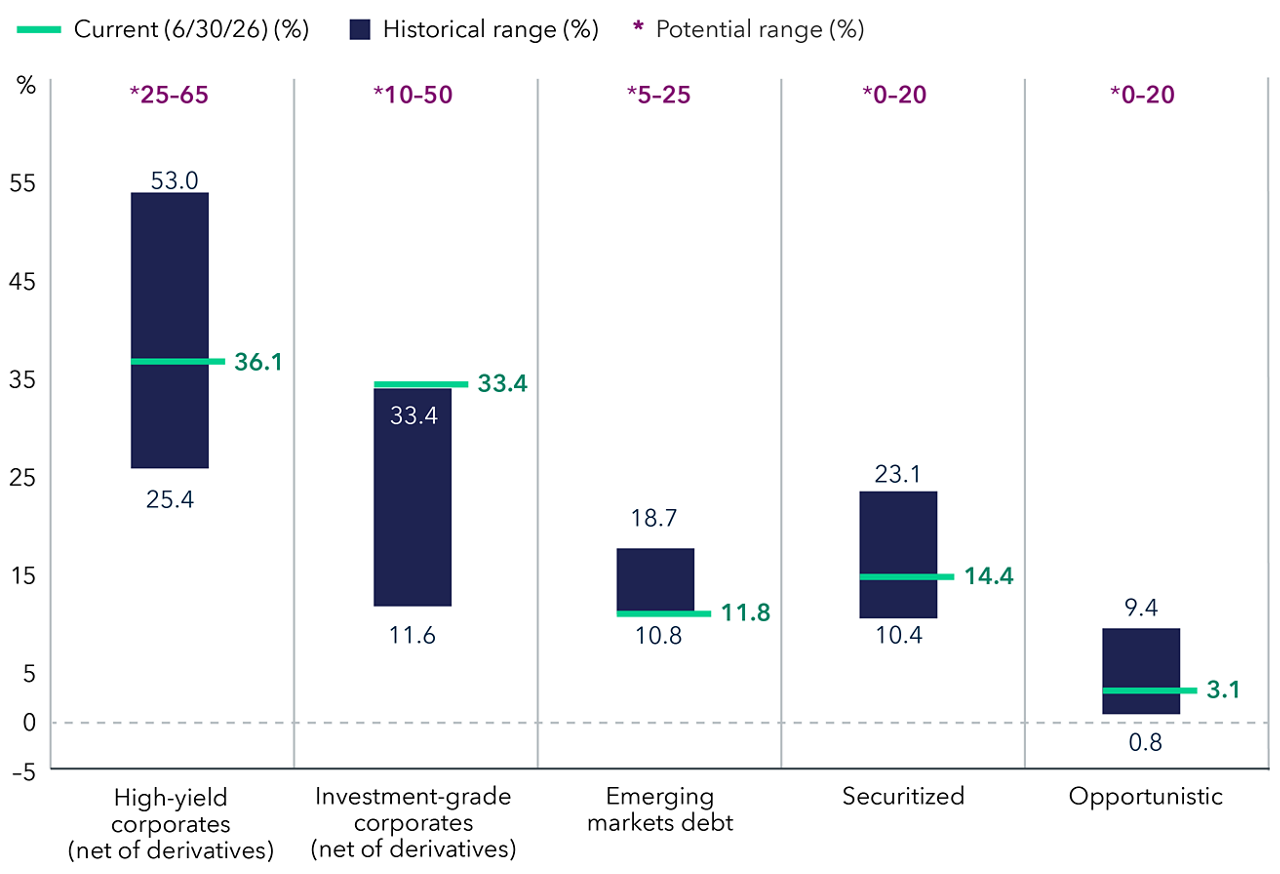
Opportunistic includes U.S. Treasuries, municipal bonds, noncorporate credit and other debt instruments. Securitized includes financial securities that are created by securitizing individual loans (debt). Source: Capital Group. Data as of 6/30/26. Investment-grade = BBB/Baa rated and above.
Securitized
In securitized markets, the fund maintained its core positioning in commercial mortgage-backed securities (CMBS) and asset-backed securities (ABS), but reduced exposure throughout the period, specifically within CMBS. CMBS positioning continued to favor single-asset/single-borrower (SASB) structures with stronger collateral support, while ABS exposure remained focused on sectors with more stable underlying consumer fundamentals. Overall, the portfolio’s securitized allocations are used to help generate income and help provide capital preservation.
Investment-grade credit
Within investment-grade (IG) corporates, we reduced exposure modestly in the middle of the period and selectively added to exposure in idiosyncratic opportunities at the issuer or security level. The fund also maintained or modestly increased exposure in more defensive and higher-quality areas such as financials and select health care issuers. Technology exposure remained selective, focused on issuers with strong margins and resilient cash flow profiles. Overall, the portfolio’s IG mix shifted toward higher-conviction, fundamentally resilient industries.
High yield
The fund increased its overall allocation to high-yield credit early in the quarter, moving from a more cautious stance to more constructive positioning as volatility created opportunity. A combination of cash holdings and the use of high-yield credit default swap indexes (CDX) drove this increase. As spreads normalized later in the period, the fund reduced exposure to high-yield bonds, primarily through CDX exposure. The fund remained underweight high yield relative to the benchmark.
Emerging markets
Within emerging markets debt (EMD), we modestly increased exposure through a rotation into higher-yielding segments and specific country opportunities, rather than a broad-based increase. The fund added to its high-yield EMD positions, with exposure in select Latin American credits, where spreads and fundamental trajectories appeared more attractive. This reflected a targeted approach focused on country-level relative value, emphasizing regions with stronger carry and improving fundamentals, while trying to avoid areas where spreads remained tight relative to risk.
Weightings are relative to the American Funds Multi-Sector Income Fund Custom Index. As of 6/30/26.
Industries shown below are among the fund's notable overweights and underweights relative to the index

Sources: Capital Group, Bloomberg. Data as of 6/30/26.
REITs
Our American High-Income Trust maintained a modest overweight to real estate investment trusts (REITs) through select issuers due to their strong fundamentals, including resilient free cash flow and REITs' generally stable leverage profile. These assets offer defensive yields and diversification potential.
Brokerage, asset managers & exchanges
Financial advisory platforms are growing via consolidation and should benefit from elevated interest rates. Investments across the industry have produced an attractive level of cash flow despite recent regulatory concerns.
Consumer cyclical
Although the fund remained broadly underweight the industry, we maintained idiosyncratic positions in retailers, gaming and leisure. These investments skewed toward higher quality issues within these industry groups.
Capital goods
In our view, the fundamental outlook is stable across industries like diversified manufacturing. The largest underweight within the sector came from building materials, which have been impacted by decreasing home sales in recent years.
Weightings are relative to the Bloomberg U.S. Corporate High Yield 2% Issuer Capped Index as of 6/30/26.
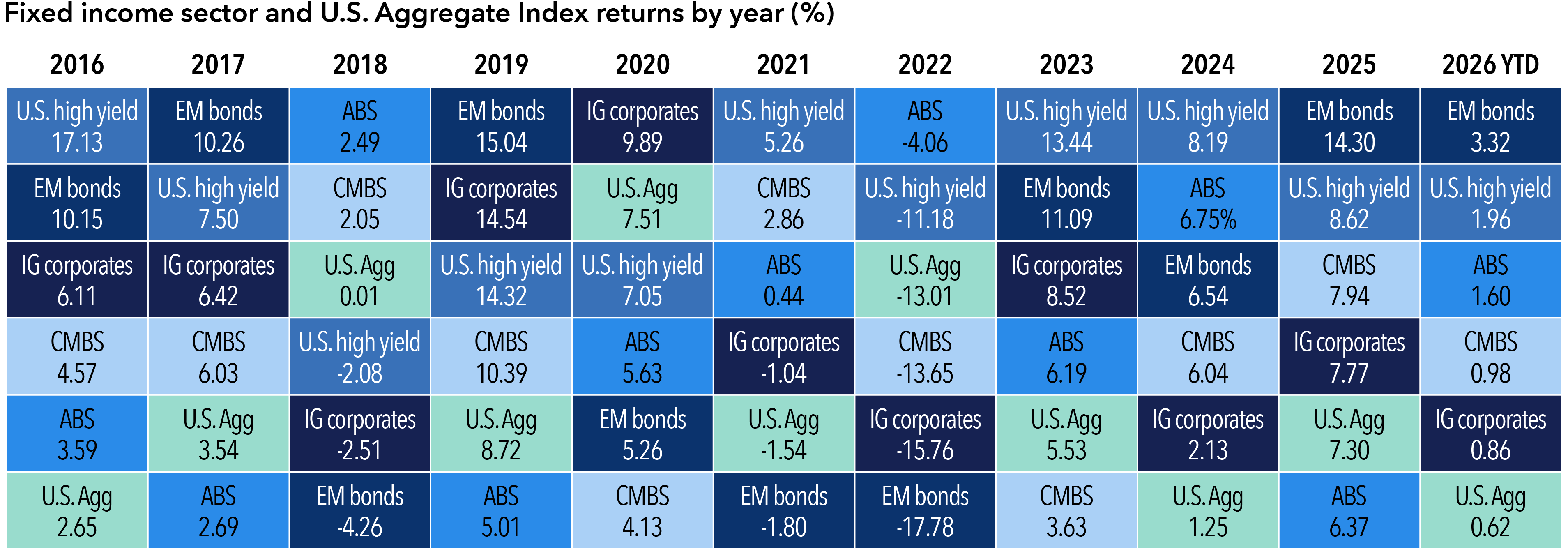
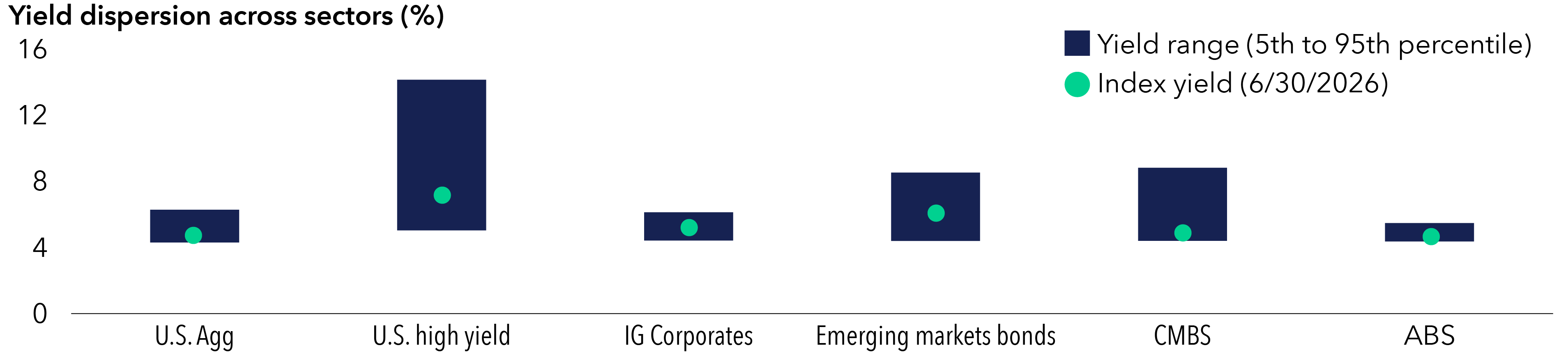
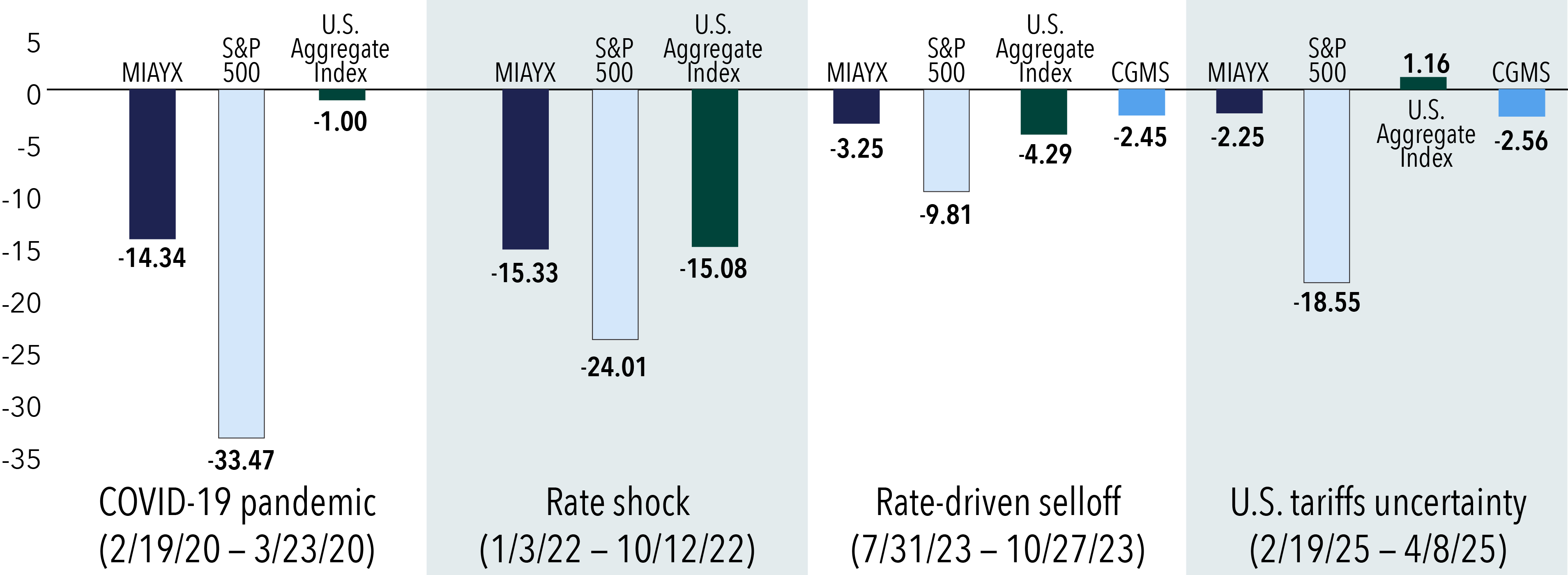
While most credit spreads are tight on a historical basis, many starting yields are near or above their five-year average. Even if the Fed raises rates later in 2026, we believe income-oriented sectors can effectively complement a core bond allocation.
In our view, high yield, emerging markets bonds, investment-grade corporates and other sectors can potentially enable income investors to achieve long-term excess returns even if the federal funds target rate holds steady.
In addition to dividend-paying stocks, investments in higher income bonds can help income-seeking investors fund a longer retirement. Higher income bonds include investment-grade and high-yield corporates, emerging markets and securitized debt.
In addition to diversification, most of these bonds offer steady coupon payments. However, they also carry the risk of defaulting on their obligations. Depending on their objectives, income-seeking investors may want to consider allocating a portion of their investments to these assets.
While it’s natural for fixed income investors to be concerned with tight spreads, indicators such as starting yield to worst (YTW)4, credit quality and the likely direction of U.S. corporate earnings suggest that high yield may continue to outpace other fixed income sectors in 2026. With a starting YTW of 7.16% and with more than 50%* of the high-yield market rated BB/Ba, we believe high yield can continue to complement a core bond allocation and potentially offer greater long-term income than dividend-paying stocks.
Emerging markets bonds can offer high income with currency and geographic diversification. Many emerging markets sovereign bonds are investment-grade-rated, and the sector includes some of the fastest growing economies in the world.
Still, idiosyncratic and geopolitical risks tied to emerging markets are real, and we believe a capable investment manager with disciplined risk-management processes in place is essential for investors to achieve long-term success.
Investors across multiple tax brackets can benefit from allocations to municipal bonds. Munis are typically exempt from federal taxes and sometimes state and local taxes, which means that investors can keep more of their interest income.
Beyond tax advantages, munis typically have lower credit risk compared to high-yield bonds and equities. They can also serve to diversify a portfolio.
Figures shown are past results and are not predictive of results in future periods. Current and future results may be lower or higher than those shown. Investing for short periods makes losses more likely. Prices and returns will vary, so investors may lose money. View mutual fund expense ratios and returns. View current mutual fund SEC yields and tax-equivalent SEC yields.
For CGMS: The use of derivatives involves a variety of risks, which may be different from, or greater than, the risks associated with investing in traditional securities, such as stocks and bonds. Lower rated bonds are subject to greater fluctuations in value and risk of loss of income and principal than higher rated bonds. The return of principal for bond portfolios with significant underlying bond holdings is not guaranteed. Investments are subject to the same interest rate, inflation and credit risks associated with the underlying bond holdings. Investing outside of the United States involves risks, such as currency fluctuations, periods of illiquidity and price volatility. These risks may be heightened in connection with investments in developing countries.
Investments in mortgage-related securities such as CGMS involve additional risks, such as prepayment risk.
1. The SEC yield reflects the rate at which the fund is earning income on its current portfolio of securities while the distribution rate reflects the fund’s past dividends paid to shareholders. Accordingly, the fund’s SEC yield and distribution rate may differ. For American Funds Emerging Markets Bond Fund, a portion of the fund's distribution may be classified as a return of capital. Please refer to the fund's Annual Report for details.
2. Calculated by Morningstar. Due to differing calculation methods, the figures shown here may differ from those calculated by Capital Group.
3. Expense ratios are as of each fund’s prospectus/characteristics statement, as applicable, available at the time of publication.
4. Yield to worst is defined as the lowest possible yield that an investor would receive if all the issuers in a fixed income fund fulfilled their payment obligations.
© 2026 Morningstar, Inc. All Rights Reserved. Some of the information contained herein: (1) is proprietary to Morningstar and/or its content providers; (2) may not be copied or distributed; and (3) is not warranted to be accurate, complete or timely. Neither Morningstar, its content providers nor Capital Group are responsible for any damages or losses arising from any use of this information. Past performance is no guarantee of future results. Information is calculated by Morningstar. Due to differing calculation methods, the figures shown here may differ from those calculated by Capital Group.
Duration indicates a bond fund’s sensitivity to interest rates. Higher duration indicates more sensitivity.
Sharpe ratio uses standard deviation and excess return to determine reward per unit of risk. The higher the number, the better the portfolio's historical risk-adjusted performance.
Annualized standard deviation (based on monthly returns) is a common measure of absolute volatility that tells how returns over time have varied from the mean. A lower number signifies lower volatility.
Correlation to S&P 500 is a measurement of how returns for the fund and S&P 500 move in relation to each other. A correlation ranges from -1 to 1. A positive correlation close to 1 implies that as one moved, either up or down, the other moved in “lockstep,” in the same direction. A negative correlation close to -1 indicates the two have moved in the opposite direction.
Bloomberg U.S. Corporate Investment Grade Index represents the universe of investment grade, publicly issued U.S. corporate and specified foreign debentures and secured notes that meet the specified maturity, liquidity, and quality requirements. This index is unmanaged, and its results include reinvested distributions but do not reflect the effect of sales charges, commissions, account fees, expenses or U.S. federal income taxes.
Bloomberg U.S. Corporate High Yield 2% Issuer Capped Index covers the universe of fixed-rate, non-investment-grade debt. The index limits the maximum exposure of any one issuer to 2%. This index is unmanaged, and its results include reinvested distributions but do not reflect the effect of sales charges, commissions, account fees, expenses or U.S. federal income taxes.
American Funds Multi-Sector Income Fund Custom Index comprises: 45% Bloomberg U.S. Corporate High Yield 2% Issuer Capped Index, 30% Bloomberg U.S. Corporate Investment Grade Index, 15% J.P. Morgan EMBI Global Diversified Index, 8% Bloomberg CMBS Ex AAA Index, 2% Bloomberg ABS Ex AAA Index and blends the respective indices by weighting their cumulative total returns according to the weights described. This assumes the blend is rebalanced monthly.
J.P. Morgan Emerging Market Bond Index (EMBI) Global Diversified is a uniquely weighted emerging market debt benchmark that tracks total returns for U.S. dollar-denominated bonds issued by emerging market sovereign and quasi-sovereign entities. This index is unmanaged, and its results include reinvested dividends and/or distributions but do not reflect the effect of account fees, expenses or U.S. federal income taxes.
J.P. Morgan CEMBI Broad Diversified Index tracks the performance of US dollar-denominated bonds issued by emerging market corporate entities.
JP Morgan Government Bond Index – Emerging Markets Global Diversified covers the universe of regularly traded, liquid fixed-rate, domestic currency emerging market government bonds to which international investors can gain exposure. This index is unmanaged, and its results include reinvested dividends and/or distributions but do not reflect the effect of account fees, expenses or U.S. federal income taxes.
Bloomberg CMBS Ex AAA Index: tracks investment-grade (Baa3/BBB- or higher, excluding Aaa/AAA) commercial mortgage backed securities that are included in the Bloomberg U.S. Aggregate Index. These securities have a minimum life of at least one year and must be fixed-rated weighted average coupon or capped weighted average coupon securities.
Bloomberg ABS Ex AAA Index: covers fixed-rated investment-grade (Baa3/BBB- or higher, excluding Aaa/AAA) asset backed securities that are included in the Bloomberg U.S. Aggregate Index. The index has three subsectors, which includes credit and charge cards, autos, and utility. These securities are ERISA-eligible and must have an average life of at least one year and must be senior class, tranche B or C of the deal.
