
MODULE 3: PUBLIC-PRIVATE EQUITY 3.2 Lifecycle of a private equity investment

This video presents a deeper dive into the lifecycle of a private equity investment, from acquisition to exit, with a focus on how private equity managers seek to create value in their portfolio companies. 

5MINVIDEO

[upbeat music]


Patrick Nelson, Principal of private equity strategies at KKR


Welcome. In this lesson, we’ll go deeper into how private equity works. We’ll cover the lifecycle of a private equity investment from acquisition to exit and talk about some of the strategies managers can use to create value within a portfolio company. 


[upbeat music]


Company acquisitions are at the end of the first stage of the investment lifecycle, which starts with deal sourcing and due diligence. This is a process that can often span multiple years. Depending on their size, scale and investment focus, a private equity firm might consider hundreds, even upwards of a thousand potential target companies every year and end up investing in only a small percentage of them.  


While acquisitions can follow different transaction types, including purchasing a company from its founder, three of the more commonly discussed transactions are corporate carveouts, public to privates and acquiring companies from an existing private equity owner, otherwise known as a sponsor-to-sponsor transaction. 


A corporate carve out is a transaction where a private equity firm purchases a specific business unit, division or subsidiary from a larger parent company. The classic carve-out thesis is that a private equity firm can help unlock significantly more value from a non-core business unit than the parent company could. However, these transactions require knowledge and resources, as they are complex, involving significant operational disentanglement from the parent company and requiring careful structuring around legal, IT and operational integration issues. 


A public to private transaction is a process where a private equity manager takes a controlling interest in a publicly listed company and delists it from a stock exchange. A sponsor-to-sponsor transaction occurs when one private equity firm sells its portfolio company investment to another private equity firm. Sponsor-to-sponsor deals have become a significant component of the private equity market where, for example, a growth focused private equity manager may sell its portfolio company to a manager that is more focused on companies that have reached the next phase of maturity in their lifecycle. We’ll talk more about that in a moment when we touch on exit strategies.  


[upbeat music]


Ultimately, the goal for a private equity firm is to exit its investments and realize the value that was created on behalf of its investors. There are several ways private equity managers can directly influence a company's strategy and help create that value. 


One way is by strengthening the management team. Private equity managers might work with the existing management team to enhance their capabilities or bring in new talent. This ensures that the company's leadership is aligned with the strategic goals.  


Another way is through acquiring other companies which could open up new product offerings, exposure to new markets and perhaps a new area of specialized knowledge or technology that can be integrated with the goal of creating synergies.  


Streamlining and improving operations is yet another value creation lever. Working with management teams to identify and implement operational improvements is essential to ensuring there is alignment with the desired outcome.  


Lastly, private equity firms may use financial strategies to help enhance returns. This could include refinancing existing debt at lower interest rates, restructuring the company's balance sheet or implementing a tax-efficient approach to help improve cash flow and potential profitability.


[upbeat music]


Finally, let’s turn our attention to exit strategies. Selecting investments that could pursue multiple exit routes and then building the value that makes them desirable to potential buyers during the holding period can enable a successful exit down the road. Planning for exits early, taking a creative and flexible approach to the exit plan and trying to make good companies great, makes even the most difficult environments navigable.  


Exits typically come in three routes: strategic sales to a company within the same industry, sponsor-to-sponsor sales in which a company is sold to another financial sponsor, whether that be another private equity manager, a sovereign wealth fund or a pension plan and finally, the public market route, which would refer to an IPO in which the company lists on a public exchange. 


To have multiple exit routes available in a variety of market environments, it helps to own companies that many buyers also want to own. That starts with selecting the right companies and continues with making those companies more valuable through repeatable playbooks. An approach that balances flexibility and discipline, along with getting the fundamentals of operational improvement right, is key for private equity managers.  


We hope this lesson has helped deepen your understanding of how private equity funds operate. Thanks for watching.


[upbeat music]
Deepen your understanding

Select each resource below to learn more.

Ultimately, the goal of a private equity firm by the time of exit is to generate substantial returns on their investment for their investors. There are several ways private equity managers can directly influence a company's strategy and seek to create value for investors. But these changes do not take place overnight. Building value, and doing it sustainably, can take years of hard work.

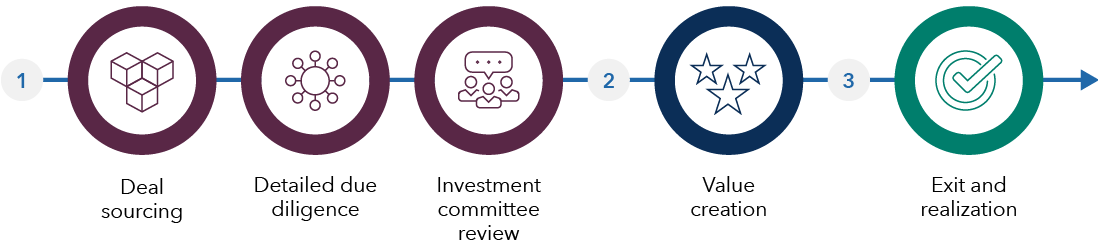
A graphic illustrates the lifecycle of a deal from idea to entry, monitoring and exit. The chart shows how value is created in each step, from deal sourcing, detailed due diligence, investment committee review, value creation, exit and realization.

Management:

One way to create value is by strengthening the management team. Private equity managers might work with the existing management team to enhance their capabilities or bring in new talent. This ensures that the company's leadership is aligned with the strategic goals.

Acquisitions:

Acquiring other companies could open up new product offerings, exposure to new markets and perhaps a new, specific area of expertise or technology that can be integrated with the goal of creating synergies. 

Business strategy:

A private equity manager can shape business strategy and work with the company’s management team to set other specific goals and objectives. Part of this collaboration may be to make sure that management’s incentives are aligned with the goals of the business. These goals may include revenue targets, profit margins, market share expansion, operational improvements and more. Private equity managers closely monitor the company's progress toward these goals and may provide guidance to achieve them. 

Efficiencies:

Improving operations is another way private equity managers can add value. This can involve streamlining processes, optimizing supply chains, implementing cost-saving measures and enhancing overall productivity. Private equity managers can work closely with the company's management team to identify areas for improvement and implement operational changes that align with the desired strategic outcomes.

Financial strategies:

This could include refinancing existing debt at lower interest rates, restructuring the company's balance sheet or implementing a tax-efficient approach to improve cash flow and profitability.

In order to help understand what a private equity firm does, consider this fictional case study, inspired by an actual investment.


In 2015, Company A (CA) was the leading manufacturer of widgets in North America. It had a reputation for providing high-quality products with great customer service and delivery times. That reputation caught the eye of a firm we’ll call Private Equity A (PEA), which acquired CA through one of its funds. 


One of the first steps PEA took was an audit of CA’s current policies and procedures. It found several areas where processes were able to be streamlined, including by removing redundancies on the factory floor and changing truck route logistics for more efficient deliveries. 


Aging company laptops were replaced with newer models and improvements were made to the company cafeteria, boosting employee happiness and productivity. 


PEA also conducted a survey of current customers and learned there was demand for a new type of widget that CA did not currently produce. 


With a fresh infusion of capital, CA was able to launch that new product line, as well as build a new website and run a major ad campaign, which directly led to increased sales. 


Seven years later, the company was booming. Its widgets were more popular than ever, and its EBITDA margin (a common profitability measure that stands for “earnings before interest, taxes, depreciation and amortization”) had expanded by 10%. 


PEA was ready to exit its investment and realize the return on all the changes it had made at CA. It began talks with Company B (CB), which manufactured widgets in the European market and was looking for a way to enter North America. Ultimately, the sale of CA to CB closed for a significant return on the initial purchase price. 


It is important to note that not every investment will have such returns. Investing in private equity, similar to investing in other asset classes, carries the risk of a total loss of capital, among other risks. There can be a significant dispersion in results between private equity managers, and the same is true of individual investments.  

For financial professionals only. Not for use with the public.

Investments are not FDIC-insured, nor are they deposits of or guaranteed by a bank or any other entity, so they may lose value.
Investors should carefully consider investment objectives, risks, charges and expenses. This and other important information is contained in the interval fund prospectuses, which can be obtained from a financial professional and should be read carefully before investing.
For Public-Private+ Funds: Capital Group KKR Core Plus+ and Capital Group KKR Multi-Sector+ are interval funds that currently provides liquidity to shareholders through quarterly repurchase offers of up to 10% of its outstanding shares. Capital Group KKR U.S. Equity+ is an interval fund that currently provides liquidity to shareholders through quarterly repurchase offers of 5% of its outstanding shares. To the extent a higher percent of outstanding shares are tendered for repurchase, the redemption proceeds are generally distributed proportionately to redeeming investors (“proration”). Due to this repurchase limit, shareholders may be unable to liquidate all or a portion of their investment during a particular repurchase offer window. In addition, anticipating proration, some shareholders may request more shares to be repurchased than they actually wish, increasing the likelihood of proration. Shares are not listed on any stock exchange, and we do not expect a secondary market in the shares to develop. Due to these restrictions, investors should consider their investment in the fund to be subject to illiquidity risk.

- Investment strategies are not guaranteed to meet their objectives and are subject to loss. Investing in the fund is not suitable for all investors. Investors should consult their investment professional before making an investment decision and evaluate their ability to invest for the long term. Because of the nature of the fund's investments, the results of the fund's operations may be volatile. Accordingly, investors should understand that past performance is not indicative of future results.

- Investing outside the United States involves risks, such as currency fluctuations, periods of illiquidity and price volatility. These risks may be heightened in connection with investments in developing countries.

- Illiquid assets are more difficult to sell and may become impossible to sell in volatile market conditions. Reduced liquidity may have an adverse impact on the market price of such holdings, and the fund may be unable to sell such holdings when necessary to meet its liquidity needs or to try to limit losses, or may be forced to sell at a loss. Illiquid assets are also generally difficult to value because they rarely have readily available market quotations. Such securities require fair value pricing, which is based on subjective judgments and may differ materially from the value that would be realized if the security were to be sold. Situations involving uncertainties as to valuation of assets held by the fund could have an adverse effect on the returns of the fund.

- The fund is a non-diversified fund that has the ability to invest a larger percentage of assets in the securities of a smaller number of issuers than a diversified fund. As a result, poor results by a single issuer could adversely affect fund results more than if the fund were invested in a larger number of issuers.


For Public-Private Credit+ Funds:

- Bond investments may be worth more or less than the original cost when redeemed. High‐yield, lower‐rated, securities involve greater risk than higher‐rated securities; portfolios that invest in them may be subject to greater levels of credit and liquidity risk than portfolios that do not.

- The funds may invest in structured products, which generally entail risks associated with derivative instruments and bear risks of the underlying investments, index or reference obligation. These securities include asset-based finance securities, mortgage-related assets and other asset-backed instruments, which may be sensitive to changes in interest rates, subject to early repayment risk, and their value may fluctuate in response to the market's perception of issuer creditworthiness; while generally supported by some form of government or private guarantee, there is no assurance that private guarantors will meet their obligations.

- While not directly correlated to changes in interest rates, the values of inflation-linked bonds generally fluctuate in response to changes in real interest rates and may experience greater losses than other debt securities with similar durations. The use of derivatives involves a variety of risks, which may be different from, or greater than, the risks associated with investing in traditional securities, such as stocks and bonds.

- The fund invests in private, illiquid credit securities, consisting primarily of loans and asset-backed finance securities. The fund may invest in or originate senior loans, which hold the most senior position in a business's capital structure. Some senior loans lack an active trading market and are subject to resale restrictions, leading to potential illiquidity. The fund may need to sell other investments or borrow to meet obligations. The funds may also invest in mezzanine debt, which is generally unsecured and subordinated, carrying higher credit and liquidity risk than investment-grade corporate obligations. Default rates for mezzanine debt have historically been higher than for investment-grade securities. Bank loans are often less liquid than other types of debt instruments and general market and financial conditions may affect the prepayment of bank loans, as such the prepayments cannot be predicted with accuracy.


For Public-Private Equity+ Funds:

- The fund also intends to concentrate in the financial services group of industries, and to invest at least 80% of its assets in securities issued by companies based in the United States.

- K-PEC and co-investment risks: The fund's investments in KKR Private Equity Conglomerate LLC (“K-PEC”) and co-investments alongside K-PEC or one or more other KKR vehicles that pursue private equity strategies entail additional risks. Private equity investments are typically illiquid, speculative, and difficult to value, often requiring multi-year holding periods with returns generally realized only upon sale or refinancing of a portfolio company. These investments depend on access to financing, and market disruptions or increased competition may limit opportunities and affect performance. The fund's significant investment in K-PEC creates concentration risk and a decline in K-PEC's value could materially impact the fund's returns. Co‑investment opportunities are competitive and limited and there is no assurance the fund will receive allocations or comparable terms and will generally have less information than for public companies. Through its investments in K-PEC or other KKR Vehicles and co-investments, the fund may have exposure to portfolio companies with limited operating histories, evolving markets, unproven technologies, and inexperienced management, which may require significant capital and create heightened vulnerability to downturns. Most holdings are illiquid, subject to resale restrictions and may require consents or be sold at a discount. Costs associated with investments in private equity are generally greater than those of investments in other asset classes. In addition to bearing their portion of the fund's fees and expenses, shareholders in the fund will indirectly bear a portion of the asset-based fees, incentive fees and other expenses incurred by the fund as an investor in K-PEC or other KKR Vehicles and in co-investments. Incentive fees are paid to KKR when the fund's investments in K-PEC or other KKR Vehicles and/or co-investments deliver returns in excess of a specified hurdle; when paid, these fees reduce the net realized returns of such investments.

This material does not constitute legal or tax advice. Investors should consult with their legal or tax advisors.
Statements attributed to an individual represent the opinions of that individual as of the date published and do not necessarily reflect the opinions of Capital Group or its affiliates. This information is intended to highlight issues and should not be considered advice, an endorsement or a recommendation.
Capital Group and Kohlberg Kravis Roberts & Co. L.P. (“KKR”) are not affiliated. The two firms maintain an exclusive partnership to deliver public-private investment solutions to investors. KKR serves as the sub-adviser of Capital Group KKR Core Plus+ and Capital Group KKR Multi-Sector+ with respect to the management of each fund's private credit assets. KKR is not a sponsor, promoter, investment adviser, sub-adviser, underwriter or affiliate of Capital Group KKR U.S. Equity+.
All Capital Group trademarks mentioned are owned by The Capital Group Companies, Inc., an affiliated company or fund. All other company and product names mentioned are the property of their respective companies.
Use of this website is intended for U.S. residents only. Use of this website and materials is also subject to approval by your home office.
Capital Client Group, Inc.
This content, developed by Capital Group, home of American Funds, should not be used as a primary basis for investment decisions and is not intended to serve as impartial investment or fiduciary advice.