Strategic Scale 4 ways to manage passive fund risks in a mega IPO era

7 MIN ARTICLE

KEY TAKEAWAYS

  • Mega IPOs look set to take tech and AI passive fund concentration to new extremes. 
  • Potential stock-picking opportunities peak as the gap between winners and laggards nears record highs.
  • Four active strategies to help address rising passive risks and access new opportunities. 

A clear theme keeps surfacing in conversations with advisors and CIOs at registered investment advisory (RIA) firms this quarter: The U.S. equity market is pulling in two directions at once. 


On one side, already extreme index concentration in AI and tech mega-caps looks poised to deepen as more trillion-dollar private companies follow SpaceX’s record-breaking initial public offering (IPO). On the other, the gulf between the market’s winners and laggards is hovering near historic highs, as rival companies sprint to capture their share of AI capital spending. 


These two forces create the yin and yang of today’s market. The tighter the grip a handful of AI and tech behemoths hold on index performance, the richer the opportunity set becomes for stock pickers.


Yet clients heavily exposed to passive index funds are automatically taking on rising concentration risks they may not want, while missing out on a growing opportunity set for stock-picking. 


In our view, many passive index funds no longer deliver the broad market exposure they were designed to provide — and their growth-stock tilt will likely deepen as more private tech and AI names transition to public markets. That could leave some clients unwittingly holding a lopsided equity allocation at odds with their risk appetite.


Here's how markets are changing — and four ways advisors can build flexibility into clients' equity allocations, as well as help offset rising passive concentration risk.
Tech and AI concentration is now too big to ignore


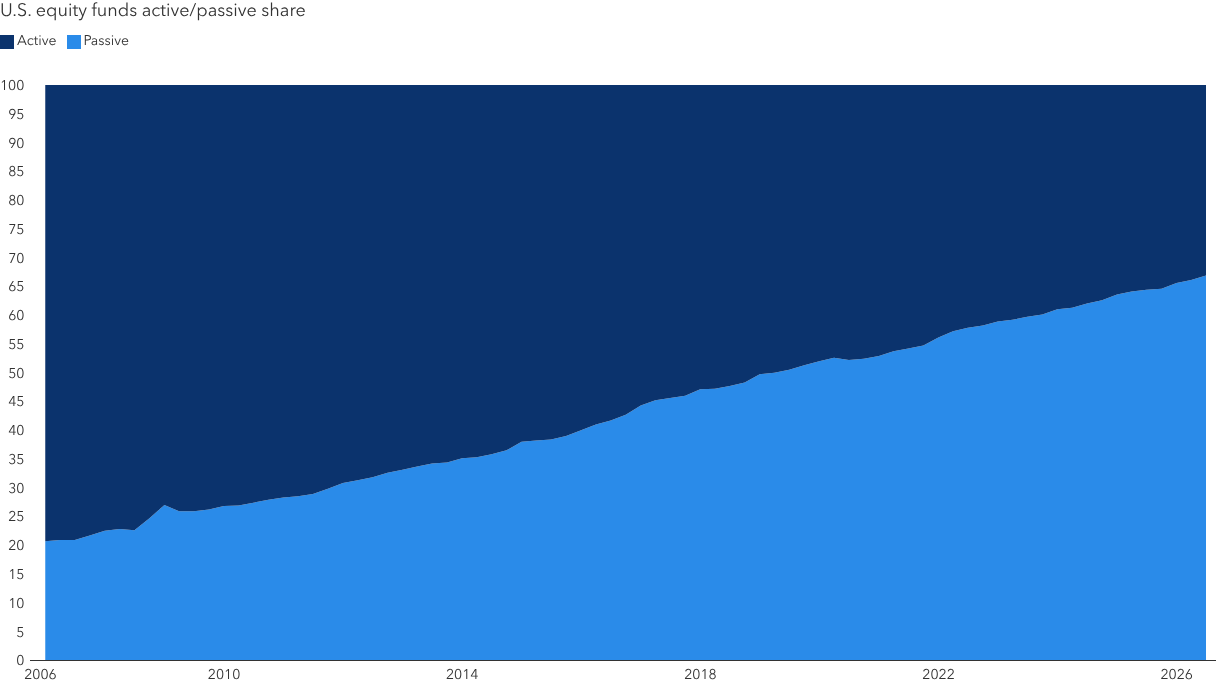
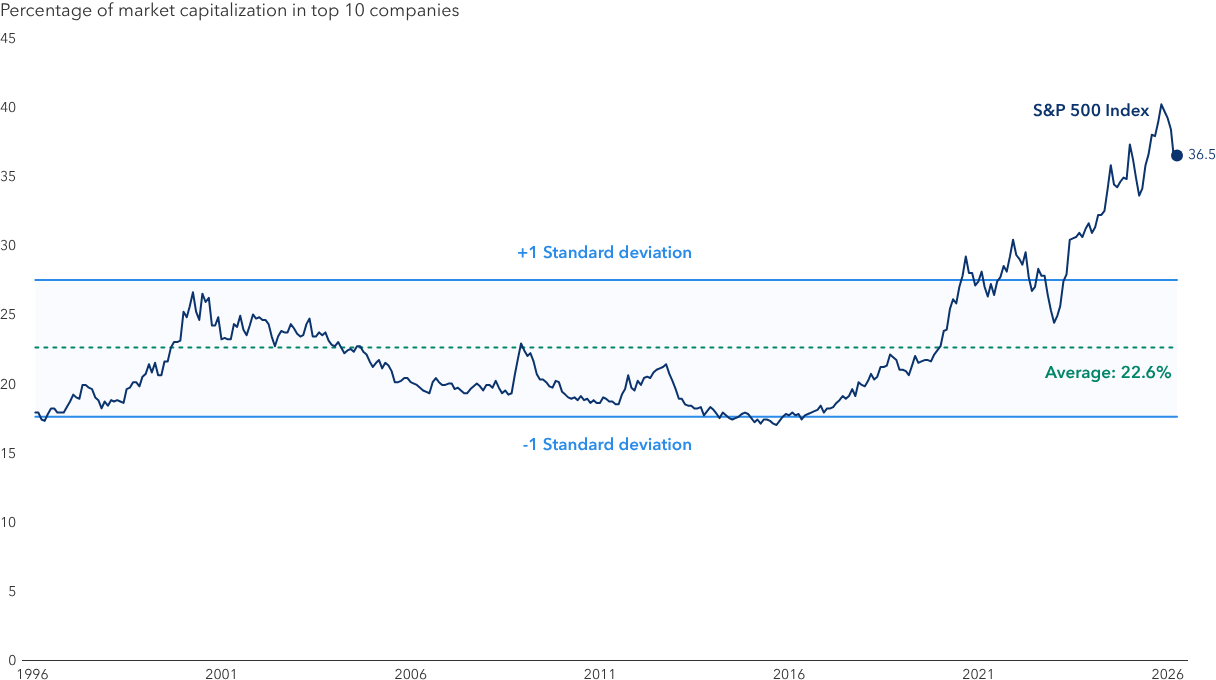
Today 67% of U.S. equity assets sit in passive funds. And concentration in the S&P 500 is already extreme, with the top 10 companies — most of which are highly correlated tech and AI-related companies — comprising nearly 40% of its market cap.  

Passive funds hold 67% of U.S. assets under management

Chart showing the share of U.S. equity mutual fund and ETF assets held in passive versus actively managed funds. Passive funds’ share rose from 20.7% on December 31, 2006, to 66.9% on June 30, 2026, while active funds’ share fell from 79.3% to 33.1% over the same period.

Sources: Capital Group, Morningstar. U.S. equity funds are represented by U.S. open-end mutual funds and ETFs, excluding money market funds, fund-of-funds, and feeder funds. Obsolete funds are included for historical consistency. Data shown is quarterly from December 31, 2006, to June 30, 2026.

This will likely worsen when the full force of SpaceX’s $2T IPO (based on its $152 stock price on July 9), and potential $1T debuts each by Anthropic and OpenAI are felt. The losses these firms make today should preclude them from S&P 500 inclusion in the shorter term, but we expect they will eventually join the Magnificent 7 largest tech and AI-adjacent stocks dominating the S&P.  


Just eight tech and AI-centric names represent more than 22% of the Russell 1000,1 whose rules have changed to allow mega-cap IPOs to join the index within days rather than months. These include the hyperscalers building out AI infrastructure.

Index fund investors may hold high concentration risk

A line chart showing the share of S&P 500 market capitalization held by the top 10 companies in the index. The share has increased sharply in recent years and is currently at 36.5%, well above its long term average of 22.6%, pointing to significant market concentration.

Sources: Capital Group, Morningstar, S&P Global. As of March 31, 2026. Weights shown are the sum of the market capitalization for the top 10 holdings of the S&P 500 index on a monthly basis.

As tech and AI stocks increase their dominance, the underlying investment characteristics of indexes change. Growth starts to overwhelm the impact of value and dividend stocks on returns. The quality of an index can erode as unprofitable mega-caps like SpaceX, OpenAI and Anthropic become members of many indexes. Their influence on returns can also contribute to tech and AI-centric companies drowning out any diversification benefits mid-caps might provide. 


As Capital Group’s CIO, Martin Romo noted, this is not an argument against owning the companies driving the AI era. My point is that when markets become as lopsided as they are today, advisors may need to surround a passive core with active equity strategies to restore the broad, balanced market exposure clients expect.

Opportunity is widening at the same time


The flipside of rising tech and AI-related concentration is a widening gap between the performance of these favored areas and everything else in the market. 


Stock and sector performance dispersion in the S&P 500 has been hovering near multidecade highs in 2026, a fact that has not gone unnoticed by institutional investors and active fund managers. Industrials, utilities and materials, along with value and yield factors, are benefiting as they look beyond the largest AI names to the “picks-and-shovels” companies supplying the buildout. 


The search for stock dispersion opportunities and diversification away from the large-cap heavyweights is also lifting different market segments: The Russell 2000 small cap index returned more than 20% in the first half of 2026, compared with the S&P 500's 9.6%. 

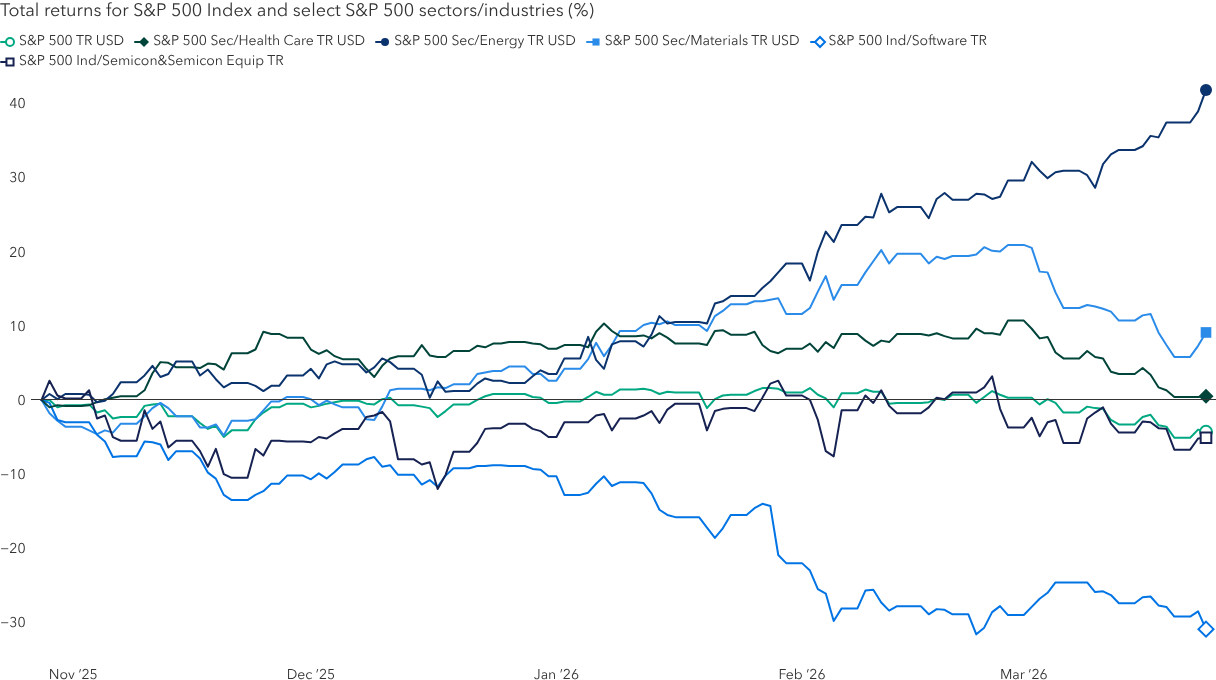
Changing patterns of industry returns suggest broadening market opportunities

Line chart shows total returns for the S&P 500 Index and select S&P 500 sectors and industries from November 2025 through March 2026. The S&P 500 Index trends slightly downward, similar to the semiconductor and semiconductor equipment sector, with returns of roughly negative 5%. The energy and materials sectors rise more than the other industries shown, with energy at nearly 45% and materials at roughly 10% in total returns. The health care sector trends upward until March 2026 and levels off at roughly 0% total return. The software sector declines over the period and ends with total returns of roughly negative 30%.

Source: Capital Group, Morningstar. As of March 31, 2026.

The active-passive balance matters more in a two-speed market 


Our latest Portfolio Construction Insights survey suggests that RIAs and others are following the footsteps of institutional investors. Investment in international stocks and active ETF exposure increased in the first several months of 2026 as advisors sought diversified returns. Yet it also showed that active exposure to U.S. passive equity is still high, at around 50%. 


The practical lever for advisors is adding active custom models and targeted equity sleeves to a client’s portfolio. They can be used to exclude a concentrated position, underweight a sector and add a mandate for tactical stock-picking, while aligning with a CIO’s investment philosophy.  Here are four common applications: 


1. Redirect flows to capture new opportunities


Rather than selling concentrated positions at appreciated levels, consider routing  new contributions, dividends and interest into underrepresented areas through a custom sleeve. Diversification into active management accrues gradually and tax-efficiently, while the embedded gains in legacy passive holdings stay undisturbed. 


2. Time entry into mega-cap IPOs


Active managers can take advantage of programmed passive fund flows that drive the price — rather than fundamentals — when a mega IPO goes into certain indexes.


Most index providers (with the S&P 500 as the notable holdout) changed their rules to fast-track index inclusion to days rather than months, as well as waived or reduced the minimum size of initial stock floats by mega IPOs. These two moves can combine to create a shock of passive fund demand that drives up the price as the stock enters the index.  Active managers can take tactical advantage of these predictable mechanical flows. 


Active investors might also benefit from potential price pressure when companies like SpaceX accelerate the release of additional shares for public trading. Opportunities can also arise as passive funds sell stock holdings to finance the purchase of a new index entrant. 


3. Expand global exposure


Adding an international sleeve with latitude to blend developed and emerging markets or income-oriented strategies can help rebalance the changes increasing tech and AI concentration can have on a portfolio.


4. Cancel out double-exposure to private companies going public


For clients carrying double-concentration risk — pre-IPO private equity in a soon-to-list mega-cap alongside passive exposure to the same name — a custom completion sleeve can explicitly exclude or underweight that security. The rest of the equity allocation continues to track the market while the sleeve is designed to neutralize the overlap. Completion sleeves can also underweight or overweight specific sectors or factors like growth in a benchmark.

The bottom line


Passive index funds have long been the advisory industry’s go-to for cost-effective broad market exposure. Today, with a handful of highly correlated tech and AI mega-caps steering index returns, that exposure is anything but broad. Meanwhile, a client’s passive core may be missing out on finding potentially mispriced stocks in a market where the gaps between the best and worst performing stocks hover near record highs. 


What advisors can do to balance the risks and make the most of potential opportunities is blend passive exposure with active strategies. That’s how clients can participate in market trends by design, rather than by default. 

Casey Dregits is a senior portfolio consultant at Capital Group. He has 23 years of industry experience, all with Capital Group. He holds a bachelor’s degree in political science, history and Germanic studies from Indiana University and an MBA. Casey is also a certified Chartered Alternative Investment Analyst and Chartered Financial Analyst.

1 MSFT, GOOGL (Alphabet Class A shares), GOOG (Alphabet Class C shares), AMZN, META, NVDA, ORCL, PLTR, CRWV. Market capitalization as of 6.30.26


Passive funds are not striving to outpace their benchmarks; rather, they seek to replicate the benchmark’s return pattern.

For financial professionals only. Not for use with the public.

Investments are not FDIC-insured, nor are they deposits of or guaranteed by a bank or any other entity, so they may lose value.
Statements attributed to an individual represent the opinions of that individual as of the date published and do not necessarily reflect the opinions of Capital Group or its affiliates. This information is intended to highlight issues and should not be considered advice, an endorsement or a recommendation.
All Capital Group trademarks mentioned are owned by The Capital Group Companies, Inc., an affiliated company or fund. All other company and product names mentioned are the property of their respective companies.
Use of this website is intended for U.S. residents only. Use of this website and materials is also subject to approval by your home office.
Capital Client Group, Inc.
This content, developed by Capital Group, home of American Funds, should not be used as a primary basis for investment decisions and is not intended to serve as impartial investment or fiduciary advice.