Global equities A unique market moment and the case for active judgment

We are living through an extraordinary market environment. The level of concentration in many equity benchmarks has increased significantly.


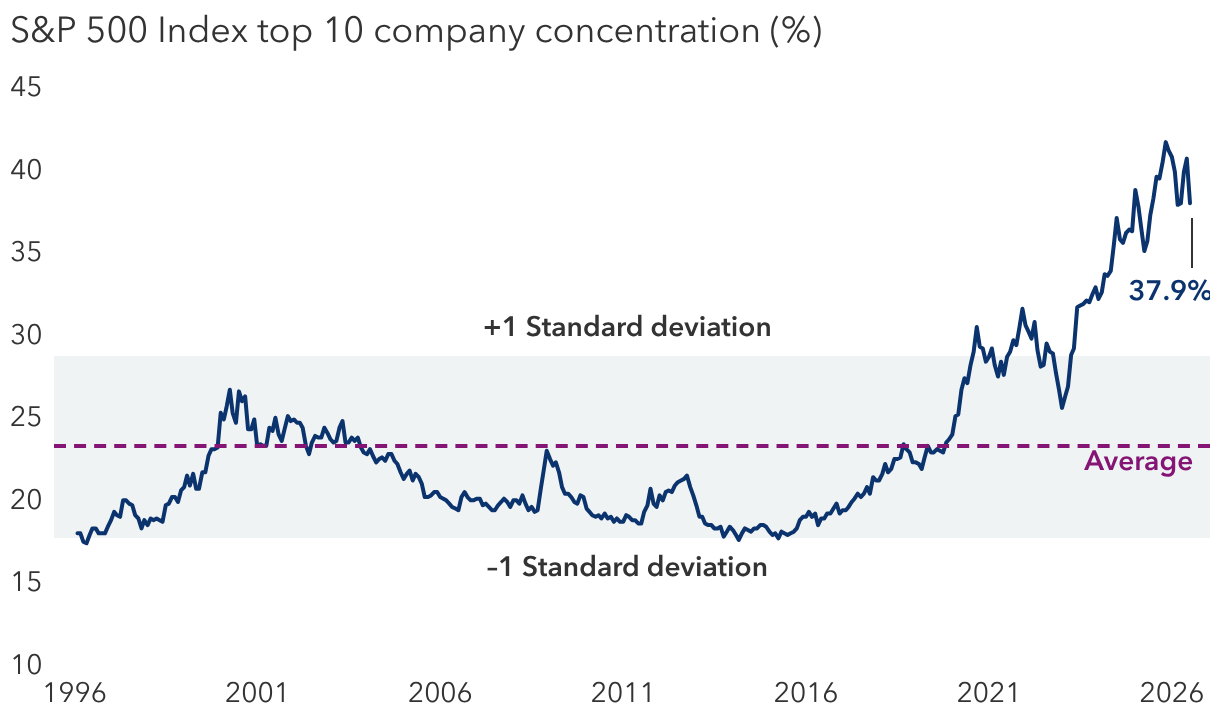
The evidence is striking. The 10 largest companies in the S&P 500 represent nearly 40% of the index, a level not seen since the mid-1960s. Semiconductor-related companies are approaching one-fifth of the S&P 500. In emerging markets, the exposure is even more acute: Three companies alone — TSMC, Samsung and SK hynix — represent 29% of the MSCI EM Index.


As this concentration grows amid investor euphoria, I felt it appropriate to remind Capital’s investment group of our responsibilities, which I did in collaboration with Capital Group Vice Chair Jody Jonsson and CEO Mike Gitlin. I want to share those same thoughts with you now.


As I told my colleagues, Capital Group’s mission to improve people’s lives through successful investing carries a deep obligation. We are entrusted with the savings of individuals, families and institutions who rely on us to grow their wealth, generate income, fund retirements, support beneficiaries and leave enduring legacies.


That requires us to pursue superior long-term outcomes on a risk-adjusted basis with the discipline to help protect, to the best of our abilities, our clients’ savings during market extremes. We should not simply mirror the risk profile of an index when that index becomes unusually concentrated or extended, as is increasingly the case in markets around the world today.

How today’s market structure is driving concentration

This is not an argument against owning the companies driving the artificial intelligence era. Many are extraordinary businesses with durable prospects. The point is that, at today’s weights and valuations, the benchmarks — and the passive strategies following them — increasingly assume one set of outcomes will dominate.


We have seen this before. Markets have always displayed moments when leadership narrows around a compelling view of the future. Sometimes that view is right. Sometimes it is partly right but valued to perfection. And sometimes the greatest beneficiaries are not the ones investors expect.


In 1980, fossil fuels represented 29% of the S&P 500; today they are roughly 3%. At the peak of Japan’s late-1980s equity boom, Japan reached 44% of the MSCI World Index; today it is around 5%. These are not perfect analogs, and concentration is not a timing tool. But they are powerful reminders that benchmark weights can become increasingly concentrated as conviction in a prevailing theme builds.

A handful of stocks are driving a highly concentrated market

Sources: Capital Group, FactSet, S&P Global. Figures represent the index concentration of the top 10 companies by market capitalization. Standard deviation is a statistical measure of how much values vary from their average. A higher number indicates greater variation. Data shown is monthly, from January 31, 1996, through June 30, 2026.

History shows that the leaders of one era are rarely the leaders of the next. Active managers can use research and judgment to adapt as market leadership evolves. Maintaining a clear-eyed view of fundamentals can be especially important when enthusiasm becomes widespread.

Passive investors may be taking unintended risks

A passive allocation by design is a benchmark tracking position with no mechanism to manage valuation risk, position size or changes in underlying fundamentals. Indexes do not assess whether a business is strengthening or weakening, whether a competitive moat is widening or narrowing, or whether today’s price adequately compensates investors for long-term risk.


Jody Jonsson recently testified before the U.S. Congress and told its members that there is a broad misperception that index funds somehow are safer for most investors. She explained that an index fund doesn’t assess whether markets are overvalued, whether a sector is in a bubble, or whether a specific holding has deteriorated.


As index ownership has grown to roughly half of U.S. assets under management, the share of investors actively weighing prices against fundamentals has declined. Jody noted in her testimony that active managers play a central role in price discovery — the process by which markets translate information into price — while index funds, by design, do not.

A moment to rebalance — and to exercise judgment

Of course, where deep fundamental research gives us conviction, we managers should hold AI beneficiaries where appropriate. We should seek companies that can use AI to improve productivity, strengthen moats and expand addressable markets. We research and invest globally across the full value chain for opportunities the benchmark may underappreciate and where valuations may provide compelling risk-adjusted returns.


And we should size positions with an awareness that market benchmarks can become lopsided in markets like the ones we are seeing today.


We recognize that our clients do not hire us simply to replicate the risk profile of an index. They hire us to exercise judgment and thoughtful differentiation in investments to deliver solid results over the long term. And that is what we have done.


Over the past 30 years — a period during which U.S. equity markets experienced two separate 50% drawdowns — 91% of our equity and multi-asset strategies beat their benchmarks after fees, and 100% of our equity and multi-asset funds were ranked in the first or second quartile of their Morningstar peer group on both an absolute and risk-adjusted basis as of March 31, 2026.


Our job is to remain faithful to a process that has navigated change for nearly a century. That heritage goes back to our founder, Jonathan Bell Lovelace. He recognized early the power of collaborative research, diverse perspectives and a long-term view, which became the foundation of The Capital System™. It was not designed for easy markets. It was designed for markets like this one.


The winners of this current period will need to be both bold and humble. Bold enough to own great companies when the fundamentals justify it. Humble enough to recognize that no single theme, however powerful, should dictate the shape of portfolios. Bold enough to differ from the benchmark when risk and reward call for it. Humble enough to know that being different can be uncomfortable but necessary, especially when a narrow market continues to rise.

Martin Romo is chair and chief investment officer of Capital Group. He is also an equity portfolio manager with 33 years of investment industry experience (as of 12/31/2025). He holds an MBA from Stanford and a bachelor's degree in architecture from the University of California, Berkeley.

Methodology for index-strategy comparisons: Source: Capital Group as of March 31, 2026. Strategies with at least 30 years of history and based on applicable composite results, and in cases where a composite includes only one fund, applicable fund results, compared to each composite’s/fund’s assigned benchmark. Strategies offered primarily by Capital Group Private Client Services are excluded. Net results were calculated by deducting from the gross composite results a model fee equal to the current highest management fee of any account in the composite or all applicable fund fees and expenses. Results for other periods differ and there have been periods when the strategies/funds have lagged their benchmarks.


Methodology for Morningstar quartile analysis of equity and multi-asset funds: Source: Morningstar as of March 31, 2026. Based on a comparison of each Capital Group-managed public fund’s 30-year average annual total return with its respective Morningstar category peers. Morningstar category peers data reflects peer groups as of July 2026. Data is based on the following — U.S. mutual fund share classes: Class F-2, Class M, Class 1. For Luxembourg Funds Class Z was used. The analysis uses Morningstar hypothetical returns methodology to calculate hypothetical fund results for periods before a share class’s inception. For those periods, Morningstar uses results for the oldest share class (unless the newer share class is more expensive, in which case they adjust returns for the expense difference). Risk-adjusted rankings are based on annualized Sharpe ratio.


The market indexes are unmanaged and, therefore, have no expenses. Investors cannot invest directly in an index. There have been periods when the funds/strategies have lagged their indexes/peers.


MSCI Emerging Markets Index: A free-float-adjusted market-capitalization-weighted index designed to measure equity market results in global emerging markets.


MSCI World Index: A free-float-adjusted market-capitalization-weighted index designed to capture large- and mid-cap representation across developed market countries.


S&P 500 Index: A market capitalization-weighted index of about 500 major U.S. stocks. Includes reinvested dividends but excludes fees and taxes.


Past results are not predictive of results in future periods.

Investments are not FDIC-insured, nor are they deposits of or guaranteed by a bank or any other entity, so they may lose value.
Statements attributed to an individual represent the opinions of that individual as of the date published and do not necessarily reflect the opinions of Capital Group or its affiliates. This information is intended to highlight issues and should not be considered advice, an endorsement or a recommendation.
All Capital Group trademarks mentioned are owned by The Capital Group Companies, Inc., an affiliated company or fund. All other company and product names mentioned are the property of their respective companies.
Use of this website is intended for U.S. residents only. Use of this website and materials is also subject to approval by your home office.
Advisory services offered through Capital Research and Management Company (CRMC) and its RIA affiliates. Capital Client Group, Inc., member FINRA.
This content, developed by Capital Group, home of American Funds, should not be used as a primary basis for investment decisions and is not intended to serve as impartial investment or fiduciary advice.