
ACCESSING PRIVATE MARKETS 1.3 Capital Group KKR partnership

Capital Group has partnered with KKR to expand access to private markets via public-private solutions. Watch this video to learn more about the synergies of these two companies and how their innovation can benefit you and your clients. 

3MINVIDEO

[upbeat music]


John Queen, Fixed income portfolio manager at Capital Group


What makes a successful partnership? Aligned goals, strategic vision, trust, transparency, complementary strengths and capabilities. Capital Group found all of that with KKR, and we’re excited to tell you about the Public-Private+ Solutions we’ve created and how it may help your clients.


We know that to be the partner of choice for our clients and shareholders, everything we do needs to be in their best interest. That means ensuring their portfolios, whether on the public or the private side, are being sourced, overseen, underwritten and risk managed.


We wanted to partner with somebody who was as good with private markets as we are with public markets. KKR was the natural fit. They're one of the most recognized leaders in multiple areas of private markets.


Private credit, real estate, private equity. It takes that kind of breadth to really bring the best thinking to bear for our clients’ portfolios. KKR has decades of experience in private markets, hundreds of billions in assets under management and investments across the world. That level of knowledge and familiarity with the marketplace is hard to replicate.


KKR and Capital are also culturally aligned. If we think about our mission statement and our five core values, they’re very similar. KKR believes strongly in investing alongside their clients, focusing on long-term strategies and making every effort to ensure the best outcome. That's certainly the way we've always thought about investing. 


Historically, private markets have been inaccessible to many investors. We believe in broadening opportunities for our clients and this partnership allows us to do that. By combining private market assets with public markets, we’re able to lower some of the barriers to entry. 


Illiquidity, complexity and high investment minimums have all traditionally been seen as hurdles. The specific products we’ve built together are designed to mitigate some of those concerns.  


Our goal has always been to help improve people’s lives through successful investing. In KKR, we’ve found a partner who is not only aligned with that mission, but who has the resources, the knowledge and the skills to help us see it through.


[upbeat music]
 

Deepen your understanding

Select each resource below to learn more.

For decades, Capital Group and KKR have been stewards for investors in public and private markets, respectively. Now, we’ve partnered to help investors thoughtfully and broadly access private market investment opportunities in their equity and fixed income portfolios.


Guiding principles


Capital Group has partnered with KKR to help unlock private markets while addressing some of the risks and impediments that have kept these options out-of-reach for non-institutional investors. 


Selecting the right partner


KKR shares Capital Group’s commitment to deep fundamental research and, with 50 years’ experience in private markets, KKR has a demonstrated history that is comparable to Capital Group’s experience in public markets.


Deep knowledge and shared values combine to help clients achieve their goals


An exclusive, strategic partnership combines Capital Group’s active management, long-term investment approach and distribution scale with KKR’s deep private markets knowledge and rigorous investment process.

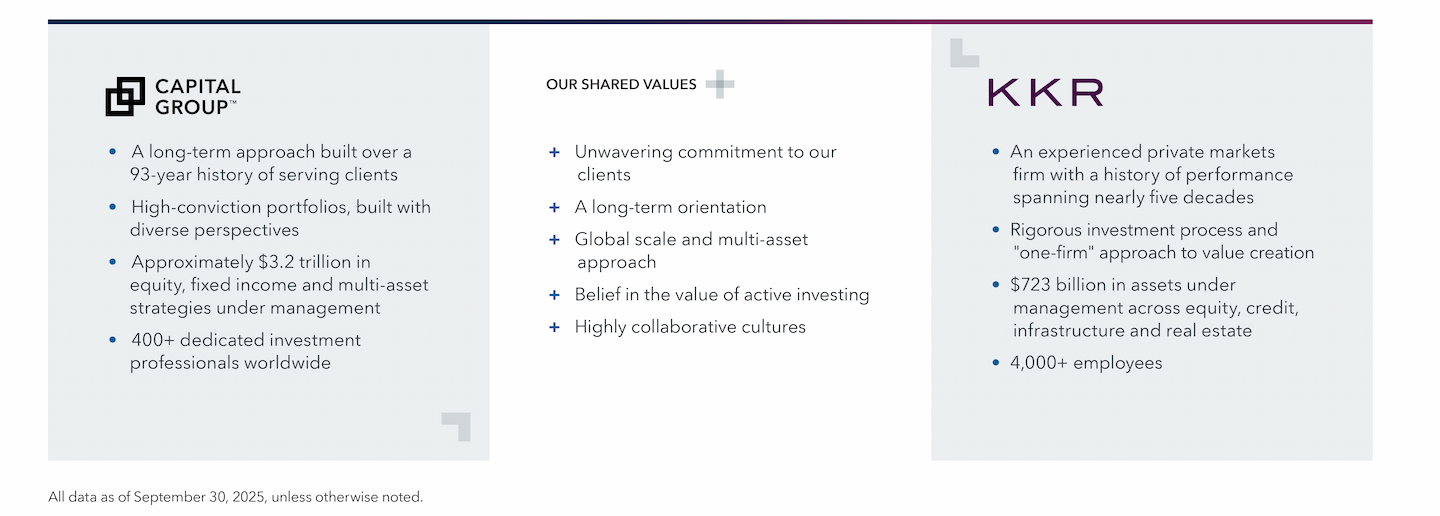
A chart explains why Capital Group partnered with KKR. On the left side, it highlights Capital Group’s experience, including: a long-term approach built over a 93-year history of serving clients; high conviction portfolios, built with diverse perspectives; approximately $3.2 trillion in equity, fixed income and multi-asset strategies under management; and 400 plus dedicated investment professionals worldwide. On the right side, it highlights KKR, an experienced private markets firm with a history of performance spanning nearly five decades; rigourous investment process and "one-firm" approach; more than $723 billion under management across equity, credit, infrastucture and real assets. 4,000 plus employees. The center of the chart lists shared values of the two companies: unwaivering commitment to our clients; a long-term orientation; global scale and multi-asset approach; belief in the value of active investing and highly collaborative cultures.

For financial professionals only. Not for use with the public.

Investments are not FDIC-insured, nor are they deposits of or guaranteed by a bank or any other entity, so they may lose value.
Investors should carefully consider investment objectives, risks, charges and expenses. This and other important information is contained in the interval fund prospectuses, which can be obtained from a financial professional and should be read carefully before investing.
For Public-Private+ Funds: Capital Group KKR Core Plus+ and Capital Group KKR Multi-Sector+ are interval funds that currently provides liquidity to shareholders through quarterly repurchase offers of up to 10% of its outstanding shares. Capital Group KKR U.S. Equity+ is an interval fund that currently provides liquidity to shareholders through quarterly repurchase offers of 5% of its outstanding shares. To the extent a higher percent of outstanding shares are tendered for repurchase, the redemption proceeds are generally distributed proportionately to redeeming investors (“proration”). Due to this repurchase limit, shareholders may be unable to liquidate all or a portion of their investment during a particular repurchase offer window. In addition, anticipating proration, some shareholders may request more shares to be repurchased than they actually wish, increasing the likelihood of proration. Shares are not listed on any stock exchange, and we do not expect a secondary market in the shares to develop. Due to these restrictions, investors should consider their investment in the fund to be subject to illiquidity risk.

- Investment strategies are not guaranteed to meet their objectives and are subject to loss. Investing in the fund is not suitable for all investors. Investors should consult their investment professional before making an investment decision and evaluate their ability to invest for the long term. Because of the nature of the fund's investments, the results of the fund's operations may be volatile. Accordingly, investors should understand that past performance is not indicative of future results.

- Investing outside the United States involves risks, such as currency fluctuations, periods of illiquidity and price volatility. These risks may be heightened in connection with investments in developing countries.

- Illiquid assets are more difficult to sell and may become impossible to sell in volatile market conditions. Reduced liquidity may have an adverse impact on the market price of such holdings, and the fund may be unable to sell such holdings when necessary to meet its liquidity needs or to try to limit losses, or may be forced to sell at a loss. Illiquid assets are also generally difficult to value because they rarely have readily available market quotations. Such securities require fair value pricing, which is based on subjective judgments and may differ materially from the value that would be realized if the security were to be sold. Situations involving uncertainties as to valuation of assets held by the fund could have an adverse effect on the returns of the fund.

- The fund is a non-diversified fund that has the ability to invest a larger percentage of assets in the securities of a smaller number of issuers than a diversified fund. As a result, poor results by a single issuer could adversely affect fund results more than if the fund were invested in a larger number of issuers.


For Public-Private Credit+ Funds:

- Bond investments may be worth more or less than the original cost when redeemed. High‐yield, lower‐rated, securities involve greater risk than higher‐rated securities; portfolios that invest in them may be subject to greater levels of credit and liquidity risk than portfolios that do not.

- The funds may invest in structured products, which generally entail risks associated with derivative instruments and bear risks of the underlying investments, index or reference obligation. These securities include asset-based finance securities, mortgage-related assets and other asset-backed instruments, which may be sensitive to changes in interest rates, subject to early repayment risk, and their value may fluctuate in response to the market's perception of issuer creditworthiness; while generally supported by some form of government or private guarantee, there is no assurance that private guarantors will meet their obligations.

- While not directly correlated to changes in interest rates, the values of inflation-linked bonds generally fluctuate in response to changes in real interest rates and may experience greater losses than other debt securities with similar durations. The use of derivatives involves a variety of risks, which may be different from, or greater than, the risks associated with investing in traditional securities, such as stocks and bonds.

- The fund invests in private, illiquid credit securities, consisting primarily of loans and asset-backed finance securities. The fund may invest in or originate senior loans, which hold the most senior position in a business's capital structure. Some senior loans lack an active trading market and are subject to resale restrictions, leading to potential illiquidity. The fund may need to sell other investments or borrow to meet obligations. The funds may also invest in mezzanine debt, which is generally unsecured and subordinated, carrying higher credit and liquidity risk than investment-grade corporate obligations. Default rates for mezzanine debt have historically been higher than for investment-grade securities. Bank loans are often less liquid than other types of debt instruments and general market and financial conditions may affect the prepayment of bank loans, as such the prepayments cannot be predicted with accuracy.


For Public-Private Equity+ Funds:

- The fund also intends to concentrate in the financial services group of industries, and to invest at least 80% of its assets in securities issued by companies based in the United States.

- K-PEC and co-investment risks: The fund's investments in KKR Private Equity Conglomerate LLC (“K-PEC”) and co-investments alongside K-PEC or one or more other KKR vehicles that pursue private equity strategies entail additional risks. Private equity investments are typically illiquid, speculative, and difficult to value, often requiring multi-year holding periods with returns generally realized only upon sale or refinancing of a portfolio company. These investments depend on access to financing, and market disruptions or increased competition may limit opportunities and affect performance. The fund's significant investment in K-PEC creates concentration risk and a decline in K-PEC's value could materially impact the fund's returns. Co‑investment opportunities are competitive and limited and there is no assurance the fund will receive allocations or comparable terms and will generally have less information than for public companies. Through its investments in K-PEC or other KKR Vehicles and co-investments, the fund may have exposure to portfolio companies with limited operating histories, evolving markets, unproven technologies, and inexperienced management, which may require significant capital and create heightened vulnerability to downturns. Most holdings are illiquid, subject to resale restrictions and may require consents or be sold at a discount. Costs associated with investments in private equity are generally greater than those of investments in other asset classes. In addition to bearing their portion of the fund's fees and expenses, shareholders in the fund will indirectly bear a portion of the asset-based fees, incentive fees and other expenses incurred by the fund as an investor in K-PEC or other KKR Vehicles and in co-investments. Incentive fees are paid to KKR when the fund's investments in K-PEC or other KKR Vehicles and/or co-investments deliver returns in excess of a specified hurdle; when paid, these fees reduce the net realized returns of such investments.

This material does not constitute legal or tax advice. Investors should consult with their legal or tax advisors.
Statements attributed to an individual represent the opinions of that individual as of the date published and do not necessarily reflect the opinions of Capital Group or its affiliates. This information is intended to highlight issues and should not be considered advice, an endorsement or a recommendation.
Capital Group and Kohlberg Kravis Roberts & Co. L.P. (“KKR”) are not affiliated. The two firms maintain an exclusive partnership to deliver public-private investment solutions to investors. KKR serves as the sub-adviser of Capital Group KKR Core Plus+ and Capital Group KKR Multi-Sector+ with respect to the management of each fund's private credit assets. KKR is not a sponsor, promoter, investment adviser, sub-adviser, underwriter or affiliate of Capital Group KKR U.S. Equity+.
All Capital Group trademarks mentioned are owned by The Capital Group Companies, Inc., an affiliated company or fund. All other company and product names mentioned are the property of their respective companies.
Use of this website is intended for U.S. residents only. Use of this website and materials is also subject to approval by your home office.
Capital Client Group, Inc.
This content, developed by Capital Group, home of American Funds, should not be used as a primary basis for investment decisions and is not intended to serve as impartial investment or fiduciary advice.