Strategic Scale Is the workplace the next growth channel for RIAs?

10 MIN ARTICLE

KEY TAKEAWAYS

  • A wave of M&A activity between retirement and wealth advisory firms is reshaping the RIA growth model.
  • Roughly one in every 10 employees in large retirement plans hold about $1M in household wealth outside of their 401(k)s.   
  • Building a scalable retirement-to-wealth bridge requires centralized processes and leadership investment — and can take five or more years to gain momentum. 

For decades, many wealth management firms viewed retirement planning and management as a low margin business not worth their time. Today, the ubiquitous 401(k) is at the epicenter of the next growth phase of the registered investment advisor (RIA) industry.


Over the past two years, more than $4 trillion in assets under management and advisement have converged as wealth platforms pursue both executive referrals from defined contribution (DC) advisors and long-term organic growth through relationships with 401(k) participants.


Mega RIAs like Mariner Wealth Advisors, Creative Planning, CAPTRUST and Cerity Partners are among the largest acquirers, as they see the competitive advantages of offering clients integrated workplace and personal finance advice under a single advisory relationship.


Underpinning the trend is a shift in many employers' attitudes toward wealth advisors. The Morgan Stanley at Work 2026 survey ranked access to a financial advisor among the top three retirement-planning priorities for both employees and HR leaders. 


The opportunity to boost organic growth and assets under management is potentially large: A Capital Group and Retirement Leadership Forum (RLF) study of advisory firms with larger-than-average retirement plans found that roughly one in 10 participants held about $1 million in household wealth outside their workplace retirement account.
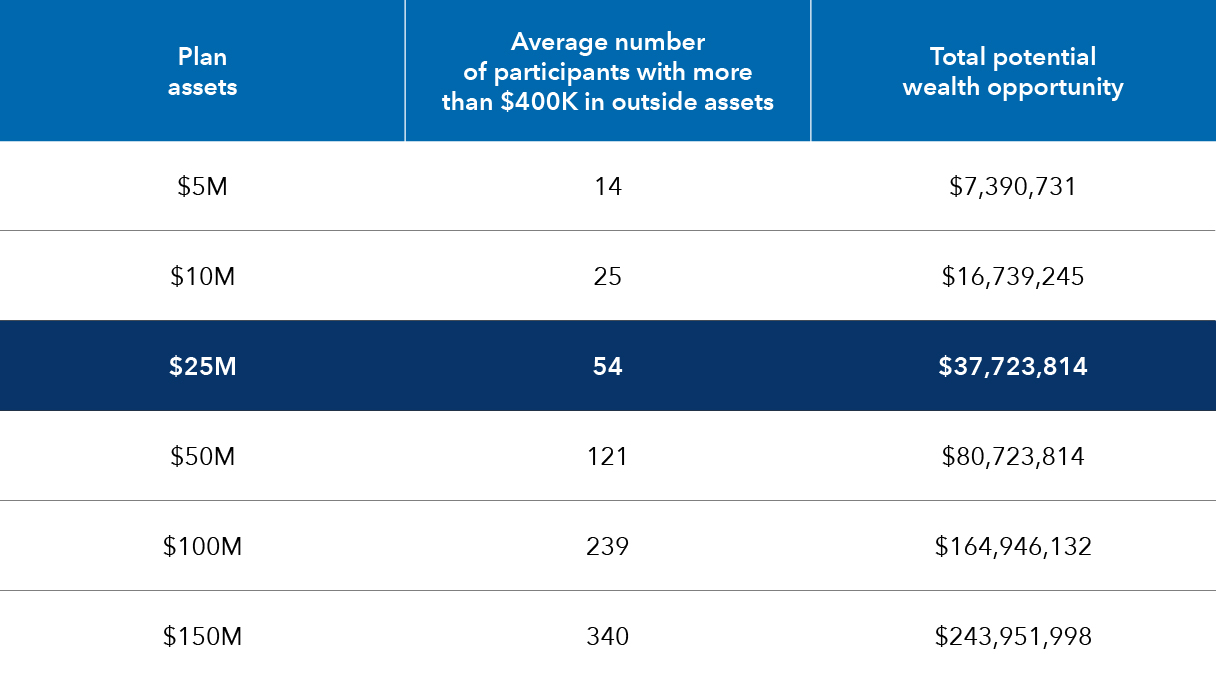
Capturing the wealth opportunity for participants with $400,000+ in outside assets, 2024

Table comparing retirement plan size with potential wealth opportunity. As plan assets increase from $5 million to $150 million, the average number of participants with more than $400,000 in outside assets rises from 14 to 340, and total potential wealth opportunity increases from $7.4 million to $244.0 million.

Source: Retirement Leadership Forum and Capital Group: “Progress in Pursuit of Wealth: Capitalizing on the Potential of the Plan Relationship,” July 2024.

Yet for many firms, developing a system that bridges institutional DC advisory relationships and the wealth advisory side of the business is far easier to envision than execute. 


“Advisory firms recognize the opportunity and are investing heavily in building scalable workplace wealth offerings,” says Suzanne Raffaele, co-founder and partner at RLF. “But we’re now in the execution phase, and that takes time. It can take five years or more to develop a repeatable process and build real momentum with advisors.”

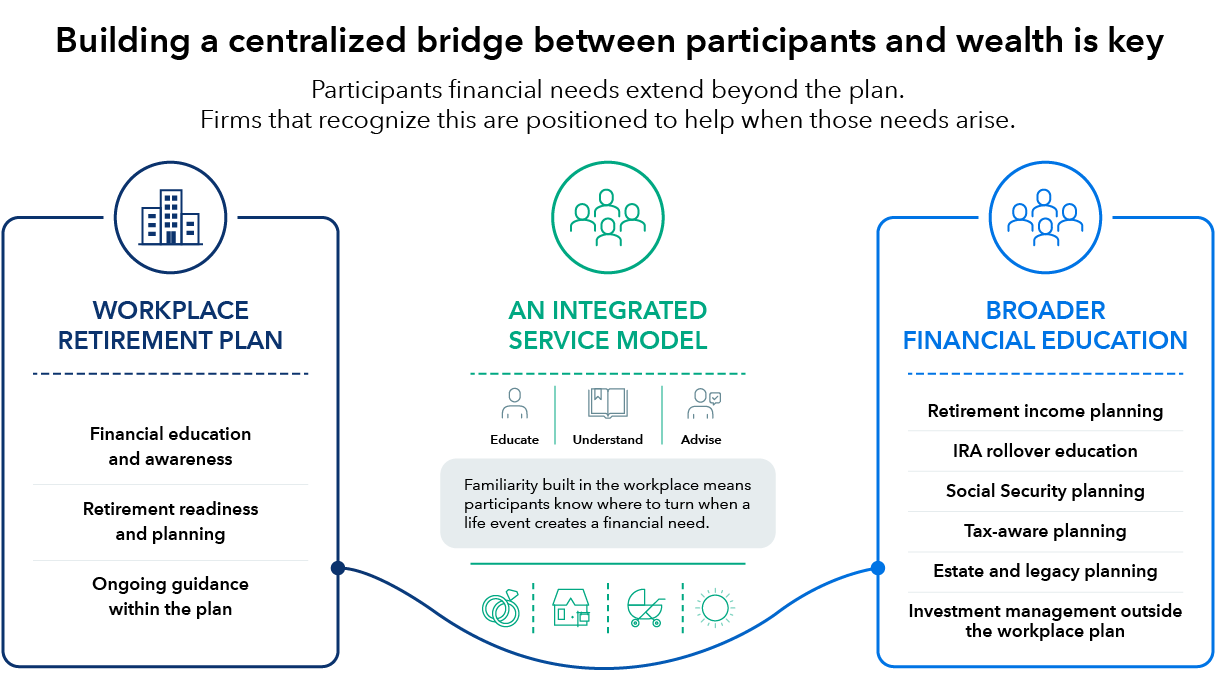
A bridge from participants to wealth management

Infographic titled “When Workplace Advice Meets Broader Financial Needs.” The graphic illustrates how financial guidance can expand from retirement plan services to broader wealth planning through an integrated service model. On the left, a blue panel labeled “Within the Plan” lists three workplace retirement services: financial education and awareness, retirement readiness and planning, and ongoing guidance within the plan. In the center, a teal section labeled “An Integrated Service Model” shows a three-step process: Educate, Understand, and Advise. A callout box states that familiarity built in the workplace helps participants know where to turn when a life event creates a financial need. Icons below depict common life events and milestones. Arrows connect the left and center sections to a green panel on the right labeled “Beyond the Plan.” This section lists broader financial planning needs, including retirement income planning, IRA rollover guidance, Social Security planning, tax-aware planning, estate and legacy planning, and investment management outside the workplace plan. The overall message is that trusted workplace retirement guidance can serve as a foundation for helping individuals address a wider range of financial planning needs over time.

Source: Capital Group, Retirement Leadership Forum, August 2026

What it takes for an RIA to build a bridge between retirement and wealth


A successful convergence of DC plan and wealth advisory businesses needs two things, according to Raffaele: A way to encourage advisors to partner with one another and repeatable processes. “Advisor partnerships are one of the most important components of building a scalable approach,” she says. “Firms need a scientific, repeatable process — they can’t simply hope the right people find each other. They also need a consistent way to pair the right retirement plan advisor with the right wealth advisor and give them a model they can use again and again.”


Acquirers shouldn’t take for granted that DC plan advisors and wealth advisors will work together: Both have entirely different sets of clients, skills and levels of comfort when it comes to referrals. The DC plan advisor owns the corporate relationship and can sometimes be wary about referring executives over to wealth advisors they don’t know and trust. 


Raffaele believes CAPTRUST is one of the few RIAs to date that has managed to do it — and it’s taken many years of investment in processes and leadership to build trust among advisors and a solid reputation with employers and their workforces.


“The critical component for us is having a centralized financial advisory service model that sits in the middle and structurally binds the two businesses together,” says Nick DeCenso, a member of Capital Group’s RIA Advisory Board and senior director of wealth solutions at CAPTRUST. “Ours is a standalone business that DC plan advisors offer to their corporate clients. It works like a partner for HR departments, fielding and answering employees’ questions about their retirement benefits.”

Know what you want to centralize and who you want to serve


CAPTRUST has the scale to service all participants in a plan. Its central model includes an in-house call center manned by fulltime staff, and a team that carefully matches executive referrals with the right advisors, manages a meeting scheduling system for participants who want to hire a financial advisor, and trains young wealth advisors to conduct introductory meetings with employees. 


It also helps to be clear about which parts of the wealth market a firm can realistically serve, according to Raffaele. A participant with $100,000 has very different needs — and requires a very different service model — than someone with $3 million. “Firms also have to decide what support they’ll provide to the broader participant population, whether that means proprietary financial-wellness resources like  financial coaches, an outsourced solution, or some combination of the two.”

Invest in leadership


Raffaele additionally emphasizes the need for investment in leadership. Someone needs to oversee the entire centralized process and ensure that DC plan and wealth advisory processes aren’t siloed. Some firms will have an executive dedicated to building best practices by finding advisors having success at developing workplace-wealth interactions.

2026 DC plan benchmark study: Inside the high-performing DC practice

Building trust among employees is critical


Creating the centralized processes and developing the appropriate leadership structure are table stakes. Building a lasting bridge can’t be done without developing solid long-term relationships with employers and their employees. 


Morgan Stanley emphasizes that success depends on carefully engaging employees in ways that respect personal financial boundaries and preserve trust. Employers may be more willing than ever to give advisors access to their workforce, but they also expect advisory offerings to be transparent, affordable and tailored to employees’ financial needs.


Building trust and a support system for employees throughout their careers is foundational at CAPTRUST, according to DeCenso. “Intentionally cross-selling is not our model. And I actually think we’ve been successful because it isn’t our model.” 


From the outset, advisors are taught to focus on serving participants rather than seeking prospects. Meetings are centered on helping employees make the most of their workplace benefits and strengthening their financial well-being. The goal is to earn trust and build rapport over time with individual participants, so that if they ever do need financial advisory services the advisor’s name may be more likely to come to mind.

RIAs may have to build a retirement plan to wealth bridge to stay competitive


Bringing these elements together is expensive and time-consuming, and it takes a particular depth of institutional judgment to manage a delicate set of relationships — between DC and wealth advisors, and between each of them and the employers and employees they serve. It's a tall order, and some firms may decide it isn't theirs to take on.


The question is whether DC and wealth advisory firms can afford to ignore the trend. 


“If you’re a retirement plan advisor and you’re not talking about wealth, you’re leaving the door open for a wealth advisor to prospect your clients,” says Raffaele. “And if you’re a wealth advisor who isn’t talking to business-owner clients about their retirement plans, you may be letting the fox into the hen house.”


As more mega RIAs bring institutional and wealth advisory businesses under one roof, staying in a traditional lane may become increasingly difficult to justify.

Nick DeCenso is Senior Director of Wealth Management solutions at CAPTRUST, where he is responsible for growing the firm’s private wealth assets through building practice and experience. He and his teams are focused on delivering personalized solutions. Nick earned his undergraduate degree from Saint Louis University.

Suzanne Raffaele is co-founder and partner at Retirement Leadership Forum (RLF), with more than 15 years’ experience in the retirement industry. Before RLF Suzanne was a director at Bank of America Merrill Lynch. She earned her undergraduate degree from B.S. Bucknell University.

Investments are not FDIC-insured, nor are they deposits of or guaranteed by a bank or any other entity, so they may lose value.
Statements attributed to an individual represent the opinions of that individual as of the date published and do not necessarily reflect the opinions of Capital Group or its affiliates. This information is intended to highlight issues and should not be considered advice, an endorsement or a recommendation.
All Capital Group trademarks mentioned are owned by The Capital Group Companies, Inc., an affiliated company or fund. All other company and product names mentioned are the property of their respective companies.
This content, developed by Capital Group, home of American Funds, should not be used as a primary basis for investment decisions and is not intended to serve as impartial investment or fiduciary advice.
Capital Client Group, Inc.
Use of this website is intended for U.S. residents only. Use of our website and materials is subject to approval by your home office.