MARKETING & CLIENT ACQUISITION Boost your online leads: An SEO checklist for financial advisors

Here's a test: Go to Google, Bing or your favorite search platform and type “financial advisor near me” or “retirement planner in [your city].” Then try asking the same question in ChatGPT, Copilot, Gemini or another AI search application. Does your practice appear prominently in the results? Are competitor firms showing up more often than you are? If so, what are they doing that you aren’t? 


The answer often comes down to search visibility. Search engine optimization (SEO) remains one of the most effective ways to help prospective clients discover your practice online. But today's search landscape extends beyond traditional search engines. Investors are increasingly using AI-powered tools to research financial topics, compare advisors and find answers to retirement and wealth management questions before ever visiting a firm's website.


"We're seeing a rise in zero-click searches, meaning a user searches a question and gets their answer in platform without ever clicking through to a website Industry reports are finding 60% of searches end without a click," says Cynthia Casarez, senior search manager at Capital Group. As a result your website must be trusted, chosen and cited in AI responses to maintain your brands influence."


SEO is still about organizing your website and content so that it appears prominently in search results. However, modern SEO also includes ensuring that your knowledge and experience can be understood, summarized and cited by AI-powered search experiences. The closer your practice is to the top of traditional search results—and the more often your content appears in AI-generated answers—the more opportunities you may have to connect with prospective clients. 


Simply put, SEO helps people find you online. The fundamentals remain the same: relevant content, a positive user experience and clear signals of relevant judgement and experience. What has changed is how search engines evaluate those signals and how investors discover information.
 

1. Build your online authority


Search engines do not take a cursory glance of any website. They send so-called “spiders” or bots that crawl through content across the web, seeking clues that help it sort information according to relevancy. They evaluate hundreds of signals to determine whether a website is trustworthy, authoritative and relevant for a particular search. AI systems, meanwhile, act as additional gatekeepers that only cite content that can prove its authority.


For example, Google's quality guidelines have evolved from E-A-T to E-E-A-T, which stands for Experience, Expertise, Authoritativeness and Trustworthiness. For financial advisors, this distinction is especially important because financial content falls under what search engines classify as “Your Money or Your Life” topics — areas where inaccurate information can potentially affect an individual's financial well-being.


Experience: Search engines increasingly value evidence that advisors have direct, real-world experience helping clients solve financial challenges. Advisor biographies, case studies, market commentary, speaking engagements, podcasts and examples drawn from years of client work can all help demonstrate experience. Investors are often looking not only for technical knowledge, but also for guidance from professionals who have navigated similar situations many times before.


Expertise: Expertise reflects the knowledge, credentials and professional qualifications that support your advice. Designations, education, industry certifications, published content and professional specialization all help establish expertise. Clearly communicating what your firm does best—and who you serve—helps search engines and prospective clients better understand your areas of specialization.


Authority: Your practice and profession automatically signal some level of authority, if the search engines are made aware of it. You can do this by creating free profiles of your business in Google and Bing, which highlight essential information about your business, including name, address, hours of operation, telephone number and even services offered. The more you include, the better your chances of appearing in local search results. Search engines may also look to third-party sites to validate your authority, which is why it helps to have your name included on content and in events published on other websites. 


Trustworthiness: Trustworthy website content implies a sincere and helpful intent. Search spiders will crawl your entire website for organization, ease of use and purpose of message, distinguishing from pages that are designed to sell from those designed to inform.

2. Identify topics and search intent, on top of keywords


While many of your ideas for content will likely stem from your practice and clients (for example, answering their most frequently asked questions or providing solutions to their key issues), you may want to consider aligning those pieces of content to popular or relevant keywords. And while the way search engines understand content has evolved, keyword research remains a valuable part of SEO.


Keywords 


Keywords are the words and phrases that people actually type into the search engine when looking for information, and a little keyword research can help validate and refine your content ideas from a search perspective.


There are many ways to conduct keyword research. One easy way to get started is to search for a popular competitor to see what types of keywords come up in their search rankings. If you are looking for variations on a popular keyword term, an easy way to find them is to type in your question and see the results. Every Google Search results page includes two helpful sections: “People also ask” and “Related Searches”, typically found in the middle and at the bottom of a Google Search results page or as a dropdown in the search bar. These offer great hints for related keywords. 


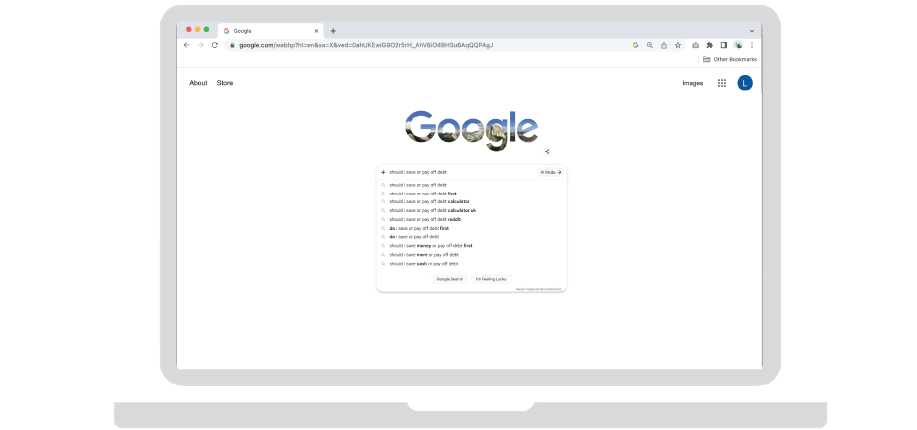
For example, try looking up "Should I save or pay off debt?" on Google Search, and the results will offer potential variations, such as: Is it better to pay off debt or save money? Do millionaires pay off debt or invest? Disadvantages of paying off debt. How to save money and pay off debt at the same time.  

Search for clues in SERPs

Google homepage displayed in a web browser on a laptop screen, showing search suggestions in the search box beneath the Google logo.

Source: Google, August 2026. Google and the Google logo are trademarks of Google LLC.

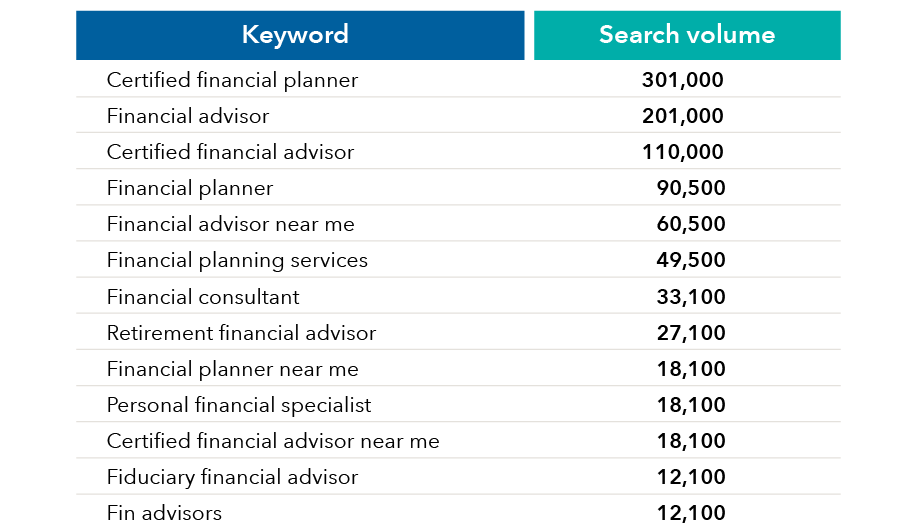
You could use a keyword search tool, which can offer you lists of related terms along with search volume, which is the average number of times that term is searched each month. Knowing the volume can help you understand which terms are most popular, but it can also help you get strategic about finding terms that are less competitive or a better fit for your niche. For example, the term “financial advisor” averages over 200,000 monthly searches as of late April. By comparison, “financial advisors near me” has only about 60,000 each month, and “financial planner near me” gets just over 18,000. 

Examples of top keywords for advisors

A keyword search tool can help you get a sense of variations and volume.

Table showing monthly search volumes for financial planning keywords. "Certified financial planner" ranks highest with 301,000 searches, followed by "Financial advisor" at 201,000 and "Certified financial advisor" at 110,000. Other listed terms include financial planner, financial advisor near me, financial planning services, financial consultant, retirement financial advisor, and fiduciary financial advisor, with search volumes ranging from 12,100 to 90,500.

Source: softscotch.com, 192 SEO Keywords for Financial Advisors (2026 Data), April 2026

There are many free keyword tools, including KeysearchGoogle’s Keyword Planner or the Ahrefs Keyword Generator to start brainstorming keywords and to get a sense of the competition. All are free, although they offer paid options that provide additional information. If you are ready to get more strategic about keyword research, a paid tool like SEMrush may also be useful. 


Topic clusters


In the past, SEO often focused heavily on identifying a specific keyword phrase and repeating it throughout a page. Today, search engines are much better at understanding context, relationships between topics and the intent behind a search query. As a result, successful SEO is less about individual keywords and more about thoroughly addressing a topic.


For example, a financial advisor creating content about retirement planning may naturally cover related subjects such as Social Security claiming strategies, retirement income, healthcare costs, required minimum distributions and tax planning. Search engines increasingly recognize these relationships and reward content that provides comprehensive, useful answers.


In addition, AI-generated summaries often provide insight into the questions investors are asking. These can serve as a valuable source of content ideas while helping you better understand search intent.


Keyword tools remain useful for validating demand and identifying opportunities, but advisors should think beyond individual phrases and focus on becoming a trusted resource for an entire subject area.

3. Think locally


One of the ways to help differentiate your firm is to focus on local search. While broad terms such as “financial advisor” can generate significant search volume, they are also highly competitive and don't necessarily reveal much about the searcher's intent. More specific searches, such as “financial advisor for corporate retirees in Tacoma,” “Tacoma retirement planner” or “retirement advisor near me,” tend to attract prospects who are further along in their decision-making process and may be more likely to convert into clients.


Local search remains a powerful opportunity for advisors. Consumers continue to rely heavily on Google when researching and evaluating local businesses, and many also consult reviews, local directories, social platforms and AI-powered search tools as part of their research process. As a result, maintaining a strong local presence can help your firm appear wherever prospective clients are looking for information. 


Keyword research can still help identify valuable opportunities within your geographic market, but the goal should be to understand the questions and needs of local investors rather than simply target individual keyword phrases. Consider creating content that reflects the specific concerns of your community, the types of clients you serve and the planning challenges they face.


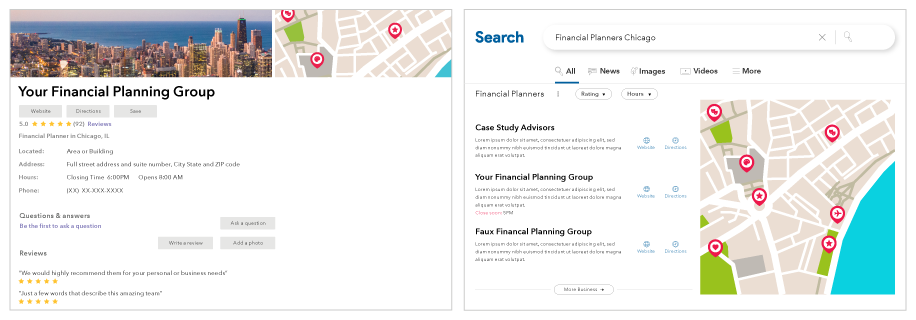
Another local search goal is to get into the “map pack” — a featured search result that literally shows your business on the map. Here is where SEO best practices come in handy. Registering your business with Google and Bing is the first step (remember to fill out as much information about your firm as possible). Getting brand or firm name mentions on other third-party sites will also help. These external mentions are known as backlinks, and they help to further signal a site’s experience authority and trust. And don’t be afraid of online reviews, as search engines tend to favor businesses they can validate through user feedback. 


The “map pack” can help with local search leads


The more information you add to your business profile, the more likely you are to put your business on the map in search. 

Screenshot of a generalized search engine’s “map pack” results. On the left, the image shows details for a business called Your Financial Planning Group in Chicago, Illinois, which has a full business profile and multiple reviews. On the right, the image shows a search for Financial Planners Chicago, with Your Financial Planning Group appearing in the second result and shown on an accompanying map.

Source: Capital Group research

Google and other search engines offer opportunities for local businesses to advertise to customers searching in your area. Typically, an ad would move you to the top of SERPs above the organic results, and you would only pay for leads generated from the ad directly.

4. Consider solutions-oriented content


What really wins in search is relevant content that helps your clients and prospects solve a problem. Content can help drive traffic and build trust, showing off the expertise of you and your firm. 


The type of content you create is less important. It could be articles, blog posts, Q&As, videos, white papers, infographics — whatever format works best with your target client. (And it doesn’t hurt to experiment and do a little of each.) Not only will it signal to search engines that your site is a source of trusted information, but the content can also be used in client emails, posted on social media and potentially shared by other websites.

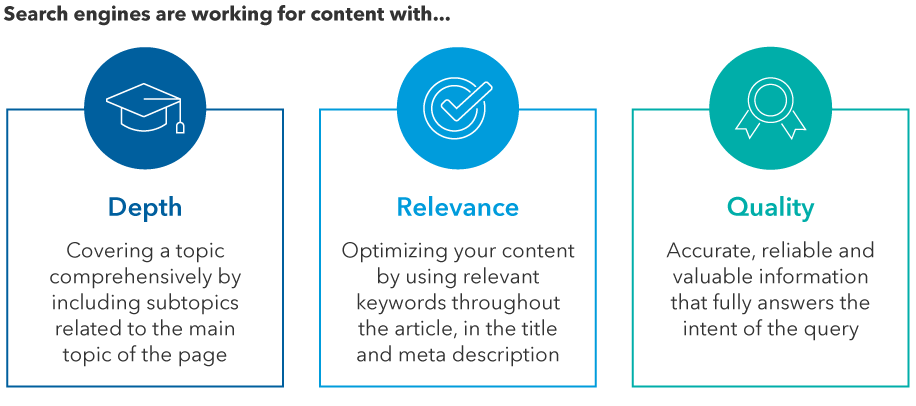
Great content can drive search interest

Under the heading “Search engines are looking for content with…” are three boxes. The first is Depth, covering a topic comprehensively by including subtopics related to the main topic of the page. The second is Relevance, optimizing your content by using relevant keywords throughout the article, in the title and meta description. The third is quality, accurate, reliable and valuable information that fully answers the intent of the query.

Source: Google; Capital Group research.

Typically, the questions you hear most from clients will correspond with topics that are searched most often by investors. Creating content that answers some of those top questions is a great place to start. If there are topics that appeal directly (or exclusively) to your ideal client, those might take priority. You can also use these questions to start your keyword research to find variations you may not have thought of. 

5. Pay attention to site structure and keyword placement


How your website is structured is important to your business and your clients. You want to create an experience that is user-friendly and leads to a conversion, of course. But the right structure can also help you signal to search engines what’s most important to you, by having a hierarchy of information, links from one page to another, and a breadcrumb navigation trail that helps users find their way back to where they started. 


Also, be sure to fill out the meta title and meta descriptions on your site’s backend. Metadata is the language best understood by search engines, and it’s what users see in search results. These titles and descriptions should be clear and well optimized for search. 


It can also help to optimize each page of content or article, which involves repeating the keywords throughout the page. Indeed, SEO experts say there are certain places on the page where these keywords are even more important. These include: 


Meta title: The meta title is the title that will appear in search results, which may be the same as the page headline but does not have to be. Either way, titles should include strong keyword terms. If you have used a given keyword on another page, subsequent pages may need keyword variations.  


Meta description: The meta description is the blurb that accompanies search results. It helps add context and drive the user to click. 


H1 or H2 headline: The headline on each content page should be the most important thing on the page, which means using a strong H1 or H2 heading in Hypertext Markup Language (HTML).  


Use AI-friendly content formats: Search engines and AI-powered search tools increasingly favor content that is easy to scan, understand and summarize. Consider incorporating elements such as key takeaways near the top of the page, bulleted or numbered lists, and FAQ sections that directly answer common investor questions. These formats can improve readability for visitors while making it easier for AI systems to identify and surface relevant information from your content.


Subheadings or subtitles: Subheadings can break up a page according to subtopics and help readers find information quickly. Search engines will scan these looking for keywords or keyword variations. Using H3 subheads in HTML can help search engines find them. 


Internal and external links: Hyperlinks to additional content and resources generally get high marks from search engines, particularly if the linked text is related to the target keyword. Consider linking to quality content created by subject experts providing useful research or source material, video tutorials, how-to guides, tools and other resources. These external links may also help you get relevant backlinks to your page or site.


Ready to take the next step?


The fundamentals of SEO have not changed. Search engines and AI platforms still seek to connect users with the most relevant, trustworthy and helpful information available.


What has changed is the way people search. Today's investors may begin their journey on Google, Bing, ChatGPT, Copilot or another AI-powered platform. Firms that consistently demonstrate expertise, provide helpful content and build a strong online presence will be better positioned to appear wherever those searches take place.


Experimentation remains important. SEO continues to evolve, and advisors who stay focused on serving client needs while adapting to new search technologies will be well positioned to generate online visibility and prospective client leads in the years ahead.

SEO checklist


Not sure where you stand in terms of search engine optimization? This handy checklist can help.


  • Keywords: Are your keywords or keyword terms clear? Are they placed strategically around the page? Are you using some keyword variations?
  • Content: Is your content helpful to users? Is it created by an expert and updated regularly? Does it fit the format your prospects prefer?
  • Architecture: Is your site user-friendly? Are the calls to action clear?
  • Reputation: Are you displaying expertise, authority and trust?
  • HTML: Have you filled out the meta title and meta description fields using clear, search-friendly language?
  • Links: Do you have relevant internal and external links to quality sources? Are there backlinks to your site?
  • User experience: Does your content match search intent? Is your site engaging? Do users spend time on the page?
Investments are not FDIC-insured, nor are they deposits of or guaranteed by a bank or any other entity, so they may lose value.
Investors should carefully consider investment objectives, risks, charges and expenses. This and other important information is contained in the fund prospectuses and/or summary prospectuses, which can be obtained from a financial professional and should be read carefully before investing.
This material does not constitute legal or tax advice. Investors should consult with their legal or tax advisors.
Statements attributed to an individual represent the opinions of that individual as of the date published and do not necessarily reflect the opinions of Capital Group or its affiliates. This information is intended to highlight issues and should not be considered advice, an endorsement or a recommendation.
All Capital Group trademarks mentioned are owned by The Capital Group Companies, Inc., an affiliated company or fund. All other company and product names mentioned are the property of their respective companies.
Use of this website is intended for U.S. residents only. Use of our website and materials is subject to approval by your home office.
Capital Client Group, Inc.
This content, developed by Capital Group, home of American Funds, should not be used as a primary basis for investment decisions and is not intended to serve as impartial investment or fiduciary advice.