MARKETING Easy and engaging email marketing for financial advisors

7 MIN ARTICLE

If email feels like old news or your communications are not breaking through, it may be time to refresh your strategy. A great email strategy can help make even a solo advisory practice feel like an enterprise, driving everything from prospecting to loyalty and retention.


Investor expectations for personalized digital communication continue to grow. CapIntel's 2025 Investor Engagement Survey found that 90% of investors prefer personalized communications and recommendations, while 69% of millennials prefer email or video interactions with their advisor. For advisors, email remains one of the most efficient ways to deliver relevant insights and stay connected with clients at scale.

Here’s how to update your email strategy to help you attract new prospects while building client loyalty.

Build your email list with a “lead magnet”


You likely already have an email distribution list, full of the names and email addresses of clients to whom you send important or regular communications. Build on that list, with as many additional emails you can gather. The point is to build now and segment later. Any (or nearly any) lead is a good lead.


To attract new clients, it helps to have what’s known as a “lead magnet.” A lead magnet is a valuable resource that can be offered in exchange for an email sign-up. Lead magnet examples include financial e-books, regular newsletters, compelling infographics, video case studies, or consumer-friendly webinars or events.


If you do any content marketing, you can build a lead magnet out of your most popular topics or content. If you are just starting to create content, most investors want to learn more about retirement, home ownership, smart goals and investment strategies. Providing key information on these topics may help get you an email address.


Once you have a lead magnet, here are ways to build an email list:


Highlight your lead magnet on your website. Create a prominent spot or link where visitors can sign up to get your lead magnet content by providing a name and email.


Promote your lead magnet on social media channels. Build a post that encourages your followers to sign up for the content. You can also promote other content on your website that links to your lead magnet, creating a journey for your prospect before asking them for a sign-up.


Attend industry events. Wherever you network with potential clients and centers of influence, market your lead magnet. Put out a clipboard as well as a digital tablet to use for sign-ups, and deputize a team member to assist the collection of emails.


Create a referral program. Find a way to reward existing clients who refer friends to share an email address with you.


Consider paid ads. Once you have refined your email strategy, you can use paid advertising to amplify your lead magnet via platforms like Facebook or Google.

Segment your email list


Once your list starts to become more robust, you can create different subsets or audience segments. For example, your first segment would be existing clients. Another segment would be individuals who get marketing emails. You could also segment by new or onboarding clients, prospective clients or new prospects, center-of-influence contacts and associates, friends and family of clients, one-time site visitors, topic interest, and so on.


However you segment your list, you can target your strategy and your messages to meet the interests or needs of each segment. This increases the chances of different types of people engaging with your content and your practice.


If you use customer relationship management (CRM) software, such as Salesforce, Redtail, Envestnet or AdvisorEngine, you should be allowed to easily segment email lists and personalize your messaging.

Get personal with AI


Advances in artificial intelligence have made personalized communication accessible to firms of all sizes. Today's marketing platforms can help advisors create multiple subject-line options, recommend content for specific audience segments, optimize send times and draft first versions of emails based on CRM data and audience interests.


AI should not replace an advisor's voice, knowledge or judgment. Instead, it can serve as a productivity tool that allows advisors to spend more time refining ideas, strengthening relationships and delivering valuable insights. The most effective communications still feel authentic, personal and relevant to the reader.


Build a strong deliverability foundation to scale


Even the best email content has little value if it never reaches the inbox. In recent years, major email providers have increased their requirements for bulk senders, making email authentication and list hygiene essential parts of every marketing strategy. Organizations should ensure their domains are properly configured with SPF (Sender Policy Framework), DKIM (DomainKeys Identified Mail) and DMARC (Domain-based Message Authentication, Reporting, and Conformance) authentication protocols and maintain accessible unsubscribe options for recipients.


Regularly remove inactive contacts, monitor spam complaint rates and keep subscriber data current. Good deliverability practices help protect your reputation, improve inbox placement and maximize the effectiveness of your communications.

Tell a story with email


Client communication emails tend to be fairly straightforward, but marketing emails and newsletters need to do much more. Tell a story, solve a problem, answer a question, or surprise and delight with information. Whatever you do, send something worth reading. You can provide themed content, tackle life stages, offer interesting or thoughtful resources, or comment on markets, economic conditions or news.


Capital Group, for example, offers weekly takes on the market and the economy, as well as more evergreen resources for financial life stage decisions, which can easily be shared with clients.  

Use templates for instant professionalism


Messaging and tone are important in a marketing email, which can feel more friendly than other types of communication. But it is important to keep a professional tone and presentation. Templates can help.  Email templates are preset formulas and layouts that you can use to help create a clear and efficient marketing message.


For example, most emails will contain a handful of similar details:


Subject line: The first detail your clients will see in their inbox, subject lines should be strong and compelling. You can feature benefits, ask a question, provide a solution to a common problem or find other ways to grab a reader’s attention. To make sure the message is not cut off, limit the character count to about 60 characters including spaces.


Preheader: This is that line of summary text often viewed when looking at your email list in your inbox. It should also be attention-grabbing, while providing more context or information regarding the email’s contents. Keep the count under 80 characters, including spaces.


Logo: Having your company name or logo listed in a prominent spot near the top of the email is a nice touch of branding.


Headline/intro: A bold announcement or introductory statement at the top can keep your audience reading. Keep it short at around 60 characters or less.


Hero image: These days, many emails use imagery as a way of highlighting a product, enforcing a message or just creating a thematic tone. You can use stock photos or create a simple graphic.


Body copy: This descriptive block of text is the place to answer questions in a brief and clear way. It helps to keep the paragraphs short and limit the text to around 700-1,000 characters, although lengths can vary.


Features: Imagine your audience has no time and heads straight to the bullets. Highlight the benefits of your offering with these strong value propositions.


Call to action (CTA) with link: Your CTA is what you want the user to do. The language should be specific, compelling and powerful. It helps to have a link to take them to the next step.


Closing: Not every email needs to end with a signature, but if it reads like a personalized letter, your email should include a proper closing message.

An email template in action


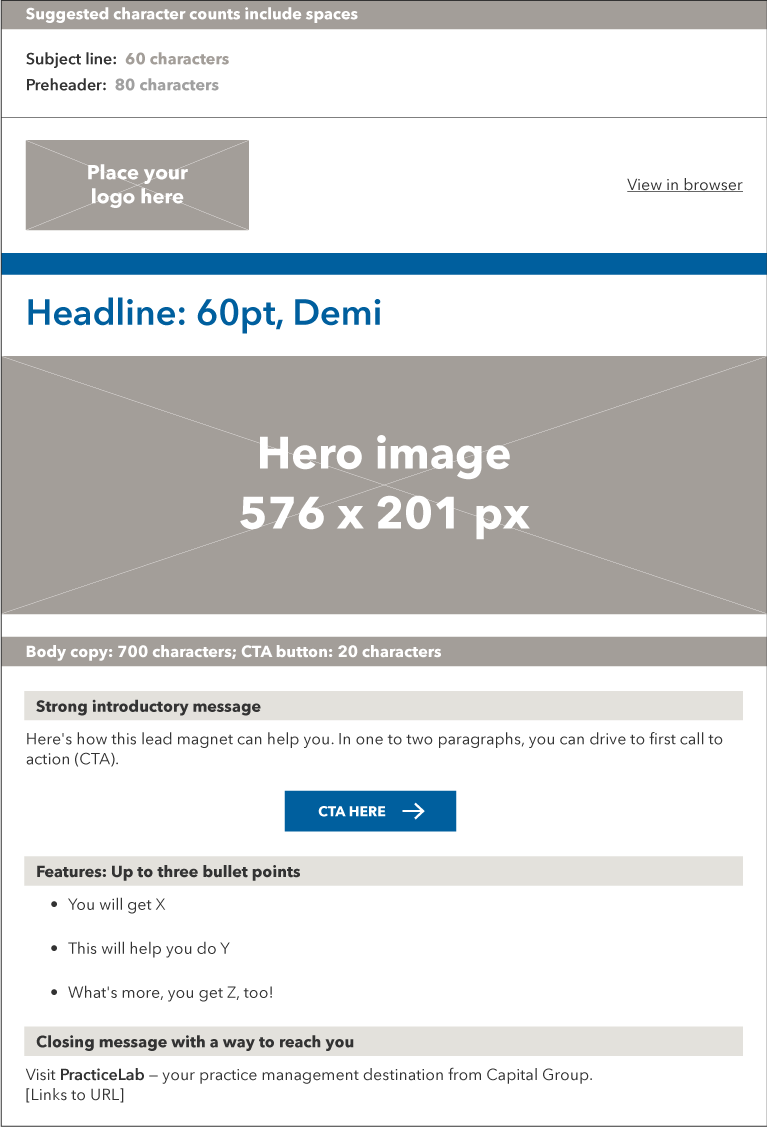
A consistent layout can help make your message even stronger. Here’s an example of an email template you can use for any type of communication. 

Example email template states at the top that suggested character counts include spaces. The graphic starts with the email subject line (60 characters) and pre-header line (80 characters). Below that, is the body of the email. On the top left is a place for a logo or company name. On the top right is a link option to view the email in your browser. Below those is the headline, suggested 60 point font, demi. The hero image is a suggested 576 x 201 pixels. Body copy is a suggested 700 characters, it comes after the hero image. Body copy includes a strong introductory message. Here’s how the lead magnet can help you. In one or two paragraphs, you can drive to the first call to action (CTA). The CTA is a button, which is a suggested 20 characters. Beneath that is the features section, with up to three bullet points. You will get X, This will help you do Y. What’s more, you get Z, too! Beneath that is closing message with a way to reach you. In this example, the closing message is Visit PracticeLab – your practice management destination from Capital Group with a direction to link to url.

Source: Capital Group, 2026

There are many free email templates to be found online, which can typically be customized to include a brand logo, colors and feel of your business, while providing reminders of including important features, calls to action and links encouraging your audience to take whatever next step you’d like them to take. Some will even offer words and sentences to use to promote different topics or types of promotion. Check out BrevoHubspotMailChimp or Constant Contact to see what you might get for free compared to paid options. Capital Group’s Marketing Lab is another free resource for registered investment advisors who sign up, allowing you to create bespoke emails with a few simple inputs. Just remember: These templates are often used as lead magnets, so you may have to give an email address to access them.

Consider tools for smarter personalization, automation and measurement


Today's advisor marketing platforms do far more than distribute emails. Modern tools integrate with CRM systems to help advisors deliver personalized communications, automate marketing workflows and create more relevant client experiences at scale. Many platforms can use client data, engagement history and stated interests to tailor content, helping advisors send the right message to the right audience at the right time. 


Many solutions now offer AI-powered capabilities alongside traditional email templates, newsletters and marketing content. These features can help generate subject lines, customize email copy, recommend audience segments, optimize send times and automate lead-nurturing campaigns. Popular advisor marketing platforms continue to include solutions such as ReachStack, Advisor Stream, FMG and Snappy Kraken, while many CRM and marketing automation providers have expanded their personalization and analytics capabilities. 


Rather than relying solely on broad audience segments, advisors can increasingly create dynamic campaigns based on client interests, life stages, engagement levels and behavioral signals. Some platforms can even identify prospects who share characteristics with existing clients, helping advisors refine their targeting efforts and improve marketing efficiency.


Equally important, modern marketing tools provide deeper insights into campaign performance. As email privacy changes have made open rates less reliable, advisors should focus on metrics such as click-through rates, conversions, meeting requests, registrations and overall engagement. These measurements can provide a clearer view of which communications resonate most with clients and prospects, allowing advisors to continuously refine their marketing strategy.

Test and learn


Trying, tracking, overcoming missteps and celebrating wins — it’s all part of the process, and it can be part of the fun. Use your segmenting skills to send different versions of an email to test subject lines, content topics and calls to action, and learn what resonates best with different audiences. Testing and learning can help you optimize future emails based on these results to improve email open and click-through rates.


While weekdays often remain strong performers for business communications, today's best practice is to rely less on broad industry rules and more on audience-specific engagement data. Many email marketing platforms can now analyze recipient behavior and automatically optimize delivery times for individual subscribers. By testing different schedules and monitoring engagement metrics, advisors can determine when their clients and prospects are most likely to interact with their content.


The point of all this learning is to find out what clients and prospects appreciate most in what you have to offer. So don’t be tempted to misrepresent or oversell in a subject line. Find what works authentically, and it will prove valuable in future emails as well as all other client conversations. 

Financial professionals should review their firm’s compliance policies and procedures prior to engaging in marketing strategies described herein.

Investments are not FDIC-insured, nor are they deposits of or guaranteed by a bank or any other entity, so they may lose value.
Investors should carefully consider investment objectives, risks, charges and expenses. This and other important information is contained in the fund prospectuses and/or summary prospectuses, which can be obtained from a financial professional and should be read carefully before investing.
This material does not constitute legal or tax advice. Investors should consult with their legal or tax advisors.
Statements attributed to an individual represent the opinions of that individual as of the date published and do not necessarily reflect the opinions of Capital Group or its affiliates. This information is intended to highlight issues and should not be considered advice, an endorsement or a recommendation.
All Capital Group trademarks mentioned are owned by The Capital Group Companies, Inc., an affiliated company or fund. All other company and product names mentioned are the property of their respective companies.
Use of this website is intended for U.S. residents only. Use of our website and materials is subject to approval by your home office.
Capital Client Group, Inc.
This content, developed by Capital Group, home of American Funds, should not be used as a primary basis for investment decisions and is not intended to serve as impartial investment or fiduciary advice.