
August 18, 2026
10 MIN ARTICLE
KEY TAKEAWAYS
Samir Mathur, chairman of the Portfolio Solutions Committee, shares his perspectives on:
- The potential impact of rapid advancements in AI and inflation, among other issues for investors.
- What he’s learned from big market events in the past and why it’s important to build portfolios for a range of different scenarios.
- The power of using flexible funds in model portfolios that can respond to market shifts in real time rather than taking a purely top-down approach to tactical allocation.
The award reflects the work done by the Capital Solutions Group (CSG) and many other associates focused on solutions here at Capital. We started this effort with the introduction of our target date solutions in 2007 and then expanded into various fund-of-fund portfolios and models. We have continuously improved our capabilities and portfolio construction process over the years. It is both humbling and gratifying to see Morningstar recognize and appreciate our approach to portfolio construction, which is anchored to the financial goals and objectives of our clients, as well as the great track record of our underlying funds.
* Important information about Outstanding Allocation Portfolio Manager category as part of the 2026 U.S. Morningstar Awards for Investing Excellence. Source: Morningstar. As of April 8, 2026. Morningstar recognized an individual or team who produced exceptional returns over the long term (periods lasting at least five years). To qualify, a manager’s strategy must currently earn a Morningstar Medalist Rating of Gold or Silver for at least one vehicle and/or share class in the allocation asset class. Manager Research analysts conduct in-depth qualitative evaluations to determine the nominees and subsequently vote to select the award winners. Capital Group has not paid Morningstar to be considered for or to promote the award. Morningstar Awards 2026 ©. Morningstar, Inc. All Rights Reserved.
2. Why is an approach based on client objectives so important and what drives your conviction in this approach?
The beauty of building portfolios based on objectives is that it’s a more direct reflection of investor goals. We have spent time getting clear on what we’re trying to solve for and have defined a few broad objectives that meet the needs of most people.
Initially, there was not enough quantitative modeling in the industry to solve this — mean variance optimization was the dominant approach, but it didn’t fully address investor needs.
Risk in portfolios is primarily defined as volatility. Naturally, volatility is one of the most important risks to control in a portfolio, but it’s not the only one. In our view, the true risk for clients is not being able to achieve their objectives. Once we explicitly defined the objectives, we came up with metrics to guide allocation and measure portfolio success based on those long-term goals. These metrics depend upon the portfolio objectives and can include return, risk-adjusted return, volatility, yield and drawdown.
Given this, we needed to develop a more comprehensive portfolio optimization and construction approach that could take these metrics into account.
We are very clear with our clients on what they can expect from objective-based portfolios. For example, if there’s a market meltdown, we would expect some drawdown in growth portfolios but relatively greater downside resilience in more conservative portfolios with maximum drawdown targets in mind.
3. Can you share with us what you’ve learned from events like the global financial crisis and 2022 stock market decline? How do you think about big market events?
While such events are valuable learning moments, I think it’s important to be careful what you carry from these events and make sure they don’t overly influence you. Some investors never got back into the market after the financial crisis and lost out on opportunities for capital appreciation. Also, you have to pay attention to downside for certain goals. This is why I’m so focused on objectives. If you’re a retiree looking for a sustainable withdrawal, being too conservative could actually be a risk — without sufficient capital appreciation, there’s a danger of running out of money.
We have to be prepared for different types of events and make sure our portfolios are robust in different types of scenarios. It’s also why we believe in the two layers of active management, where we make top-down, longer-term, valuation-based strategic decisions in selecting funds for portfolios and allow underlying funds to respond in real time to evolving market dynamics.
In general, we use flexible funds as anchors in many model portfolios since they can lean into geographic or asset class convictions in a dynamic way. American Balanced Fund® (AMBAL) — which invests in both stocks and bonds — is an example of asset class flexibility and serves as an anchor in American Funds Moderate Growth and Income Portfolio, which typically is a proxy for a 65% equity/35% fixed income portfolio.
Asset class flexibility in a moderate growth-and-income model
Source: Capital Group as of May 31, 2026.
4. What are your thoughts on the current developments in AI (artificial intelligence) and how that could affect markets?
AI is an area where we need to account for different scenarios. On the one hand, AI could contribute to immense productivity gains as it gets used more broadly. On the other hand, capital expenditure is increasing for many of these companies and profitability could go down if revenues don’t rise commensurately. Job losses could be larger than expected, which could be a problem for the economy. What do you do with that? The change in tech is so rapid, you have to consider and be mindful about the spectrum of potential outcomes. We take the same approach with inflation or other large macro factors where it is helpful to do scenario analysis. We come up with different forward expectations for these scenarios and how the portfolio would behave — there’s always a probability of the base case happening or the alternative scenarios happening — you have to make sure your portfolio is resilient and prepared for different outcomes.
5. How do you decide whether to access opportunities via strategic asset allocation or through shifts in the underlying portfolios?
It’s hard to add value from frequent, top-down tactical changes. By the time the information percolates, it’s generally too late and markets have already discounted it. Valuation-based strategic allocation decisions can add value over longer time horizons — that’s where we tend to focus. Keep in mind that we also have real-time market signals and information that are reflected in the positioning of the underlying portfolios. That’s where we’re incorporating insights from lots of investors on the ground. They’re getting fundamental insights from companies even before that shows up in the economic data. We believe that our portfolio managers in those funds will make the best use of the flexibility available to them based on the opportunities they’re seeing.
We closely follow what’s happening in the underlying funds and also revisit top-down allocations on a periodic basis if market events warrant it. As an example, when tariffs were first announced in early 2025, we decided not to increase top-down allocations to non-U.S. equity at that time since the underlying funds were already leaning into those areas. As another example, our CMAs (capital market assumptions) and other macro factors have been pointing to increased revenue and profitability for emerging markets companies, combined with better policies by governments and increased innovation in some economies. This has led us to increase our allocation to a diversified emerging markets fund in some models.
6. Tell us more about how you use flexibility in portfolios.
There are different kinds of flexibility: style, geographic, asset class. Our growth funds have some style flexibility as well as significant geographic flexibility, especially in our Global Growth model, which can quickly shift the balance of U.S./non-U.S. equity allocations via funds like New Perspective Fund®. This fund aims to take advantage of global trade patterns by investing in multinational companies with significant sales and operations outside the U.S. It’s worth noting that non-U.S. equity exposure in this fund is currently near its 10-year high. Similar to the way AMBAL is an anchor fund in the American Funds Moderate Growth and Income Model Portfolio, New Perspective Fund is an anchor in the American Funds Global Growth Model Portfolio — it makes up 20% of the model and can flex more or less into non-U.S. equity in real time.
Geographic flexibility in a global growth model
Source: Capital Group as of May 31, 2026.
We also use flexible bond funds such as American Funds® Multi-Sector Income Fund in various model portfolios. Flexible bond funds like this can lean in and out of different sectors to generate income, as can equity income funds, which seek income across global bond and equity markets. Capital Income Builder® — for example — is an equity income fund as well as an anchor in our Conservative Growth and Income model portfolio. The fund’s U.S. bond allocations are currently close to their 10-year low, as the fund has leaned into equity opportunities.
Asset class flexibility in a conservative growth-and-income model
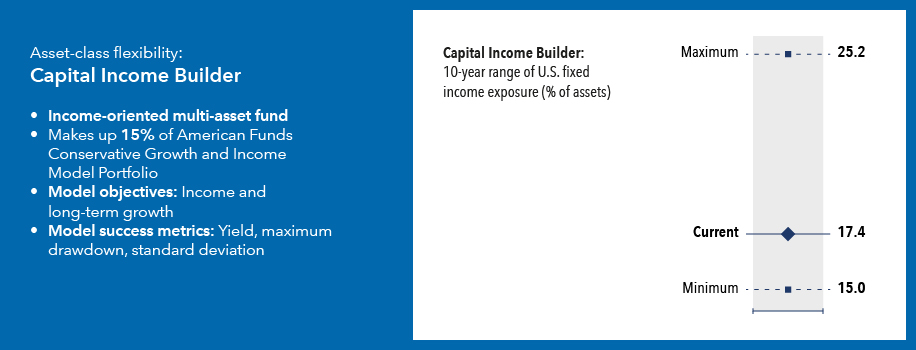
Source: Capital Group as of May 31, 2026.
7. What informs strategic asset allocations and what are some of the recent changes that the team has made at a top-down level?
We use long-term capital market assumptions, factoring in expectations for return, volatility and correlations. The strategic allocation process is very clear: We start with investor objectives, success metrics and constraints, and then optimization. As with any model, we are mindful of its strengths and weaknesses, and discuss recommended changes within our group. The 2026 CMAs showed that some of the valuations are a bit stretched in U.S. equity markets on a relative basis. We also believe the U.S. dollar remains overvalued. All of these factors combined suggested a slight tilt toward non-U.S. opportunities, particularly in select emerging markets.
In growth models, we decided to dial U.S. equity risk down slightly and get more non-U.S. equity exposure from a diversified emerging markets fund. But in more conservative growth-and-income and income portfolios, we actually added a bit of growth fund exposure to slightly dial down these models’ dividend-exposure and make sure they could also participate in gains if the run-up from AI continues.
In growth-and-income and income-oriented models, we added to an emerging markets debt fund to support higher income potential. In previous years, when yields were lower, we used equity income funds to pursue higher yield even when it wasn’t broadly available. But now that yield is a bit easier to come by, we are able to strike more of a balanced approach by drawing from a wider range of income sources, including emerging markets debt.
April 2026 model allocation changes
| Model objective | Change | Rationale | ||||||
|---|---|---|---|---|---|---|---|---|
| Growth |
| Diversifies exposure across sectors and regions given U.S. equity valuations and market concentration | ||||||
| Growth and income |
| Diversifies exposure across regions given U.S. equity valuations and market concentration; seeks additional income from EMD yield | ||||||
| Conservative growth and income/Income |
| Better participate in potential gains if Al run continues; seeks additional income from EMD yield |
Source: Capital Group.
8. How has the model portfolios program evolved in recent years and how do you approach the use of ETFs?
We have evolved our program to meet a wide range of different client needs and vehicle preferences — this includes active ETF models as well as active-passive and tax-aware models. For the ETF models, we use active ETFs as building blocks in a way that’s similar to mutual funds in our core models. While the ETFs are not always a one-to-one match for mutual funds, many of them exhibit similar traits to corresponding mutual funds. We are able to mix and match these ETFs at the portfolio level to get the characteristics we want and to meet model portfolio objectives.
9. The concept of a Total Portfolio Approach (TPA) has been more commonly talked about in the pension fund industry in recent years. What are your thoughts?
The roots of TPA go back a while in my view. It comes down to a holistic approach to assessing risk and return characteristics across the portfolio, rather than looking at each of its individual components, or asset classes, distinctly. What is the goal? What is each part of the portfolio supposed to do and how are those parts interacting? This is the essence of what we do and have been doing for many years now, starting with portfolio goals. We revisit the strategic asset allocation annually — sometimes more often depending on market events. At the same time, we are also reviewing the underlying funds on a regular basis. Are the funds doing what they’re supposed to do in each portfolio? We’ve been using this framework for a long time and continue to think about new opportunities in a similar way. It’s important for us to start with the objective and provide our clients with a clear sense of whether portfolios are actually meeting those goals.
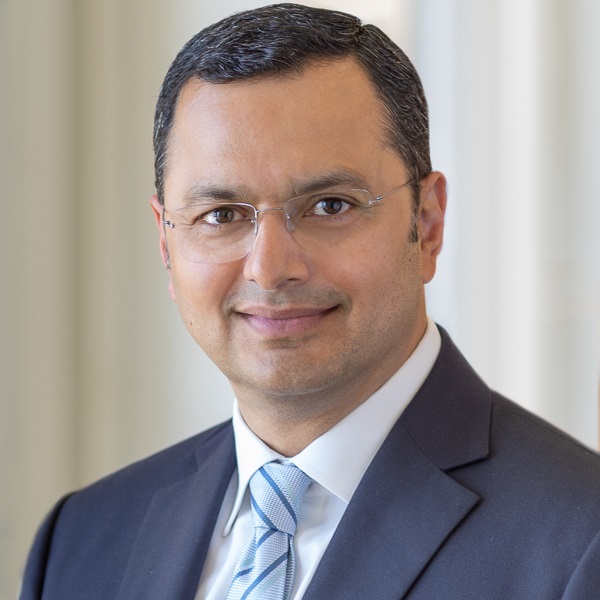
Samir Mathur is a solutions portfolio manager with 33 years of industry experience (as of 12/31/2025). He holds an MBA from the University of California at Berkeley, a master's degree in computer science from the University of Southern California and a bachelor's of technology from the Indian Institute of Technology Delhi.