With a post-Maduro Venezuela, what now for oil bonds?

KEY TAKEAWAYS

  • The U.S. raid to capture former Venezuelan president Nicolas Maduro and his wife on January 3 has changed our outlook for short- and long-term oil supplies.
  • Oil prices remain vulnerable to geopolitical events that are inherently unpredictable. That said, we anticipate lower oil prices over the short term, but we expect prices to rise going into 2027 and 2028.
  • As such, we maintain underweight positions in oil-related investment-grade (BBB/Baa and above) bonds while remaining opportunistic in adding to credits where we have a high level of conviction.

The recent U.S. intervention in Venezuela has raised major questions in the oil market. With the future governance of the country still largely uncertain, will more Venezuelan oil eventually come online? If so, how long will that take, who will manage the process and how will these dynamics affect short- and long-term oil prices? More specifically, what impact will these factors have on oil bonds across the delivery chain?


At about 300 billion barrels, Venezuela’s proven oil reserves are the largest on earth. For reference, its oil production peaked at about 3.5 million barrels per day (BPD) in the late 1990s before sliding to about 900,000 BPD today. Although its delivery chain infrastructure now appears to be in very poor shape, we think it’s likely that an additional few hundred thousand BPD of Venezuelan oil will come to market over the next several months. If the country eventually benefits from sanctions relief, the return of diluent supply1, pipeline repairs and power restoration, this figure may increase to 300,000 to 500,000 BPD over the next 12 to 18 months.


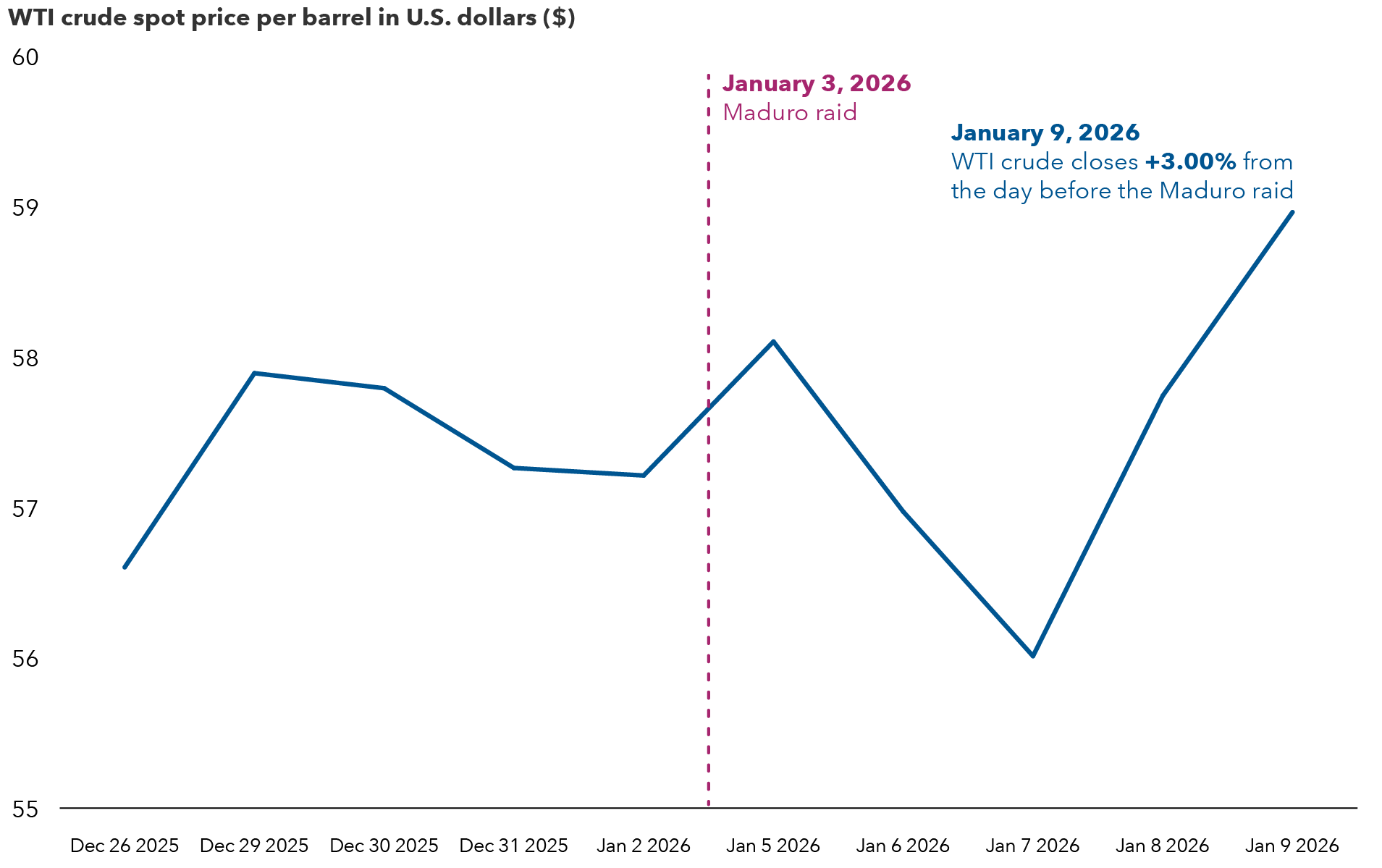
However, adding more than one million BPD of new production may take years and tens of billions of dollars in new investments in infrastructure and other aspects of the delivery chain. This tension between the likely short- and long-term outcomes in Venezuela may account for why West Texas Intermediate (WTI) crude oil prices didn’t move significantly in the immediate aftermath of the U.S. raid to capture former president Nicolas Maduro and his wife on January 3.
1Diluent supply refers to the procurement and delivery of light hydrocarbons – typically natural gas condensate or naphtha – used to reduce the viscosity of heavy crude oil (bitumen). This process, essential for transporting thick, heavy oil via pipelines or rail, ensures the fluid can move efficiently.

The Maduro raid didn’t impact oil prices dramatically

A line chart titled, ”The Maduro raid didn’t impact oil prices dramatically.” The chart shows WTI crude oil spot prices in U.S. dollars per barrel from December 26, 2025, to January 9, 2026. Prices start near $56.60, rise to about $58.00 by December 29 and ease to around $57.20 by January 2. A dashed vertical line marks January 3, 2026, as the day of the Maduro raid. Prices increase to $58.10 on January 5 and fall to about $56.00 on January 7 before rebounding sharply, closing near $59.00 on January 9. This is noted as a 3% increase from the day before the raid.

Source: U.S. Energy Information Administration. Cited February 2, 2026.

The oil sector may experience near-term weakness due to oversupply

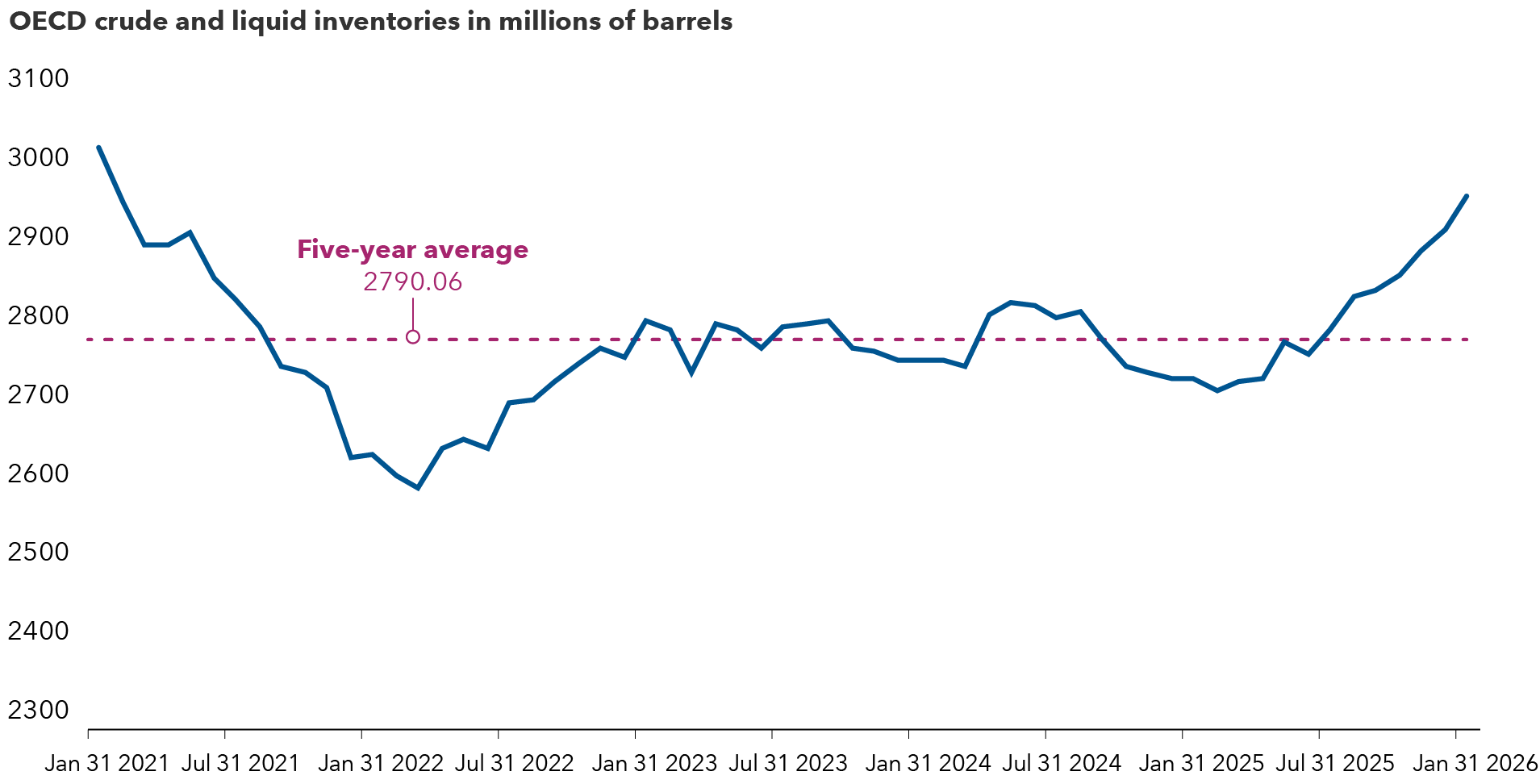
Given the dynamics above and other critical factors in the oil market, we have a split view of oil prices over the short and long term. Over the short term (i.e., the next nine months or so), we expect prices to fall for a number of reasons. First, OPEC has begun to release oil to the market after more than two years of withholding supplies. Second, production by non-OPEC producers like Guyana and Brazil reaccelerated by more than one million BPD in 2025, with some production growth expected to carry over into 2026. This has pushed crude and liquid inventories among The Organization for Economic Cooperation and Development (OECD) countries above their five-year average and led to a generally oversupplied market.

OECD crude and liquid inventories remain above their five-year average

A line chart titled, “OECD crude and liquid inventories remain above their five-year average.” The chart shows OECD crude and liquid fuel inventories in millions of barrels from January 31, 2021, to January 31, 2026. Inventories start just above three billion barrels in early 2021, decline sharply to a low near 2.58 billion in early 2022, then gradually recover. A dashed horizontal line marks the five year average at about 2.79 billion barrels. From 2023 through 2024, inventories fluctuate around this average, dip below it in early 2025, and then rise steadily through late 2025, reaching roughly 2.97 million barrels by January 31, 2026.

Source: Bloomberg. As of January 31, 2026.

As such, an increase in Venezuelan production would add to this oversupply. Other downside risks to oil prices include an increase in U.S. unemployment that triggers a decline in oil consumption and/or a durable resolution of the Russia/Ukraine war. Such a resolution would likely result in the lifting of at least some sanctions against Russia and an eventual increase in oil flows.


We’re mindful that geopolitical factors could also push oil prices somewhat higher over the short to medium term. For example, continued U.S. military action against Russia’s “shadow fleet” could limit global supplies, as could significant U.S. or Israeli military action against Iran if these operations affect Iranian oilfields or ports. Meanwhile, regime change in Iran could in theory limit the country’s ability to maintain its current level of oil exports. And while Chinese demand for oil has broadly decreased over the past few years, the Chinese government has continued to stockpile oil on a seasonally consistent basis, thereby supporting oil prices.


Still, we believe that any geopolitical price spikes will likely prove to be temporary unless unforeseen events disrupt oil supplies for a substantial period of time. With all that said, we see short-term oil prices in the $55 to $60 range for WTI crude.

The longer-term picture for oil looks more promising

We expect near-term oversupply to abate as resilient global economic growth supports oil demand and as OPEC’s spare capacity decreases. At the same time, we see non-OPEC production growth tapering off by 2027 as new supply eases and production declines elsewhere start to bite. We anticipate that exploration and production companies will remain disciplined in their capital allocations and we expect that they’ll favor free cash flow generation over investing heavily in capital expenditures, especially in terms of new projects. We also anticipate that they’ll focus on balance sheet strength and returning capital to their shareholders. As oil supplies potentially decline toward the end of 2026, we’re more constructive on prices going into 2027 and 2028. Accordingly, we expect that oil-related credits will benefit from a more benign macro environment.

Investing selectively as we seek attractive entry points

Against the backdrop above, and given tight valuations in cyclical energy credits, we’re currently underweight energy-related investment-grade (IG) bonds relative to the Bloomberg U.S. Corporate Bond Index. While energy credits comprised about 7% of the index as of December 31, 2025, our IG portfolios maintained about a 2% weighting on average. In our view, the near-term balance of risks is tilted to the downside, with little margin of safety embedded in energy credit spreads. As such, we favor investing in IG energy credits that can weather a period of lower oil prices. These companies tend to have low oil price breakeven rates, integrated operations and strong balance sheets. Within high yield, we favor oilfield service companies given their recent recapitalization and greater market concentration.


The technical backdrop for corporate credit remains supportive. We expect oil-related IG primary issuance to be somewhat elevated in 2026, driven primarily by midstream companies. While we anticipate that primary issuance will be more muted in high yield, we don’t expect the primary calendar to be a significant driver of high-yield spreads. In our experience, broad supply/demand momentum within the oil market tends to affect high-yield prices more strongly than factors such as primary bond issuance.

Amid uncertainty, we’re staying patient and nimble

Given the complexity of the factors impacting the oil market, we’re taking a patient approach to investing in the sector. We remain positioned to capitalize on investment opportunities quickly should valuations become more attractive. The oil market is impacted by macroeconomic, geopolitical and sector-specific factors that can pose unexpected risks to supply and demand – especially as developments in global hot spots like Venezuela, Iran and Ukraine remain highly fluid. On that basis, while we’re confident in our assessment of the market’s short- and long-term fundamentals, we’re mindful of the need to remain flexible and to adjust our portfolios’ positioning as conditions warrant. 

Andrea Montero is a fixed income portfolio manager with 13 years of investment industry experience (as of 12/31/2025). She holds an MBA from Harvard Business School, a master's in finance from the University of Florida's Hough Graduate School of Business and a bachelor's degree in finance from the University of Florida.

Kevin Swick is a fixed income investment analyst with 11 years of investment industry experience (as of 12/31/2025). He holds a bachelor's degree in business administration from the University of Southern California.

Denis Tolkachev is a fixed income investment analyst with 16 years of investment industry experience (as of 12/31/2025). He holds an MBA from Columbia Business School and a bachelor’s degree in finance and accounting from Ohio State University.

Read all perspectives on bond markets

The return of principal for bond portfolios and for portfolios with significant underlying bond holdings is not guaranteed. Investments are subject to the same interest rate, inflation and credit risks associated with the underlying bond holdings.


Higher yielding, higher risk bonds can fluctuate in price more than investment-grade bonds, so investors should maintain a long-term perspective.
 

Bond ratings, which typically range from AAA/Aaa (highest) to D (lowest), are assigned by credit rating agencies such as Standard & Poor's, Moody's and/or Fitch as an indication of an issuer's creditworthiness.


The Bloomberg U.S. Corporate Bond Index measures the investment grade, fixed-rate, taxable corporate bond market. It includes U.S. dollar-denominated securities publicly issued by U.S. and non-U.S. industrial, utility and financial issuers.

Investments are not FDIC-insured, nor are they deposits of or guaranteed by a bank or any other entity, so they may lose value.
There have been periods when the results lagged the index(es) and/or average(s). The indexes are unmanaged and, therefore, have no expenses. Investors cannot invest directly in an index.
Source: Bloomberg Index Services Limited. BLOOMBERG® is a trademark and service mark of Bloomberg Finance L.P. and its affiliates (collectively "Bloomberg"). Bloomberg or Bloomberg's licensors own all proprietary rights in the Bloomberg Indices. Neither Bloomberg nor Bloomberg's licensors approves or endorses this material, or guarantees the accuracy or completeness of any information herein, or makes any warranty, express or implied, as to the results to be obtained therefrom and, to the maximum extent allowed by law, neither shall have any liability or responsibility for injury or damages arising in connection therewith.
Statements attributed to an individual represent the opinions of that individual as of the date published and do not necessarily reflect the opinions of Capital Group or its affiliates. This information is intended to highlight issues and should not be considered advice, an endorsement or a recommendation.
All Capital Group trademarks mentioned are owned by The Capital Group Companies, Inc., an affiliated company or fund. All other company and product names mentioned are the property of their respective companies.
Use of this website is intended for U.S. residents only.
Capital Client Group, Inc.
This content, developed by Capital Group, home of American Funds, should not be used as a primary basis for investment decisions and is not intended to serve as impartial investment or fiduciary advice.