Retirement Plan Advising Under the hood of target date funds: What you need to know

If you’re a retirement professional, chances are you’ve discussed target date funds (TDFs) more times than you can count. These professionally managed retirement solutions are a cornerstone of defined contribution (DC) plans and the most widely used Qualified Default Investment Alternatives (QDIAs).


They’re designed to simplify retirement investment, but their construction and management are layered. There are multiple and distinct underlying investment decisions that take place largely behind the scenes, which may be less visible to you, plan sponsors and participants.


Let’s peek under the hood of TDFs and sharpen your next conversation.

Why do TDFs reign in defined contribution plans?

The passage of the Pension Protection Act of 2006 (PPA) is considered the catalyst for the widespread adoption of TDFs. The PPA created a fiduciary safe harbor for default investments including TDFs as an eligible QDIA. As a result, plan sponsors were able to move away from less diversified options such as money market and stable value funds and replace them with TDFs while benefiting from fiduciary protection.


Target date assets comprise the majority of 401(k) contributions and a growing percentage of all 401(k) assets. In 2024, 401(k) target date assets rose to $3.3 trillion, with Cerulli estimating those assets will nearly double to $6.5 trillion by 2030.


Target date 401(k) assets to rise an estimated $6.5 trillion by 2030 ($ billions)

: Bar and line chart titled “Target date 401(k) assets to rise an estimated $6.5 trillion by 2030.” The chart shows steady growth in target-date fund assets from about $1.6 trillion in 2018 to $3.3 trillion in 2024, with projections reaching over $6.5 trillion by 2030. At the same time, target-date funds’ share of total 401(k) assets increases from roughly 31% to about 49%. Contributions to target-date funds as a percentage of total 401(k) contributions also rise gradually from about 57% to around 69%. Overall, the chart highlights continued growth and increasing dominance of target-date funds in 401(k) plans over time.

Source: The Cerulli Report, U.S. Defined Contribution 2025. Analyst Note: Previous asset totals were restated. A market appreciation of 6.56% was used to calculate projections.

A smooth landing: Why the glide path matters

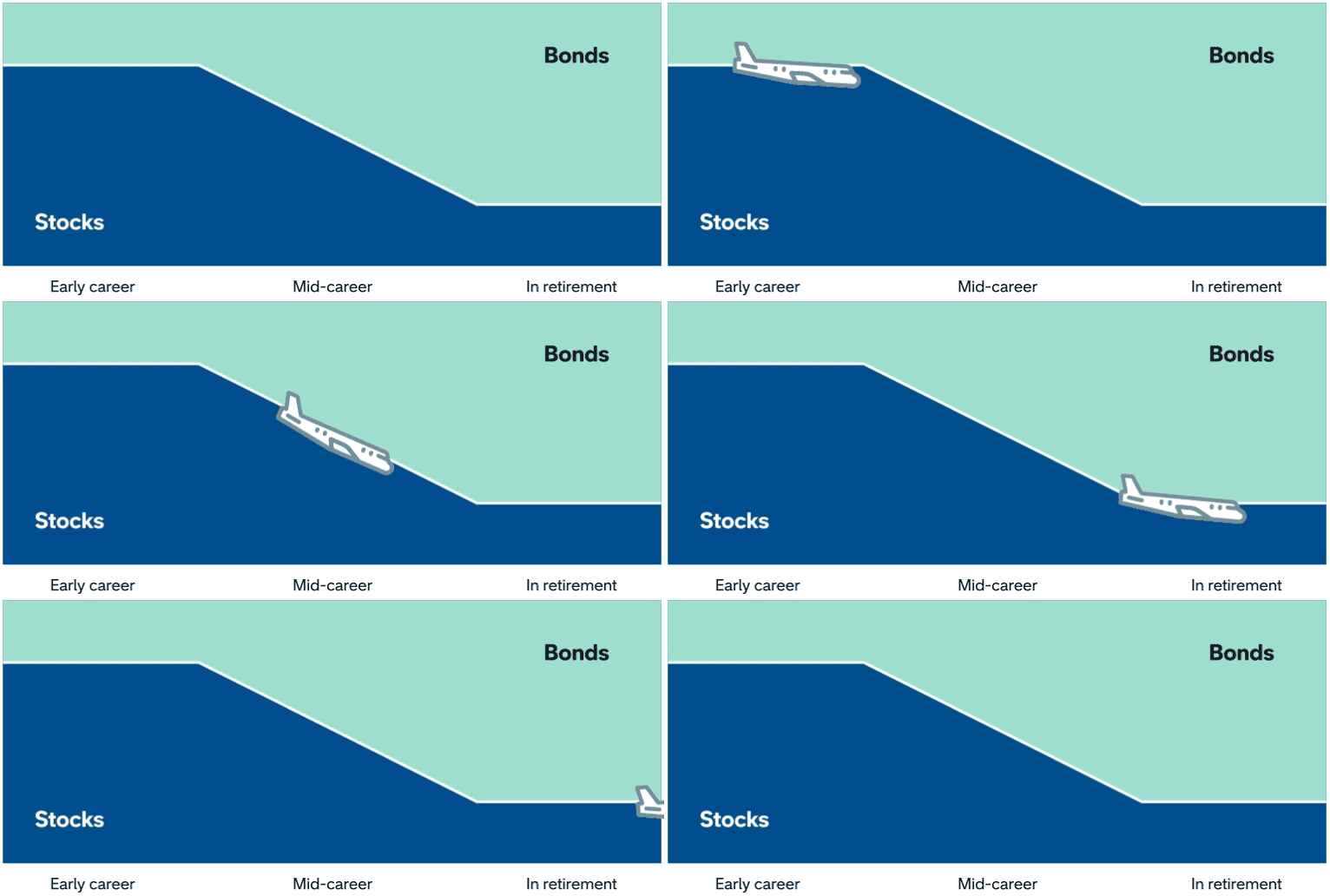
It can be helpful to think of the glide path like an airplane’s approach to a runway. On descent, an airplane aims for a smooth, controlled landing. Similarly, as retirement approaches, a target date fund is designed to reduce risk in an effort to support a smoother, more stable retirement.


In simple terms, the glide path refers to the shift in asset allocation during the life of the fund. It is a key investment characteristic because it drives how risk changes over time depending on its target date.


The target date is the year that corresponds roughly to the year in which an investor is assumed to retire, typically around age 65. Each fund is aligned with that year — these are known as vintages.


Glide path designs serving younger participants typically assume more risk with a greater emphasis on equities. As retirement nears, the glide path becomes more conservative.


A successful glide path does more than aim for a safe landing, it’s designed to support a participant’s entire journey. Because glide paths can vary significantly in how they’re managed and built, it’s important to have a thoughtful, discerning approach. Capital Group’s target date series adapts over time by adjusting both asset allocation and underlying exposures, creating a “glide path within a glide path” and aiming to better reflect participant needs throughout their retirement journey.

The plane will move from stocks and land at bonds

For illustrative purposes only. 

Key discussion points for your TDF conversations

TDFs can provide a range of benefits for financial professionals, plan sponsors and participants. But they also have a few challenges that might come up in your client discussions.
 

Here are some talking points on the potential benefits of TDFs.
 

  • Financial professionals and consultants can focus on strategic guidance and client outcomes versus day-to-day investment decisions. Proactively sharing insights with clients/prospects can deepen relationships, supporting your long term business growth.
  • Plan sponsors can offer a streamlined, age-appropriate solution. By selecting a QDIA, such as a TDF, as the plan's default investment and meeting other regulatory conditions (e.g., initial and annual notice requirements), sponsors can benefit from certain investment-related fiduciary relief.
  • Participants can benefit from diversified portfolios by using TDFs. The glide path provides automatic rebalancing of risk at every stage in their journey.
     

Conversely, certain aspects of TDF solutions can present challenges.
 

  • Advisors and consultants must navigate significant variation among TDFs to avoid overfocusing on cost or short-term performance at the expense of long term outcomes, which makes selecting an appropriate TDF a decision that requires careful consideration.
  • Plan sponsors must ensure TDF design, cost and glide paths align with participant needs and fiduciary responsibilities. Glide paths can vary significantly depending on design.
  • Participants may require a more personalized approach, such as personalized QDIAs.


TDFs dominate DC menus by simplifying retirement investing, yet that simplicity can sometimes obscure the thoughtful design and complexity beneath the surface. For financial professionals, understanding what sits beneath the surface of TDFs is what turns a widely used solution into a differentiated recommendation. Financial professionals can also use Target Date ProView to evaluate funds. Contact your Capital Group representative to get started.

Jason Carlough is a retirement plan counselor with 25 years of industry experience as of 12/31/25. He holds a bachelor’s degree in business and economics from Lafayette College. 

Investments are not FDIC-insured, nor are they deposits of or guaranteed by a bank or any other entity, so they may lose value.
Investors should carefully consider investment objectives, risks, charges and expenses. This and other important information is contained in the mutual fund prospectuses and summary prospectuses, which can be obtained from a financial professional and should be read carefully before investing.
Although the target date portfolios are managed for investors on a projected retirement date time frame, the allocation strategy does not guarantee that investors' retirement goals will be met. Investment professionals manage the portfolio, moving it from a more growth-oriented strategy to a more income-oriented focus as the target date gets closer. The target date is the year that corresponds roughly to the year in which an investor is assumed to retire and begin taking withdrawals. Investment professionals continue to manage each portfolio for approximately 30 years after it reaches its target date.
Statements attributed to an individual represent the opinions of that individual as of the date published and do not necessarily reflect the opinions of Capital Group or its affiliates. This information is intended to highlight issues and should not be considered advice, an endorsement or a recommendation.
All Capital Group trademarks mentioned are owned by The Capital Group Companies, Inc., an affiliated company or fund. All other company and product names mentioned are the property of their respective companies.
Use of this website is intended for U.S. residents only. Use of this website and materials is also subject to approval by your home office.
Capital Client Group, Inc.
This content, developed by Capital Group, home of American Funds, should not be used as a primary basis for investment decisions and is not intended to serve as impartial investment or fiduciary advice.