Retirement income The strategic evolution of registered index-linked annuities

KEY TAKEAWAYS

  • RILAs offer downside protection to help bridge the gap between equities and fixed income.
  • Our research revealed a growing interest in the ability to access active management within RILA products.
  • Applying our objective-based investing framework can help unlock the versatility of RILAs, making it easier to match strategies to clients. 

As markets grow more complex, registered index-linked annuities (RILAs) have emerged as a powerful tool for retirement portfolios. Once viewed primarily as tactical strategies to protect an equity, multi-asset, or fixed income position, financial professionals now see them as strategic components of diversified portfolios, valued for their downside protection, allocation flexibility and ability to combine equity participation with guardrails.


At the same time, financial professionals continue to cite a need for clearer guidance, simpler materials and stronger education to help position these solutions confidently with clients.


Capital Group’s latest RILA Seller’s report* reveals a clear shift: RILAs are no longer viewed as niche tools, but as strategic solutions aligned to multiple client objectives.

How are financial professionals positioning RILAs today?

Financial professionals are using RILAs to meet diverse client needs, from conservative investors seeking downside protection to growth-oriented investors looking for market participation with guardrails. Yet, when it comes to portfolio positioning, opinions diverge.


Some financial professionals present RILAs as a fixed income option, citing their potential to offer more upside with protection. “I sell it as a bond alternative,” one professional shared with researchers.


Others see them as an equity investment, particularly when tied to familiar benchmarks like the S&P 500 Index or Nasdaq-100 Index. “I see it as an equity sleeve,” another explained.


This dual perspective highlights the versatility of RILAs, but our research also showed that RILA use doesn’t stop there: As one financial professional put it, “Personally, I love them. I think they’ve gained a lot of popularity in the recent years, and I think it’s a great option for someone who is looking to participate in the market with a level of protection and a level of comfort.”


Other advantages financial professionals cited include:


  • Risk management: Downside protection for pre-retirees and clients with lower risk tolerance.

  • Tax deferral: For clients seeking tax-deferred growth outside of retirement accounts. “I think the low-cost tax deferral for some of the younger clients makes a lot of sense,” one RILA seller noted.

  • Diversification: Blend of passive and active strategies to reduce market inefficiencies and broaden results.


“I think it’s a good product that solves a specific need for a client. It’s got almost the best of both worlds, if you will. It’s got some downside protection and upside growth as opposed to one or the other.”  –Survey respondent

Positioning framework

Source: Capital Group.

Clients value RILAs for a mix of features – downside protection, buffer/floor designs, income potential and the ability to be a growth investor with guardrails. Financial professionals tell us that these client priorities often map directly onto RILA strategies, reinforcing their role as more than just tactical buffers. 

Whether positioned as equity alternatives, bond replacements, tax-deferred sleeves or diversification tools, RILAs give financial professionals a flexible way to help meet various client goals. 

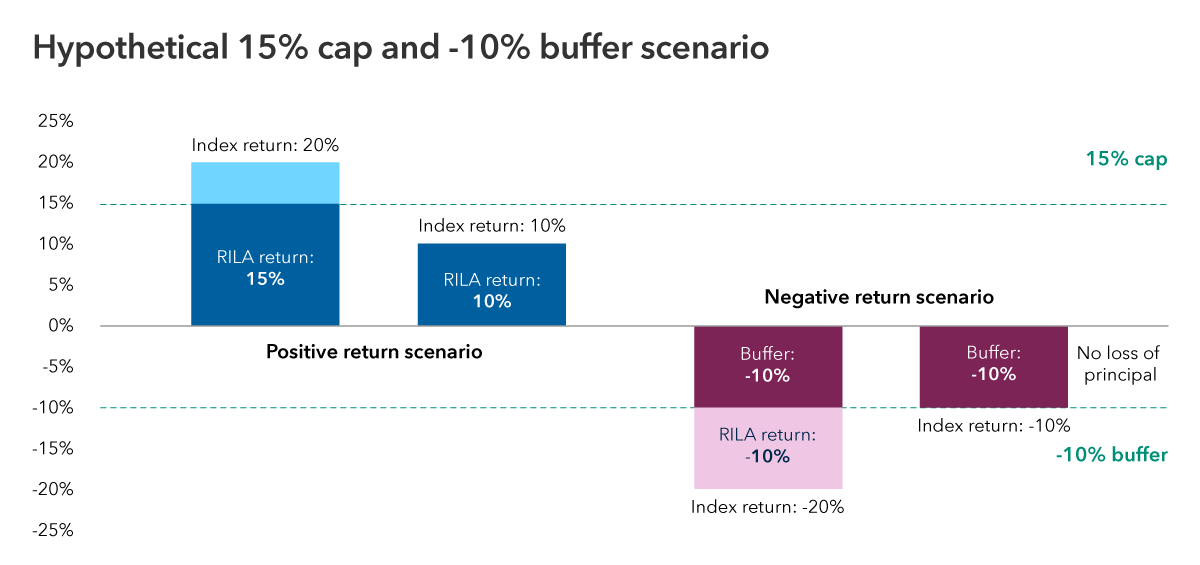
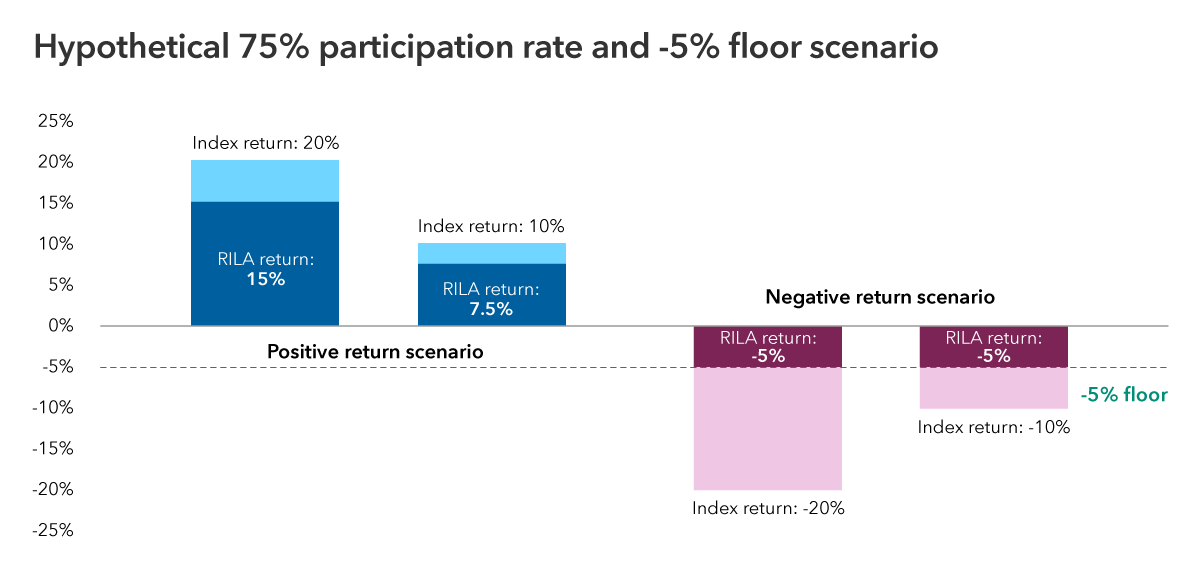
See the hypothetical scenarios

The cap and buffer scenario and the participation rate and floor scenario both offer flexible solutions for client goals.  

Cap and buffer scenario
Participation rate and floor scenario

Active strategies: A new frontier in RILAs

In 2024, Capital Group began partnering with insurance carriers to bring active management into the RILA space, linking strategies to actively managed mutual funds and ETFs. This gave investors, for the first time, access to active flexibility within a traditionally passive structure, with the potential to achieve outcomes beyond traditional index-linked returns.


Although many financial professionals were initially unfamiliar with active RILA strategies, once introduced they expressed strong interest. They see active strategies as tools to adapt quickly to market shifts, capture opportunities and enhance diversification, especially in volatile environments where static index strategies may fall short. As one financial professional put it, “They will be able to react a little quicker to market changes.”


Financial professionals emphasized that execution matters: These strategies must be offered by credible managers, add no unnecessary complexity or cost and clearly align with client goals. When those conditions are met, they view active RILAs as a win-win that can help clients pursue growth with protection, while enabling financial professionals to build more resilient, differentiated portfolios.


For more tools to help guide client conversations, see our building blocks framework and bucket strategy approach, which give pre-retirees and retirees tools to understand, quantify and prioritize retirement spending and legacy objectives.

*The RILA Seller’s report is based on in-depth conversations with 12 financial professionals across a wide range of client profiles, conducted in March and April 2025.

Kate Beattie is a senior retirement income strategist at Capital Group, home of American Funds. She has 18 years of industry experience. She also holds the Certified Financial Planner™ and Retirement Income Certified Professional® designations.

A registered index-linked annuity (RILA) is designed to offer tax-deferred growth potential and insurance components. The value of the RILA will fluctuate; it is subject to investment risk and possible loss of principal. Gains or losses are typically assessed at the end of each crediting term, which is usually one year or more. Surrender charges or early withdrawal fees could reduce the ending balance of the investment. All contract and rider guarantees, including those for optional benefits, payment from the indexed accounts, or annuity payout rates, are backed by the claims-paying ability of the issuing insurance company. They are not backed by any selling entity other than the issuing company affiliates, and none makes any representations or guarantees regarding the claims-paying ability of the issuer.


RILAs are not stock market investments and do not directly participate in any stock or equity investments. Therefore, no policyholder assets are held in the linked referenced investments and investors may not receive their full return. A RILA is not comparable to a direct investment in the linked referenced investments and dividends may not be paid.


Annuity investment options vary by insurer. Capital Group is not an annuity provider.


S&P 500 Index is a market capitalization-weighted index based on the results of approximately 500 widely held common stocks. The S&P 500 Index (“Index”) is a product of S&P Dow Jones Indices LLC and/or its affiliates and has been licensed for use by Capital Group.  Copyright © 2025 S&P Dow Jones Indices LLC, a division of S&P Global, and/or its affiliates. All rights reserved. Redistribution or reproduction in whole or in part is prohibited without written permission of S&P Dow Jones Indices LLC.

Investments are not FDIC-insured, nor are they deposits of or guaranteed by a bank or any other entity, so they may lose value.
Investors should carefully consider investment objectives, risks, charges and expenses. This and other important information is contained in the mutual fund prospectuses and summary prospectuses, which can be obtained from a financial professional and should be read carefully before investing.
Statements attributed to an individual represent the opinions of that individual as of the date published and do not necessarily reflect the opinions of Capital Group or its affiliates. This information is intended to highlight issues and should not be considered advice, an endorsement or a recommendation.
All Capital Group trademarks mentioned are owned by The Capital Group Companies, Inc., an affiliated company or fund. All other company and product names mentioned are the property of their respective companies.
Use of this website is intended for U.S. residents only. Use of this website and materials is also subject to approval by your home office.
Capital Client Group, Inc.
This content, developed by Capital Group, home of American Funds, should not be used as a primary basis for investment decisions and is not intended to serve as impartial investment or fiduciary advice.