

Many Americans are struggling financially, and that stress is affecting retirement plans. Record numbers of plan participants are dipping into retirement savings for emergency expenses such as medical bills and avoiding foreclosure/eviction, per data from Vanguard.
September 1, 2026
KEY TAKEAWAYS
- A rise in hardship withdrawals may indicate a lack of emergency savings among participants.
- Some employers offer emergency savings accounts as a benefit.
- Emergency savings accounts may help offset hardship withdrawals and keep assets in the plan.
In-service withdrawal trend
Vanguard defined contribution active participants in plans offering in-service withdrawals
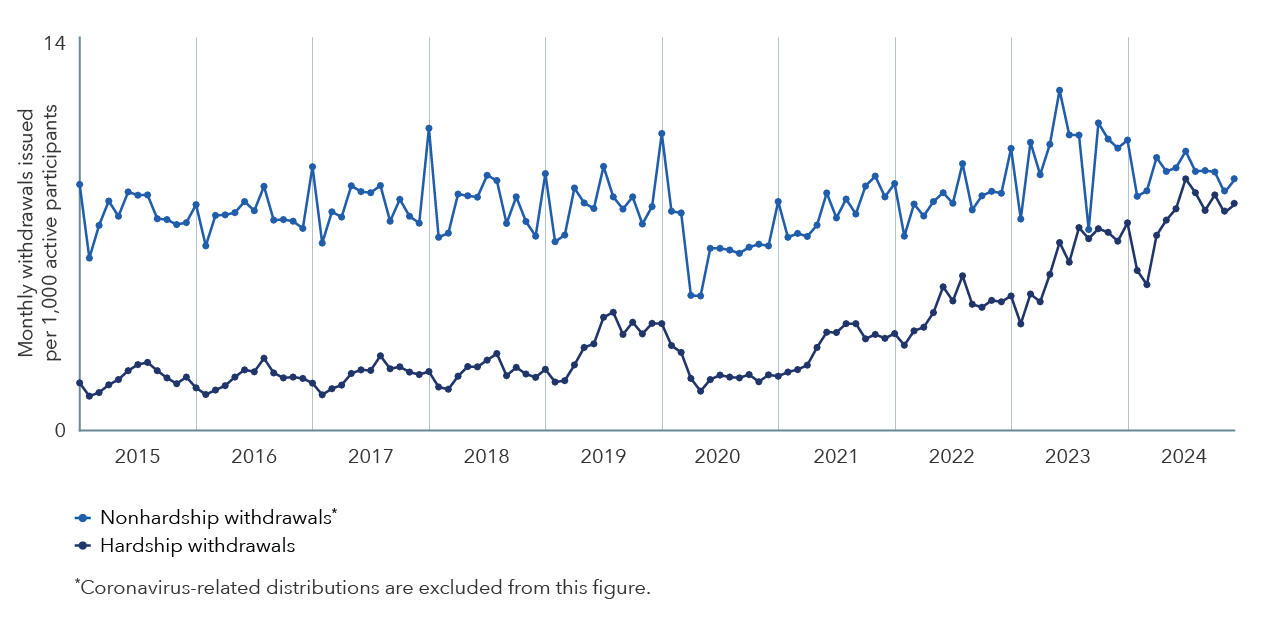
Source: Vanguard.
Following a dip in 2020, hardship withdrawals rose to new highs in 2024. This increase may indicate the absence of any other emergency savings for many plan participants, presuming that harsh tax penalties for early withdrawal would deter those who had other options.
Enter the ESA
To help combat this issue — and to keep assets in the plan — employers might consider adding an emergency savings account (ESA) to their benefits lineup. A recent study by BlackRock showed that 79% of participants said they would contribute to an emergency savings account, but only a third of their employers offered something.
Like a retirement account, an ESA benefit can offer employer matching to incentivize employees to save. The hope is that by helping employees prepare for the unexpected, more retirement assets will stay in the plan where they can mature as intended — a win for both the employer and the employee.
Link to retirement account not required
Lawmakers attempted to encourage this very idea by including an emergency savings provision in the SECURE 2.0 Act of 2022. These pension-linked ESAs (PLESAs) came with a number of limitations and complications, including strict contribution and withdrawal limits, that may have deterred employers from implementation.
Rather, some employers have begun offering ESAs that are not linked to retirement plans. These accounts have the benefit of unlimited contributions, access and withdrawals and offer companies freedom of customization.
Follow others’ examples
Large employers like Delta and Starbucks have partnered with banks and niche firms to offer payroll-deducted ESAs coupled with company matching and financial education. Some hallmarks of these plans include:
- Initiation bonus to incentivize account-opening
- After-tax contributions
- Employer matching contributions
- Financial education requirement to complete before withdrawal
- Debit cards for immediate access to funds
- Unrestricted participation (i.e., participation does not require eligibility for retirement plan)
Without the constraints of retirement regulations, each ESA can be modified to address the unique needs of each employer and its employees.
What you can do
A great first step would be to research banks and institutions offering ESAs. There are even companies like Rainy Day Fund or SecureSave whose sole purpose is to address this specific need.
Then look at hardship withdrawal trends in any plans for which you are responsible. Where there are increases, you may want to open a conversation with appropriate stakeholders about the value of keeping assets in the plan and whether an ESA could help achieve this goal.
While many factors influencing emergency withdrawals are outside employers’ control, offering an ESA may be a way to help mitigate their impact. Talk to plan sponsors about using ESAs to help keep retirement plan assets in the plan.

John Doyle is a senior retirement strategist with 39 years of investment industry experience (as of 12/31/2025). He holds an MBA from the F.W. Olin Graduate School of Business at Babson College and a bachelor’s degree in economics from Georgetown University.