Aerospace & Defense Final frontier: 6 opportunities in the space economy

Investor enthusiasm for space skyrocketed this spring when SpaceX launched its initial public offering (IPO) just weeks after NASA sent four astronauts to the far side of the moon.


SpaceX CEO Elon Musk characteristically fanned the flames, declaring that SpaceX will someday shuttle private citizens to the moon, Mars and beyond. The IPO quickly became the largest in history. With dreams of making money in a galaxy far, far away — or at least beyond earth’s atmosphere — investors also poured capital into a host of space-related ETFs.


Skeptics couldn’t be blamed for having doubts about tourism on Mars. But the space economy is no Jedi mind trick. It’s already generating real-world opportunities for astute investors.


“It would be a mistake to write this off as science fiction,” says Michael Beckwith, principal investment officer of AMCAP Fund®. “The declining cost of getting into orbit will expand some businesses and open doors to others unimaginable a couple years ago. Some will materialize quickly; others will take much longer.”


The question for investors: How do you distinguish between mere fantasy and tangible opportunities that can generate value before Halley’s Comet next flashes by?


Here are six opportunities for investing in the space economy.

Artificial Intelligence

Megatrends: From AI to space and beyond

Thursday, September 24 | 11 AM PT / 2 PM ET

CE credit available

1. Space is not one, but many markets

Space is not a single market, but a constellation of existing and potential markets.


The gateway to these opportunities is a space travel ecosystem that starts with rocket manufacturing and launch but also includes ground infrastructure and satellite development. This layer of infrastructure serves as a doorway to other businesses, such as satellite communications, Earth observation, logistics, navigation and defense systems.


“Most of the revenue opportunities are in these downstream businesses, not in launch,” explains equity analyst Andrei Muresianu, who covers U.S. telecom, cable and media companies.


Further cost reductions in launch make other businesses feasible, including the placement of AI data centers in space, which could happen in the next five to 10 years. Further down the road, companies are also exploring the potential for zero-gravity manufacturing, space travel and mining.


“Space may be like The New World when Europe explored it 500 years ago,” Muresianu adds. “First there was extraction and one-way trade, then colonization, manufacturing and eventually a self-sustaining society.”


In total, space represents a $630 billion economy and is expected to grow to $1.8 trillion by 2035, according to the World Economic Forum.

A snapshot of the space economy in 3 phases

A table illustrates a potential three-phase evolution of the space economy, from launches and connectivity to orbital computing and lunar exploration, ultimately leading to possible future applications including lunar manufacturing, orbital travel and Mars exploration.

Source: Capital Group. Timelines and examples are for illustrative purposes only and do not constitute forecasts, estimates or investment recommendations.

2. Launch costs are plummeting

Once rare and costly, rocket launches are now routine. SpaceX, which launched its 100th mission of 2026 in August, has dominated this area, accounting for 90% of the total payload taken into orbit, up from about 5% a decade ago.


State-sponsored efforts in China rank a distant second globally in terms of launch payloads. Other companies that have active programs include Rocket Lab, United Launch Alliance (ULA), Relativity Space and Blue Origin.


SpaceX has come to dominate the launch business by making rockets partly reusable. This breakthrough and other advances drove down the cost to reach low Earth orbit from $54,000 per kilogram in the days of the Space Shuttle to $2,700 per kilogram today. This kickstarted commercial opportunities previously economically unfeasible and spawned dozens of new companies.


SpaceX is now testing its next generation rocket, Starship, a fully reusable orbital launch system capable of carrying as much as 100 to 150 metric tons to low Earth orbit, versus about 23 tons for today’s Falcon 9 rocket.


“Starship could be the railroad to the next space economy,” Muresianu says.

The U.S. is the clear leader in tonnage launched into orbit

A line chart showing the annual number of objects launched into space by country from 1957 to 2025. The number of objects launched into space declined for decades before accelerating sharply in the 2010s, driven primarily by a surge in launches from the United States.

Sources: Capital Group, Our World in Data, United Nations Office for Outer Space Affairs. Objects defined as satellites, probes, landers, crewed spacecrafts and space station flight elements launched into Earth orbit or beyond.

3. AI in space is no longer science fiction

The pieces are already in place for orbital data centers to move from the realm of science fiction to reality.


Early demonstrations have shown that graphic processing units and other hardware can operate in orbit. And companies are beginning to test space-based inferencing and edge computing. To be sure, data centers in space still face challenges, including latency to Earth and the possible effects of radiation. But the key to making them commercially viable is driving down launch costs.


“Today’s economics make it difficult to launch large networks into space, but if Starship achieves its cost targets and payload capacity, orbital data centers could become a new layer of AI infrastructure,” Beckwith adds. “And space-based systems offer potential advantages compared with earthbound data centers.”


Data centers on Earth are becoming increasingly expensive as hyperscalers run into bottlenecks in the form of scarce land, power and cooling resources. They also face growing opposition from elected officials and local populations.


“In space, data centers could have access to abundant solar power, avoid competition for water and land, and face no community resistance,” says equity investment analyst Zach Alexander, who covers the U.S. aerospace and defense industries.

Falling launch costs could make AI in space economically feasible

A line chart depicts projected capital expenditures per megawatt for earth-based and space-based data centers from 2026 to 2040. Earth-based costs increase over time while space-based costs decline, with projected cost convergence around 2030 under an illustrative launch-cost reduction scenario.

Source: Capital Group analysis based on publicly available information, company disclosures, industry research and expert consultation. Terrestrial data center costs reflect estimated up-front capital expenditure (capex) required to develop one megawatt (MW) of data center capacity. Space-based data center costs reflect illustrative estimates based on assumptions regarding satellite construction, power and cooling requirements, launch economics, deployment scale and technological improvements. Analysis assumes commercialization of next generation heavy lift launch capabilities beginning in 2028. Figures shown are hypothetical, sensitive to underlying assumptions and intended solely to illustrate a potential scenario. Actual costs and deployment timelines may differ materially. As of August 31, 2026.

4. Satellite service is coming to your smartphone

Satellite connectivity has already emerged as one of the most promising growth markets in telecommunications. With more than 6,000 satellites in low Earth orbit, SpaceX’s Starlink dominates the sector. Other providers include Amazon Leo (formerly Project Kuiper), AST SpaceMobile and OneWeb. These networks are well suited to providing broadband service to rural regions, aircraft, ships and developing markets where infrastructure is expensive or impractical, but less competitive in more populous markets with extensive infrastructure.


Today satellite networks represent only a fraction of the multibillion-dollar global broadband market. Declining costs and advances in satellite development could help these companies expand their market share.


“Satellite broadband is already scaling rapidly and could become a roughly $40 billion market by 2030,” Muresianu adds. “But the game changer for satellite communications companies is direct-to-device (D2D) services that allow ordinary smartphones to connect directly to satellites.”


D2D connectivity is still early in its development, with commercial deployments only beginning. As next generation satellite constellations improve capacity, speed and coverage, satellite operators could capture a growing share of broadband and wireless markets.

Satellite networks account for a fraction of the potential broadband and mobile markets

A bar chart comparing SpaceX Connectivity segment revenue with its estimated total addressable market (TAM). Current broadband and mobile connectivity revenue is approximately $14 billion, while the estimated TAM is approximately $1.61 trillion, including $870 billion from broadband and $740 billion from mobile services. The chart highlights that current revenue represents less than 1% of the management estimated market opportunity. Trailing 12-month Connectivity segment revenue as of June 30, 2026, is shown in the bar on the left.

Sources: Capital Group, company reports. TAM (total addressable market) illustrates the addressable market opportunity of SpaceX's current and future products and services and is estimated by SpaceX management as of April 1, 2026. The SpaceX Connectivity segment operates a worldwide high-speed, low-latency broadband network powered by thousands of Starlink satellites in Low Earth Orbit (LEO), delivering connectivity to millions of consumer, enterprise and government customers through its Starlink offering. Trailing 12-month Connectivity segment revenue as of June 30, 2026, is shown in the bar on the left.

5. National security priorities will boost the space economy

Not since the Cold War has geopolitical competition been so focused on the stars.


The U.S., China and other governments increasingly view space-based defense systems as critical to national security. “It could very well be the key battlefield between superpowers,” Alexander says.


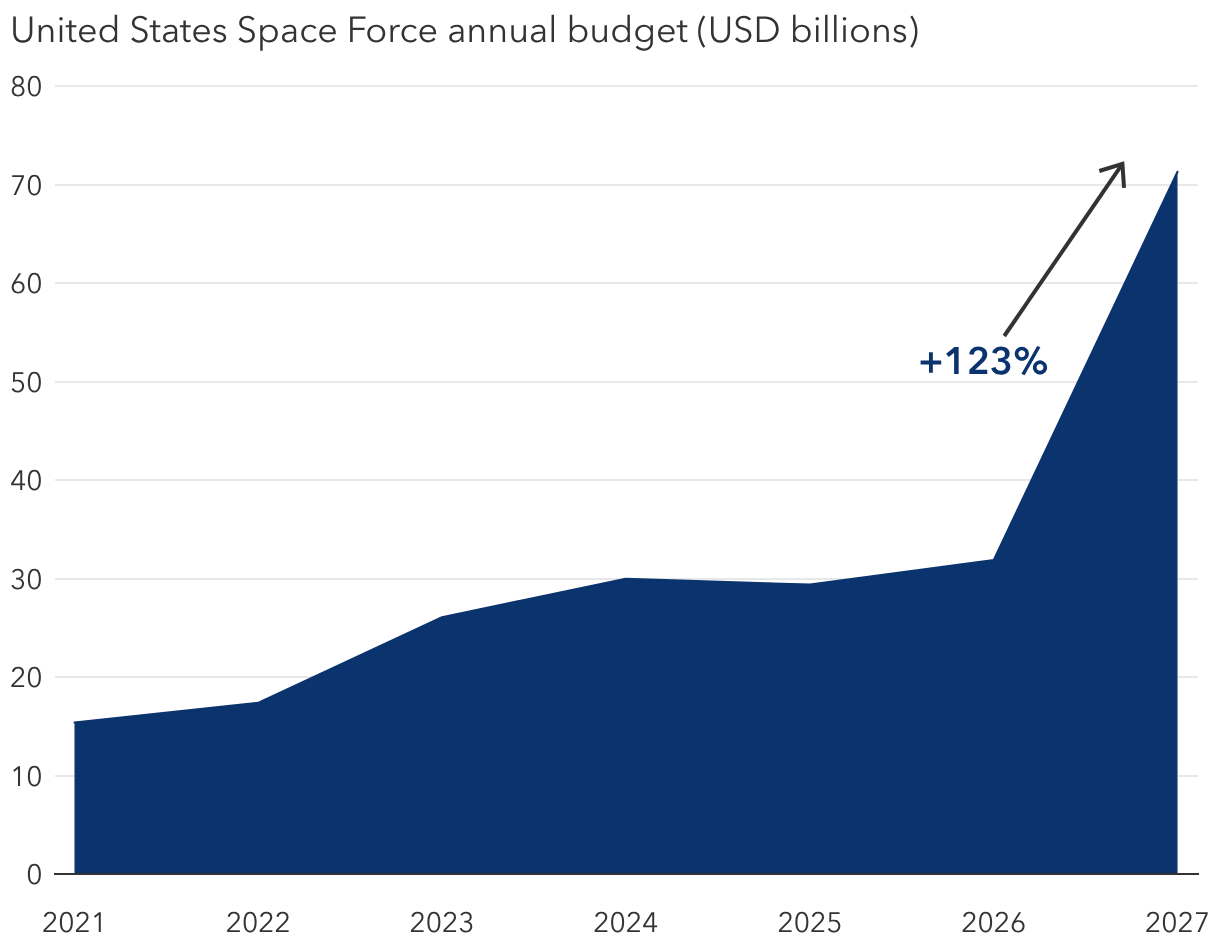
In the U.S., NASA has long-term plans to build a new space station as well as a permanent base on the Moon. And in August, SpaceX launched NASA’s $4 billion Nancy Grace Roman Space Telescope into orbit for cosmic exploration. Separately, the U.S. Space Force is seeking to double its budget to $70 billion in its fiscal 2027. Much will be invested in satellite communications, intelligence gathering, surveillance and navigation systems.


President Trump has also identified the Golden Dome missile defense system as a key priority for the remainder of his term. Golden Dome plans include upgrading missile tracking and response capabilities to advanced hypersonic missiles and other threats.


“The system is expected to rely heavily on space-based sensors, communications networks and potentially orbital interceptors,” Alexander explains. “This effort will involve a number of companies, including most major defense contractors.”


For example, in July the Space Development Agency awarded L3Harris a $955 million contract to build 18 missile-tracking satellites equipped with infrared sensors to detect and track hypersonic and ballistic missiles. Lockheed Martin, Northrop Grumman and RTX are among the companies developing space-based missile interceptors.

The Defense Department wants to double its Space Force budget in 2027

Sources: Capital Group, United States Air Force. Data represents regular appropriations for each fiscal year and does not reflect supplemental appropriations made due to any budget shortfalls. Figures for 2027 reflect the Air Force's latest budget proposal as of August 31, 2026.

6. Space manufacturing and travel aren’t out of the question

Zero-gravity manufacturing of cancer treatments and flights from San Francisco to Tokyo in under 45 minutes may sound outlandish, but as launch costs fall even further and orbit becomes more routine, they could become more feasible. And space offers unique physical conditions that cannot be replicated on Earth.


“Space has no dust or rain, heat radiates away, energy is free and unlimited, and waste disposal is a minimal expense,” Muresianu explains. “Microgravity changes how crystals form and fluid moves, transforming the way chips, fiber and pharmaceuticals are made, to name a few examples.”


But don’t expect these developments to take place in the next five or 10 years, Muresianu concludes. “I think it’s more realistic to think of these as opportunities in 10 to 30 years.”

Zach Alexander is an equity investment analyst with 11 years of investment industry experience (as of 12/31/25). He holds an MBA from Harvard and a bachelor’s degree in business administration and economics from the University of North Carolina at Chapel Hill.

Michael Beckwith is an equity portfolio manager with 27 years of investment industry experience (as of 12/31/2025). He holds a law degree from Harvard and a bachelor’s degree in history from Middlebury College.

Andrei Muresianu is an equity investment analyst with 21 years of investment industry experience (as of 12/31/2025). He holds an MBA from Harvard and a bachelor’s degree in business economics from Brown University.

Investments are not FDIC-insured, nor are they deposits of or guaranteed by a bank or any other entity, so they may lose value.
Investors should carefully consider investment objectives, risks, charges and expenses. This and other important information is contained in the fund prospectuses and/or summary prospectuses, which can be obtained from a financial professional and should be read carefully before investing.
Statements attributed to an individual represent the opinions of that individual as of the date published and do not necessarily reflect the opinions of Capital Group or its affiliates. This information is intended to highlight issues and should not be considered advice, an endorsement or a recommendation.
All Capital Group trademarks mentioned are owned by The Capital Group Companies, Inc., an affiliated company or fund. All other company and product names mentioned are the property of their respective companies.
Use of this website is intended for U.S. residents only. Use of our website and materials is subject to approval by your home office.
Capital Client Group, Inc.
This content, developed by Capital Group, home of American Funds, should not be used as a primary basis for investment decisions and is not intended to serve as impartial investment or fiduciary advice.