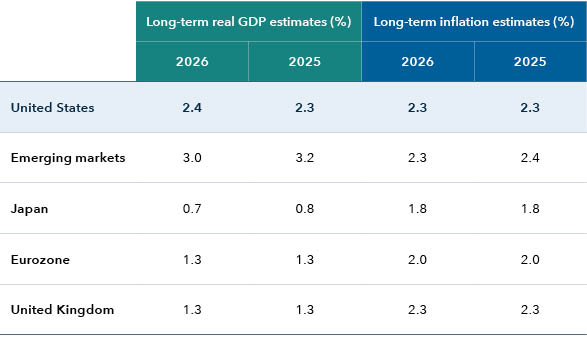
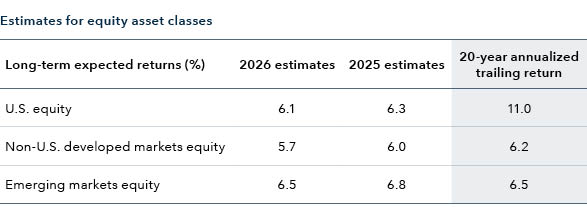
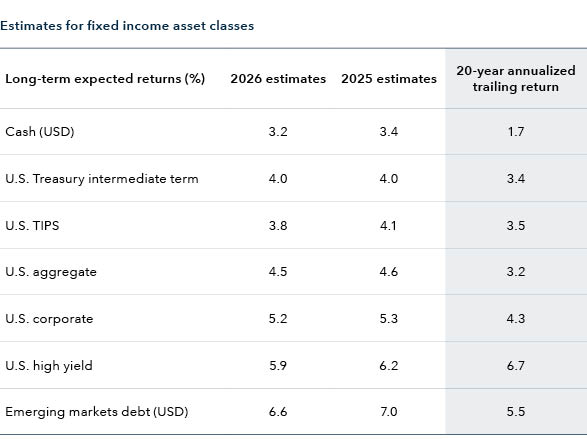
This analysis represents the views of a small group of investment professionals based on their individual research and are approved by the Capital Market Assumptions Oversight Committee. They should not be interpreted as the view of Capital Group as a whole. As Capital Group employs The Capital System™, the views of other individual analysts and portfolio managers may differ from those presented here. They are provided for informational purposes only and are not intended to provide any assurance or promise of actual returns. They reflect long term projections of asset class returns and are based on the respective benchmark indices, or other proxies, and therefore do not include any outperformance gain or loss that may result from active portfolio management. Note that the actual results will be affected by any adjustments to the mix of asset classes. All market forecasts are subject to a wide margin of error.
Past results are not predictive of results in future periods.
Bond ratings, which typically range from AAA/Aaa (highest) to D (lowest), are assigned by credit rating agencies such as Standard & Poor’s, Moody’s and/or Fitch, as an indication of an issuer’s creditworthiness. If agency ratings differ, the security will be considered to have received the highest of those ratings, consistent with the fund’s investment policies.
Lower rated bonds are subject to greater fluctuations in value and risk of loss of income and principal than higher rated bonds.
Glossary:
Capital market assumptions (CMAs): Long-term projections of the future performance of asset class returns based on their respective benchmark indexes or other proxies that incorporate analysis and observations.
Consumer Price Index (CPI): A measure of the average change over time in the prices paid by urban consumers for a market basket of consumer goods and services.
Duration: The measurement of the sensitivity of the price of a bond or debt instrument to the change in interest rates. The higher the duration, the more a bond’s price will drop as interest rates rise, and the greater the interest rate risk.
Geometric return: Also known as the compound annual growth rate (CAGR), it is a measure of compound growth rates of investment results over multiple periods.
Multiple: A way of assessing the value of a company by comparing it to peers, usually by a ratio. This helps to quantify a company's health and find investment opportunities.
Terminal yield: The value of a debt asset beyond the forecasted period when future cash flows can be estimated. In our analysis, terminal yield occurs in year 10 and stays the same for years 11 through 20.
Term premium: The additional yield investors require for holding long-term bonds as opposed to owning a series of shorter term bonds.
Volatility: The degree of variation in the price of a financial instrument over time, usually measured by standard deviation or variance.
Yield curve: An illustration of the yields on similar bonds across various maturities. An inverted yield curve occurs when yields on short-term bonds are higher than yields on long-term bonds. Yield curve steepening occurs when long-term rates rise more than short-term rates, or short-term rates fall more than long-term rates.
Index definitions:
All-country world equity: The MSCI All Country World Index (ACWI) is a free-float-adjusted, market-capitalization-weighted index that measures equity market results in global developed and emerging markets, consisting of more than 40 developed and emerging markets country indexes.
All-country world small-cap equity: The MSCI All Country World Small Cap Index is a free-float-adjusted, market-capitalization-weighted index that measures equity market results of smaller capitalization companies in both developed and emerging markets. Results reflect dividends net of withholding taxes.
Asset-backed securities (ex AAA): The Bloomberg Asset-Backed Securities Index (ex AAA) covers fixed-rated investment-grade (Baa3/BBB or higher, excluding Aaa/AAA) asset-backed securities included in the Bloomberg U.S. Aggregate Index. The index has three subsectors: credit and charge cards, autos and utilities.
Cash (USD): The FTSE 3-Month U.S. T-Bill Index Series tracks the daily performance of 3-month U.S. Treasury bills and serves as a reference rate for a series of funds.
Developed markets equity: The MSCI World Index is a free-float-adjusted, market-capitalization-weighted index that measures equity market results in global developed markets, consisting of 23 developed market country indexes.
Emerging markets debt (USD): The J.P. Morgan Emerging Markets Bond Index (EMBI) Global Diversified is a weighted emerging markets debt benchmark tracking total returns for USD-denominated bonds issued by emerging markets sovereign and quasi-sovereign entities.
Emerging markets debt (local): The J.P. Morgan Government Bond Index — Emerging Markets (GBIEM) Global Diversified covers regularly traded, liquid, fixed-rate, domestic-currency emerging markets government bonds accessible to international investors.
Emerging markets equity: The MSCI Emerging Markets Index is a free-float-adjusted, market-capitalization index measuring equity performance of emerging markets.
Global aggregate: The Bloomberg Global Aggregate Bond Index measures global investment-grade bonds, including Treasury, government-related, corporate and securitized fixed-rate bonds from both developed and emerging markets issuers.
Municipal bonds: The Bloomberg Municipal Bond Index is a market-value-weighted index representing the long-term investment-grade tax-exempt bond market.
Nikkei 225: A price-weighted index covering 225 large Japan-based companies.
Non-U.S. developed markets equity: The MSCI World ex USA Index is a free-float-adjusted, market-capitalization-weighted index measuring equity results in developed markets excluding the U.S., consisting of 22 of 23 developed markets country indexes.
Non-U.S. global aggregate: The Bloomberg Global Aggregate ex-USD Index measures global investment-grade bonds excluding the U.S., spanning Treasury, government-related, corporate and securitized fixed-rate bonds from developed and emerging markets issuers.
The S&P 500 Index: A market-capitalization-weighted index based on the results of approximately 500 widely held U.S. common stocks.
U.S. agency mortgage-backed securities: The Bloomberg U.S. Mortgage-Backed Securities Index is a market-value-weighted index covering fixed-rate, publicly issued, dollar-denominated obligations from U.S. Treasury, agencies, quasi-federal corporations, and mortgage-backed pass-through securities of Fannie Mae, Freddie Mac and Ginnie Mae.
U.S. aggregate: The Bloomberg U.S. Aggregate Bond Index represents the U.S. investment-grade fixed-rate bond market.
U.S. commercial mortgage-backed securities non-agency (ex AAA): The Bloomberg U.S. CMBS Non-Agency Ex-AAA Index measures the non-agency U.S. commercial mortgage-backed fixed income market, excluding AAA-rated issues.
U.S. corporate: The Bloomberg U.S. Corporate Investment Grade Index represents investment-grade, publicly issued U.S. corporate and specified international debentures and secured notes meeting defined maturity, liquidity and quality standards.
U.S. corporate long duration: The Bloomberg U.S. Long Corporate A or Better Index (1% Issuer Cap) tracks high-quality, long-maturity U.S. corporate bonds rated A or better, with no single issuer exceeding 1% of the index.
U.S. equity: The MSCI USA Index is a free-float-adjusted, market-capitalization-weighted index measuring the U.S. portion of the global equity market. Results reflect dividends gross of withholding taxes.
U.S. high yield: The Bloomberg U.S. Corporate High Yield Index 2% Issuer Cap covers fixed-rate, non-investment-grade debt, capping exposure to any single issuer at 2%.
U.S. small-cap equity: The MSCI USA Small Cap Index is a free-float-adjusted, market-capitalization-weighted index measuring the small-cap segment of the U.S. market.
U.S. TIPS: The Bloomberg U.S. Treasury Inflation-Protected Securities (TIPS) Index includes investment-grade, fixed-rate, USD-denominated, non-convertible inflation-protected securities issued by the U.S. Treasury with at least one year to maturity and $250 million minimum par outstanding.
U.S. Treasury short term: The Bloomberg 1-5 Year U.S. Treasury Index measures USD-denominated, fixed-rate, nominal U.S. Treasury debt with maturities from one to five years.
U.S. Treasury intermediate term: The Bloomberg 5-10 Year U.S. Treasury Index measures USD-denominated, fixed-rate, nominal U.S. Treasury debt with maturities from five to ten years.
U.S. Treasury long term: The Bloomberg 10–20 Year U.S. Treasury Index measures USD-denominated, fixed-rate, nominal U.S. Treasury debt with maturities of 10 to 20 years. The Bloomberg 20+ Year U.S. Treasury Index measures USD-denominated, fixed-rate, nominal U.S. Treasury debt with maturities of 20 years or more.