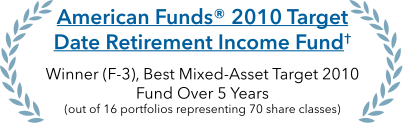



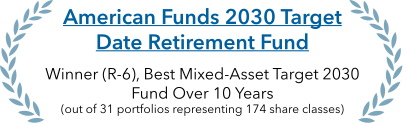
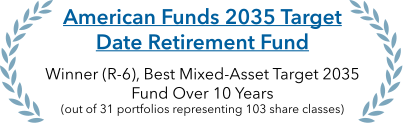

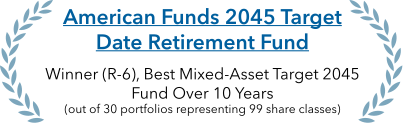

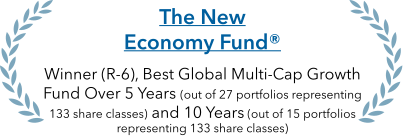
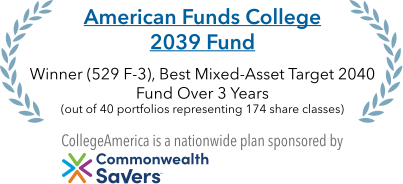


INVESTMENTS 11 Capital Group funds win LSEG Lipper Fund Awards

OUR WINNING FUNDS

LSEG Lipper Fund Awards 2026 U.S.*

For periods ended November 30, 2025. Click the name of each fund for more information.

LSEG Lipper Fund Awards Logo

About the award

The LSEG Lipper Fund Awards, granted annually, highlight funds and fund companies that have excelled in delivering 
 consistently strong risk-adjusted performance relative to their peers. The LSEG Lipper Fund Awards are based on the Lipper Leader for Consistent Return rating, which is a risk-adjusted performance measure calculated over 36, 60 and 120 months. The fund with the highest Lipper Leader for Consistent Return (Effective Return) value in each eligible classification wins the LSEG Lipper Fund Award. Lipper Ratings for Consistent Return are based on the Effective Return computation and reflect funds’ historical risk-adjusted returns, relative to peers.


For more information, visit LSEG’s Lipper Fund Awards webpage. Although LSEG makes reasonable efforts to ensure the accuracy and reliability of the data contained herein, the accuracy is not guaranteed by LSEG Lipper. Past results are not predictive of results in future periods.

INVESTMENTS & THOUGHT LEADERSHIP

Information for informed decisions

Get to know target date funds

Footnotes/Important information:


* Source: LSEG Lipper Fund Awards, awarded March 12, 2026. LSEG Lipper Fund Awards, ©2026 LSEG. All rights reserved. Used under license. Criteria: Funds registered for sale in the U.S. as of the end of the calendar year of the respective evaluation year. At least 36 months of performance history as of the end of the calendar year of the respective evaluation year. U.S. Mutual Fund classifications with at least 10 distinct portfolios based on the primary share class definition. U.S. local classifications are used in the United States, rather than Lipper Global classifications. Institutional funds are included in the universe of eligible funds. The following are excluded: residual classifications, institutional and other non-retail funds; private, closed-end, exchangetraded, insurance, linked, and closed funds; S&P 500 and S&P Midcap 400 Index funds; equity leverage funds; specialty diversified equity funds; specialty fixed income funds; specialty/ miscellaneous funds; other states municipal debt, intermediate municipal debt and short/intermediate municipal debt funds. Some funds may be excluded from award consideration if, in the opinion of LSEG Lipper’s Research staff, the portfolio has undergone too many classification changes or changed classifications recently. Lipper ratings do not take into account the effects of sales charges.


Only one share class (the one with the best Lipper Leader score) is used for each portfolio in determining asset class and overall awards. The calculation periods are through the end of November of the respective evaluation year. The currency for the calculation corresponds to the currency of the country for which the awards are calculated and relies on monthly data. Classification averages are calculated with all eligible share classes for each eligible classification. For a detailed explanation, please review the Lipper Leader Methodology Document.


Effective January 1, 2026, American Funds 2010 Target Date Retirement Fund was renamed American Funds 2010 Target Date Retirement Income Fund; American Funds 2015 Target Date Retirement Fund was renamed American Funds 2015 Target Date Retirement Income Fund; American Funds 2020 Target Date Retirement Fund was renamed American Funds 2020 Target Date Retirement Income Fund; and American Funds 2025 Target Date Retirement Fund was renamed American Funds 2025 Target Date Retirement Income Fund.

Investments are not FDIC-insured, nor are they deposits of or guaranteed by a bank or any other entity, so they may lose value.
Investors should carefully consider investment objectives, risks, charges and expenses. This and other important information is contained in the mutual fund prospectuses and summary prospectuses, which can be obtained from a financial professional and should be read carefully before investing.
Investments in mortgage-related securities involve additional risks, such as prepayment risk.
The use of derivatives involves a variety of risks, which may be different from, or greater than, the risks associated with investing in traditional securities, such as stocks and bonds.
Interests in Capital Group's U.S. Government Securities portfolios are not guaranteed by the U.S. government.
Lower rated bonds are subject to greater fluctuations in value and risk of loss of income and principal than higher rated bonds.
The return of principal for bond portfolios and portfolios with significant underlying bond holdings is not guaranteed. Investments are subject to the same interest rate, inflation and credit risks associated with the underlying bond holdings.
While not directly correlated to changes in interest rates, the values of inflation-linked bonds generally fluctuate in response to changes in real interest rates and may experience greater losses than other debt securities with similar durations.
Investing outside the United States involves risks, such as currency fluctuations, periods of illiquidity and price volatility. These risks may be heightened in connection with investments in developing countries.
Smaller company stocks entail additional risks, and they can fluctuate in price more than larger company stocks.
Allocations may not achieve investment objectives. The portfolios' risks are related to the risks of the underlying funds as described herein, in proportion to their allocations.
Although the target date portfolios are managed for investors on a projected retirement date time frame, the allocation strategy does not guarantee that investors' retirement goals will be met. Investment professionals manage the portfolio, moving it from a more growth-oriented strategy to a more income-oriented focus as the target date gets closer. The target date is the year that corresponds roughly to the year in which an investor is assumed to retire and begin taking withdrawals. Investment professionals continue to manage each portfolio for approximately 30 years after it reaches its target date. Investment professionals gradually adjust a college target date portfolio over time so that it becomes more preservation-oriented. The target date is the year that corresponds roughly to the year in which the beneficiary is expected to begin taking withdrawals. The allocation strategy does not guarantee that investors' education savings goals will be met. Investors and their financial professionals should periodically evaluate their investment to determine whether it continues to meet their needs.
All Capital Group trademarks mentioned are owned by The Capital Group Companies, Inc., an affiliated company or fund. All other company and product names mentioned are the property of their respective companies.
Use of this website is intended for U.S. residents only. Use of this website and materials is also subject to approval by your home office.
Capital Client Group, Inc.
This content, developed by Capital Group, home of American Funds, should not be used as a primary basis for investment decisions and is not intended to serve as impartial investment or fiduciary advice.