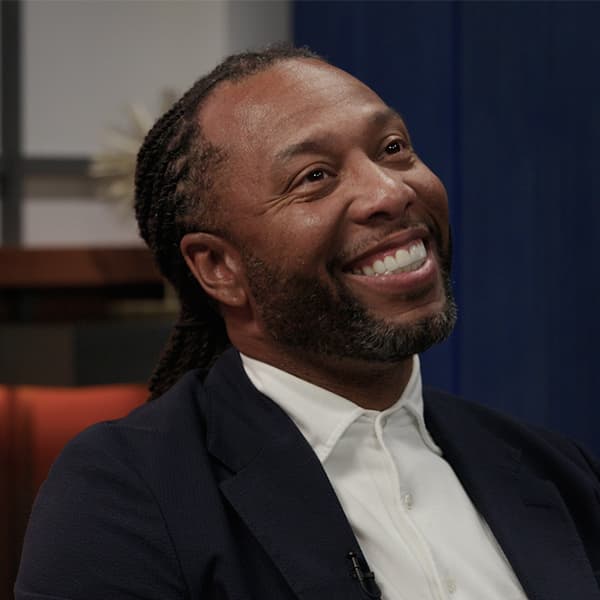
Shaun Tucker: Welcome everyone. On behalf of all of us here at Capital Group, I just wanna welcome you to a very special conversation that we're gonna have today. We're calling it "The Leadership Roundtable." I am so grateful to be joined by two incredible guests who have spent their entire careers performing in the most elite of environments, under intense pressure, and delivering outstanding results all the while. Our industry strives for that. We crave learning from superlative people like both of these individuals.
To my left is Larry Fitzgerald. Larry is an absolute legend. He's one of the most respected players in the NFL, in its history. He's a recent inductee into the Pro Football Hall of Fame. And his career was defined by a number of attributes, not the least of which was his exceptional performance, but the consistency. And probably most important to him is the character, and of course his leadership.
Next to him is my good friend, Jonathan Wilson. Jonathan's a veteran Navy SEAL, and after his time in the service, we've been lucky enough to have him come aboard here at Capital Group. He serves as an advisor practice management consultant, and also as an executive coach. Jonathan helps leaders understand how to prepare, execute, and grow through challenges. And just as a former Navy guy myself thinking about Jonathan's 16 years of service as a U.S. Navy SEAL, he's an absolute hero. And so, gentlemen, it's just a privilege having you guys. We're gonna unpack your experiences in your life, whether it's on the battlefield, Jonathan, or on the athletic field, Larry, and translate all that into how our advisors that we work with can use this to better lead their teams, support their businesses and help us at Capital with our collective mission of improving people's lives through successful investing.
Leadership is one of those topics that we need to talk about and we don't spend enough time talking about and practicing. And, and I think we can all agree, leadership is the absolute unlock to the potential of not just individuals, but of teams. It's important to develop your own authentic leadership style. It's important to set the tone. It's important to create an environment for your team, where they can realize their fullest potential.
Larry, I'm gonna start with you. What is your leadership style? How do you show up as a leader? And then, is there any one right style in the business environment or can there be multiples?
Larry Fitzgerald: Yeah. I mean, I don't think there is a right leadership style. I think there's an effective leadership style based on the people you're trying to lead. When I was on my team, you have 53 different people from 53 different cities, 53 different, family histories, different objectives, contract length, number of kids, races, religions. You have so many different factors that you're taking into account. And so, everybody needs a little bit different, right? And so, I never take the one-size-fits-all approach. I did a lot of work early on in the off season, try to get to know guys. And in our profession, you know, teams turn over in terms of percentage-wise, between 20 and 40% a year, depending on if there's a coaching change and a coach comes in and he says, you know, "I wanna run a three, four defense versus a four three." Like the defense looks very different in terms of the personnel and same thing on offense. And so, teams change a lot. Um, and so, you know, what worked for the team last year doesn't necessarily work for the team this year.
And, uh, you know, being able to get rookies on the same page and into the culture and understand the dos and the don'ts and why we do it this way, why we've done it this way, or why we need to change it, because, it was ineffective last year, you know, I think all of those things, you know, can be adjusted. And so, I never was into this rigid mindset of, this is the way it is, this is the way it's always been. You know, every team is very different. And I think, our best teams have been, where accountability's high, attention to detail is high, and guy's ability to sacrifice was high. Leadership is definitely different for me now in corporate. In football, I would say, 100% of the people are intrinsically motivated to be great. They've always been the best. They were the best in little league. They were the best in high school. They were the best in college. And they might not be the best in p- in the pros, but their mind, they think that they're the best.
And they're willing to do what they need to do to be the best. And so, it's very different leading that mindset of a person, right? And when you get to corporate, like you see people and it gets to, it gets to about 4:30 in the afternoon and you start seeing laptops closing and dinner reservations are being made. And it, it's just, I'm not saying people don't care the same, but the buy-in is a little bit different.
You know, when you're in SEAL team or, or you're on a football team, like, your, your entire persona is wrapped up into, into this, right? And when you don't play well and you're at dinner with your significant other, or you're picking up your kids from football practice, people like, "Fitz, y'all sucked yesterday. And like, you destroyed my fantasy team and you need to be better." Like, that doesn't happen, you know, if you're, (laughs), if you're working, you know, at another corporate job. When you go home and you're at dinner, like, you're not bringing the work. The care factor is the one that I struggle with a little bit. It doesn't matter for me how long it takes me to do the job, as long as the job gets done and it gets done well. I've had to adjust a lot myself, you know, in terms of, understanding where people's thresholds are too.
Understanding who, who you can push, who you need to put your arm around who needs a little vacation, needs some time off, you know, don't contact them for the weekend, you know, things of that nature. And I've gotten better with that myself.
Shaun Tucker: I love that lesson learned. It's so powerful. Know your people, understand their motivations, adjust your style accordingly. I think that makes a ton of sense, and that's what great leaders do. I was a one-dimensional leader coming from the Navy, moving into corporate life because I didn't understand the differences in motivations of different types of people, and I needed to learn that agility. Jonathan, a question for you. In the military, in the Navy especially, we talk about something called command climate. And really, it's just a question about the environment that a leader creates, to get the best out of their people. Talk about why that's so important, whether it's the SEAL teams or just generally in terms of, leadership and really kind of getting your people to, to maximize their potential and perform incredibly well.
Jonathan Wilson: Yeah, that's a great question. I do have to just say, as you were talking, Larry, in my head, I'm just like ditto. Exact same thing that happened to SEAL teams. Some of the best leaders, everything you were saying, like, the accountability, that purpose, everybody's driven with that same mission. First and foremost, everybody's a leader on the battlefield. We set the tone out of the gate. everybody felt that empowerment, felt that they were empowered by the leadership to take action within this framework that we created. That command climate was really important because it created that clear picture of, what is our mission? What's our objective? What's our roles and responsibilities? We needed that clarity. But again, once it was set, I knew what my job was. I knew what my role was, achieving this mission. And oh, by the way, I knew what my teammate was gonna do unequivocally, because we prepped so much.
It created trust within that team. I knew what was going on. My teammate knew what I was gonna do. We knew what our job was. If we made a mistake, oh, by the way, and we all make mistakes, it was okay to make a mistake. We created a system that allowed us to identify how to improve so we never make that mistake again. Command climate really set the tone for our training, and then set the tone for, for the deployments.
Shaun Tucker: Given what you said about knowing your people, having agility, adjusting your style, you just said about setting the tone, making sure everyone knows their role, and they're feeling empowered to do it. Can you each just share with me, who's the leader that personified that in your experience?
Larry Fitzgerald: I had a wonderful coach in, in college by the name of J.D. Brookhart. He was my receiver coach. And I was a pretty raw kid coming to school, physical attributes, but not refined. And the way he would tell me things or get things across to me and how, and how he was able to convey it to me always, like, resonated. So I’ll give you an example. I remember I was, I was in training camp my freshman year. I was showing a lot of promise, really getting better. I caught a pass, I was running it up, and I fumbled the football. And obviously, it's a cardinal sin as an offensive player to do that. And he didn't yell at me, he just put his arm around me. He said, "Larry, you don't love Jojo, huh?" And I looked at him, I was like, "What, what do you mean?" And that was his son. I said, "What are you talking about? We, we were playing on the field yesterday after practice." He said, "You, you can't though." And I said, "Why would you say that?" He said, "Larry, when you're carrying that football, you're not just carrying your destiny. But if you are putting that ball on the ground, I'm gonna lose my job and he's not gonna eat." And so, he made it bigger than just me individually. It wasn't just me fumbling. I was putting the university, I was putting the community, our fans, my coaching staff, and teammates, all in jeopardy, because of my inability to do my job.
And so, when he made it big like that to me, I never did it again in college. And I only think I did it, you know, six times or seven times in my entire playing career because that message that he gave me at 18 years old was so impactful. And like, that's leadership to me. Like, if he'd have told me, "Larry, you idiot. I told you not to do it," it would not have, it would not have had the same impact on me psychologically. 'Cause now every time I've carried that football, I'm thinking about my coach's kids. I'm thinking about my teammates' families. And I'm thinking about all of those things. I'm carrying our, our, our destiny in our hands. And so, that's just one example of a coach taking a position of leadership and being able to teach me a lesson by how he's able to frame it for me.
Shaun Tucker: Oh, that's an awesome example. And connecting folks to the mission, I also can't help but think about your acceptance speech. And what you said to your sons about making sure that they surround themselves by people that tell them what they need to hear, not what they wanna hear. And that sounds like a powerful moment for you. And that sounds like a powerful moment for you.
Larry Fitzgerald: Yeah, I think it's really important, especially even more so today, is because of the information that we get.
I mean, you open your phone and you go on IG or, or X or TikTok, it only feeds you the information that the algorithm has noticed that you like. So if you like cooking you're gonna get a bunch of cooking shows. So, that essentially, it is giving you only what you want, you know? And I just think that's pretty dangerous. You know, I think it's, it's a great governor to be able to know that people around you are gonna tell you the truth. Unequivocally. I don't care how successful you are, what you've accomplished. "Oh, he's got four Super Bowls, or he's a platoon leader." It doesn't matter. You need to be told the truth. And because, like, I think in life, having somebody hold a mirror up to you, it truly holds you accountable and it lets the people around you know that you're willing to be held accountable also.
Shaun Tucker: Yeah. I mean, there's a theme here. It's about, not just knowing your people, but caring about them so much that you're willing to stand in truth and give them what they need to hear to develop to their fullest. What about you, Jonathan? Who stands out and why?
Jonathan Wilson: So there's two. Uh, the first one, I was a new guy in the team, so brand new. We're deploying to Iraq. And my boss was Commander Bourgeois, from Louisiana, of course. And you know, we were extremely busy. We were doing ops almost every single night. And we would get back and we would be cleaning our weapons, cleaning the vehicles. And Commander Bourgeois, despite the fact that he had everything else to do from an admin standpoint, was in there with us, cleaning weapons, cleaning the vehicles. He didn't have to do that, but he brought it down to this level of just being humble. Like, "Hey, I'm, I'm one of you. I'm gonna, I'm gonna stand side by side with you. Because I know when we're gonna get shot at, that you're gonna be able to trust me." And for me, when I saw that, I was like, "I trust him unequivocally. From this point on, anything that man wants." He knew everybody's name. Not just the SEAL teams, that's, you know, there's 30 or so folks in a platoon. He knew everybody that supported the SEAL teams by name. And that was a trait that I just respected and never forgot. He can go around a room and, and name everybody. And oh, by the way, you know, their family members, birthdays, graduations. And I was just like, to me, that was a true leader. The other one is Jeremy Wise. Jeremy was the first one that was killed overseas.
He was alongside us, one of the new guys. Shots are getting fired, bombs are going off. And you would just hear him, the comms come up, and you would think it would be a, a maneuvering, you know, we're doing something and we're taking threats. And he would just drop like a joke over the comms, in the middle of a gunfight, and it just brought everybody down. It just, it's what we needed because, all the new guys were stressed to the max. They didn't know what the, what was going on. It was their first couple missions. And he was able just to take it down to just, "Hey, we gotta do our jobs. We know what we're here to do. We've trained for this. Oh, by the way, maybe just drop a joke in there so we can try to have some fun," right? So, I really appreciate that. Those are two, some of the biggest lessons learned from two of the most amazing men I've ever met in my life.
Shaun Tucker: Oh, thank you. Thank you both 'cause they're incredibly powerful. I'm gonna stay on this thread just of great leadership, 'cause we wanna really try to define it for our audience. Where was a scenario where true leadership stood out as the reason that you were successful instead of failing?
Jonathan Wilson: What comes to my head is when a leader recognized that they had to step back and let the team run because there’s a team full of talented individuals. They've prepped, they've trained. Everybody knows their roles and responsibilities. And then that person became the bottleneck and they recognized that. When they recognized that and were able to step back, create the trust, up and down the chain of command, by the way, to just step back and let it run, that's when the magic happened. You know, it's, it's a scary thing to just say, "Hey, I'm running this organization” or “I'm running this advisory practice, and I'm hiring all these people." If you've done your job and you've empowered them and you know your troops or the folks that you've hired, and you've created this system and you can just take a step back, I promise you, just stand by and watch the magic, 'cause you've created it.
Larry Fitzgerald: That's awesome.
Shaun Tucker: Larry?
Jonathan Wilson: Top that, Larry.
Larry Fitzgerald: (laughing) Analytics has really proliferated in our sport. Like, a lot of these decisions are made based on numbers and algorithms, right? And I always appreciate it when you can go to a coach and say, "Yes, I know what you, what you're thinking and what the numbers tell you, but I, but I believe, based on us playing the, the last two quarters, this is something that we need to do." Right? And having the, the humbleness to be able to take input from somebody who's n- who is not a peer, um, and not take it personally, right? I remember we played against the Detroit Lions some years ago when we really wanted to run an up tempo. They had big offensive linemen who were a little bit slower. We wanna tire them out by tempo-ing them up. And it just wasn't working for the first three series. It was three and out, three and out, three and out. And I was like, "Coach, listen, man, I know we, we game plan it this way the entire week and they're big and physical, but let's get in the huddle and get to some of the basics that we do." And first he ripped my ass. He's like, "We practiced all week about this and this is what we're gonna do. I don't care what they're doing. This is what we're gonna do."
You know, like, he... he dug his heels in. And I say, "I understand that. Let's try it this one way and if it doesn't work, we'll do it the way you wanna do it." And he said, "You better do it right." We end up going down the field, like seven play drive, scored a touchdown. Coming to the sideline, he didn't even look, he didn't even look at me. (laughs) I go sit down and he comes over to me and he wraps his arm around me, say, "I love you, Fitzi. I love you. Thank you. We, we really needed that." And so, like, I just always really appreciated, like, great leadership is also, like, a humbleness. And your ability to also know where you're fallible too and, and where your blind spots are and, and allowing other people to kind of pour into you, that's a really strong characteristic of leadership that I think is not often talked about.
Shaun Tucker: I love what you both just said. One is trust your people and empower them, right? And listen to them when they have something constructive to say or a better idea. They're the repository of all the great ideas.
Larry Fitzgerald: Yeah. I think, I think it's really important to, you know, know what you don't know, um, and finding the answers that you need to find.
Shaun Tucker: How do you adjust your approach and your style to be effective in a completely different environment? How do you make that pivot? And how do you show up differently as a leader? And did you put yourself under tons of pressure to be great right away?
Larry Fitzgerald: Finance was a very new, you know, frontier for me in 2013 when I first got into it. But one of my mentors, uh, a man by the name of John Kim, said something to me that money moves at the speed of trust. (Laughs) And, um, when people trust you, who you are, how you operate, transparency, those things, people actually move at a faster, at a faster rate with you. That's what I really try to make sure that I'm, I'm on point. I have the answers to the questions. I anticipate where the ball is going, uh, where the puck is going.
Those are some of the skill sets I think that are really, really important to be able to help you, um, not only lead individuals, but, you know, have LPs trust you, have founders trust you, um, you know, with their hard-earned capital and the businesses that you're trying to support. So, if you're willing to do the work when people are always willing to take the shortcuts, you know there's not much traffic on the extra mile in life. (laughs) And, and if you're willing just to do it a little bit of extra, like, you will run circles around most people.
Jonathan Wilson: So, you talk about having to be humble after, like, being at the peak and, you know, I'll speak just to folks that have similar experiences coming out of a, a job where they, they found a lot of success and they're starting over. Eat that humble pie. Just, your work ethic will get you to where you're headed. It's gonna take a few years, but you'll get there. Just trust the process, trust the system. Don't worry about starting over from the bottom because you're gonna be at the top pretty soon if that's what your ambitions are.
Shaun Tucker: I think both of those stories just talked about the portability of the systems you've put in place. The discipline, how you did your homework, how you thirsted for knowledge and how you attacked success were absolutely portable. And I think that's one of the themes just about leadership is that what works in one industry can absolutely transition to being effective in another. So to be encouraged by that, I think that's a really important one. Can I shift gears just as we're clicking through different attributes of great leadership?
Let's talk about failure and how you overcome that. And in particular, how does a leader, how should a leader respond to when things don't go well? So much of the measure of the effectiveness of a leader is how they show up in adversity, when things go wrong. And how do you set a positive attitude?
Larry Fitzgerald: Yeah, I mean, it's sad for me to even say this, but I have a losing record over my 17 years, so I lost more games than I won. And you often learn a lot more from the bad days than you ever do from the good days. You know, the good days, you know, the film sessions are a little shorter. Details are sometimes skirted over because of the success that you had. But the days when you lose, like, every single detail was combed over. Like, nothing was, was fast forwarded. You know, everything was, was meticulously detailed. And those were some of the best weeks of preparation when you got embarrassed by the 49ers on the Monday night game.
They beat you by 20 points and, you know, you were favored going into the game and, like, you know, all the talk shows are talking about how you guys are the worst team in the division. Like all of these things and it's that, I mean, that, that hunker down mentality where 53 guys had to get together, make a commitment to each other to address all the, the holes that are in the boat, plug the boat, plug them up. Nobody cares. "Nobody's coming to save us."
"Only guys that are saving this is the guys that are in this room." And those, those moments are really where I feel like, um, you know, it defines who you are you know, during those tough times when you're, when you're on a two-game losing streak and, and you gotta fight your way out of it.
Shaun Tucker: Yeah. I couldn't agree more. I think that's where leadership is forged.
Jonathan, comment?
Jonathan Wilson: Here's a couple thoughts here. One is, we got I think the teams, the SEAL teams got really good at what they did because of their debrief process or after-action review. So for us, we created an environment where we analyzed both wins and successes. Um, this mentality of nobody's coming to save us is one that we embraced as well because we got hit in the teeth a bunch of times. You know, there's some days that, you know, I don't know how we got out of there. And, and the reality is, is some of my teammates didn't get out of there, right? So how do we come back from that and create this mindset that we have to keep marching forward for greater good?
Like, this isn't about you. It's not about me. It's about us. It's about we. It's about this team and this mission. And for us, we all got behind that. So when we did get those tough days, we'd get in a room and we'd talk about them honestly. Like, "Hey, what happened? What were the mistakes? We're not pointing fingers. We're just trying to understand how this happened so it doesn't happen again." And then we go back out and get back on that horse again and figure it out. Um, and there's times when we, again like, there's days, even weeks when we were just underperforming, is what I would say. I'd use another word, but we're not gonna use it on camera. (laughs) Underperforming.
Shaun Tucker: Might be inaccurate.
Jonathan Wilson: Yeah. Um, but the mentality was, hey, this is, there's people relying on us. There's a country relying on us. There's a world relying on us to figure this out. So stop whining, figure it out, get back on the horse, and let's get after it.
Shaun Tucker: So as you think about those teams, as you're going through adversity, how do you understand where morale is really at? How do you keep your thumb on the pulse? And, and why is that important?
Jonathan Wilson: You know, some leaders will ask you how, how the mission was, right? Um, almost all leaders will ask you how that mission went. We would debrief it. The best leaders are gonna ask you how was that mission? Then follow up, how are you? And they meant it, right? So they would ask you, "How are you doing? What's going on?" They knew their troops. And if you knew your troops, you know your people, they're gonna take care of you if you take care of them. Bottom line, I seen it. I would do anything for the, the best leaders, and I'm pretty sure it's the same with you, your teammates, your coaches, like the ones that laid it all out for you.
Anytime we found success, they were the first one out of the room saying, "Hey, great job guys and gals. You did it. Mission success." And anytime we made a mistake, they would own that mistake and then pull you offline and say, "Hey, what happened? Because the reality is, is it's because you were supposed to do X, Y, Z. Walk me through what actually took place."
Larry Fitzgerald: I would always remember morale would always get the lowest when you would end up losing, you know, a key contributor. You know, not like Jonathan's losses, but you know, your quarterback goes down and you know for all intents and purposes, your season is pretty much not gonna go the way you had hoped, right? And you got five games left and you band the guys together to rally behind, you know, somebody else that's coming in. And like those were the always the most difficult conversations and times to be able to, you know, get guys to understand, like, "Not all is lost. You know, there's, there's opportunities here. Is it gonna be more difficult? Is our margin for error a lot smaller? Absolutely, but this is how I think we can get it done."
"And, you know, following this plan and, you know, being more efficient with this and we need to cause more turnovers." Like whatever the metrics we were using to be able to figure out a path forward was something that was, I think when your, when your leadership was really tested, when you got guys hanging their heads and not knowing, if they were all bought in at that time. You know, those are difficult days. But the ones as a leader, you really look forward to because it puts you, it puts you to the test. And it, it makes you figure out new ways to be able to communicate and be able to get the very best out of men.
Shaun Tucker: Well, I like that. It's almost a focus on what you can control. Getting smaller, having limited objectives and saying, "Look, we can get better at this."
Larry Fitzgerald: Yeah.
Shaun Tucker: And you work towards something and you're constantly improving. And then before you know it, you are winning.
Larry Fitzgerald: It sucks sometimes too. It's not fun having to carry the flag all the time. It's not always glamorous and it sometimes it just, it feels like you're carrying the weight of the world at times. But I always like to think back to when I was a child and all I could ever imagine was being in that position. That always helped me kind of reframe where I was at, you know? And I need to take this with approach of gratitude and finding the silver lining and whatever I was trying to get done, you know, because it's, it just, it's not always easy, man. The road is littered with, with obstacles and things that you don't even know are gonna be there. But what I always enjoyed is just figuring out the path forward was something that gave me a lot of joy. You know, figuring out what the next objective is, figuring out how we're gonna, you know, rise to the occasion. Like that's really what, like, breathed life into me, in terms of the leadership that I was able to impart.
Shaun Tucker: And enjoying the challenge, it sounds like.
Larry Fitzgerald: Yeah, you have to.
Shaun Tucker: Yeah.
Larry Fitzgerald: You have to, 'cause it, (laughs) it's hard. It's a hard job.
Shaun Tucker: Yeah.
Larry Fitzgerald: It's a hard job. And it has consequences associated with it.
Shaun Tucker: Of course.
Larry Fitzgerald: Not, not as severe as the consequences obviously that Jonathan's, uh, you know, job required, but, you know, you see guys get bodies broken up and things happening, and you understand it could happen to anybody. Um, and being able to push through and, and find a way to be able to spark the momentum is something that I really miss.
Shaun Tucker: There's a lot there that I think we've unpacked, so thank you. Let's talk about teaming. And a lot of it comes down to, as you've said, both of you, trust and process. Can you talk about the importance of developing trust and establishing a process prior to the moment of execution? Because it's not about the moment.
Jonathan Wilson: 100 original boring moments is what I would say there. And what I mean by that is being consistent with a system that you have in place, whatever it may be. Like, what is that routine that you have in place? So when the fog of war does kick in and the bullets start flying or there's chaos happening or you're down with a couple minutes left on the clock, you gotta drive down. Whatever it may be, what's the system that you know everybody's gonna get after it and do it? And it takes the, the prep work is, is what I'm alluding to. 100 boring original moments in my head. And our team got really good at that. Like, we would do this, we'd be on a range doing a pistol drill thousands of times, right? Why? Because when your primary goes down and it's a life or death situation, you need to know muscle memory that you're gonna be able to do something like that without making a mistake, right? Uh, and there's so many different scenarios like that. I think about advisors, you know, what, what's, what's the thing they need to put in place so that they know their team's not dropping the ball, that they're following through, they're being held accountable. And again, that's a system. Like, what is that system? We can spend hours talking about different parts of it. The prep going into a finals meeting. The follow-up after a client meeting. Whatever that may be, that should be a system. And oh, by the way, that's boring, right? But again, what your clients want is consistency. They wanna know that when you have a conversation, you're gonna do exactly what you said you're gonna do when you said you were gonna do it every single time. So to me, 100 boring hours of just putting, putting in those, those moments of just boring work, and then that's gonna create that consistent output that your clients deserve to have.
Shaun Tucker: Yeah. Larry, prior to game day, what's your version of that?
Larry Fitzgerald: Ooh, man. Um, you know, I would always sit in the locker room and, and go through all my notes just to make sure that all the systems were full go. And all I needed to do was physically execute. The mental aspect was already taken care of. I knew my assignments. I knew my adjustments. I knew what my teammates were supposed to be doing, where they were supposed to be, when they were supposed to be there. And now it was just physically to be able to go out there and execute it. And if you look at it at that, talk about that in terms of, you know, building a really good financial team, it's like really understanding what the client's desires and needs are. I think that you have to have a really solid team who can deal with these adjustments and is well versed in building relationships and helping solve these complex issues. You know, that's kind of what I used to always try to do, you know, as I prepared for the game, you know? You prepare for scenarios and, you know, we used to have these times in practice where we only worked on you know, special situations, you know? "Oh, it was interception. It was a fumble. It was a blocked field goal or it was an onside kick," say.
You know, always the coach would never tell you what the situation was, but it was gonna be some type of situational football that you need to be aware of. I really, really enjoyed that, uh, you know, figuring out the problems when they were, when they were coming up, but there was always a system in place for every problem that possibly could be. You just needed to be on the, you needed to be on the same page and understand what was required for you in those particular sequences.
Shaun Tucker: No, I mean, what comes through for me is just, just an intensity and an obsession about preparation. The extra mile. You've mentioned it, watching tape, reviewing notes, you know, practicing scenarios. it's the post-game debrief. It's the after-action review. Can you both talk about how important that is and what needs to be the ground rules in that environment to get the most out of that scenario?
Jonathan Wilson: I mentioned earlier that I think this is the secret sauce to any high-performing team. And it's not easy to do, in my opinion. When we first got overseas and we started doing our after-action reviews, we got egos in the room, people were pointing fingers, we weren't taking accountability. We just didn't know. To your point, we didn't have the ground rules set in place. But when we pushed our egos aside, because we reframed, it was like, "What are we doing here? Like we wanna be the best at what we're doing here, but we can't even have a conversation about the mistakes we made. And oh, by the way, that's impacting the team, that's impacting the mission. Take a step back and let's figure this out." So we set the groundwork. No rank in there. Didn't matter if it was the most senior enlisted, most senior officer, that brand-new SEAL had the authority, if that person made a mistake and they had an observation, to respectfully share that with that senior individual because nothing is more important than the team operating at optimal capacity. So no rank, respectful feedback. Again, we're not trying to beat each other up. We're just trying to identify that mistake happened. And then if there is like a, a mistake or if there was a new way of doing business, you planned this certain way and, and you did something different, that might actually be okay because the battlefield evolves really fast. So maybe you did that because self-preservation was there. You said you were gonna do this, but for whatever reason you, you keep doing this. We would analyze that and look at it. "Is that a better way of doing business?" And if it is, we would test it out. And then if we test it out and we're like, yeah, this is a better way, we would implement that as a new SOP, standard operating procedure. And oh, by the way, we can do this with any team. We did it when we were coaching teams, you can, your advisory practice. After every single meeting, you should do this. For us, after every single mission, no matter what happened, we would have this debrief. People got hurt on the mission. Didn't matter. We didn't take our gear off, we would go back to the room and the first thing we did was debrief. Not get food, not take our gear off, because we wanted it fresh in our heads. And then we'd document it and then share it with other teams too, right? So think about if you're part of a bigger practice here across the country, are you sharing your lessons learned, successes and failures, by the way, with your other teammates? And if you're not around the country, then it's overall impacting the mission of your company. So we need to share those successes and failures broadly. So I think for me, this is what I get really passionate about is debrief because it's one of the easiest things once you figure out how to set the tone, so that you can constantly optimize.
Shaun Tucker: Fabulous. Larry? What’s your version look like?
Larry Fitzgerald: You know, so we would, we would meet Monday morning, as a team and review The greatest thing about our sport is everything that you did on the football field- was caught in 4D. Um, so there wasn't a lot of wiggle room. Like you either made the tackle, you either caught the ball, the field goal either went through the uprights or didn't go through the uprights. So like-
Jonathan Wilson: (laughs) No place to hide.
Larry Fitzgerald: Like you could, you could very easily see everything for what it was. Um, and then our coaches often get, they will be okay with physical losses. What I mean, physical and there's mental losses. Mental losses is the guy beat you because you didn't know what you were doing. You ran the wrong route. The quarterback threw the interception. Those are mistakes that you can't live with. When you're playing against the very best and they just beat you physically occasionally, like you can, you can tolerate that because they are just as good as you are on the other side, right? And so, I think those are the biggest things that we used to always talk about. "Is this, is this something that you, you weren't prepared for? Did you not know or do you not care?" You know? And trying to figure out those mistakes, things that I really enjoyed, you know, when we get into that room and talk about it. And then once we did that, we would literally close the chapter. And the next meeting will be on to the Detroit Lions. It will be on to the Washington Commanders. You know, you will close that and get right into the next opponent. Um, taking the same things that you just learned from that debriefing meeting into the next week. And so, it was kinda cool to have that closure, and then you can implement it right into the future as you move forward.
Shaun Tucker: Yeah. No, I mean, there's so much there, but number one is consistency of doing this, establish this as a process. Two is candor that I'm hearing in a lot of ways. The other is this kind of forensic analysis of what can we control? Where can we tweak the process? Establish the standard operating procedures. Go to work on everything from attitude to maybe, maybe physical readiness if you got beat for that reason. Just being scientific about it and going to work on the things that, that you can improve on. I love that.
Jonathan Wilson: Larry, you said something that's really important. I just gotta double click on that. When that debrief was done, it was behind us. And I think, you know, a lot of mistakes happen. We all make mistakes. Everybody that's, you know, listening to this, you're gonna make a mistake and multiple mistakes, but how do you learn from that mistake so it never happens again? And then how do you give yourself grace to move past it? The, the leaders that are able to move past it, the teams that are able to move past that find tons of success. The ones that keep going back to it, revisiting that failure, that mistake, are the ones that really struggle. So it's a great point, like, "Hey, we did the debrief. We figured out what happened. We gotta get back to work. Let's move past it."
Shaun Tucker: That's great wisdom. I wanna get to one of the pervasive problems, and you've probably seen this, and that is kind of the leadership bottleneck. And we, we experience this, I think, in our industry, uh, a good amount as, as we struggle with transitioning a succession plan through. But there are times where organizations can be a cult of personality and you see too much of a concentration of the work and the reliance upon one leader. Talk about, you know, how to avoid this sort of trap of the, the leadership bottleneck and how you can solve for that through the team.
Larry Fitzgerald: I just think the, the performance shows, it shows up. And I look at, like, the Capital Group, and I've gone to a lot of the national, you know, the national events, and you see people being recognized for 25 and 30 and 35 and 40 years. You don't see that very often unless your culture is right. You know, you see young people now that have five or six different jobs on their resumes, you know, 26, 27 years old, right? When your culture is right, people don't wanna leave. But also, the leaders recognize the talent and give them new positions and opportunity for growth.
And that's something that has to be done at the highest levels, right? We talked about succession planning. I think sports does it better than anybody. You know, you'll see a player at his peak, and they'll draft another guy in the first round, um, just, just in case, you know, things don't work out so that person can learn from. You know, you see Aaron Rodgers get drafted and, and Brett Favre is still playing at a high level and you're thinking "Why, why would they do that?" You know? But, oh, this is we need two years for Aaron to be able to learn from one of the greatest. So when he does hit the ground running, nothing changes. And we keep, we keep this train moving forward. And so I, I think that's really, really important.
Shaun Tucker: What I'm hearing is do it early.
Larry Fitzgerald: Yes.
Shaun Tucker: Right? Do it early. Build a breadth of experience, believe in your people, right? Get out of the way. Train them up. Give them the resources they need and get out of the way.
Jonathan Wilson: Part of what we did as Navy SEALs, it stands for sea, air, and land, um, was the sea part. And I hated the water. We all hated the water. (laughing) But we had these compass boards and they had these big compasses on them. You have your watch, your chem light, And then we always said, "Plan your dive, dive your plan." Like, you have a plan. And my point here is make sure you have a plan here. And, you know, if we're talking succession plan, you should be talking about that years out. Whatever it is, get that plan in place, and then dive your plan. I think some of the best leaders, once they take the time to just take a step back, "Where am I going? What is the goal of this, of what I built here? Like, I, I started this as a solo practitioner, now I got this massive team. Like, where are we going?" Take some time and think about that. Once you put that north star out there, work backwards from there, right? And then think about how can you achieve mission success, your objectives, by empowering your team, right? So when you got this plan now, let's dive it, empower your team, and don't be the bottleneck. And it happens quite a bit. It's accidental and I appreciate it. In the moment, it feels like, "You know what? I'm just gonna do it. I'm a leader. I know how to do this. I've done it thousands of times." At some point, that's gonna fail. Either your health is gonna fail, or your team is gonna fail, because they're gonna get frustrated that you keep stepping in and micromanaging, right?
So, take a step back, empower your team, you got this plan, and then trust the process. And oh, by the way, there's gonna be mistakes along the way, and that's where you step in as a CEO, as a leader, and you start course correcting. "Okay. I was off one degree here, two degrees here." That's your job. Not to go in there and put the fires out. Let your team figure out how to do that, and they're gonna perform at a high level because you wouldn't have hired them if they wouldn't. Just course corrections as you go. Dive your plan.
Shaun Tucker: Trust your people, empower them, get out of the way. What would stand out as, as maybe your best leadership moment from someone that you look up to?
Larry Fitzgerald: Yeah, I would go with Kurt Warner. Um, he got to the Cardinals my second year in the league. And I was a talented young player. I had a lot of athletic gifts and I could do, you know, a lot. And I remember when he first got there, we were going through OTAs. It was like the second or third day OTAs, and I was doing my thing. And he pulled me aside at lunch and he said, "Hey, Larry. You're, you're a terrific player. But the way you play doesn't really mesh with the way I play." And I'm, and I'm thinking to myself, "Well, you better, you better figure that out."
"You know, you're on your last leg here. You're a little long in the tooth. I'm gonna be here for a while." This is what I'm thinking in my mind. I didn't say that. But Kurt said, "My best years of success were in St. Louis under Mike Martz when I had Marshall Faulk, and Torry Holt, and Isaac Bruce. And it was a timing-based system. I could trust that Torry Holt was gonna be two yards into inside the numbers and 20 yards deep. And I would be able to throw that ball on my fifth step without even seeing him in that position. But I knew, based on our time together and his attention to detail, he would be there. And for us to have the success I know we're capable of having, I need you to have that level of detail. And that's gonna require you to play a game that you're not accustomed to playing." And I just remember him saying that, and I was I could feel like the, the rage kinda bubbling up in me, you know? I remember driving myself home still kinda mad. And by the time I laid down in bed that night, I was like, "You know what? He's not asking me to change my game for the worst. He's asking me to, to refine it to be better." He's trying to make me better. And I just needed to be able to see that. And we went, we went out that year and had a really, really good year. And, you know, it was, it was, it was all because of how he challenged me. It wasn't "The way you're doing it is not gonna get it done." It was, "Hey, I need to, I need to help you see the game through my eyes. And if I, and if you can do that, I can help you become the player that you wanna become." And so that really kinda changed the way I thought of leadership too.
Shaun Tucker: This is a big one, and it talks about what shaped you most as a leader. So I would just ask you to think back. Maybe it was the most challenging thing you've ever gone through as a leader or the biggest failure you ever had, but how did it shape you and result in the leader that you are today?
Larry Fitzgerald: So, um, parents had a great, great loving relationship. Only saw them argue about finance. And my dad, still to this day, one of the greatest leaders I've ever been around. Um, my dad was a — my mom would call him, uh, cheap all the time because my dad was a saver. And he would always talk about, you know, you make a dollar, you save a quarter. And my mom would spend it, you know, pretty quickly as it would come in. And I remember them kind of getting into, you know, arguments about that periodically. And we ended up going through a bankruptcy and we lost our home. And, um, I just remember, like, seeing, you know, my parents, like, embarrassed and dejected a little bit about, about the situation we were in. And remember, I remember vividly we're sitting at the kitchen table, um, about to go to school. My dad said, "Don't worry. I'm go- I'm going to figure this out and we're going to be fine and we will, we will own another house." I remember him. Like, vividly, I remember him saying that. And this was, like, at a really tough time. We had moved into this apartment, you know, in the short term. And I just saw him just systematically every single day just make deposits, deposits, deposits. And I'm not talking about physical deposits in the bank, but I'm just talking about deposits every single day in the way he showed up and how hard he worked and, and the sacrifices he would make. And I remember to the day, like six years later, we, we were able to afford to buy another house. And it wasn't just one decision. It was a decision that he made every single day to get up, no woe is me, I'm not making any excuses, nobody's feeling sorry for me. But I have to provide for my family and I, this is the way I'm gonna do it. And so, like, when I, when I think about how I want my kids, uh, to grow up, it's not about what you say. It's about what you do. And those are the lessons that I learned, uh, most often by the people around us. And the things I always remember about him was what he did during the tough times and how he showed up for the people he cared about. And like, did my dad ever, you know, save a save a hostage, you know? Did my dad ever catch a touchdown in the Super Bowl? No. But what he did, um, was so impactful in the way he was able to shape my psyche and, and what my standard of leadership looked like. And so there was one example that always resonates with me is, it was that one from my dad just bearing down and locking in on what he needed to do to be able to provide for his family. And that was something that I'll never forget.
Shaun Tucker: Yeah. I can't thank you enough for sharing that.
Larry Fitzgerald: Yeah.
Shaun Tucker: That's so powerful.
Larry Fitzgerald: Hmm.
Shaun Tucker: Jonathan, what about you?
Jonathan Wilson: Somewhat similar. So when I got out, the whole world's congratulating me, you know, you're Navy SEAL. You're working at Goldman. And I went to go see a friend and I had my son with me and he was probably maybe 17 at the time, right? And we go see a friend and we're in Brooklyn, we're at the park, and my friend turns to him and says, "Hey, what's it like, you know, growing up with your dad, like a Navy SEAL? And, you know, as successful as he is?” And my son turns to him and he's like, he didn't use these words, he used choice words. He was like, "It was not good." And my heart sunk because I had worked so hard on everything else for my family, I forgot what I was doing here. I forgot about the balance. I forgot about why do I get out of bed in the morning? It's for my wife and for my kids. And I've completely pushed them aside thinking I was doing the right thing here. And for me, the greatest lesson I ever learned was that moment. It's like, you need to find balance. Yes, all this other thing is important. You gotta take care. You gotta show your kids the example, but you also gotta be there for them. You gotta have the tough conversations with them. You gotta be an ear for them. Don't forget about why we do these things, right? And for me, I had completely forgotten why I was getting them out of bed in the morning. So that was one of the greatest lessons, uh, in my life was for my son.
Larry Fitzgerald: That's awesome.
Shaun Tucker: There's a bigger mission above the mission.
Jonathan Wilson: 100%.
Shaun Tucker: Gentlemen, I can't thank you enough for this. I'm just enjoying this conversation. I know we covered a lot about all the attributes of leadership, teaming, how that all manifests, but final parting thoughts from each of you.
Jonathan Wilson: If you're gonna say you're gonna do something, then do it. Set the standard. And then hold yourself accountable as a leader to that standard. never make an exception around that because what you allow in your presence, that, that exception is the new normal. Just be humble at this. Like, you never know what others are going through. Like just be humble around your success. Be easy when you fail. Paint that example to everybody else out there, and then they're gonna mimic what, what you've said in front of 'em.
Larry Fitzgerald: I'd say leadership is about evolution. Like, I'm sitting here with you on this couch as a 42-year-old man with, you know, some worldly experiences. I mean, you know, when I was 21 years old, I would've never imagined that I would be in the seat that I'm in right now. But, you know, knowing when to keep your mouth shut, listening, taking advice, trying new ideas, implementing new strategies, like trial and error, those things are so very important, you know, for you to be able to have mistakes and be able to learn from those mistakes. Have your own after-action report. And you can do that no matter what your job is. And instill in some of these, these processes to be able to help you become better and more efficient. You don't have to be a Navy SEAL, you don't have to be a football player. You can be anything, anyone, and be able to implement some of these same strategies to be able to help you become more effective and efficient leader.
Jonathan Wilson: Yeah. Love that. Thank you.
Shaun Tucker: Love that.
Jonathan Wilson: That's great.
Shaun Tucker: I just wanna say thank you to both of you for this time together. It's been really special. I've learned a ton. Hopefully everyone in the audience has gotten a ton out of this. It's just been a treasure trove of wisdom. Both of you come from very different environments. Your careers could not have been more different, and yet, there was so much consistency in the principles that you discussed. And I hope, I hope that's what's encouraging to everyone out there.
For our financial advisors, and certainly for us at Capital, leadership is, shows up every day in the way we serve our clients, in the way we support our teams, navigate through uncertainty, helping our teams reach their fullest potential. There are a lot of ways to manifest that, and I know we're all committed to doing that. So if you wanna learn more about these principles, we do have a lot that we like to share on this topic of leadership. Please go to our Capital Ideas Pro website, register, and behind there you can see within our practice management section, all that we're doing to help develop leadership among advisory teams to help them with their businesses. So, please do check that out. Thank you so much, and have a great rest of your day.