Strategic Scale How do private equity investors value RIAs? 9 questions answered

10 MIN ARTICLE

KEY TAKEAWAYS

  • Determine your RIA’s value through a buyer’s lens — before seeking a formal valuation.
  • RIA size still matters, but it’s not enough on its own to drive premium valuations. 
  • Organic growth is often one of the biggest drivers of multiples.
  • A deep bench of next-gen advisors and leaders can help reduce key-person risk. 

Judging by recent mergers and acquisitions (M&A) activity, it seems founders of registered investment advisory (RIA) firms have more opportunities than ever to sell externally.  DeVoe & Company’s first-quarter Deal Book shows that 2026 is off to the fastest start of any year on record — building on the record-breaking deal volume of 2025. New private equity (PE) capital keeps flowing into RIAs, lured by the recurring revenue streams and high margins that often characterize the independent wealth management industry.


Yet for most sellers, the market has rarely been more exacting.


Private equity-backed RIAs and a growing cohort of PE minority investors are competing fiercely for prime acquisitions. But size alone is no longer enough to generate interest from PE-backed buyers paying the highest valuations — usually expressed as a multiple of a firm’s earnings before interest, taxes, depreciation and amortization (EBITDA). After a decade of bulking up, these buyers tend to be hyper-focused on bolstering the durability and organic growth of their platforms, rather than simply aggregating assets.
“We’re not buying a billion dollar firm just to say we added another $1 billion of assets under management (AUM),” says Ted Motheral, executive managing partner overseeing M&A at Mercer Advisors, a $100B-plus RIA integrator1 majority-owned by three private equity firms and with more than 50% employee owners. “We’ve become much more selective, and we look at several variables that indicate high-quality businesses.”


Those variables now exert a powerful effect on valuations. “For larger platforms that we focus on, multiples can be in the mid-to-high teens and for the highest quality scaled businesses 20x or more,” says Pat McHugh, partner and head of investments at private equity firm Constellation Wealth Capital (CWC), a prominent minority investor.


He added that smaller high-quality firms with less than $1B in AUM can often attract multiples in the 7x to 15x range from already scaled RIA enterprises seeking specific geographic or service reach.


The corollary is less flattering. Many firms without the infrastructure and organic growth to scale are often passed over by dominant buyers like the largest RIA consolidators.


Lesser quality RIAs can still attract buyers. DeVoe & Co. notes that newer PE entrants seeking lower cost entry points—notably for minority investments — are targeting smaller RIAs under $1B in AUM. Many of these sellers need capital to fund organic growth or have succession planning challenges. But lower quality typically translates into lower multiples and more restrictive deal structures for the founders. “A high multiple on a fragile business is an illusion,” says Jon Wainman, an advisor practice management consultant at Capital Group.


Addressing these gaps should start with a buyer-focused assessment of a business, according to Wainman. To that end, Motheral and McHugh share what they look for when valuing an RIA for acquisition — and answer eight common questions from sellers.

1. What constitutes a quality RIA? 


Quality is in the eye of the buyer, not the founder — and is ultimately defined by a buyer’s strategy and operating model. Large buyers and PE firms assess the overall quality of a firm by weighing up the strengths and weaknesses across a combination of factors, like these:


  • Cultural and strategic alignment are table stakes and assessed early to determine fit.
  • Consistent organic growth — net of client attrition and excluding acquisitions and recruiting — has become one of the largest drivers of valuation multiples.
  •  A deep bench of next‑generation advisors and leaders to reduce key-person risk.
  • High levels of fee‑based recurring revenue (90% or more), strong client retention, healthy margins and overall profitability are expected.
  • Differentiated service capabilities, particularly in tax, estate, retirement or family‑office solutions, are increasingly prized as large RIAs evolve into full‑service wealth enterprises.
  • Institutional infrastructure, including technology, clean data, documented processes and measurable financial metrics are also sought after.


Few firms score highly across all dimensions, nor do they need to for certain buyers. For example, given its $100B scale and enterprise‑grade centralized platform, Mercer Advisors mainly seeks strong fiduciary firms with a financial planning focus that also align culturally and strategically with its family‑office model. 


Diagnose your RIA’s value drivers

2. How much does firm size influence RIA valuations? 


Scale alone is no longer sufficient to command a premium multiple. But it continues to shape the valuation envelope.


CWC targets firms with at least $2B in AUM and tends to invest in RIAs with $5B-$30B in AUM. It generally acquires a 20% to 35% stake in businesses that already demonstrate the potential to scale. They provide owners with liquidity, growth capital and a partner whose expertise is helping RIAs scale. 


“We’re not interested in just writing checks or fixing broken firms,” says McHugh of CWC, which holds minority investments in 15 RIAs. “We’re underwriting enduring growth; client, advisor, and executive retention, and execution — and those capabilities must already exist.”


CWC leaves day-to‑day management with existing leadership, working alongside executives who want to draw on its specialists in areas such as advisory team development, compensation, leadership pathways, client acquisition and M&A.


“We’re looking to help owners take their scale and service offering to the next level — usually over a five–to–seven-year period — to create more equity value for all stakeholders,” McHugh says. “The ultimate goal is typically a sale or recapitalization, either to a larger strategic or another private equity partner — whatever is the right path for our partner firm.”


The focus at Mercer Advisors is broader. It considers firms across a wider spectrum in terms of size, from $100M in AUM and up, provided they offer a superior advisory team with a demonstrated record of organic growth and client retention.


Even so, size remains a valuation multiplier. “Depending on cultural fit and other variables, a high‑quality $200M firm might receive high single digits or 10x EBITDA, while an equally attractive $1B firm typically commands more,” Motheral says.


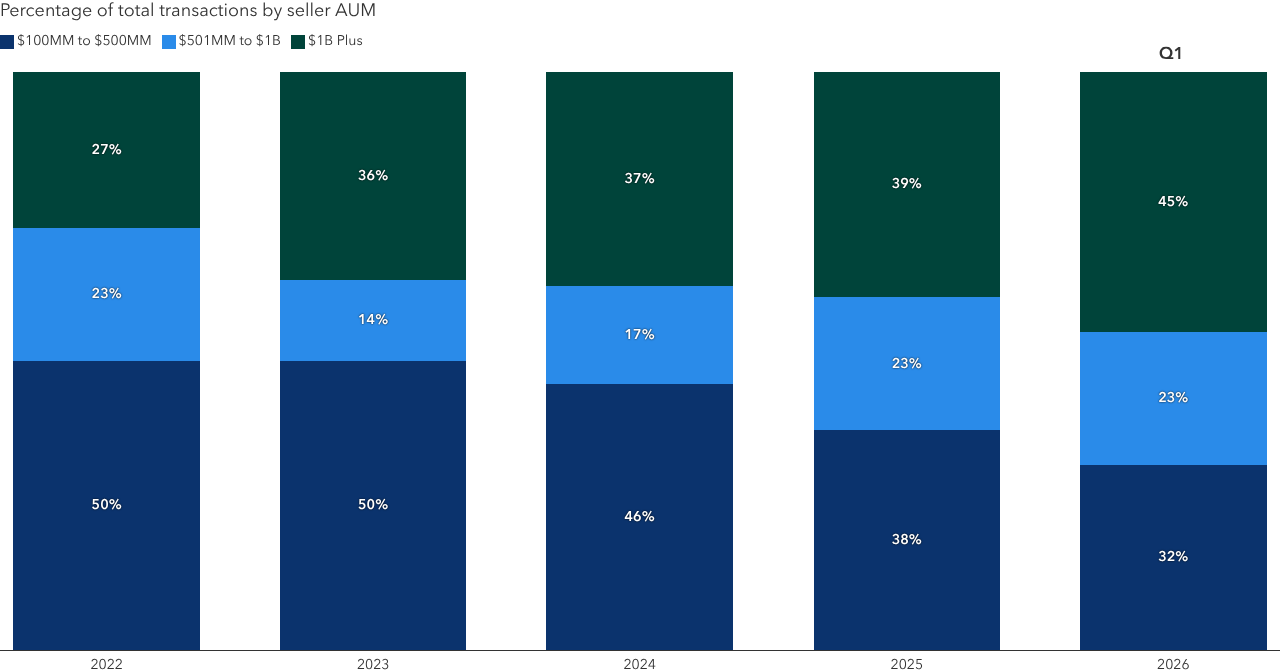
Large sellers remain the cornerstone of the M&A market, not only for moving the needle on AUM, but also because size often signals greater stability and lower risk, according to DeVoe’s first quarter Deal Book. RIAs with $1B or more in AUM represented 45% of first quarter 2026 transactions.

RIAs $1B+ in assets now 45% of total M&A transactions

Stacked bar chart showing the percentage of total RIA M&A transactions by seller AUM from 2018 through the end of the first quarter 2026. The share of transactions involving RIA sellers with $1 billion or more in assets steadily increases over time, reaching 45% in first quarter 2026. That compares with 39% of all transactions for sellers of $1 billion or more in full-year 2025. Sellers with $501 million to $1 billion in assets under management account for 23% of all transactions in the first quarter of 2026, the same as full-year 2025 and the number of sellers with $100 million to $500 million in assets account for 32% of all transactions in first quarter 2026, down from 38% in full-year 2025.

Source: DeVoe & Company. “Q1 2026 RIA M&A Deal Book”

3. How strong does an RIA’s organic growth need to be? 


Organic growth contributes more to premium valuations than any other factor, according to McHugh.


CWC’s definition of organic growth is deliberately narrow, reflecting its focus on a firm’s ability to triple or even quadruple AUM, largely through new client acquisition. Its definition of organic growth includes expanded wallet share but is net of client attrition and excludes acquisitions and recruiting.


“For us to get interested, we need to see consistent years of 5% or more organic growth,” McHugh says. “Zero growth for years and then one year at 5% is harder for us.”


Mercer Advisors may pay more for strong organic growth, but it evaluates client acquisition alongside other variables, such as the number of CERTIFIED FINANCIAL PLANNER® (CFP®) credentialed advisors and client retention. “We’re large enough to know we can jump‑start organic growth by plugging highly talented fiduciary advisors into our centers of influence, custodial and digital marketing systems,” Motheral says.


Valuations can increase as organic growth accelerates. “On a sliding scale, organic growth at 5% is good. 7.5% to 8% is great. Double digits and above are exceptional,” says McHugh, who sees many firms begin to pay significant premiums around the 10% mark. 

4. How important is it to have next-gen advisors and leaders? 


For Mercer Advisors, everything begins with the caliber of the advisory team and its cultural fit.


“We want fiduciary advisors who are excited about growth, who know how to win and retain clients, and who can deliver family‑office style service,” Motheral says. 


Reducing the risk of a firm’s dependence on just a few individuals is also top of mind and underscores the need for a deep bench of second-generation advisors and leaders.


Motheral evaluates next-gen advisors for their ability to retain a retiring founder’s clients, while McHugh looks for a strong cohort of younger talent to validate a firm’s scalability.

"7.5% to 8% is great. Double digits and above are exceptional,” says McHugh, who sees many firms begin to pay significant premiums around the 10% mark. 

5. Is too much founder dependency a deal-breaker?


Founder dependency is one of the most common valuation discounts in advisory M&A and the hardest to fix. 


“The shift from personal goodwill to enterprise goodwill is the central challenge in building transferable value across metrics like revenue quality and organic growth,” Wainman says. “A practice where clients trust the firm rather than an individual is a fundamentally different asset.”


Wainman adds that when a founder personally controls a disproportionate share of client relationships, acquirers typically mitigate transfer risk by restructuring deal economics, governance and post‑close obligations rather than simply lowering headline valuation. 


For its specific business model to work, CWC wants owners to remain involved in the firm for the duration of the partnership. It also scrutinizes the broader executive team.


“As minority investors, business ethics matter for accountability reasons,” McHugh says. “We conduct extensive background checks. We also expect diversified equity ownership among management. For us to invest, owners should retain more than half of their equity in the firm and the executive team must be fully committed to evolving the firm.”

6. How high and diversified should revenue be across the client base? 


Revenue quality is closely examined to assess both the durability of cash flows and the firm’s success in meeting client needs.


“Most of the firms we invest in have 90% or more recurring fee‑based revenue,” McHugh says. “Anything below that requires a clear strategic rationale for the interplay between the revenue streams and why the company benefits from a more diversified business model.”


Client concentration further influences valuation and buyer confidence. A practice deriving 30% of revenue from three households carries materially different risk than one in which no single client exceeds 3%. 


Buyers like McHugh also analyze demographics, including the share of clients in their 40s and 50s with future accumulation potential and whether next‑generation inheritors have been actively engaged.


7. Are high margins a strength or a signal of underinvestment? 


Strong margins are always attractive, but they are not an unqualified virtue.


Buyers normalize EBITDA and recast financials to reflect sustainable, transferable cash flow. But margins that are too high can sometimes raise concerns.


“We prefer firms with margins in the 30% to 40% range, where reinvestment supports scalability,” McHugh says. “Anything north of 40% can send the wrong signal: Not enough reinvestment for sustainable growth.”


If margins are excessively high, buyers might place greater scrutiny on a firm’s commitment to investing in people and technology, according to McHugh.


8. How can I differentiate my RIA in the M&A market?  


High‑quality financial reporting, clean and verifiable client data and integrated back‑office systems can also meaningfully differentiate a firm.


“You need to provide a single source of truth,” McHugh says. “If your back‑office and middle‑office systems aren’t integrated, it’s very hard to make informed decisions on key metrics like organic growth and client retention.”


Documented standard operating procedures also signal professionalism and reassure buyers that onboarding, compliance and service delivery are repeatable and sound.


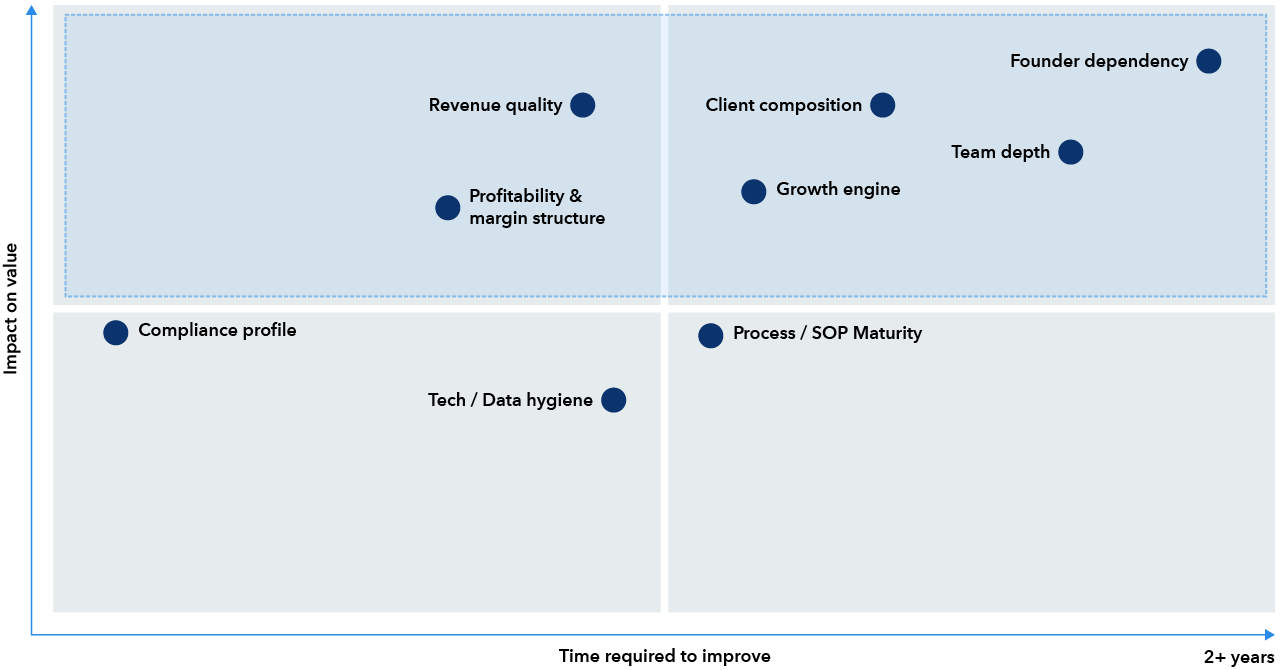
Very few firms excel across every dimension. The valuation drivers a founder decides to improve before going to the M&A market should depend on the time available and the kind of buyer they want to attract. 


Value driver improvements based on time horizon and impact

Scatter plot showing how long it typically takes RIAs to improve key business and financial metrics versus the impact those metrics have on valuation. The horizontal axis shows time required to improve (from short term to more than two years), and the vertical axis shows impact on value. Data hygiene, profitability and margin structure and revenue quality are among the fastest metrics to improve (about a year) and have a high impact on valuation in the order listed. Those that take more than a year to fix and in order of their impact on value are the following: Documented processes, organic growth, client composition, team depth and founder dependency.

Source: Capital Group, Q1 2026

9. How can I value my RIA the way a buyer would?   


Wainman’s prescription for RIAs across the quality spectrum is blunt: Before identifying the right buyer or pursuing a formal valuation, founders should conduct a rigorous diagnosis of their business through a buyer’s lens.


“Buyers don’t evaluate a practice the way a founder does,” Wainman says. “Founders see the relationships they’ve built and the revenue they’ve generated. A buyer sees a risk profile. Their job is to determine what survives after the founder leaves.”


To that end, Wainman recommends RIAs pinpoint the sources of transferable value in their businesses from the perspective of a sophisticated buyer. The analysis may help founders identify valuation gaps and distinguish what can realistically be improved within a given time frame. Wainman has created a worksheet to help you get started:


Private equity has introduced a new level of sophistication to a wealth management segment that began as a cottage industry. In today’s RIA M&A environment, institutional readiness is fast becoming table stakes for RIA founders seeking premium valuations for their firms. Evaluating your firm from a buyer’s point of view — and then developing a plan of action on what to fix is the first step to take, long before seeking a formal valuation.

Diagnose your RIA’s value drivers

Jon Wainman is an advisor practice management consultant with 23 years of industry experience and has been with Capital Group for 14 years (as of 12/31/25). He holds a bachelor’s degree in marketing from Indiana University.

Ted Motheral is an Executive Managing Partner, Merger & Acquisition Partner Development at Mercer Advisors. He is responsible for driving the growth and expansion of the organization through strategic mergers and acquisitions of other wealth management and tax firms. Ted has a law degree and an MBA from the University of Pittsburgh and a bachelor's degree from Villanova University.

Pat McHugh is Partner and Head of Investments at Constellation Wealth Capital and a member of its investment committee. He sources, evaluates and executes investments in wealth management firms, while partnering with their executive management teams to achieve strategic goals. Pat holds a bachelor's degree in economics from Yale.

1Integrators are RIA consolidators that acquire firms and fold them into a centralized operating model, often unifying branding, investing processes, technology and business development systems. They differ from “aggregators,” which typically retain acquired firms’ autonomy and identity while providing shared infrastructure. Many RIAs operate along a spectrum between the two business models.

For financial professionals only. Not for use with the public.

Investments are not FDIC-insured, nor are they deposits of or guaranteed by a bank or any other entity, so they may lose value.
Statements attributed to an individual represent the opinions of that individual as of the date published and do not necessarily reflect the opinions of Capital Group or its affiliates. This information is intended to highlight issues and should not be considered advice, an endorsement or a recommendation.
All Capital Group trademarks mentioned are owned by The Capital Group Companies, Inc., an affiliated company or fund. All other company and product names mentioned are the property of their respective companies.
Use of this website is intended for U.S. residents only. Use of this website and materials is also subject to approval by your home office.
Capital Client Group, Inc.
This content, developed by Capital Group, home of American Funds, should not be used as a primary basis for investment decisions and is not intended to serve as impartial investment or fiduciary advice.