Client Relationship & Service Beyond birthday cards: Concierge services that can add value

7 MIN ARTICLE

KEY TAKEAWAYS

  • Clients remember advisors who show up when it matters most.
  • Concierge services can help shift advisors from portfolio manager to life partner.
  • In a commoditized world, service and experience can drive loyalty and growth.

When it comes to client engagement, most advisors attempt to cover the basics. Birthday cards, holiday notes, the occasional client event. These gestures matter, but clients are unlikely to remember them as meaningful turning points in the relationship.


What they are more likely to remember are moments when their advisor helped them through something complicated, stressful or deeply personal —  at the right time.


“When you can show up for your clients at the exact moment they need you, it’s almost like they have a personal concierge for their financial life,” says Wassan Kasey, an advisor practice management consultant at Capital Group. “That’s where real loyalty can be built.”


Concierge services, at their best, are a strategic approach to deepening customer service. They’re about noticing when a client is overwhelmed by a tax issue, confused by terms of a personal loan, worried about aging parents — and stepping in with guidance or coordination that can make life easier. It doesn’t have to be flashy. What matters is that the support feels personal and genuinely useful.


“When you can solve more problems for your clients, or help them in ways they may not expect, those are concierge services that can make a difference,” Kasey says.


Consider these three distinct ways to offer new services that may improve your clients’ experience:
1. Become your client’s trusted “connector.” 


It’s common for advisors to recommend that their clients consider using other financial professionals from their network, whether it’s an estate lawyer, an accountant or a mortgage broker. This is often referred to as a “center-of-influence” strategy. One opportunity for advisors is to think much more broadly about their network, to expand it beyond traditional financial roles.


“Think about all the pain points your clients typically have: They’re buying homes, buying cars, navigating a business sale, planning weddings for their children,” Kasey says. “They’re trying to figure out what schools their children should go to. These are all referral points where you can step in and add value.”


Kasey notes that it’s important that these connections should be positioned not just as a passing thought or a happy coincidence, but as an intentional element of the value the advisor provides. “Instead of saying, ‘I know someone,’ position this as a service you provide. Communicate it as, ‘This is how we support you,’ or ‘This is part of how we support our clients’ and include it in your onboarding and service plans,” she says.


Over time, this approach may help reshape how clients perceive the relationship. You are no longer associated solely with financial performance. Instead, your firm can become the first call when something important is happening in the client’s life. That “first call” status can drive deeper loyalty and lead to referrals.


When you build your network, be strategic. If you work with business owners, and want to attract more business owners as clients, key contacts would include insurance companies or brokers, human resources specialists, recruiters and tech support experts. If you are looking to serve and attract high net worth families, think about concierge travel agents, real estate agents, mortgage brokers. Building your network around the specific needs of clients sends a clear message: "I strive to understand your life better than other advisors and believe I am well positioned to support you."


Get started: Organize your network of trusted professional contacts into a document or spreadsheet you could share with clients; contact your network regularly to keep abreast of trends and opportunities.

2. Deliver creative, high‑touch services that mark life events or make life easier.


The most memorable concierge services are often the most human, not the most extravagant. Birthday cards and generic holiday gifts are nearly ubiquitous, but they rarely create a lasting impression. High‑touch experiences, by contrast, can feel personal, timely and thoughtful.


One foundational practice is recognizing significant life events — both celebratory and challenging. Sending a care package when a new client comes on board, acknowledging a personal loss or marking a milestone moment communicates attention and empathy. These gestures reinforce that the relationship extends beyond transactions.


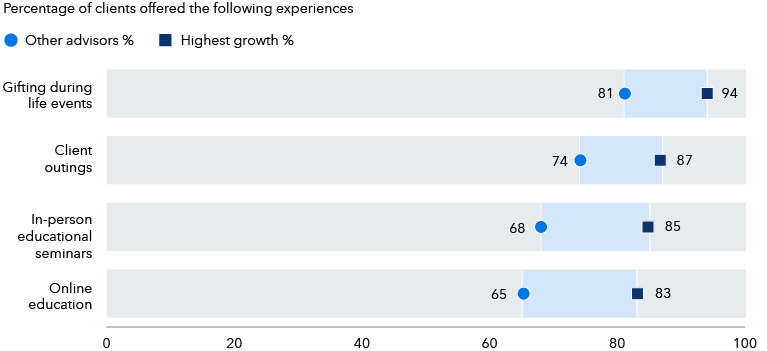
Capital Group’s latest Pathways to Growth advisor benchmark study finds that high-growth practices offer more of these “high-touch” services than other advisors.

Highest growth advisors provide more experiences for high-value clients

Chart headline: Highest growth advisors provide more experiences for high-value clients. Subtitle: Percentage of clients offered the following experiences. Legend indicates two data series: Other advisors and Highest growth. Four categories are shown. Gifting during life events: Other advisors 81%, Highest growth 94%. Client outings: Other advisors 74%, Highest growth 87%. In-person educational seminars: Other advisors 68%, Highest growth 85%. Online education: Other advisors 65%, Highest growth 83%.

“This is where you can use your creativity to help clients solve everyday problems,”  Kasey says. “For example, you or your staff can secure hard‑to‑get restaurant reservations months in advance of a holiday like Mother’s Day, then offer those reservations to clients at the last minute when it is too late for them to arrange on their own. There’s no real cost in doing something like that, but the perceived value can be high because you’re eliminating stress at exactly the right moment.”


Another simple gesture that can be powerful: When a client welcomes a new baby, send a children’s book inscribed with a thoughtful personal message to the child. The list of these life events is limited only by your imagination. Consider celebrating the purchase of a new home, a child’s graduation from high school or college, a client’s significant promotion, the birth of a child or grandchild, the sale of a family business. Similarly, consider offering support during a divorce, the death of a family member, a serious illness or the loss of a home.


If this kind of high-touch support for clients seems overwhelming at first, one way to make it manageable is to focus first on offering services to a limited group of clients — for example, those you want referrals from.


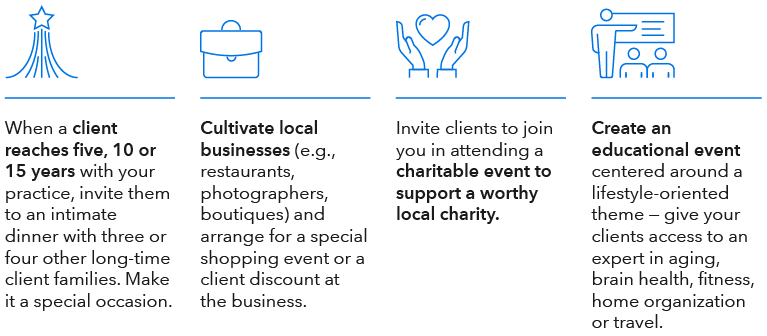
Client events offer another avenue for creative engagement. Importantly, these gatherings do not need to focus on financial planning to be impactful. Educational events on topics adjacent to wealth, such as health, longevity or family decision‑making can resonate deeply. Social or experiential events, including client appreciation outings, can build community and solidify a client’s bond with your firm.

Bringing clients together – Creating events that resonate

Title: Bringing clients together – Creating events that resonate. Four illustrated icons appear above four text sections. First section: When a client reaches five, 10 or 15 years with your practice, invite them to an intimate dinner with three or four other long-time client families. Make it a special occasion. Second section: Cultivate local businesses (e.g., restaurants, photographers, boutiques) and arrange for a special shopping event or a client discount at the business. Third section: Invite clients to join you in attending a charitable event to support a worthy local charity. Fourth section: Create an educational event centered around a lifestyle-oriented theme – give your clients access to an expert in aging, brain health, fitness, home organization or travel.

Get started: Add one new event per quarter. Start small so you don’t spend too much time as an event planner.  An intimate dinner with three or four clients can be a difference-maker.

3. Broaden your focus beyond investment advice.


For many clients, particularly high‑net‑worth households with complex needs, the most valuable financial guidance extends well beyond asset allocation. Taxes, estate considerations, charitable goals, business interests and multi‑generational planning all interact in ways that clients often find overwhelming.


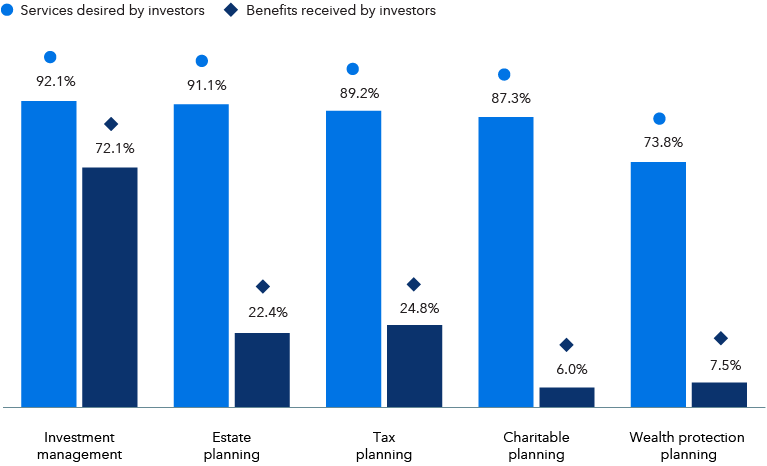
It’s likely you’re already providing many or even all of these areas of service and advice. But so is your competition. Wealth planning services that once may have set you apart are no longer a competitive edge. There’s a growing gap between what clients expect and what they are receiving. 

Clients expect more than investment management

A bar chart compares the percentage of investors who desire certain financial services with the percentage who report receiving those benefits. Five service categories are shown: investment management, estate planning, tax planning, charitable planning, and wealth protection planning. Investment management: 92.1% of investors want this service, while 72.1% report receiving it. Estate planning: 91.1% of investors want this service, while 22.4% report receiving it. Tax planning: 89.2% of investors want this service, while 24.8% report receiving it. Charitable planning: 87.3% of investors want this service, while 6.0% report receiving it. Wealth protection planning: 73.8% of investors want this service, while 7.5% report receiving it.

Source: Investments & Wealth Monitor, survey of 416 investors, May/June 2024 edition

Importantly, expanding services does not require advisors to develop specialized knowledge in every domain. Instead, the goal is to coordinate expertise in a seamless, integrated way. Some firms choose to bring advanced planning capabilities in‑house; others maintain deep relationships with outside specialists. In either case, the advisor is the connector.


“This can be a difference-maker for advisors,” Kasey says. “You’re delivering something clients increasingly seek, which is a family‑office–like experience without the formal family office structure. You can make yourself the point of integration across a client’s financial life, providing clarity and confidence where a client might feel uncertainty.”


Get started: If you don’t have the staff or capabilities to broaden your services in-house, leverage third-party professionals from outside your firm.

The bigger picture: From services to strategy


What ties all these efforts together is purpose. Concierge services work best when they are designed to simplify life, remove friction or enhance experiences clients already care about.


Concierge services, in this sense, are not a list of perks but a strategic lens through which the entire client experience can be enhanced. By broadening your scope, formalizing your role as a connector and delivering creative, high‑touch experiences, you can help elevate how clients experience the relationship.


At a time when investment access and technology have become great equalizers, service and experience remain uniquely human differentiators. Advisors who embrace these strategies are not merely adding services, they can deepen client relationships by redefining what it means to be valuable in their clients’ lives. 

Wassan Kasey is an advisor practice management consultant at Capital Group. She has 22 years of investment industry experience and has been with Capital Group for eight years. She holds a bachelor's degree in business administration from the University of Southern California. 

Investments are not FDIC-insured, nor are they deposits of or guaranteed by a bank or any other entity, so they may lose value.
Investors should carefully consider investment objectives, risks, charges and expenses. This and other important information is contained in the mutual fund prospectuses and summary prospectuses, which can be obtained from a financial professional and should be read carefully before investing.
This material does not constitute legal or tax advice. Investors should consult with their legal or tax advisors.
Statements attributed to an individual represent the opinions of that individual as of the date published and do not necessarily reflect the opinions of Capital Group or its affiliates. This information is intended to highlight issues and should not be considered advice, an endorsement or a recommendation.
All Capital Group trademarks mentioned are owned by The Capital Group Companies, Inc., an affiliated company or fund. All other company and product names mentioned are the property of their respective companies.
Use of this website is intended for U.S. residents only. Use of this website and materials is also subject to approval by your home office.
Capital Client Group, Inc.
This content, developed by Capital Group, home of American Funds, should not be used as a primary basis for investment decisions and is not intended to serve as impartial investment or fiduciary advice.