On Good Friday, the New York Stock Exchange and Capital Group’s U.S. offices will be closed.

In observance of Good Friday, the New York Stock Exchange and Capital Group’s U.S. offices will be closed on Friday, April 3.

Life Events Build trust across generations with a focus on education

6 MIN ARTICLE

Being an active participant in the education savings journey helps your clients and can also strengthen your client relationships.

If you play a passive role in your clients’ education savings journey because you view 529 education savings plans as small accounts, a hassle to set up or an unprofitable line of business, you may want to reconsider. The benefits of helping clients with educational planning go beyond assets under management. These conversations can help you build an emotional bond for a lifetime and may offer an opportunity to become a trusted financial professional for future generations.


There is a neural mechanism in the human brain that tags information with emotional associations that enhance memory.1 The birth of a child is among the most significant, life-changing events your clients will experience. The subsequent chapters of raising and educating children, then sending them off into the world, are important milestones. For financial professionals, this is a golden opportunity to form a positive emotional association with clients as you discuss investing in the education they’ll need to launch their children to the next stage of life.


Most importantly for financial professionals, a child represents a good reason to review many factors that can shape clients’ financial futures, including setting up a will, revising the family budget, and creating nest eggs for their children, whether in the form of trusts or 529 accounts. This is also a time when other members of the family may wish to financially contribute to children and play a greater role in investing in their future, including when it comes to education. 
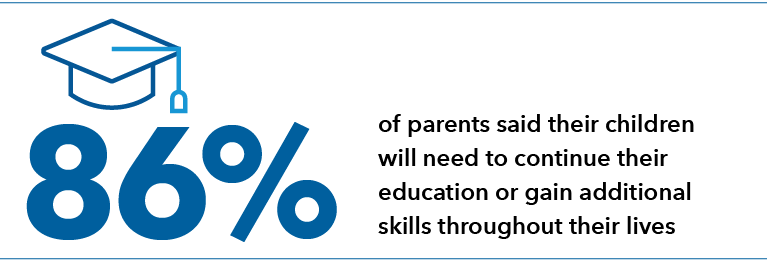
Graphic reads 86% of parents said their children will need to continue their education or gain additional skills throughout their lives.

Source: College Savings Foundation (CSF) 16th Annual State of Higher Ed Survey of 1,000 Parents, 2022.

Leverage the flexibility


Relative to the degree of benefit they provide, 529s are simple and easier to set up than other planning techniques, such as trusts. Time to set up is well spent and pays dividends in relationship alpha, how you stand apart in the eyes of your client. 


The money in a 529 savings plan isn’t limited to four-year universities. Community colleges, seminaries, or trade schools or certain apprenticeship programs … any path the beneficiary chooses that involves professional training at an accredited institution could be eligible for tax-advantaged treatment in a 529 savings plan.   Qualified expenses also include expenses for fees, books, supplies and equipment required for the participation of a designated beneficiary in certain apprenticeship programs. And thanks to recent legislative changes, 529 accounts can now be used to cover a wider array of qualified educational expenses, including certain postsecondary credentialing program expenses and expenses in connection with enrollment or attendance at an elementary or secondary public, private or religious school (kindergarten through 12th grade) beyond just tuition. Qualified K-12 expenses include (but are not limited to) tuition, curriculum materials, textbooks, instructional materials and online education materials up to a maximum of $20,000 incurred during the taxable year per beneficiary.  If withdrawals are used for purposes other than qualified education expenses, the earnings will be subject to a 10% federal tax penalty in addition to federal and, if applicable, state income tax. States take different approaches to the income tax treatment of withdrawals. For example, withdrawals for K-12 expenses may not be exempt from state tax in certain states.


Wealthy individuals can help fund primary, secondary and higher education for multiple generations of grandchildren, nieces, nephews and godchildren by investing early, front-loading 529 accounts and leveraging up to five years of lifetime gift exemptions. Tax benefits allow you to contribute up to $19,000 in 2026 ($38,000 for married couples) to each individual annually without gift-tax consequences. Under a special election, you can invest up to $95,000 ($190,000 for married couples) at one time by accelerating five years’ worth of investments. Additional gifts made to that beneficiary over the next four years after the year in which the one-time gift is made may reduce the donor’s lifetime gift and estate tax exemption. If the donor of an accelerated gift dies within the five-year period, a portion of the transferred amount will be included in the donor’s estate for tax purposes. Clients should consult with a tax advisor regarding their specific situation.


There are also several potential use cases to employ. These accounts can be invested far beyond a 20-year horizon, to fund graduate school, seed a Roth individual retirement account or transfer the balance to another eligible beneficiary. And don't forget the tax savings can be significant!

Make a next-gen connection


As wealth shifts, it falls into more hands, in many cases those of female clients. For a new mother, the birth of a child presents the opportunity to make important financial decisions that will affect her family for years to come. According to Cerulli's U.S. High-Net-Worth and Ultra-High-Net-Worth Markets Report from December 2024, American women are projected to control most of the $54 trillion of inherited financial assets from baby boomers by 2048. Engaging female investors by showing you understand their motivations is important, so capitalize on this skill. In many cases, you’re helping them “change their family tree” by adding a 529 plan to the wealth-building process.


And let’s not forget the beneficiaries of these 529 plans. As that generation comes of age and uses their education to build strong careers, the conversations with you can continue. By establishing yourself as their trusted advisor early, you may have more opportunities to serve them in the future.


Craig Cheramie, an advisor at Cambridge Securities in New Orleans, recalls attending a Financial Planning Association meeting where many investors were only focusing on setting up standard investments. “I thought, if I help these clients with their 529s, I’m building a future relationship with not only the client, but also with their children,” he says. The next generation is often as successful if not more than your existing clients, with 529 plans being a great tool to build the relationship.

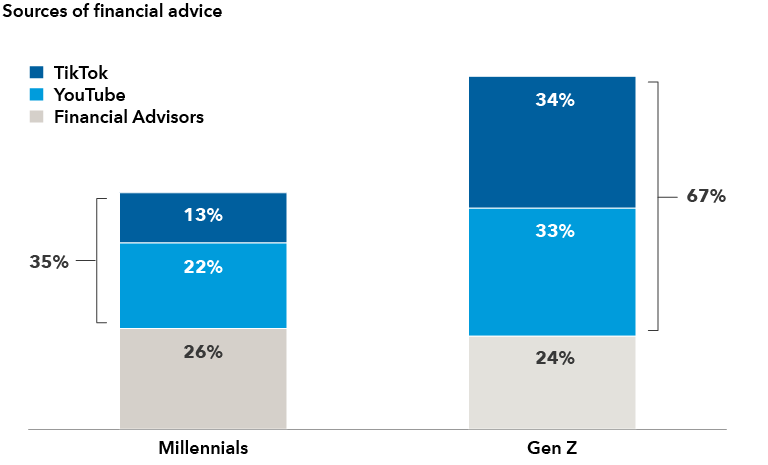
Bar chart compares sources of financial advice for Millennials and Gen Z. Among Millennials 26% cite financial advisors as a source, 22% cite YouTube and 13% cite TikTok. YouTube and TikTok combined are a source for 35% of Millennials. Among Gen Z, 24% cite financial advisors as a source of financial advice, 33% cite YouTube and 34% cite TikTok. Combined, YouTube and TikTok are a source of financial advice for 67% of Gen Z.

Source: SmartAsset, “Millennials, Gen Zers Are Gaining Wealth, But Advisors Aren't Meeting Them Where They Are,” May 2024.

Younger generations are increasingly seeking their financial advice online.7 For many, the first experience with benefits of financial advice may be through higher education. A 529 account gives you reason to connect directly to the next generation early, at a time they are reaping the benefits of their investments. Knowing that higher education is within reach helps prove your value statement to the next generation in a tangible way. And remember there’s also an emotional association. If education savings is a client’s first experience with an investment’s drawdown, it could either negatively or positively affect their confidence in future investment opportunities, such as saving for retirement.


While some advisors may view 529s as small and burdensome, including them in your conversation toolkit may help you form deeper emotional bonds with clients and their families. Either way, any conversation about their kids is a conversation they will enjoy having. 

Sources


1 Columbia University, Why Do We Remember Emotional Events Better?, January 2023.

2 Institute for Family Studies, “The true cost of raising a child,” July 2023.

3 Hanson, Melanie. “Average Cost of College & Tuition” EducationData.org, November 18, 2023

4 CDC: Key Statistics from the National Survey on Family Growth, 2017.

5 ISS 529 College Savings Quarterly Data Update, 1Q2014 & 1Q2024

6 SavingForCollege.com

SmartAsset, “Millennials, Gen Zers Are Gaining Wealth, But Advisors Aren't Meeting Them Where They Are,” May 2024.

Investments are not FDIC-insured, nor are they deposits of or guaranteed by a bank or any other entity, so they may lose value.
Investors should carefully consider investment objectives, risks, charges and expenses. This and other important information is contained in the mutual fund prospectuses and summary prospectuses, which can be obtained from a financial professional and should be read carefully before investing.
This material does not constitute legal or tax advice. Investors should consult with their legal or tax advisors.
Statements attributed to an individual represent the opinions of that individual as of the date published and do not necessarily reflect the opinions of Capital Group or its affiliates. This information is intended to highlight issues and should not be considered advice, an endorsement or a recommendation.
All Capital Group trademarks mentioned are owned by The Capital Group Companies, Inc., an affiliated company or fund. All other company and product names mentioned are the property of their respective companies.
Use of this website is intended for U.S. residents only. Use of this website and materials is also subject to approval by your home office.
Capital Client Group, Inc.
This content, developed by Capital Group, home of American Funds, should not be used as a primary basis for investment decisions and is not intended to serve as impartial investment or fiduciary advice.