

Welcome to +, investment solutions from Capital Group and KKR that focus on unlocking broad access to private markets by blending public securities and private investments.
February 27, 2026
KEY TAKEAWAYS
- The average investor has largely been left out of the expansion of private markets (known as alternatives) in recent decades.
- Capital Group and KKR have partnered to develop a series of public-private investment solutions to thoughtfully and responsibly unlock private market access for the average investor.
- Public-Private+ Funds may fit into existing allocations to provide enhanced return/income potential.
Private markets don’t need to be an “alternative”
For years, private markets, including private credit, real assets and private equity grew with little involvement from the typical individual investor. Institutions, endowments and some sophisticated high net worth investors increasingly pursued higher returns in private markets as the Global Financial Crisis reshaped areas like commercial lending and public capital markets.
Capital Group and KKR have formed an exclusive partnership to help financial professionals and investors thoughtfully and responsibly access these asset classes. Capital Group and KKR each bring decades of experience, breadth and scale with a shared investor-first approach.
As private markets have matured, it’s become possible to no longer think of them as “alternatives,” necessarily, but as extensions of existing allocations to equity and/or fixed income. For investors who can tolerate a little less liquidity in exchange for potentially enhanced returns, we believe a solution that joins public and private markets in a single fund can be compelling. Our research suggests that many investors may not need as much liquidity as they think, which presents a possible opportunity.
We’re delivering these investments via interval funds, a vehicle which combines the ability to access less-liquid investments through a fund regulated by the Investment Company Act of 1940 (like mutual funds and ETFs).
Key features of the Capital Group KKR funds include:
- No investor eligibility requirements (non-accredited investors can invest)
- Low investment minimums ($1,000) for most share classes
- IRS 1099 tax reporting
- Compelling fee structure
Meet the funds
Introducing our Public-Private+ Funds, which can allow investors to add private markets exposure to their existing equity and/or fixed income allocations.
Capital Group KKR U.S. Equity+
Objective: The fund’s investment objective is to seek long-term capital appreciation.
Investing across a comprehensive equity spectrum to pursue the fund’s objective
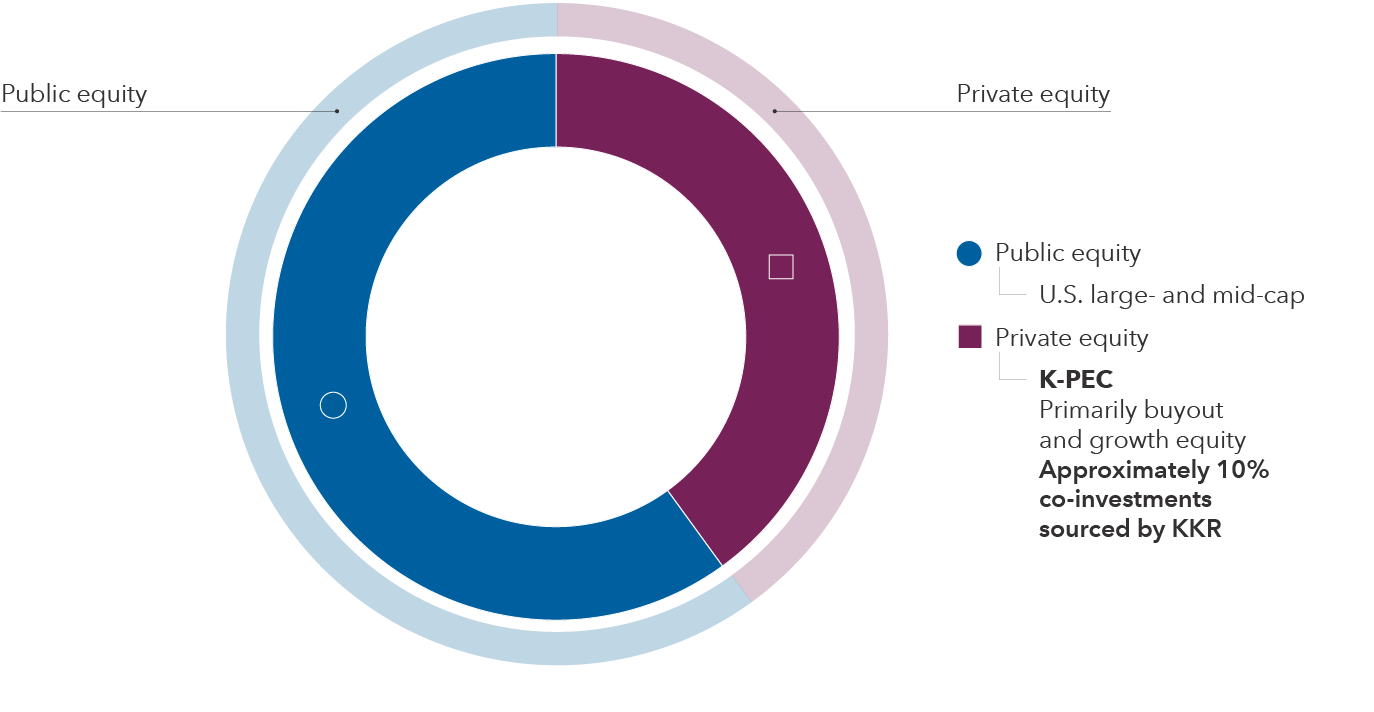
For illustrative purposes only. Actual allocations to sectors may vary depending on portfolio managers’ bottom-up security selection and/or market conditions.
Key takeaways
Broad equity spectrum: Offers, in a single fund, investments in both U.S. large- and mid-cap public companies, as well as private equity investments sourced by KKR.
Deep research and scale: Offers the research and scale of two of the most experienced asset managers in their respective areas: Capital Group in public equities, with more than 90 years of experience, and KKR, with nearly 50 years of private equity experience.
Thoughtful approach: Designed with an investor-first orientation, fund shareholders have the potential to benefit from investing in public equities, co-investments sourced by KKR and KKR’s evergreen private equity strategy, known as KKR Private Equity Conglomerate LLC (“K-PEC”).
Objective: The fund’s investment objective is to provide a high level of current income and seek maximum total return, consistent with preservation of capital.
Investing across fixed income sectors to pursue the fund's objectives
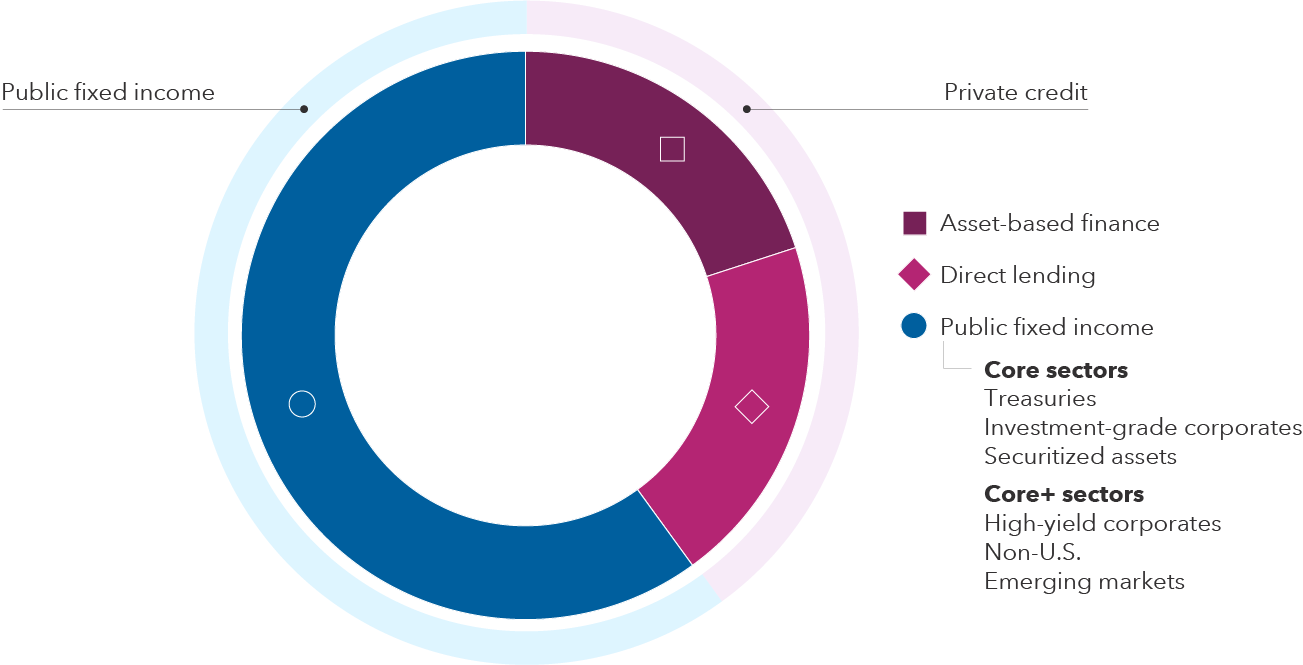
For illustrative purposes only. Actual allocations to sectors may vary depending on portfolio managers’ bottom-up security selection and/or market conditions.
Key takeaways
Capturing a broader opportunity set: Invests across public and private markets, allowing investors opportunities to pursue higher income and total return across the full credit spectrum. The fund will seek to generally invest 60% in traditional fixed income and 40% in private credit under normal circumstances.
Wide range of potential sources of income: Seeks to identify income opportunities in public fixed income sectors such as securitized assets, investment-grade and high yield corporates, and in private credit, specifically direct lending to upper middle market companies and asset-based finance.
Active risk management: Capital Group's ongoing risk analysis and management at the fund level along with Capital Group and KKR's respective embedded risk analysis and mitigation processes at the individual investment level seek to create a multi-layer risk ecosystem.
Capital Group KKR Multi-Sector+
Objective: The fund's investment objective is to provide a high level of current income.
Seeks diversification across public and private income sectors
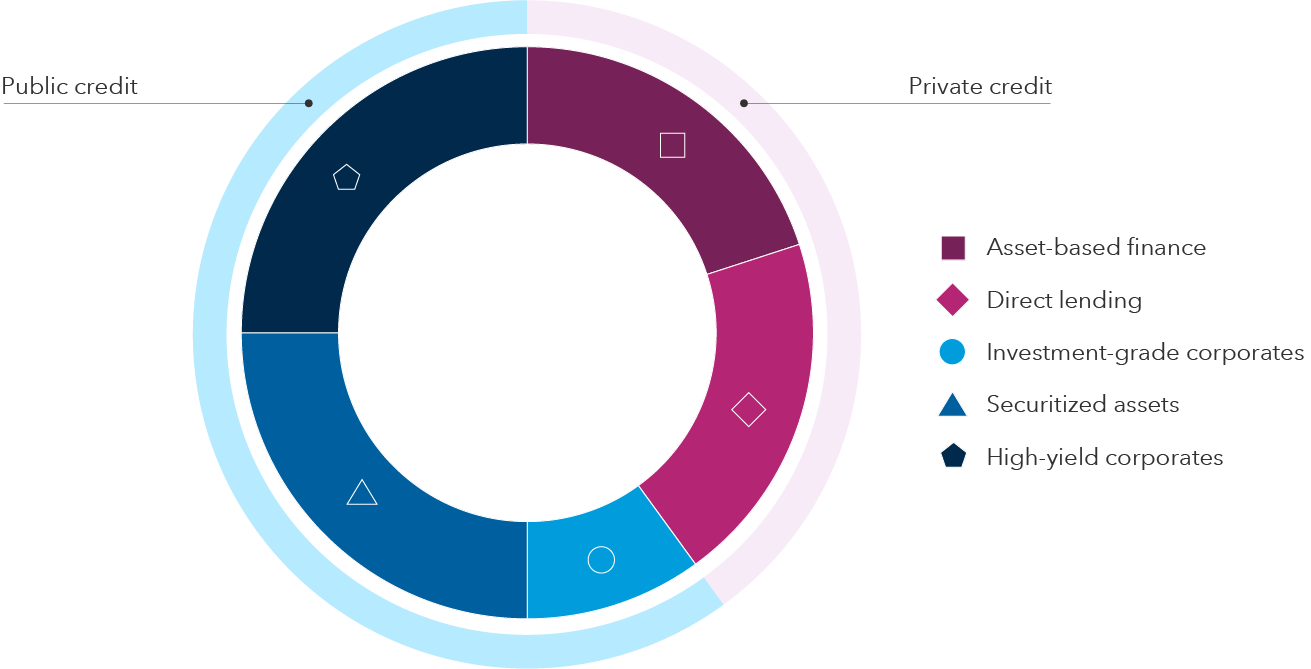
For illustrative purposes only. Actual allocations to sectors may vary depending on portfolio managers’ bottom-up security selection and/or market conditions.
Key takeaways
High income seeking: Offers strategic active exposure to various higher income-focused sectors in the public fixed income markets with a target of 40% of assets to be invested across higher income seeking private credit sectors under normal circumstances.
Flexibility: A broad portfolio that invests across investment-grade and high-yield corporates, securitized assets, as well as private loans to direct upper middle-market companies and asset-based finance instruments.
Enhanced opportunity set: With KKR's well-established private credit platform, investors can pursue potentially higher yielding credit opportunities that have not been historically available to the typical investor.
Dig deeper into +
Financial professionals: We have a variety of resources available to help you dig deeper into the world of public-private investments:
- Our Capital Ideas Pro educational program, a four-module self-directed course that covers topics such as what are private markets, positioning public-private solutions for investors and other interesting areas of this growing investment category.
- Capital Group’s Portfolio Consulting and Analytics Team can help evaluate opportunities to optimize portfolio construction to pursue investor’s goals, including how to consider public-private investments with a detailed portfolio analysis.
Reach out to your Capital Group sales representative who will be able to help guide your journey in learning more about these funds and the partnership with KKR.
Investors: Please reach out to your financial professional to learn more about public-private investments and whether they may be a fit to help pursue your investment goals.
For those still building their private markets vocabulary, we’ve compiled a glossary of terms that can be accessed here.