
5 things to know about Washington Mutual Investors Fund

WMIF
 1

It's delivered both growth and income
 

  • Washington Mutual Investors Fund (WMIF) strives to accomplish its objective through fundamental research, careful selection and broad diversification, considering current and anticipated income, as well as the potential for long-term capital appreciation.
  • The fund emphasizes dividend payers, with flexibility to own select nonpayers.
  • This approach has translated into higher yields and stronger returns.

10-year range of 12-month dividend yields (%)
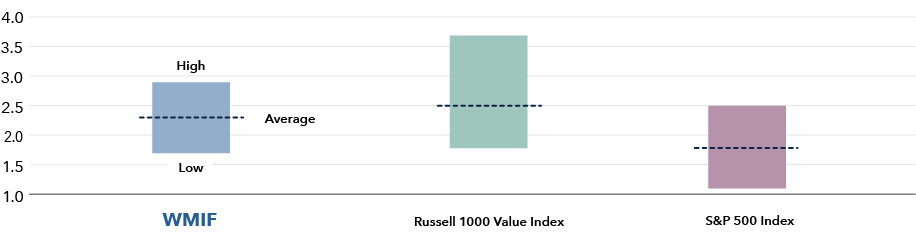
 Bar chart with three floating bars showcases the 10-year range of 12-month dividend yields for Washington Mutual Investors Fund (WMIF), the Russell 1000 Value Index and the S&P 500 Index from December 31, 2015 to December 31, 2025. Among the three groups, the Russell 1000 Value Index has the highest yield range, from 1.8% to 3.7%, followed by WMIF, ranging from 1.7% to 2.9%. The S&P 500 Index shows the lowest range, from 1.1% to 2.5%. The Russell 1000 Value Index has an average yield of 2.5% over the decade followed by WMIF at 2.3%, while the S&P 500 Index displays the lowest average yield of 1.8%.

Source: Morningstar. Data from 12/31/15 of 12/31/25. Calculated by Capital Group. Due to differing calculation methods, the figures shown here may differ from those calculated by Morningstar.

 2

Focused on high quality
 

  • The fund stands apart from the S&P 500 and the Russell 1000 Value indexes through its focus on high-quality companies.
  • The fund maintained 85% of its holdings in high-quality companies, well above the S&P 500 and Russell 1000 Value.
  • In our view, quality dividend-paying companies can help consistently mitigate downside risk in a way traditional value stocks cannot.

10-year average investment grade by holdings and assets (%)
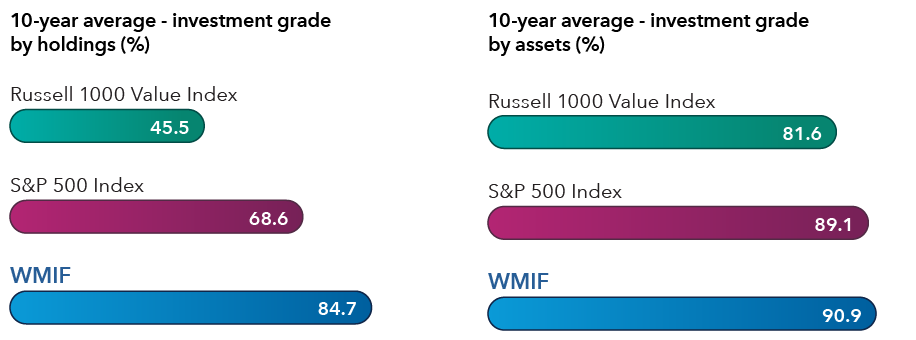
A series of two bar charts compare the 10‑year average investment‑grade exposure across Washington Mutual Investors Fund (WMIF), the S&P 500 Index, and the Russell 1000 Value Index. The first bar chart measures investment grade by holdings and shows WMIF at 84.7%, the S&P 500 Index at 68.6% and the Russell 1000 Value Index at 45.5%. The second bar chart measures investment grade by assets and shows WMIF at 90.9%, the S&P 500 Index at 89.1% and the Russell 1000 Value Index at 81.6%.

Source: FactSet, with credit ratings by S&P Global Ratings. As of 12/31/25. Data reflect the average percentage of fund holdings and index constituents rated investment grade (BBB- and above) by S&P Global Ratings. The average percentage by assets are in U.S. dollars for those holdings and constituents. Investments not rated or rated BB+ or lower are not reflected in the data.

 3

A disciplined framework
 

  • The fund has an eligible list of securities considered appropriate for a prudent investor seeking opportunities for income and growth of principal.
  • This differentiated positioning is enabled by continuous research, a global presence and active management.
  • Out of 2,245 companies listed on the New York Stock Exchange, only 745 met WMIF’s investment standards and approximately 1/4 of those stocks were held in the fund.
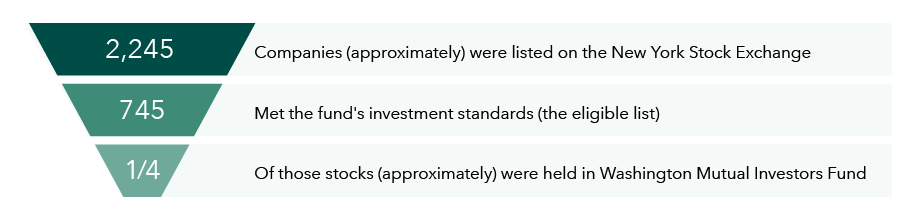
Funnel graphic illustrates the investment selection process for Washington Mutual Investors Fund. Approximately 2,245 companies were listed on the New York Stock Exchange as of December 31, 2025. Of those, 745 met the fund’s investment standards and were included in the eligible list. From that group, approximately 1/4 stocks were held in Washington Mutual Investors Fund.

Source: FactSet, with credit ratings by S&P Global Ratings. As of 12/31/25.

 4

A history of more upside, with less downside
 

  • Beyond strong results in rising markets, WMIF demonstrated resilience when markets fell.
  • With an emphasis on quality dividend-paying stocks, the fund has led the S&P 500 and Russell 1000 Value in the majority of the recent market corrections.
  • A distinctive approach, active flexibility and an emphasis on quality dividend payers have helped when markets were at their worst.

WMIF excess returns during market downturns (%)
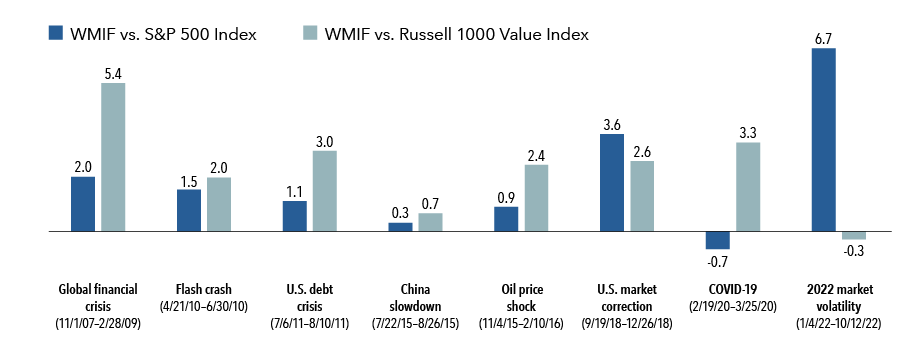
Bar chart compares the Washington Mutual Investors Fund (WMIF) excess returns versus the S&P 500 Index and the Russell 1000 Value Index across eight market downturns. During the Global Financial Crisis, roughly between the end of 2007 and the beginning of 2009, WMIF outperformed the S&P 500 Index by 2 percentage points and the Russell 1000 Value Index by 5.4 points. During the flash crash in the summer of 2010, excess returns were 1.5 versus the S&P 500 and 2 versus the Russell 1000 Value Index. During the U.S. debt crisis in the summer of 2011, WMIF showed excess returns of 1.1 versus the S&P 500 and 3 versus the Russell 1000 Value Index. In the China slowdown during the summer of 2015, excess returns were 0.3 and 0.7, respectively. During the oil price shock in late 2015 into early 2016, WMIF exceeded the S&P 500 by 0.9 and the Russell 1000 Value Index by 2.4. During the U.S. market correction in the fourth quarter of 2018, WMIF excess returns were 3.6 versus the S&P 500 and 2.6 versus the Russell 1000 Value Index. During the COVID 19 period in 2020, WMIF underperformed the S&P 500 by 0.7 but outperformed the Russell 1000 Value Index by 3.3. In the 2022 market volatility period, WMIF outperformed the S&P 500 by 6.7 and underperformed the Russell 1000 Value Index by 0.3.

Source: Morningstar. As of 12/31/25. Market downturns are defined as cumulative declines of the S&P 500 Price Return Index of more than 10% from peak to trough with a 100% recovery. Past results are not predictive of results in future periods.

 5

A differentiated approach
 

  • Using a bottom‑up approach, WMIF has unique sector exposures compared to the S&P 500 and Russell 1000 Value indexes.
  • The fund has been materially more weighted in technology versus the Russell 1000 Value — while remaining below the S&P 500’s concentration — and less weighted in consumer discretionary and communication services.
  • This positioning seeks to deliver diversification from extreme market concentration while breaking from conventional value allocations.

Sector allocations (%)
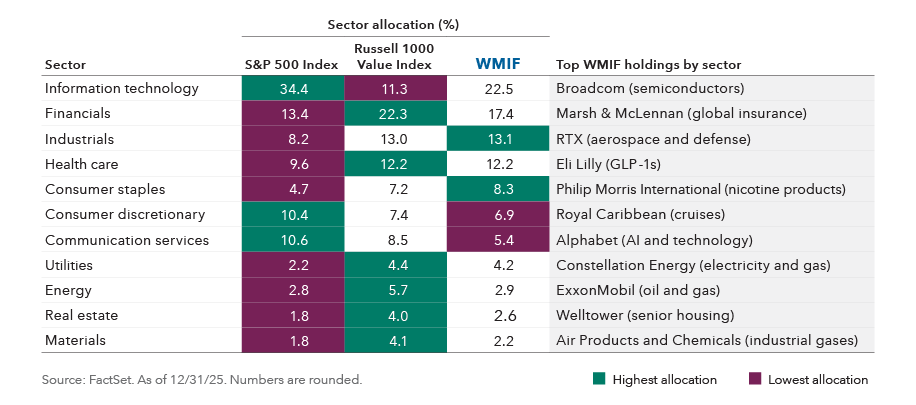
Table compares sector allocations for top Washington Mutual Investors Fund (WMIF) holdings by sector versus the S&P 500 Index and the Russell 1000 Value Index. Information technology represents 34.4% of the allocation in the S&P 500 Index, 22.5% in WMIF and 11.3% in the Russell 1000 Value Index. Financials is 13.4% in the S&P 500 Index, 17.4% in WMIF and 22.3% in the Russell 1000 Value Index. Industrials is 8.2% in the S&P 500 Index, 13.1% in WMIF and 13% in the Russell 1000 Value Index. Health care is 9.6% in the S&P 500 Index, 12.2% in WMIF and 12.2% in the Russell 1000 Value Index. Consumer discretionary represents 10.4% of the allocation in the S&P 500 Index, 6.9% in WMIF and 7.4% in the Russell 1000 Value Index. Consumer staples is 4.7% in the S&P 500 Index, 8.3% in WMIF and 7.2% in the Russell 1000 Value Index. Communication services is 10.6% in the S&P 500 Index, 5.4% in WMIF and 8.5% in the Russell 1000 Value Index. Utilities is 2.2% in the S&P 500 Index, 4.2% in WMIF and 4.4% in the Russell 1000 Value Index. Energy is 2.8% in the S&P 500 Index, 2.9% in WMIF and 5.7% in the Russell 1000 Value Index. Real estate is 1.8% in the S&P 500 Index, 2.6% in WMIF and 4% in the Russell 1000 Value Index. Materials is 1.8% of the allocation in the S&P 500 Index, 2.2% of WMIF and 4.1% of the Russell 1000 Value Index.

Source: Capital Group, FactSet. As of 12/31/25. Numbers are rounded.

WMIF details

Read more perspectives on equity markets

Figures shown are past results and are not predictive of results in future periods. Current and future results may be lower or higher than those shown. Investing for short periods makes losses more likely. Prices and returns will vary, so investors may lose money. View mutual fund expense ratios and returns. View current mutual fund SEC yields.
Investments are not FDIC-insured, nor are they deposits of or guaranteed by a bank or any other entity, so they may lose value.
Investors should carefully consider investment objectives, risks, charges and expenses. This and other important information is contained in the mutual fund prospectuses and summary prospectuses, which can be obtained from a financial professional and should be read carefully before investing.
Capital Group offers some funds in a range of share classes designed to meet the needs of retirement plan sponsors and participants. The different share classes incorporate varying levels of financial professional compensation and service provider payments. Because Class R-6 shares do not include any recordkeeping payments, expenses are lower and results are higher. Other share classes that include recordkeeping costs have higher expenses and lower results than Class R-6.
There have been periods when the results lagged the index(es) and/or average(s). The indexes are unmanaged and, therefore, have no expenses. Investors cannot invest directly in an index.
FTSE/Russell indexes: London Stock Exchange Group plc and its group undertakings (collectively, the “LSE Group”). © LSE Group 2026. FTSE Russell is a trading name of certain of the LSE Group companies. FTSE indexes are trademarks of the relevant LSE Group companies and are used by any other LSE Group company under license. All rights in the FTSE Russell indexes or data vest in the relevant LSE Group company which owns the index or the data. Neither LSE Group nor its licensors accept any liability for any errors or omissions in the indexes or data and no party may rely on any indexes or data contained in this communication. No further distribution of data from the LSE Group is permitted without the relevant LSE Group company's express written consent. The LSE Group does not promote, sponsor or endorse the content of this communication.
Each S&P Index ("Index") shown is a product of S&P Dow Jones Indices LLC and/or its affiliates and has been licensed for use by Capital Group. Copyright © 2026 S&P Dow Jones Indices LLC, a division of S&P Global, and/or its affiliates. All rights reserved. Redistribution or reproduction in whole or in part is prohibited without written permission of S&P Dow Jones Indices LLC.
All Capital Group trademarks mentioned are owned by The Capital Group Companies, Inc., an affiliated company or fund. All other company and product names mentioned are the property of their respective companies.
Investment results assume all distributions are reinvested and reflect applicable fees and expenses.
Certain share classes were offered after the inception dates of some funds. Results for these shares prior to the dates of first sale are hypothetical based on the original share class results without a sales charge, adjusted for typical estimated expenses. 
  • Class R-6 shares were first offered on 5/1/2009.
Results for certain funds with an inception date after the share class inception also include hypothetical returns because those funds' shares sold after the funds' date of first offering. Refer to dates of first sale and specific expense adjustment information.
Use of this website is intended for U.S. residents only. Use of this website and materials is also subject to approval by your home office.
Capital Client Group, Inc.
This content, developed by Capital Group, home of American Funds, should not be used as a primary basis for investment decisions and is not intended to serve as impartial investment or fiduciary advice.
© 2026 Morningstar, Inc. All rights reserved. The information contained herein: (1) is proprietary to Morningstar and/or its content providers; (2) may not be copied or distributed; and (3) is not warranted to be accurate, complete or timely. Neither Morningstar, its content providers nor Capital Group are responsible for any damages or losses arising from any use of this information. Past performance is no guarantee of future results. Information is calculated by Morningstar. When applicable, due to differing calculation methods, the figures shown here may differ from those calculated by Capital Group.

Russell 1000 Value Index: Tracks large-cap U.S. value stocks by market capitalization.


S&P 500 Index: A market-capitalization-weighted index of about 500 major U.S. stocks. Includes reinvested dividends but excludes fees and taxes.


Bond ratings, which typically range from AAA/Aaa (highest) to D (lowest), are assigned by credit rating agencies such as Standard & Poor’s, Moody’s and/or Fitch, as an indication of an issuer’s creditworthiness. If agency ratings differ, a security will be considered to have received the highest of those ratings, consistent with applicable investment policies. Securities in the Unrated category have not been rated by any of the rating agencies referenced above; however, the investment adviser performs its own credit analysis and assigns comparable ratings that are used for compliance with applicable investment policies.