
5 things to know about The Growth Fund of America

CGGR
 1

A flexible approach to growth
 

  • The Growth Fund of America® (GFA) is principally focused on U.S.-based companies but can also invest selectively in companies outside the U.S.
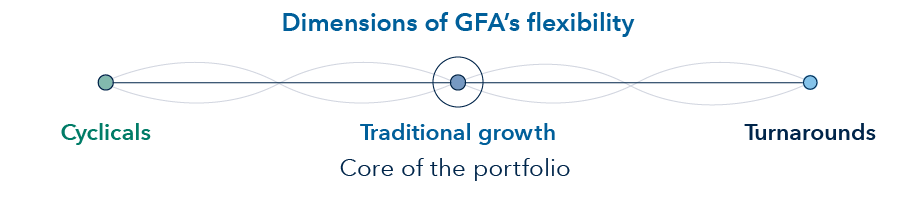
  • The fund’s flexible approach allows managers to invest across different types of growth opportunities, including cyclicals and turnarounds.
  • This approach has produced a differentiated growth fund that has delivered strong returns without the concentration risk and rigidity of passive approaches.
 Line chart compares the cumulative growth of a hypothetical $10,000 invested from 1987 to 2025 for The Growth Fund of America (GFA), the S&P 500 Index and the Russell 1000 Growth Index. All three rise over time, with GFA outperforming the indexes. By the end of the period, GFA reaches more than $1 million, 1.4 times as much as the Russell 1000 Growth Index, which ended at just over $745,000, and 1.7 times as much as the S&P 500 Index, which ended at just over $616,000.
 2

Dynamic positioning
 

  • GFA’s sector positioning is an outcome of bottom-up security selection, not top-down sector calls or benchmark weights.
  • As managers gain or lose conviction in individual holdings, sector exposures naturally expand or contract, reflecting where research is uncovering growth opportunities.
  • This process has resulted in dynamic sector positioning over time, rather than static alignment with index sector weights.

Range of relative sector exposure vs. S&P 500 Index (%)
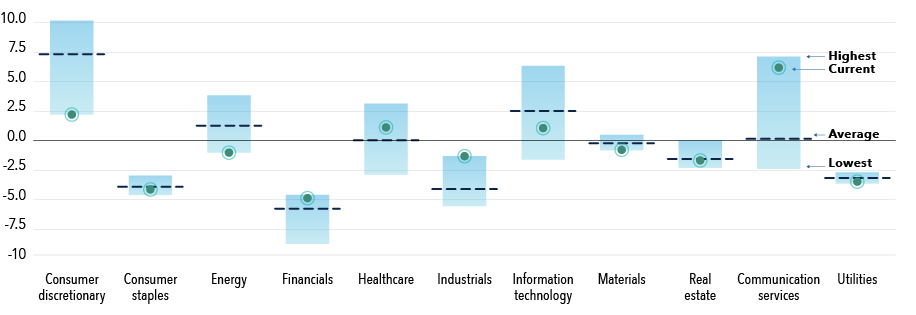
Chart showcases the range of relative sector exposure of The Growth Fund of America (GFA) versus the S&P 500 Index in all sectors including consumer discretionary, consumer staples, energy, financials, health care, industrials, information technology, materials, real estate, communication services and utilities. The vertical axis shows relative exposure ranging from negative 10% to positive 10%. For each sector, a shaded vertical bar indicates the highest and lowest relative exposure, a dashed line marks the average, and a dot shows the current exposure. Consumer discretionary and information technology show the highest average relative exposure, while financials shows the lowest average exposure. Other sectors display smaller positive or negative deviations around the S&P 500.

Source: Capital Group. Data from 12/31/15 to 12/31/25.

 3

Diversified, not concentrated
 

  • GFA seeks to avoid the single sector and megacap concentration that has increasingly defined style-based growth benchmarks and the passive funds that track them.
  • This diversification spreads risk across the portfolio, reducing exposure to a narrow list of stocks.
  • As a result, the fund’s returns have been less dependent on top holdings than the indexes.*

Weight in top five holdings (%)
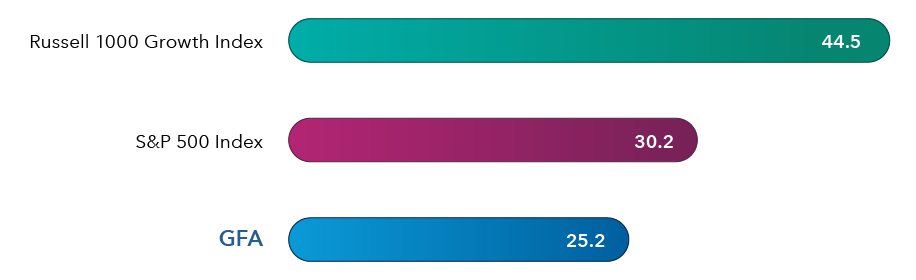
Horizontal bar chart compares the weight in top five holdings between the Russell 1000 Growth Index, the S&P 500 Index and The Growth Fund of America (GFA). The Russell 1000 Growth Index has the highest concentration, with 44.5% of assets in its top five holdings. The S&P 500 Index is at 30.2% while GFA is the lowest at 25.2%.

Source: Capital Group. As of 12/31/25.

 4

Seeking growth, but not at any cost
 

  • GFA offers a similar expected growth profile to the Russell 1000 Growth Index but at meaningfully lower valuations based on price-to-earnings (P/E) ratios.
  • This gap suggests investors are paying less for each unit of expected growth, potentially improving the return profile if fundamentals play out.
  • Growth is pursued with valuation awareness — not index indifference.

Valuation metrics
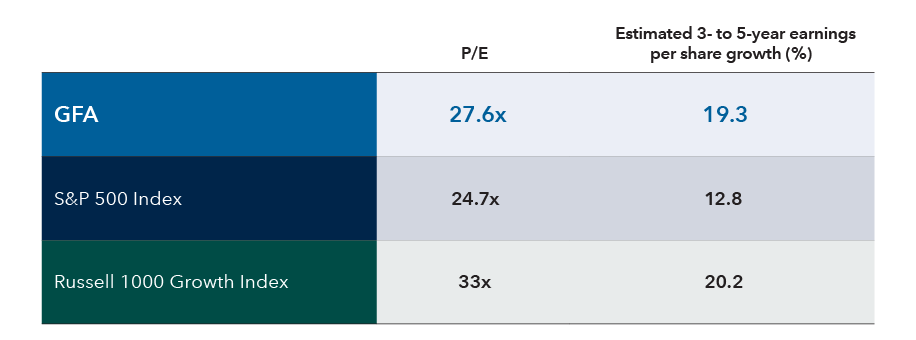
Table displays the price-to-earnings ratio alongside the estimated 3- to 5-year earnings per share growth for The Growth Fund of America (GFA), the S&P 500 Index and the Russell 1000 Growth Index. GFA has a price-to-earnings ratio of 27.6 times and estimated earnings per share growth of 19.3%. The S&P 500 Index shows a lower price-to-earnings ratio of 24.7 times and estimated earnings per share growth of 12.8%. The Russell 1000 Growth Index has the highest price-to-earnings ratio of 33 times and estimated earnings per share growth of 20.2%.

Sources: Capital Group, Factset. As of 12/31/25.

 5

A differentiated approach
 

  • Using a bottom-up approach, GFA has differentiated sector exposures compared to the S&P 500 and the Russell 1000 Growth indexes.
  • The fund has significantly smaller positions in technology companies relative to the Russell 1000 Growth and smaller relative to the S&P 500.
  • The fund has delivered diversification from extreme market concentration while breaking from conventional growth allocations.
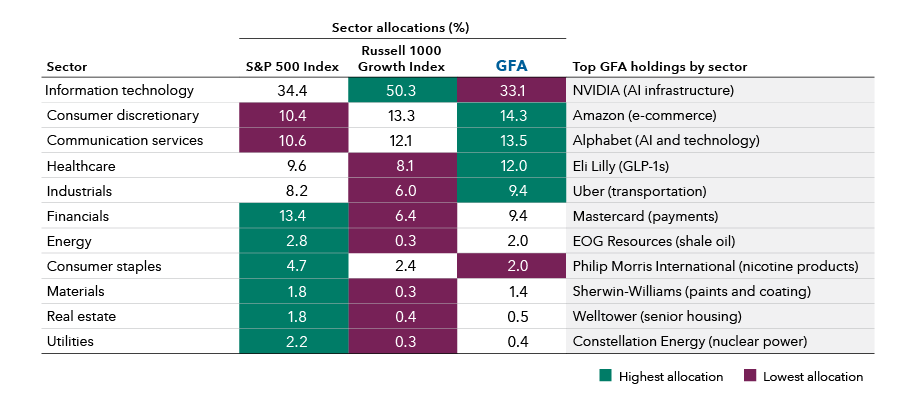
Table compares sector allocations for the top The Growth Fund of America (GFA) holdings by sector versus the S&P 500 Index and the Russell 1000 Growth Index. Information technology represents 34.4% of the allocation in the S&P 500 Index, 33.1% in GFA and 50.3% in the Russell 1000 Growth Index. Communication services is 10.6% in the S&P 500 Index, 13.5% in GFA and 12.1% in the Russell 1000 Growth Index. Consumer discretionary accounts for 10.4% in the S&P 500 Index, 14.3% in GFA and 13.3% in the Russell 1000 Growth Index. Health care represents 9.6% of the S&P 500 Index, 12% in GFA and 8.1% in the Russell 1000 Growth Index. Industrials is 8.2% in the S&P 500 Index, 9.4% in GFA and 6% in the Russell 1000 Growth Index. Financials accounts for 13.4% in the S&P 500 Index, 9.4% in GFA and 6.4% in the Russell 1000 Growth Index. Consumer staples represents 4.7% of the S&P 500 Index, 2% in GFA and 2.4% in the Russell 1000 Growth Index. Energy is 2.8% in the S&P 500 Index, 2% in GFA and 0.3% in the Russell 1000 Growth Index. Materials accounts for 1.8% in the S&P 500 Index, 1.4% in GFA and 0.3% in the Russell 1000 Growth Index. Utilities represents 2.2% in the S&P 500 Index, 0.4% in GFA and 0.3% in the Russell 1000 Growth Index. Real estate is 1.8% in the S&P 500 Index, 0.5% in GFA and 0.4% in the Russell 1000 Growth Index.

Source: Capital Group. As of 12/31/25. Numbers are rounded.

GFA details

Read more perspectives on equity markets

Footnote/Important information:
*For the three years ended 12/31/25.
 
Figures shown are past results and are not predictive of results in future periods. Current and future results may be lower or higher than those shown. Investing for short periods makes losses more likely. Prices and returns will vary, so investors may lose money. View mutual fund expense ratios and returns.
Investments are not FDIC-insured, nor are they deposits of or guaranteed by a bank or any other entity, so they may lose value.
Investors should carefully consider investment objectives, risks, charges and expenses. This and other important information is contained in the mutual fund prospectuses and summary prospectuses, which can be obtained from a financial professional and should be read carefully before investing.
Investing outside the United States involves risks, such as currency fluctuations, periods of illiquidity and price volatility. These risks may be heightened in connection with investments in developing countries.
Capital Group offers some funds in a range of share classes designed to meet the needs of retirement plan sponsors and participants. The different share classes incorporate varying levels of financial professional compensation and service provider payments. Because Class R-6 shares do not include any recordkeeping payments, expenses are lower and results are higher. Other share classes that include recordkeeping costs have higher expenses and lower results than Class R-6.
There have been periods when the results lagged the index(es) and/or average(s). The indexes are unmanaged and, therefore, have no expenses. Investors cannot invest directly in an index.
FTSE/Russell indexes: London Stock Exchange Group plc and its group undertakings (collectively, the “LSE Group”). © LSE Group 2026. FTSE Russell is a trading name of certain of the LSE Group companies. FTSE indexes are trademarks of the relevant LSE Group companies and are used by any other LSE Group company under license. All rights in the FTSE Russell indexes or data vest in the relevant LSE Group company which owns the index or the data. Neither LSE Group nor its licensors accept any liability for any errors or omissions in the indexes or data and no party may rely on any indexes or data contained in this communication. No further distribution of data from the LSE Group is permitted without the relevant LSE Group company's express written consent. The LSE Group does not promote, sponsor or endorse the content of this communication.
Each S&P Index ("Index") shown is a product of S&P Dow Jones Indices LLC and/or its affiliates and has been licensed for use by Capital Group. Copyright © 2026 S&P Dow Jones Indices LLC, a division of S&P Global, and/or its affiliates. All rights reserved. Redistribution or reproduction in whole or in part is prohibited without written permission of S&P Dow Jones Indices LLC.
All Capital Group trademarks mentioned are owned by The Capital Group Companies, Inc., an affiliated company or fund. All other company and product names mentioned are the property of their respective companies.
Portfolios are managed, so holdings will change. Certain fixed income and/or cash and equivalents holdings may be held through mutual funds managed by the investment adviser or its affiliates that are not offered to the public.
Totals may not reconcile due to rounding and/or cash flows.
Investment results assume all distributions are reinvested and reflect applicable fees and expenses.
Certain share classes were offered after the inception dates of some funds. Results for these shares prior to the dates of first sale are hypothetical based on the original share class results without a sales charge, adjusted for typical estimated expenses. 
  • Class R-6 shares were first offered on 5/1/2009.
Results for certain funds with an inception date after the share class inception also include hypothetical returns because those funds' shares sold after the funds' date of first offering. Refer to dates of first sale and specific expense adjustment information.
Use of this website is intended for U.S. residents only. Use of this website and materials is also subject to approval by your home office.
Capital Client Group, Inc.
This content, developed by Capital Group, home of American Funds, should not be used as a primary basis for investment decisions and is not intended to serve as impartial investment or fiduciary advice.
© 2026 Morningstar, Inc. All rights reserved. The information contained herein: (1) is proprietary to Morningstar and/or its content providers; (2) may not be copied or distributed; and (3) is not warranted to be accurate, complete or timely. Neither Morningstar, its content providers nor Capital Group are responsible for any damages or losses arising from any use of this information. Past performance is no guarantee of future results. Information is calculated by Morningstar. When applicable, due to differing calculation methods, the figures shown here may differ from those calculated by Capital Group.


For current information and month-end results, visit capitalgroup.com.
 

Price-to-earnings (P/E) ratio: The market value weighted, harmonic average of the P/E ratios of the individual companies held in the portfolio. This metric reflects the valuation of the underlying  companies held in the portfolio and is not a measure of the portfolio’s own earnings, share price, NAV, or operating performance.
 

Russell 1000 Growth Index: Tracks large-cap U.S. growth stocks by market capitalization.
 

S&P 500 Index: A market-capitalization-weighted index of about 500 major U.S. stocks. Includes reinvested dividends but excludes fees and taxes.
