5 things to know about CGDV – Capital Group Dividend Value ETF

KEY TAKEAWAYS

  • Income can play a critical role in portfolios.
  • Although traditional value strategies may leave portfolios vulnerable during periods of market volatility, a curated group of high-quality, dividend-paying companies can help.
  • CGDV aims to achieve this by actively pursuing companies that pay dividends or are positioned to do so, while seeking long-term capital appreciation through deep, fundamental research.

1.  It’s delivered both growth and income

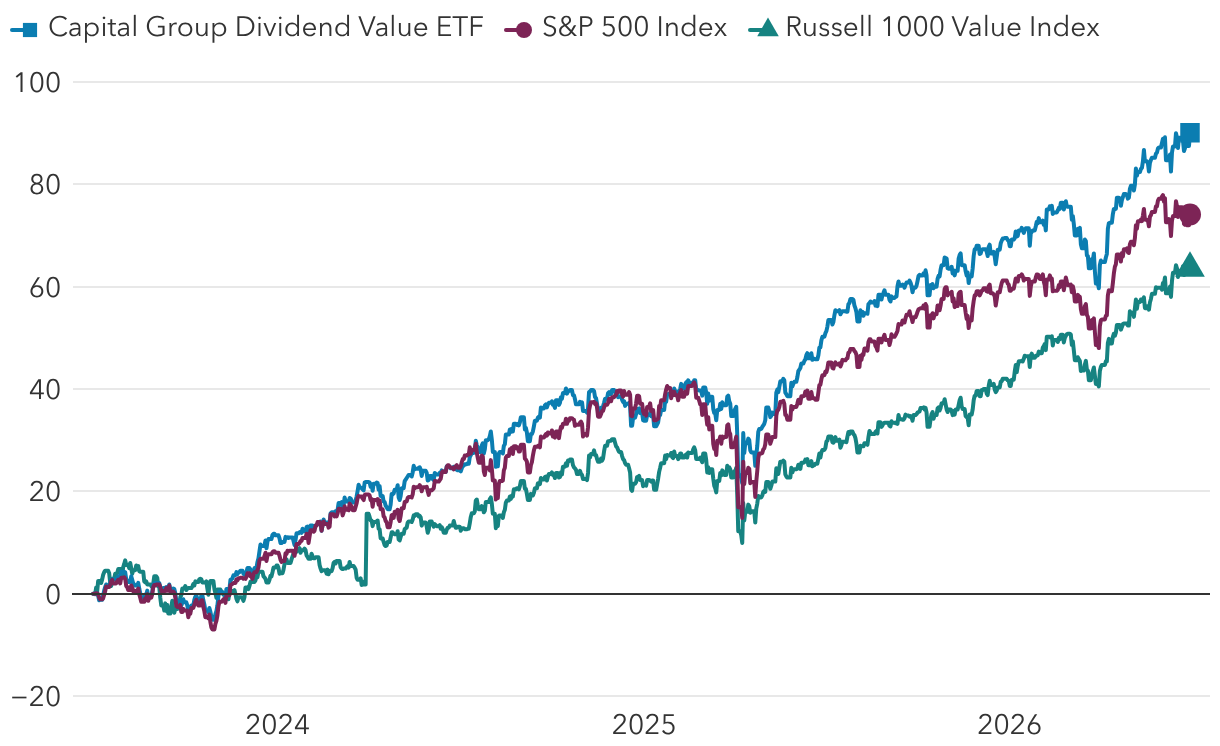
  • CGDV seeks gross income that outpaces the S&P 500 Index, along with greater capital appreciation.
  • The fund emphasizes dividend payers, with flexibility to own select nonpayers while maintaining quality discipline.
  • This approach has translated into higher yields, stronger returns and less downside than the S&P 500.

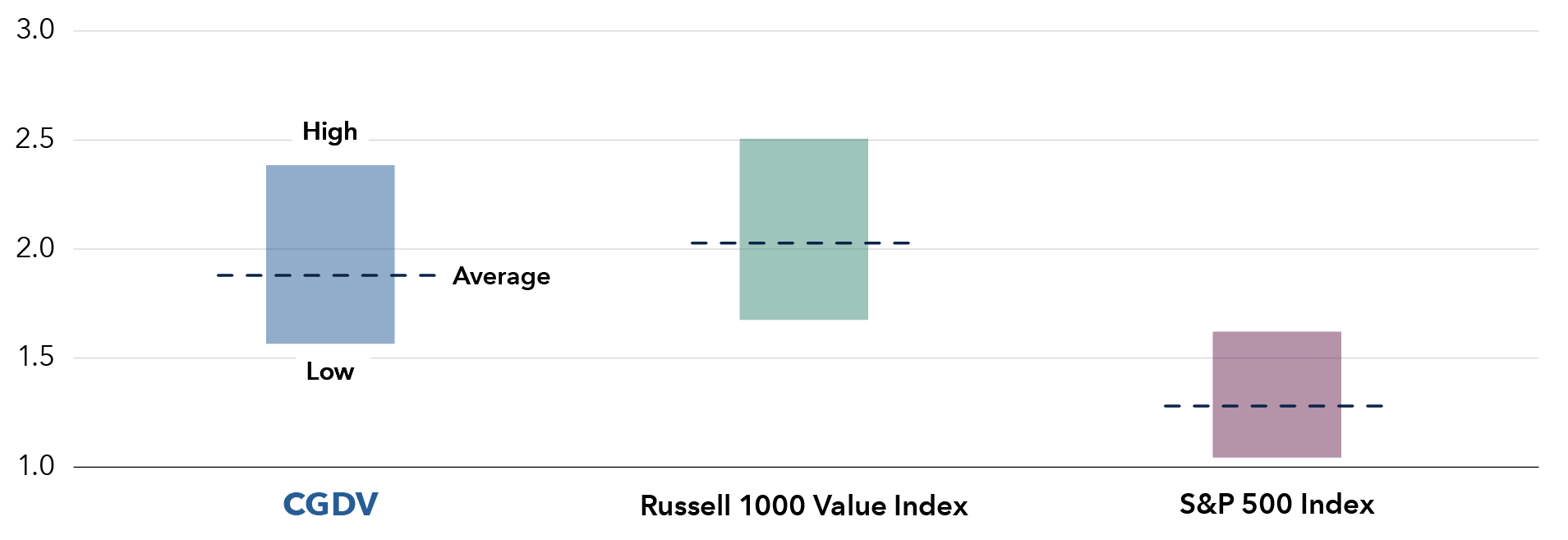
3-year range of dividend yields (%)

Three floating bar charts shows 3‑year dividend yields for CGDV – Capital Group Dividend Value ETF, the Russell 1000 Value Index, and the S&P 500 Index from January 1, 2023, to December 31, 2025. Among the three groups, the CGDV has the highest yield range, from 1.6% to 2.6%, followed by the Russell 1000 Value Index, ranging from 1.8% to 2.5%. The S&P 500 Index shows the lowest range, from around 1.1% to 1.8%. The Russell 1000 Value Index and CGDV share the same estimated average yield of 2.1%, while the S&P 500 Index displays the lowest average yield, below 1.5%.

Source: Morningstar. As of 12/31/25.

2.  Focused on high quality

  • The fund stands apart from the S&P 500 and the Russell 1000 Value indexes through its focus on high-quality companies.
  • The fund maintained 88% of its holdings in high-quality companies, well above the S&P 500 and Russell 1000 Value.
  • In our view, quality dividend-paying companies can help consistently mitigate downside risk in a way traditional value stocks cannot.

Holdings breakdown by security quality (equal weighted)
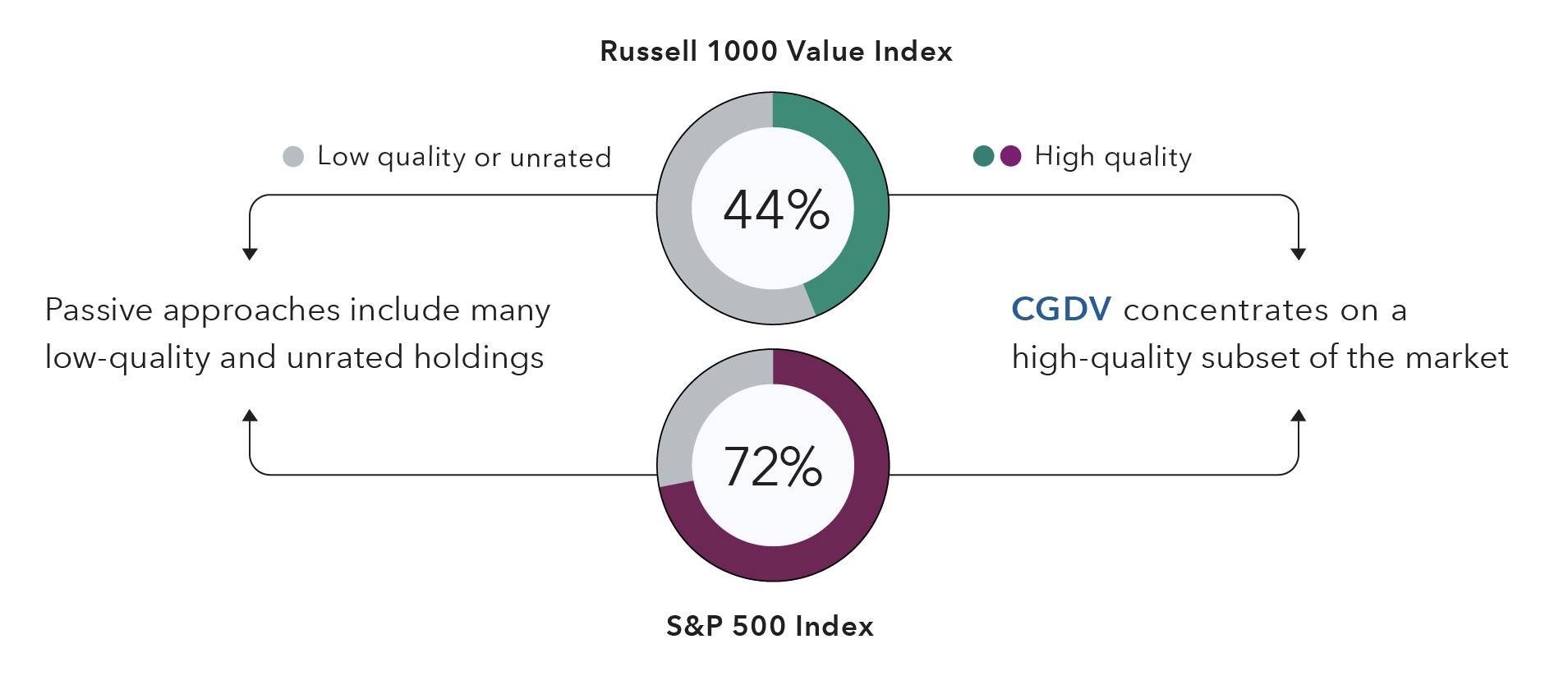
Donut charts showcase the holdings breakdown by security quality for the Russell 1000 Value Index and the S&P 500 Index on an equally weighted basis. For the Russell 1000 Value Index, 46% of holdings are rated high quality. For the S&P 500 Index, 71% of holdings are rated high quality. The accompanying annotations note that passive approaches include many low quality and unrated holdings, while CGDV – Capital Group Dividend Value ETF concentrates on the high-quality subset of the market.

Source: FactSet, with credit ratings by S&P Global Ratings. As of 12/31/25. High quality: BBB- and above.

3.  A disciplined framework

  • CGDV has invested in higher quality companies, more dividend payers and provided more international diversification than the S&P 500 and Russell 1000 Value indexes.
  • This differentiated positioning is enabled by continuous research, a global presence and active management.
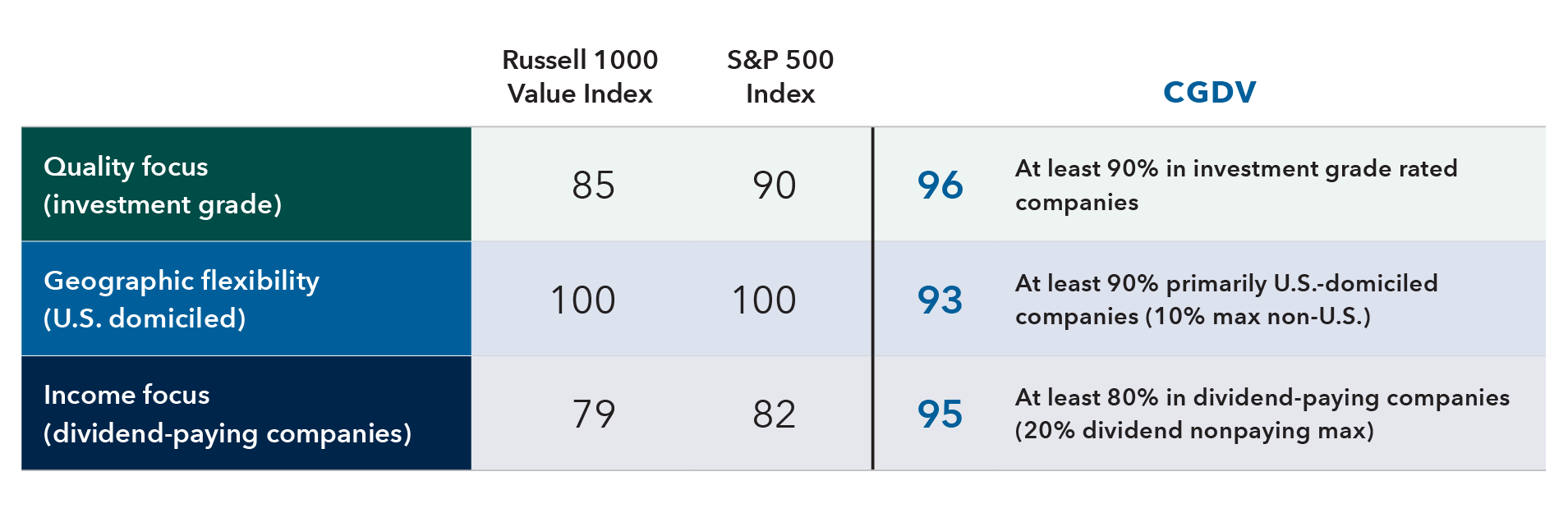
  • Three guidelines provide focus: CGDV holdings are at least 90% investment grade (BBB/Baa and above), primarily U.S.-domiciled (10% max non-U.S.) and at least 80% dividend payers.

Allocations to investment grade, U.S.-domiciled and dividend-paying companies (%)

Table shows allocations to investment grade, U.S.-domiciled and dividend paying companies for CGDV – Capital Group Dividend Value ETF, the Russell 1000 Value Index and the S&P 500 Index in percentages. Under quality focus, CGDV has 93% in investment grade rated companies compared with 82% for the Russell 1000 Value Index and 91% for the S&P 500 Index. Under geographic flexibility, CGDV has 93% in U.S.-domiciled companies, while both the Russell 1000 Value Index and the S&P 500 Index match in 100% allocation. Under income focus, CGDV invests 95% in dividend paying companies, compared with 83% for the Russell 1000 Value Index and 85% for the S&P 500 Index.

Source: FactSet, with credit ratings by S&P Global Ratings. As of 12/31/25.

4.  A history of more upside, with less downside

  • Beyond strong results in rising markets, CGDV demonstrated resilience when markets fell.
  • Notably, over the last three years, the fund delivered strong upside (participating in rising prices), with less downside (falling less than the market).
  • A distinctive approach, active flexibility and an emphasis on quality dividend payers have helped when markets were at their worst.

CGDV 3-year capture ratios (%)
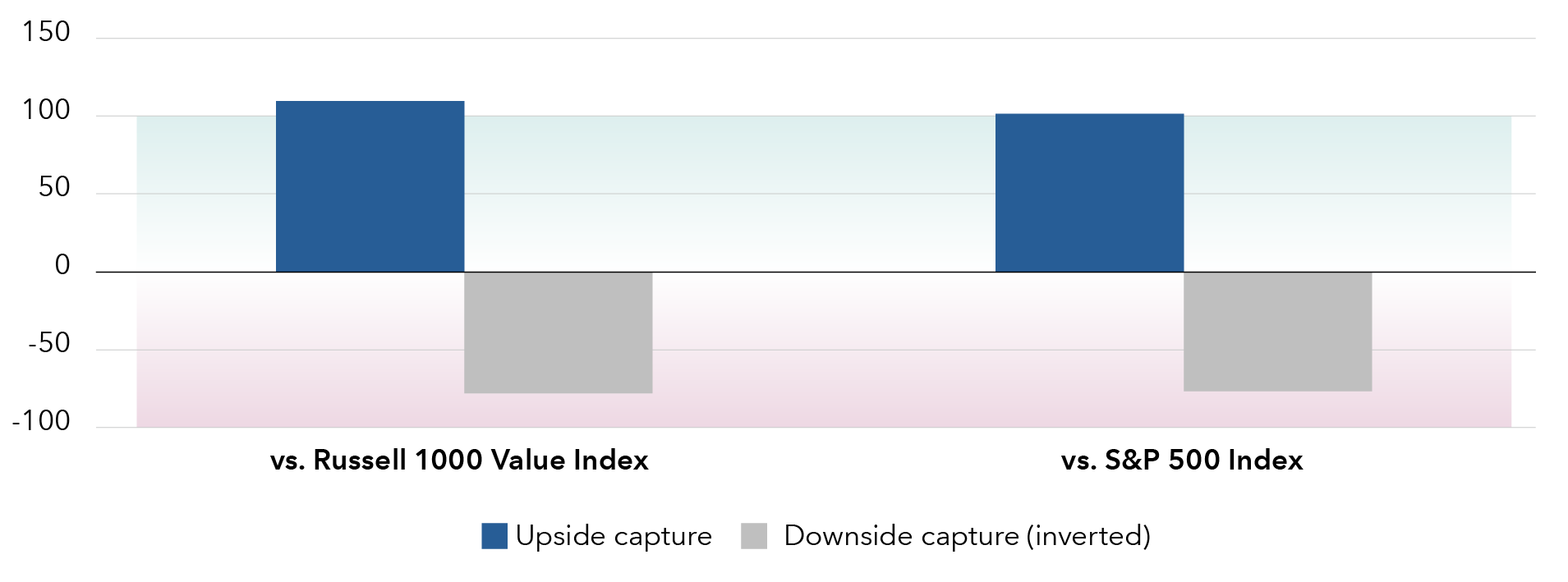
Bar chart shows CGDV – Capital Group Dividend Value ETF’s 3-year capture ratios versus the Russell 1000 Value Index and the S&P 500 Index. Against the Russell 1000 Value Index, CGDV shows an upside capture ratio more than 100% and a downside capture ratio around negative 50%, indicating it fell less than the index. Against the S&P 500 Index, CGDV shows an upside capture ratio of 100% and a negative downside capture ratio around negative 75%.

Source: Morningstar. As of 12/31/25.

5.  A differentiated approach

  • Using a bottom‑up approach, CGDV has unique sector exposures compared to the S&P 500 and Russell 1000 Value indexes.
  • The fund has been materially overweight technology versus the Russell 1000 Value — while remaining below the S&P 500’s concentration — and meaningfully underweight financials.
  • This positioning seeks to deliver diversification from extreme market concentration while breaking from conventional value allocations.
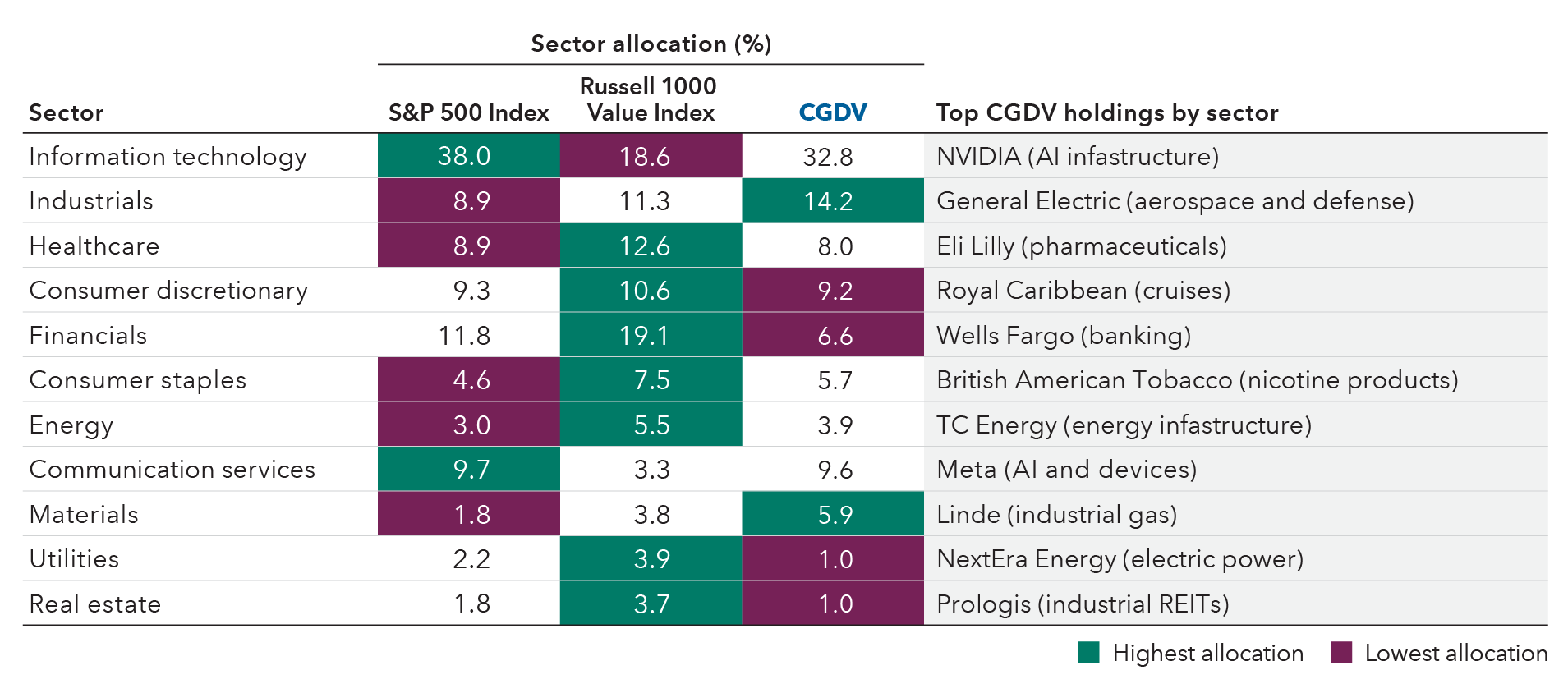
Table shows allocation comparisons for CGDV – Capital Group Dividend Value ETF holdings by sector versus the S&P 500 Index and the Russell 1000 Value Index. Information technology represents 34.4% of the allocation in the S&P 500 Index, 25.3% in CGDV and 11.3% in the Russell 1000 Value Index. Industrials is 8.2% for the S&P 500 Index, 15.8% for CGDV and 13.0% for the Russell 1000 Value Index. Health care is 9.6% in the S&P 500 Index, 14.0% in CGDV and 12.2% in the Russell 1000 Value Index. Consumer discretionary is 10.4% in the S&P 500 Index, 10.9% in CGDV and 7.4% in the Russell 1000 Value Index. Financials is 13.4% in the S&P 500 Index, 6.8% in CGDV and 22.3% in the Russell 1000 Value Index. Consumer staples is 4.7%in the S&P 500 Index, 6.6% in CGDV and 7.2% in the Russell 1000 Value Index. Energy is 2.8% in the S&P 500 Index, 5.7% in CGDV and 5.7% in the Russell 1000 Value Index. Communication services is 10.6% in the S&P 500 Index, 4.7% in CGDV and 8.5% in the Russell 1000 Value Index. Materials is 1.8% in the S&P 500 Index, 3.7% in CGDV and 4.0% in the Russell 1000 Value Index. Utilities is 2.2% in the S&P 500 Index, 2.5% in CGDV and 4.4% in the Russell 1000 Value Index. Real estate is 1.8% in the S&P 500 Index, 1.7% in CGDV and 4.0% in the Russell 1000 Value Index.

Source: FactSet. As of 12/31/25. Numbers are rounded.

Jacob M. Gerber is an equity and multi-asset investment director with 28 years of investment industry experience (as of 12/31/2025). He holds a bachelor’s degree in biology from University of California, Los Angeles.

Chris Dziubasik is an investment product manager with 25 years of industry experience (as of 12/31/2025). He holds an MBA from the University of Bridgeport and a bachelor's degree in finance from Central Connecticut State University.

Read all perspectives on equity markets

Figures shown are past results and are not predictive of results in future periods. Current and future results may be lower or higher than those shown. Investing for short periods makes losses more likely. Prices and returns will vary, so investors may lose money. View ETF expense ratios and returns. View current ETF SEC yields.
For Capital Group ETFs, market price returns are determined using the official closing price of the fund's shares and do not represent the returns you would receive if you traded shares at other times.
Investments are not FDIC-insured, nor are they deposits of or guaranteed by a bank or any other entity, so they may lose value.
Investors should carefully consider investment objectives, risks, charges and expenses. This and other important information is contained in the ETF prospectuses and summary prospectuses, which can be obtained from a financial professional and should be read carefully before investing.
Capital Group exchange-traded funds (ETFs) are actively managed and do not seek to replicate a specific index. ETF shares are bought and sold through an exchange at the then current market price, not net asset value (NAV), and are not individually redeemed from the fund. Shares may trade at a premium or discount to their NAV when traded on an exchange. Brokerage commissions will reduce returns. There can be no guarantee that an active market for ETFs will develop or be maintained, or that the ETF's listing will continue or remain unchanged.
Bond ratings, which typically range from AAA/Aaa (highest) to D (lowest), are assigned by credit rating agencies such as Standard & Poor's, Moody's and/or Fitch, as an indication of an issuer's creditworthiness.
There have been periods when the results lagged the index(es) and/or average(s). The indexes are unmanaged and, therefore, have no expenses. Investors cannot invest directly in an index.
FTSE/Russell indexes: London Stock Exchange Group plc and its group undertakings (collectively, the “LSE Group”). © LSE Group 2026. FTSE Russell is a trading name of certain of the LSE Group companies. FTSE indexes are trademarks of the relevant LSE Group companies and are used by any other LSE Group company under license. All rights in the FTSE Russell indexes or data vest in the relevant LSE Group company which owns the index or the data. Neither LSE Group nor its licensors accept any liability for any errors or omissions in the indexes or data and no party may rely on any indexes or data contained in this communication. No further distribution of data from the LSE Group is permitted without the relevant LSE Group company's express written consent. The LSE Group does not promote, sponsor or endorse the content of this communication.
Each S&P Index ("Index") shown is a product of S&P Dow Jones Indices LLC and/or its affiliates and has been licensed for use by Capital Group. Copyright © 2026 S&P Dow Jones Indices LLC, a division of S&P Global, and/or its affiliates. All rights reserved. Redistribution or reproduction in whole or in part is prohibited without written permission of S&P Dow Jones Indices LLC.
All Capital Group trademarks mentioned are owned by The Capital Group Companies, Inc., an affiliated company or fund. All other company and product names mentioned are the property of their respective companies.
Portfolios are managed, so holdings will change. Certain fixed income and/or cash and equivalents holdings may be held through mutual funds managed by the investment adviser or its affiliates that are not offered to the public.
Totals may not reconcile due to rounding.
Use of this website is intended for U.S. residents only. Use of this website and materials is also subject to approval by your home office.
Capital Client Group, Inc.
This content, developed by Capital Group, home of American Funds, should not be used as a primary basis for investment decisions and is not intended to serve as impartial investment or fiduciary advice.
© 2026 Morningstar, Inc. All rights reserved. The information contained herein: (1) is proprietary to Morningstar and/or its content providers; (2) may not be copied or distributed; and (3) is not warranted to be accurate, complete or timely. Neither Morningstar, its content providers nor Capital Group are responsible for any damages or losses arising from any use of this information. Past performance is no guarantee of future results. Information is calculated by Morningstar. Due to differing calculation methods, the figures shown here may differ from those calculated by Capital Group.

Russell 1000 Value Index: Tracks large-cap U.S. value stocks by market capitalization.


S&P 500 Index: A market-capitalization-weighted index of about 500 major U.S. stocks. Includes reinvested dividends but excludes fees and taxes.


Upside/downside capture ratios: Upside and downside capture ratios are expressed as percentages that measure how much of an index’s gains or losses an investment captures during rising and falling markets.


ETF market price returns since inception are calculated using NAV for the period until market price became available (generally a few days after inception).


Investing outside the United States involves risks, such as currency fluctuations, periods of illiquidity and price volatility. These risks may be heightened in connection with investments in developing countries.


When applicable, results reflect fee waivers and/or expense reimbursements, without which they would have been lower. Please see capitalgroup.com for more information.