
AMCAP Fund®
- Vehicle
- Mutual Fund
- Objective
- Growth
Percentage rolling success rates vs. benchmarks
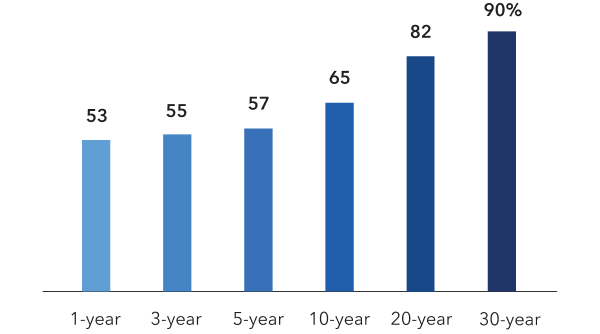
Percentage weight in Magnificent 7 stocks
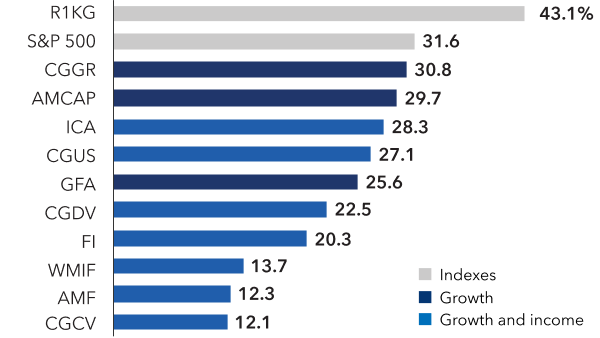
Source: Capital Group. As of 6/30/26. Rolling monthly success rates are for the American Funds® and ETFs noted in the right-hand chart. Observation periods for equity funds are based on individual inception dates and are for the full lifetime of each fund. The primary benchmark for all 10 of these funds is the S&P 500. Magnificent 7: Alphabet, Amazon, Apple, Meta, Microsoft, NVIDIA and Tesla. Alphabet is represented by both Class A and Class C shares. R1KG – Russell 1000 Growth Index, CGGR – Capital Group Growth ETF, AMCAP – AMCAP Fund®, CGUS – Capital Group Core Equity ETF, GFA – The Growth Fund of America®, ICA – The Investment Company of America®, FI – Fundamental Investors®, CGDV – Capital Group Dividend Value ETF, WMIF – Washington Mutual Investors Fund, CGCV – Capital Group Conservative Equity ETF, AMF – American Mutual Fund®.
“I am focused on both the mix of AI-related stocks I own and how I am counterbalancing them with the rest of the portfolio.”
Alan Wilson
Portfolio manager
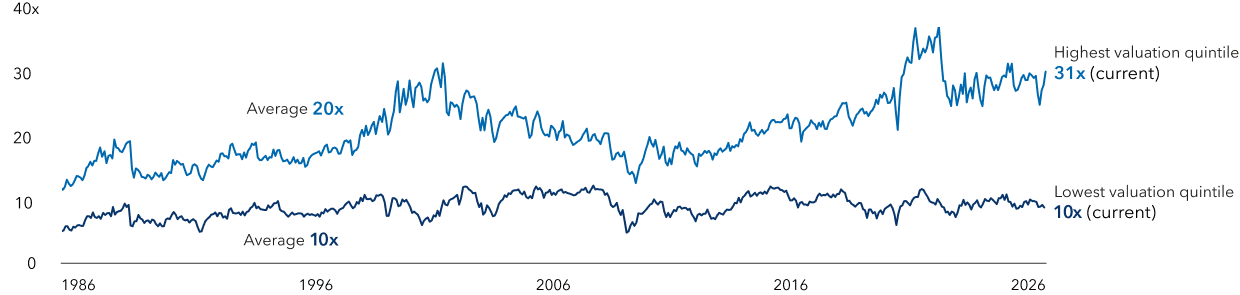
Source: Goldman Sachs Global Investment Research. As of 6/30/26. Forward P/E represents the P/E multiple for the next fiscal year. Price-to-earnings (P/E) ratio: Stock price divided by earnings per share. Valuation: An estimate of a company’s worth based on metrics including earnings, revenue or assets.
CAPITAL GROUP GROWTH ETF

Analyst-Driven: 100%
Data Coverage: 100%
Source: Morningstar.
As of 4/27/26.
“I am actively looking for companies that are out of favor today but could do well amid volatility. These types of sectors are trading near historically low valuations with decent earnings, long-term assets and upside potential.”
Chris Buchbinder
Portfolio manager
*Based on total returns between 2/19/25 and 4/8/25.
S&P 500 annualized total return by decade as of 12/31/25

Sources: Capital Group, S&P Dow Jones Indices. Total return for the S&P 500 Index was negative for the 2000s. Dividends provided a 1.8% annualized return over the decade.
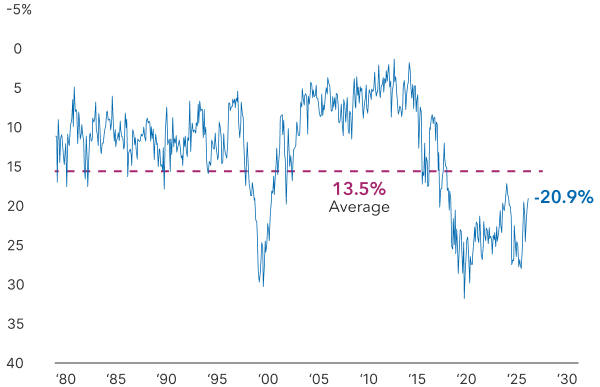
Source: Goldman Sachs Global Investment Research. As of 6/30/26. P/E ratio: Price-to-earnings. The forward P/E represents the forward ratio for the next fiscal year. This exhibit is examining the P/E multiple of the cohort of stocks in the S&P 500 Index with the highest quintile dividend yield (sector neutral) relative to the broad S&P 500 Index.
CAPITAL GROUP DIVIDEND VALUE ETF
Analyst-Driven: 100%
Data Coverage: 100%
Source: Morningstar.
As of 4/27/26.

Perspectives
Multiple: A way to gauge company performance by dividing one metric by another. Above, it refers to the P/E ratio.
Success rate: How often a fund outpaced peers or benchmarks.
Volatility: A measure of how much a stock’s price fluctuates. Higher volatility means larger price swings and more risk.
Past results are not predictive of results in future periods.
Russell 1000 Growth Index is a market capitalization-weighted index that represents the large-cap growth segment of the U.S. equity market and includes stocks from the Russell 1000 Index that have high price-to-book ratios and higher expected growth values.
S&P 500 Index is a market capitalization-weighted index based on the results of approximately 500 widely held common stocks. Results include reinvested dividends but excludes fees and taxes.
Investing outside the United States involves risks, such as currency fluctuations, periods of illiquidity and price volatility. These risks may be heightened in connection with investments in developing countries. (Also applies to CGDV, CGGR and CGUS).
Nondiversified funds have the ability to invest a larger percentage of assets in the securities of a smaller number of issuers than a diversified fund. As a result, poor results by a single issuer could adversely affect fund results more than if the fund were invested in a larger number of issuers. See the applicable prospectus for details. (Also applies to CGCV and CGGR).
The Morningstar Medalist Rating is the summary expression of Morningstar's forward-looking analysis of investment strategies as offered via specific vehicles using a rating scale of Gold, Silver, Bronze, Neutral, and Negative. The Medalist Ratings indicate which investments Morningstar believes are likely to outperform their Morningstar Category average on a risk-adjusted basis over time.
Investment products are evaluated on three fundamental pillars (People, Parent, and Process) and the Medalist Rating Price Score, which forms the basis for Morningstar's conviction in those products' investment merits and determines the Medalist Rating they are assigned. Pillar ratings take the form of Low (-2), Below Average (-1), Average (0), Above Average (+1), and High (+2). Pillars may be evaluated via an analyst's qualitative assessment (either directly to a vehicle the analyst covers or indirectly when the pillar ratings of a covered vehicle are mapped to a related uncovered vehicle) or using algorithmic techniques.
The cost of an investment product is evaluated using the Medalist Rating Price Score, which is a continuous score running from negative 2.5 to positive 2.5 based on the percentile rank of a vehicle's expense ratio within its Morningstar Category. Morningstar combines the pillar scores and Medalist Rating Price Score using predetermined weights for actively and passively managed vehicles to calculate a weighted score. The weighted score is then compared to a set of fixed numeric thresholds employed consistently across Morningstar Categories and regions, with separate thresholds for actively and passively managed investments. Rating thresholds are reviewed at least annually. Buffers and ratings caps are employed to prevent frequent ratings changes.
When analysts directly cover a vehicle, they assign the fundamental pillar ratings based on their qualitative assessment, subject to the oversight of the Analyst Rating Committee, and monitor and reevaluate them approximately once a year. When vehicles are covered either indirectly by analysts or by algorithm, the ratings are assigned monthly. For more detail information about the Medalist Ratings, including their methodology, please visit Morningstar’s website for more information.
The Morningstar Medalist Ratings are not statements of fact, nor are they credit or risk ratings. The Morningstar Medalist Rating (i) should not be used as the sole basis in evaluating an investment product, (ii) involves unknown risks and uncertainties which may cause expectations not to occur or to differ significantly from what was expected, (iii) is not guaranteed to be based on complete or accurate assumptions or models when determined algorithmically, (iv) involves the risk that return targets will not be met due to unforeseen changes in management, technology, economic development, interest rate development, operating and/or material costs, competitive pressure, supervisory law, exchange rates, tax rates, or political and social conditions, and (v) should not be considered an offer or solicitation to buy or sell the investment product.
A change in the fundamental factors underlying the Morningstar Medalist Rating may result in the rating no longer being accurate. Analysts do not have any other material conflicts of interest at the time of publication. Users wishing to obtain further information should contact their local Morningstar office.