Economic Indicators
“Made in America” has been a government policy, a political slogan and a marketing strategy throughout U.S. history. Going as far back as the Revolutionary War, the Homespun Movement encouraged colonists to make their own blankets and clothing in symbolic resistance to British economic control.
So it should be no surprise that this deeply rooted tradition is once again gaining momentum in a bipartisan push to bring manufacturing back to the United States. The goal is to reindustrialize, at least partially, a nation that abandoned the manufacturing sector decades ago. So far, there are concrete signs it’s happening and may continue to gain momentum in the years ahead.
“There are some powerful tailwinds at work here,” says Diana Wagner, a portfolio manager with Washington Mutual Investors Fund. “We’ve had 30-plus years of offshoring manufacturing to China, and now those trends are starting to reverse. Given labor and regulatory bottlenecks in the U.S., I think this reshoring trend is going to take many years to play out, and that’s why I see it as a tailwind that could be with us for a long time.”
While it may be too optimistic to think the U.S. will regain its former status as a manufacturing powerhouse, here are three areas where progress is being made to rebuild a long-neglected segment of the domestic economy:
The Trump administration, and the Biden administration before that, have both used a combination of incentives and penalties to encourage companies to invest in new manufacturing facilities. Taking a “carrot and stick” approach — with tax incentives as carrots and tariffs as sticks — political leaders have persuaded some of the biggest companies in the world to invest billions of dollars to boost their manufacturing capabilities inside the U.S.
This year alone, U.S. tech giants such as Apple and NVIDIA, as well as non-U.S. companies such as AstraZeneca, Taiwan Semiconductor Manufacturing and Hyundai, have announced multibillion-dollar plans to establish or expand their U.S. operations making computer chips, pharmaceuticals and automobiles.
Companies plan to spend billions to boost U.S. manufacturing capabilities
Sources: Capital Group, company press releases.
Just last week, NVIDIA said it is now manufacturing its most advanced computer chip, known as the Blackwell platform, entirely within the United States. Designed for use in large-scale artificial intelligence (AI) generative models, the first Blackwell wafer was produced in October at a plant in Arizona operated by Taiwan Semiconductor.
Citing national security concerns, the Trump administration has maintained that the most powerful AI chips should be built in the U.S. On top of that, the U.S. government has restricted sales to certain countries, primarily China and Russia.
“In targeted sectors related to national security, the reindustrialization of the United States is achievable. It will just take time and consistent bipartisan effort,” says Capital Group international policy advisor Tom Cooney, a former diplomat with the U.S. State Department. “This includes computer chips, AI data centers and ship building. There is bipartisan support to encourage and even subsidize that type of manufacturing in the U.S.
“Other sectors, such as automobiles and electronics, may be more difficult,” Cooney adds. “But I think the government will do whatever it takes to shore up areas where national security issues are at stake.”
Hear more from Tom Cooney:
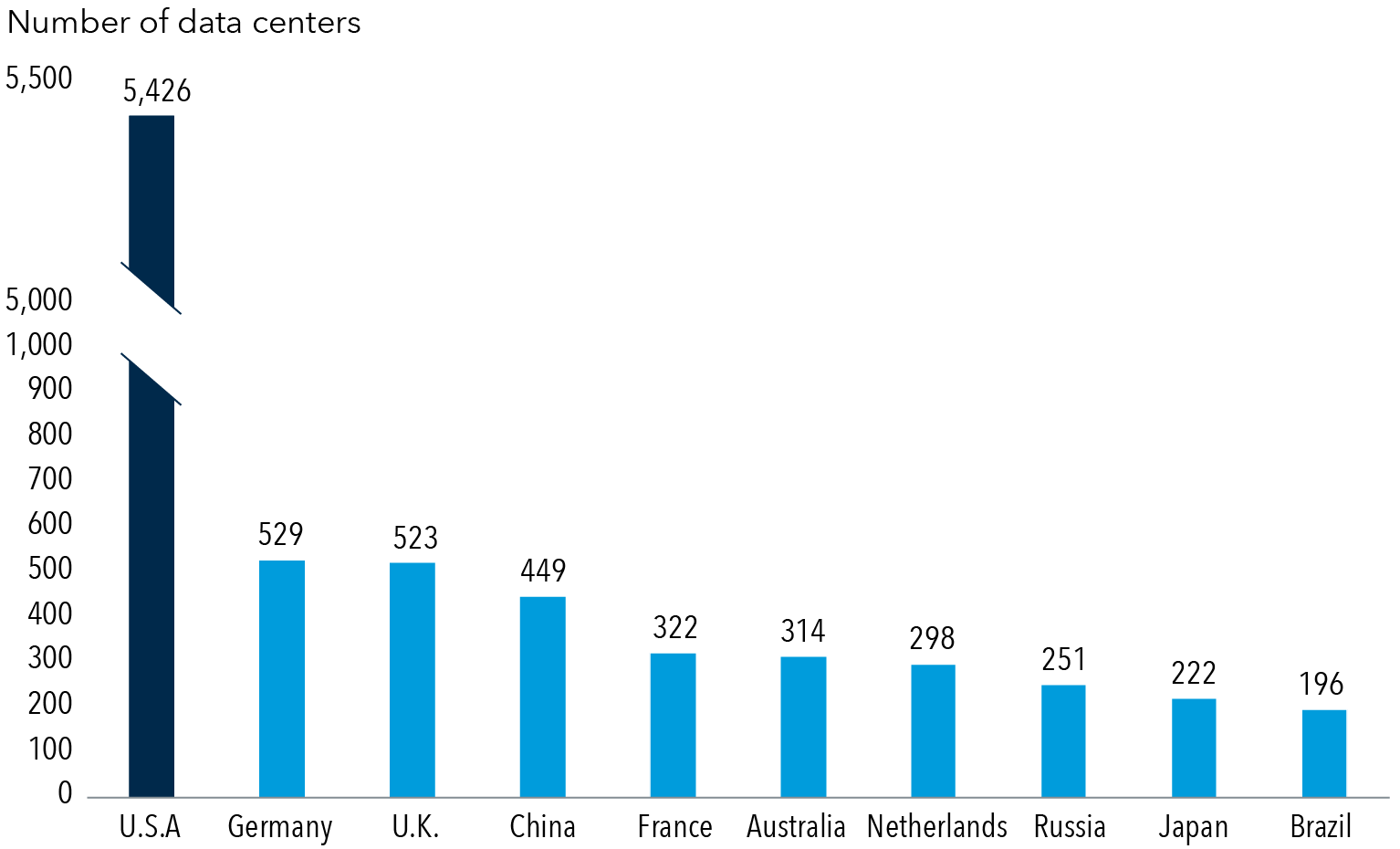
Of all the areas where companies have made commitments to invest in U.S. manufacturing, artificial intelligence is by far the most impactful. The AI boom has spawned a massive construction effort building data centers across the country, including major concentrations in California, Texas, Illinois and Virginia. The U.S. currently has more than 5,400 data centers, which is more than Germany, the U.K., China, France, Australia, the Netherlands, Russia, Japan and Brazil combined.
The AI building spree is effectively spreading tech-sector wealth to companies in the industrials sector, particularly those that provide construction services, industrial equipment, power generation and cooling systems. Leading companies in these areas, such as construction giant Caterpillar and energy equipment maker GE Vernova, have seen demand for their services soar.
The U.S. is far ahead in the race to build AI data centers
Sources: Capital Group, Statista, Cloudscene. Data as of March 2025.
A maker of gas turbines and transformers, GE Vernova recently reported that it has a three-year backlog of orders for equipment. In some high demand areas of the country, companies are on waiting lists to connect to power utilities. Similarly, Siemens Energy, a maker of gas and wind turbines, said its quarterly backlog reached a record $141 billion, with much of the demand coming from U.S. data centers.
“Data center expansion has created a great divide in industrial markets between the haves and have nots,” says equity analyst Nate Burggraf, who covers U.S. industrial companies. The “haves” are the companies with business tied to AI data centers, in addition to aerospace and defense. The “have nots” are essentially all other industrial firms, including those connected to agriculture, trucking, housing and commercial office space. “What we are seeing so far in terms of the reindustrialization of America has been the industrialization of AI.”
Pharmaceuticals are one of several areas where it may be difficult to shift large-scale manufacturing back to the U.S., particularly for certain key medical needs. This was a harsh lesson learned during the COVID-19 pandemic when supply chains broke down and, for a time, the U.S. struggled to obtain important drugs and other medical supplies.
In the realm of antibiotics, for example, China dominates the global market as the lowest cost provider of critical drugs used to treat bacterial infections. In perhaps the most extreme example, the country supplies 95% of U.S. Ibuprofen imports, giving it a near monopoly on a treatment for pain, fever and inflammation.
Although the pharma sector has been less enthusiastic about moving its operations, which are generally concentrated in lower cost countries such as China and India, some of the world’s largest drug companies are bucking the trend. They are taking advantage of generous tax incentives to expand their domestic capabilities — and seeking to avoid higher tariffs in the process.
U.S. relies heavily on China for crucial antibiotics
Sources: Capital Group, U.S. Census Bureau, US Antibiotic Importation and Supply Chain Vulnerabilities. JAMA Health Forum. Published October 3, 2025. Export shares are based on total kilograms exported in 2024.
Johnson & Johnson announced in July that it will spend $55 billion over the next four years to build three new drug-manufacturing complexes in the U.S. and expand several others. That same month, AstraZeneca committed to spending $50 billion on a new facility in Virginia. In June, unveiling an initiative called “Lilly in America,” Eli Lilly pledged to invest $27 billion to build four new facilities dubbed “mega sites.”
“There are good reasons for pharmaceutical companies to build new incremental capacity in the U.S., and we are starting to see that happen,” says Charles Ellwein, a portfolio manager with CGUS — Capital Group Core Equity ETF.
How far could the U.S. go on this path of reindustrialization? Only time will tell. But it’s not difficult to see how a modern-day version of Made in America could wind up being a highly selective endeavor.
“Realistically, I don’t think the U.S. will reemerge as a manufacturing powerhouse — we gave up that capability a long time ago,” says Steve Watson, a portfolio manager with New Perspective Fund®. “But I do think the U.S. will become more self-reliant, particularly when it comes to critically important products, such as computer chips and pharmaceuticals.
“The actions of the current U.S. administration are reinforcing that message, taking us down rockier terrain than many investors would like,” he adds. “But there’s no mistaking the goal: The U.S. is seeking to reshape the path of global trade.”
Economic Indicators
Demographics & Culture
U.S. Equities
RELATED INSIGHTS
Economic Indicators
The Capital Ideas newsletter delivers weekly insights straight to your inbox.