Defined Contribution
Categories
Market Volatility
Looking beyond conflict: Viewing volatility as opportunity
 Steve Watson
April 23, 2026
Don't miss our latest insights.
Investors are climbing a high wall of worries in 2026. With wars in the Middle East and Ukraine, messy trade disputes in the world’s major economic regions, growing fears over the impact of artificial intelligence, and deep political divisions in the United States and elsewhere, it can be difficult to remove emotions from practical investment decisions.
The war in Iran is the latest example. Each day brings a new distressing headline about a fragile ceasefire, elevated oil prices and the threat of renewed military action. The world looks terrible right now. It often looks terrible. But at times like these, I always try to remember that difficult times can also bring compelling investment opportunities for patient, long-term investors.
I’ve been in this business now for nearly 40 years, and I have counted the number of market disruptions I’ve experienced. It’s about 25, which means there has been a major event in the market, on average, every 18 months during my career. So I’m not saying be happy about bad times; I’m saying remember what they represent. Remember that they can present opportunities as share prices go on sale. And, perhaps most importantly, remember that a better day is coming.
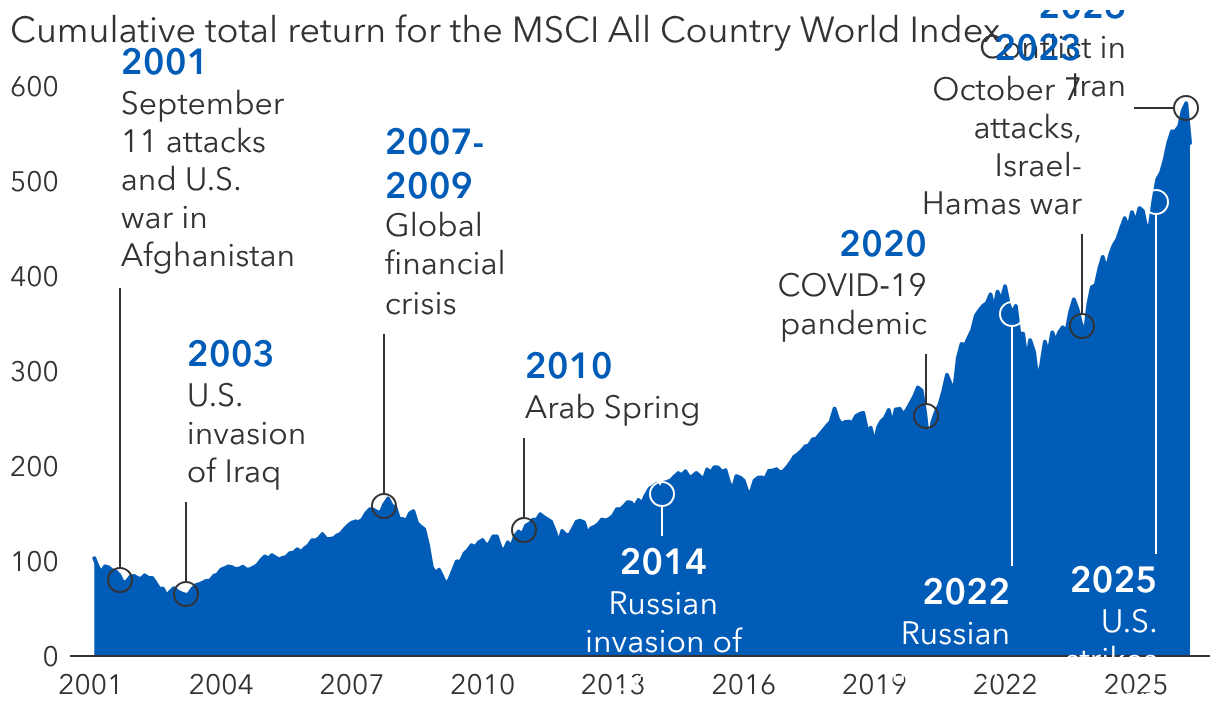
Global equities have powered through decades of conflicts and crises
Sources: Capital Group, MSCI. Monthly data is indexed to 100 as of December 31, 2000, based on cumulative total returns in U.S. dollars for the MSCI All Country World Index. Figures shown are from January 31, 2001, to March 31, 2026. Past results are not predictive of results in future periods.
It may sound surprising given all the drama in the world, but I am cautiously optimistic about the outlook for global equities. There's a lot of negative news. There's a lot of stock market volatility. So I feel more cautious today than I did a year ago. But if the Iran conflict can be resolved soon, I think oil prices will start to trend back down. That means interest rates may also trend down. I think that will be a plus for global economic growth and for returns from global stocks. Of course, everyone hopes for a speedy end to this conflict. That is my hope. But it is also my expectation.
That expectation also appears to be reflected in U.S. stocks. Despite sharply higher oil prices since the Iran war began, the S&P 500 Index hit a new record high last week. Things could change, but for the time being, the stock market is anticipating a swift end to the hostilities. We are seeing the same message in oil futures, which are now indicating that prices should fall toward $73 a barrel by the end of the year, roughly where they were before the U.S. and Israel attacked Iran on February 28.
U.S. stocks have risen to record highs amid elevated oil prices
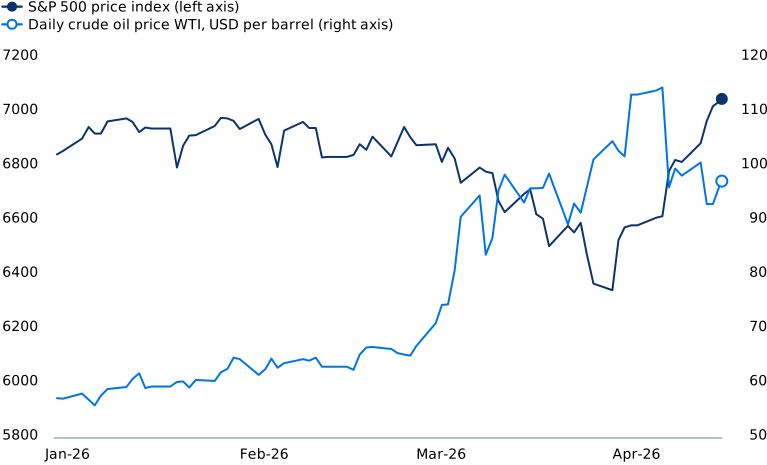
Sources: Capital Group, LSEG Refinitiv, S&P Global. Oil prices are represented by the spot price for the West Texas Intermediate (WTI). As of April 16, 2026.
Investing after the war ends
As we anxiously await the outcome of peace negotiations, I am looking ahead to the investment opportunities that may emerge as the world moves on from this conflict. In my view, international and emerging market stocks were highly attractive before the Iran war interrupted a rally in non-U.S. markets, and I think they are still attractive today. The biggest reason for that is a valuation advantage.
Even after a strong rally among non-U.S. stocks in 2025, stocks in the rest of the world are still trading at a sizable price-to-earnings discount relative to the S&P 500. Emerging markets are trading at a roughly 40% discount. So, in my view, there are real bargains outside the U.S. today, and often they can be found among companies that are world leaders in their industries. They just happen to be domiciled in other countries. They include companies like U.K.-based drug giant AstraZeneca; China-based Tencent, the largest gaming company in the world; and Taiwan Semiconductor Manufacturing Company, the world’s leading computer chip maker.
Much earlier in my career, leadership shifted back and forth between U.S. and non-U.S. stocks. It was like a game of ping-pong. I think there is a strong chance that we are headed back to that type of investment environment, where U.S. stocks lead for a while, but international and emerging market stocks also have their time to shine.
Hear more from Steve Watson:
Energy sector on the rise
I am also constructive on the energy sector, which has been out of favor with investors for many years. Yes, oil companies such as ExxonMobil, Royal Dutch Shell and TotalEnergies have benefited from higher oil prices during the Iran conflict, but I find the sector attractive on a long-term basis as well.
Setting aside near-term moves in oil prices, the industry has changed its spots in recent years. There is less focus on finding new oil fields to drill and more emphasis on being thoughtful about the balance sheet, strategic about capital expenditures and serious about dividends. I am not likely to walk away from the oil industry after this conflict is over because it offers some positive attributes for long-term shareholders, not the least of which have been generous dividend payments.
I am also sifting through the artificial intelligence wreckage for companies that may have been unfairly hit by fears that easy-to-use AI applications will impair their business. Those include large software companies, such as Germany’s SAP, and companies in the online travel space, including China’s Trip.com and Spain’s Amadeus IT Group. These companies are AI enablers, in my view, not "AI roadkill."
Volatility is your friend
All the investment themes I have discussed thus far have gone through bouts of volatility, unloved by investors for one reason or another. It comes with the territory, especially if you are the type of investor, like me, who prioritizes valuations and doesn’t mind waiting for an investment to come back into favor at some point down the road. Trouble and uncertainty are fertile hunting grounds for these opportunities.
And uncertainty is always just around the corner. We may imagine a past characterized by low volatility, and great certainty, but I think if that's how you remember the past, you're probably misremembering.
Learn more about
Investing outside the United States involves risks, such as currency fluctuations, periods of illiquidity and price volatility.
MSCI All Country World Index (ACWI) is a free float-adjusted market capitalization-weighted index designed to measure equity market results in the global developed and emerging markets, consisting of more than 40 developed and emerging market country indexes.
S&P 500 Index is a market capitalization-weighted index based on the results of approximately 500 widely held common stocks. The market index is unmanaged and, therefore, has no expenses. Investors cannot invest directly in an index.
Source: MSCI. The MSCI information may only be used for your internal use, may not be reproduced or redisseminated in any form and may not be used as a basis for or a component of any financial instruments or products or indices. None of the MSCI information is intended to constitute investment advice or a recommendation to make (or refrain from making) any kind of investment decision and may not be relied on as such. Historical data and analysis should not be taken as an indication or guarantee of any future performance analysis, forecast or prediction. The MSCI information is provided on an “as is” basis and the user of this information assumes the entire risk of any use made of this information. MSCI, each of its affiliates and each other person involved in or related to compiling, computing or creating any MSCI information (collectively, the “MSCI Parties”) expressly disclaims all warranties (including, without limitation, any warranties of originality, accuracy, completeness, timeliness, non-infringement, merchantability and fitness for a particular purpose) with respect to this information. Without limiting any of the foregoing, in no event shall any MSCI Party have any liability for any direct, indirect, special, incidental, punitive, consequential (including, without limitation, lost profits) or any other damages. Visit the MSCI.com website for more information.
The S&P 500 Index is a product of S&P Dow Jones Indices LLC and/or its affiliates and has been licensed for use by Capital Group. Copyright © 2026 S&P Dow Jones Indices LLC, a division of S&P Global, and/or its affiliates. All rights reserved. Redistribution or reproduction in whole or in part is prohibited without written permission of S&P Dow Jones Indices LLC.
Our latest insights
-
-
-
Artificial Intelligence
-
Artificial Intelligence
-
Interest Rates
RELATED INSIGHTS
Don’t miss out
Get the Capital Ideas newsletter in your inbox every other week
Investments are not FDIC-insured, nor are they deposits of or guaranteed by a bank or any other entity, so they may lose value.
Investors should carefully consider investment objectives, risks, charges and expenses.
This and other important information is contained in the fund prospectuses and/or summary prospectuses, which can be obtained from a financial professional and should be read carefully before investing.
Statements attributed to an individual represent the opinions of that individual as of the date published and do not necessarily reflect the opinions of Capital Group or its affiliates. This information is intended to highlight issues and should not be considered advice, an endorsement or a recommendation.
All Capital Group trademarks mentioned are owned by The Capital Group Companies, Inc., an affiliated company or fund. All other company and product names mentioned are the property of their respective companies.
This content, developed by Capital Group, home of American Funds, should not be used as a primary basis for investment decisions and is not intended to serve as impartial investment or fiduciary advice.
Capital Client Group, Inc.
Use of this website is intended for U.S. residents only.