A growing share of secured bonds
The risk profile for high-yield bonds has improved as more companies issued secured bonds over the past decade. In 2025, 39% of high-yield issuance was secured debt, with 52% of first-time high-yield issuers in the market with senior secured paper, according to an annual report from J.P. Morgan. The rise of secure financing is near peak levels, having increased significantly in the last five years. Specifically, in 2025, 34% of the high-yield universe is now secured against a pool of collateral, up from 12% in 2007 prior to the GFC and 18% in 2020, ahead of the pandemic.
Duration has shortened
Another trend in the high-yield market has been a steady decline in duration over the past two decades. Generally, companies are seeking financial flexibility within their capital structure by staggering maturities and call options. Many issuers opted to issue shorter dated paper as interest rates rose in 2022 to avoid locking in higher rates. They also sought call structures that allow refinancing over a shorter time horizon than prior deals. Still, despite a structurally shorter duration profile over the past 15 years, longer dated issuance in the six-year-and-beyond timeframe may slowly return to pre-COVID levels.
Looking beyond spreads
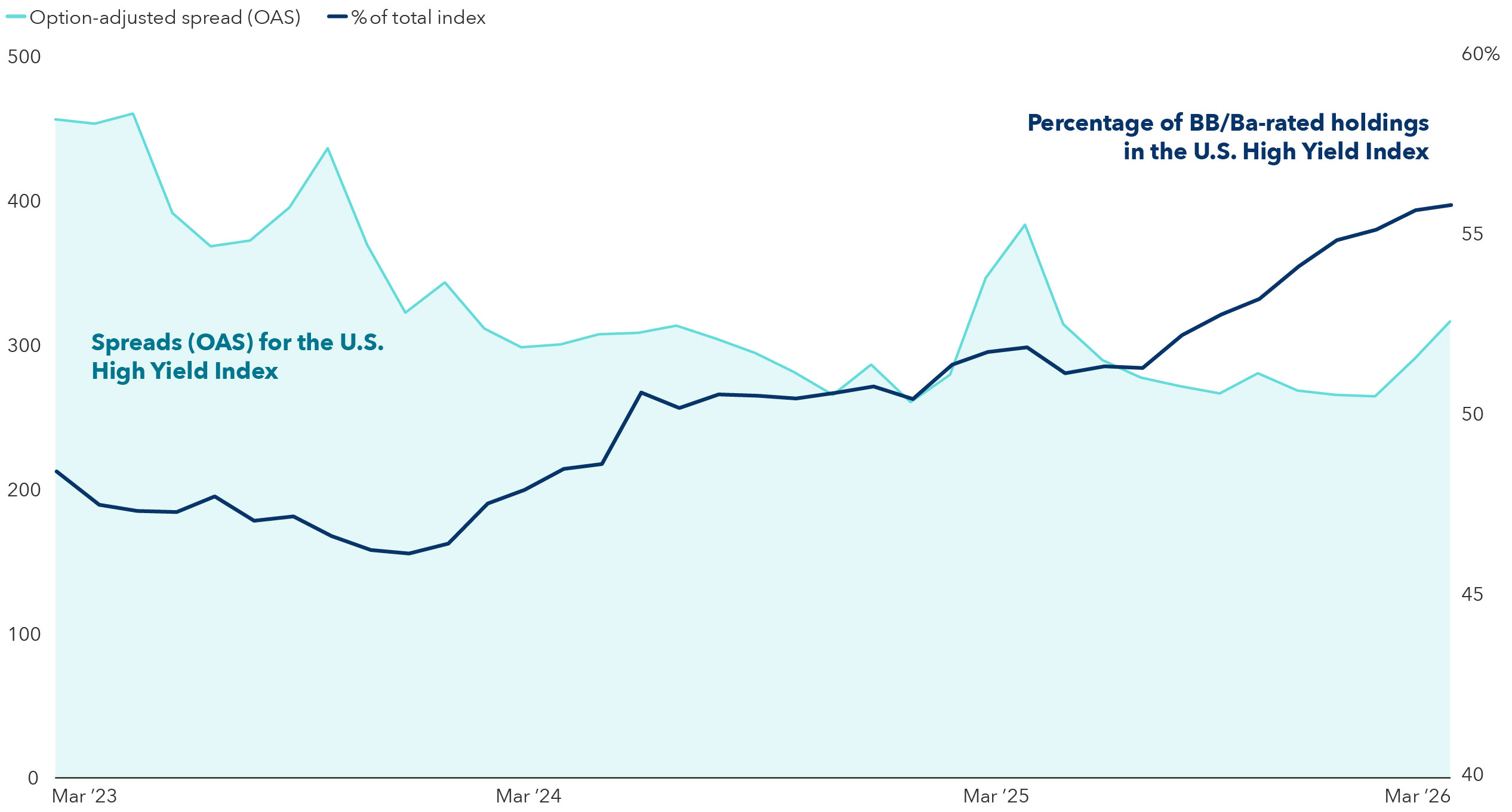
Spreads are an indicator of risk and the compensation investors seek for taking that risk. As that risk has changed over time and demand for high yield has remained elevated, spreads are trading at the tight end of the range we would expect for this part of the economic cycle. Meanwhile, yield-based valuation is near the high-yield market’s 15-year average of 6.6%. Given today’s strong starting yield, income will likely be the largest driver of total return, which we expect to be in line with the sector’s historical average.
These aren’t the junk bonds of the past
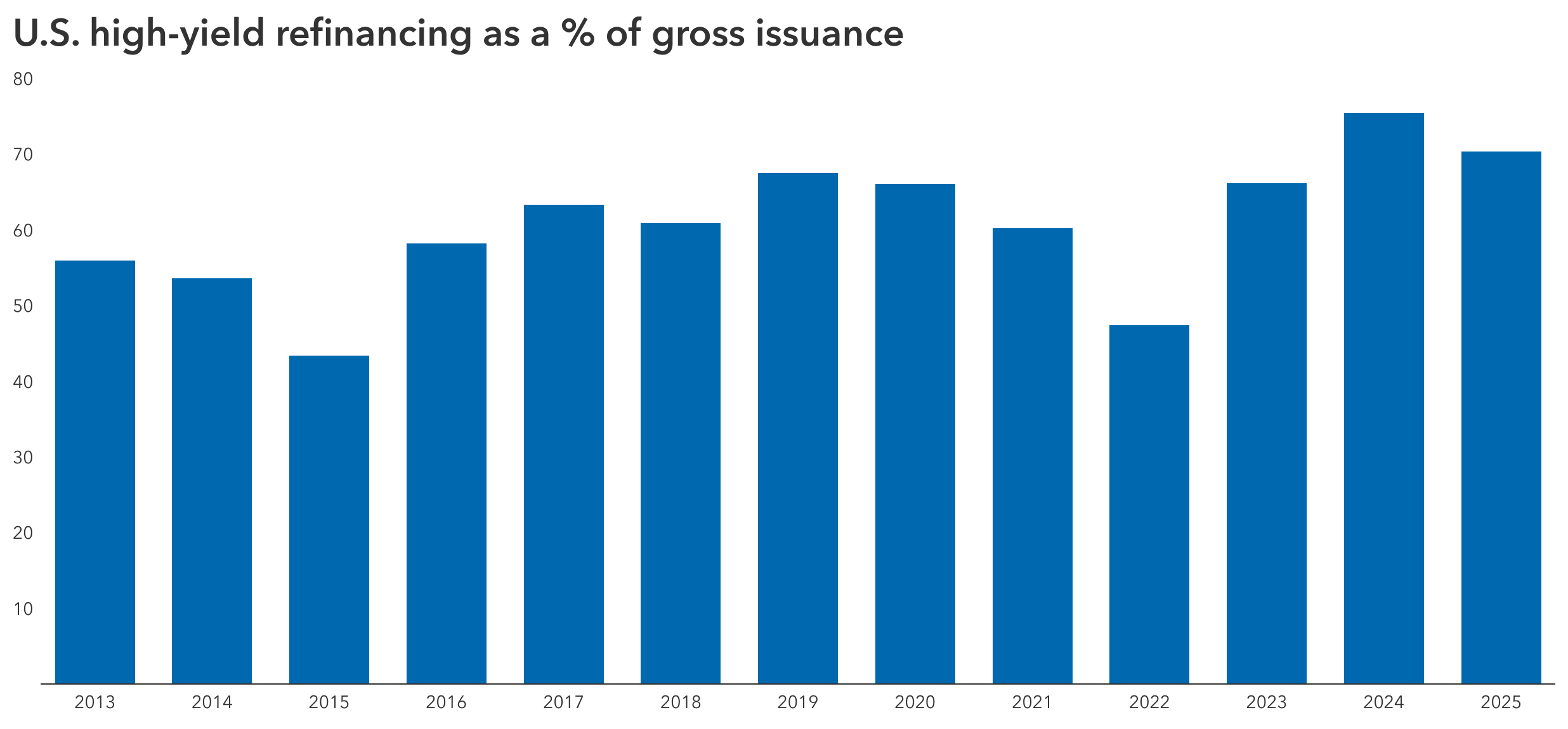
Today’s high-yield market is structurally different than prior economic cycles. Quality has improved, risk has increasingly migrated to loans and private credit, and issuance has been dominated by refinancings alongside a meaningful rise in secured paper. These shifts help explain why spreads can look tight on the surface and why spread volatility has been more muted, even amid macro uncertainty.
In fact, looking at the recent bout of equity volatility in March 2026, option-adjusted spreads for the high-yield index only widened 26 basis points, while equities, as characterized by the S&P 500 Index, were down 5.0%. As we look ahead, the key is to evaluate spreads in the context of this evolved risk and maturity profile — focusing on issuer fundamentals, collateral position and refinancing pathways — rather than relying on historical comparisons alone.
High-yield bonds are a unique asset class that investors should not ignore given its potential yield advantage relative to other fixed income categories. The asset class is widely owned by dedicated high-yield bond funds and ETFs, but demand is high across some investment-grade corporate bond (BBB/Baa and above), core plus bond and multi-sector bond funds. Some of the largest institutional investors also have dedicated allocations to high yield.
Nevertheless, we remain mindful of its asymmetrical return profile. At the moment, all investors are attempting to decipher the same headlines: AI evolution, the Fed’s next move and global geopolitical developments. The irony is that despite the uncertainty, the U.S. economy appears quite solid. While valuations are near historical tight spreads, yields are still reasonable and those valuations could even improve further if interest rates start to drop and fundamentals strengthen. In a world where a single tweet can move markets materially, our job is to determine if a price move is temporary or longer term and to reposition efficiently, so timing is critical as well.