Defined Contribution
Categories
Election
U.S. midterm elections may be closer than expected
 Matt Miller
October 22, 2026
Don't miss our latest insights.
KEY TAKEAWAYS
- A “blue wave” is unlikely to materialize.
- The high cost of living will be a big factor for voters in this and future elections.
- Divided government would create legislative gridlock, which has been positive for markets.
- Historically, U.S. stocks have performed well following midterms.
With the U.S. midterm elections just around the corner, I am asked multiple times a day by colleagues, clients and friends how I think this pivotal contest is going to turn out. It’s my job after all to provide political analysis and public-policy research to Capital Group’s investment team — with an emphasis on analysis, not advocacy, as I always stress.
So, with that in mind, here are three insights I’ve been sharing as we count down to Election Day. Politics is never an exact science, but this is my assessment of the potential outcome and what it could mean for investors.
1. Democrats will win the House, but don’t expect a blue wave.
Contrary to an increasingly popular narrative in the news media, I don’t think we are going to see a “blue wave” of Democratic Party victories across the country. In my view, it’s going to be much closer. When all the ballots are counted, I think Democrats will regain control of the House of Representatives by a narrow margin, but I also believe the Republican Party will maintain its majority in the Senate.
Are the political winds poised to shift in the House?
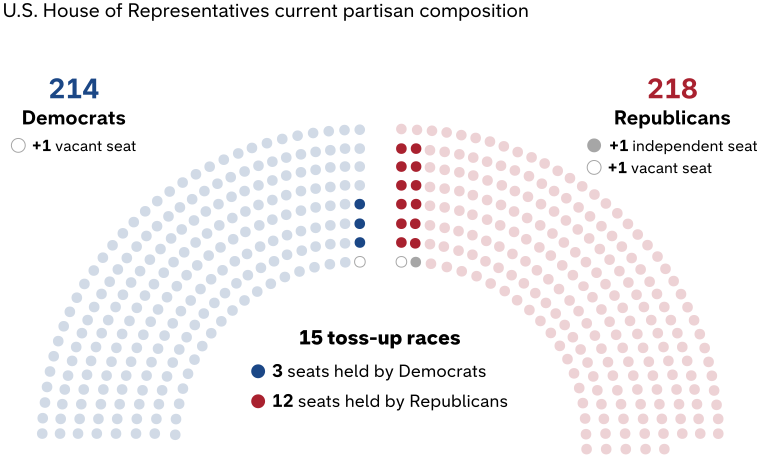
Sources: Capital Group, 270toWin, Office of the Clerk of the U.S. House of Representatives. Toss-up races are 2026 U.S. House elections rated "toss-up" in the 270toWin consensus forecast, which combines race ratings from multiple independent forecasters. One dot on the Republican side represents an independent member of Congress who caucuses with Republicans. Figures reflect latest available data as of October 15, 2026.
From my perspective there just aren’t as many competitive races as there were in previous elections. Due to partisan gerrymandering, Congressional District lines have been redrawn to the point where there are less than 20 truly competitive races. The vast majority of the 435 seats in the House are now comfortably held by Democrats (blue) or Republicans (red).
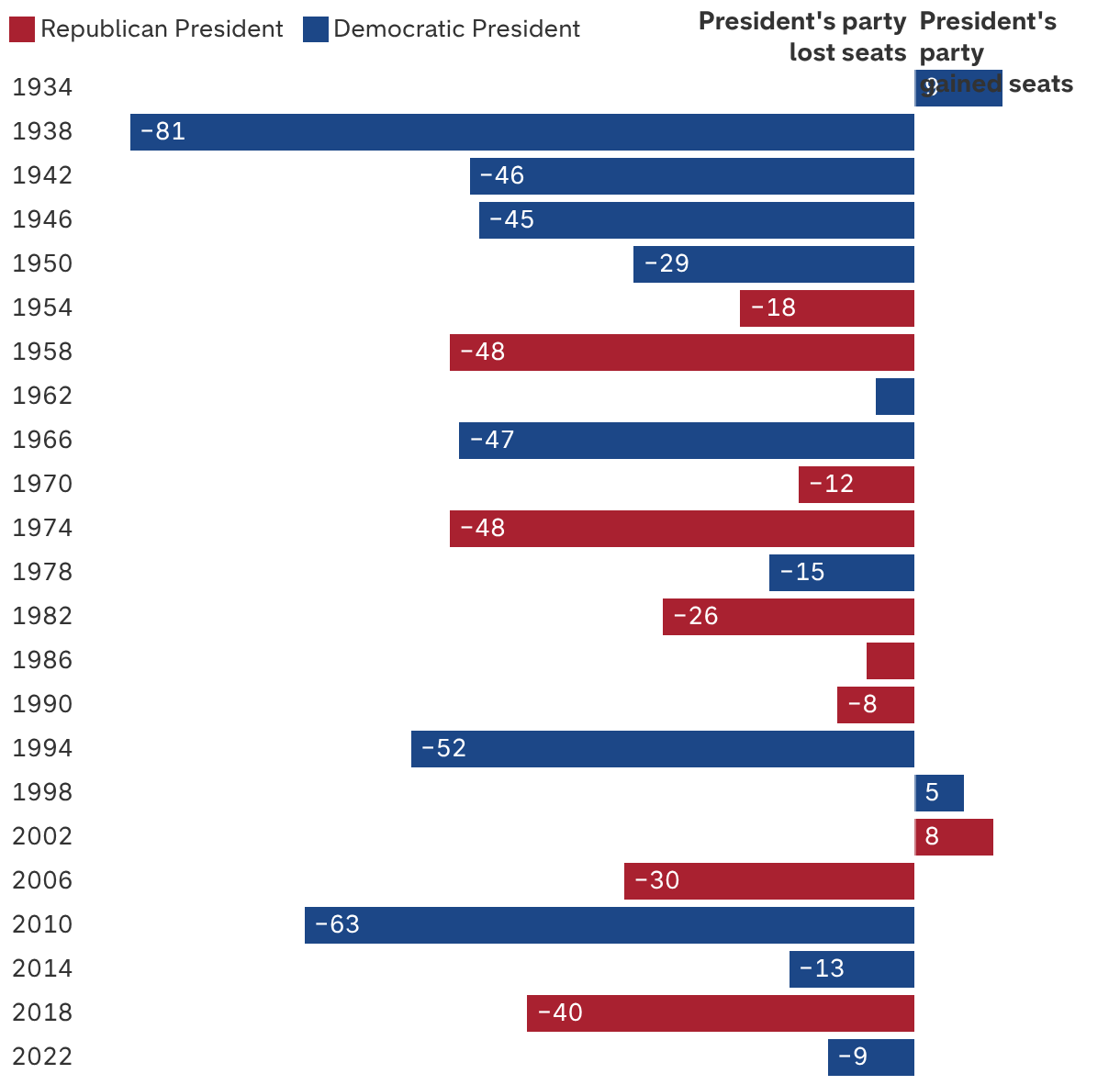
That means the party in power — in this case, the Republican Party — isn’t as likely to lose as many seats as we’ve typically seen throughout history. Sweeping victories where the party that has been out of power wins 40 to 60 seats are much more difficult to achieve. We saw it happen during President Trump’s first term in office, and famously in 1994 during President Clinton’s first term. But it is entirely possible we won’t see that kind of shellacking again for many years.
If Democrats gain a 20-seat majority in the House, that would be considered a huge win. My sense is, the Democratic majority will be smaller, perhaps just a handful of seats. That would make it tougher to pass legislation because just a few representatives can derail the process, as Republicans have learned over the past two years given their slim majority.
The president’s party typically loses seats in midterm elections
Sources: Capital Group, University of California at Santa Barbara: The American Presidency Project. As of December 31, 2025.
The Senate, meanwhile, is a tougher nut to crack. Incumbent candidates are more entrenched, and the Republican Party’s fundraising advantage should help it retain contested seats in Maine, Texas, Michigan and elsewhere. Earlier this year, the Senate wasn’t even considered to be in play. But the Iran war, rising energy prices and higher inflation changed that calculus as President Trump’s approval ratings declined sharply. Many polls suggest the Senate is now a toss-up and either party could prevail. I don’t have much faith in those forecasts. Even the most reputable polling organizations have been egregiously wrong in recent years. At the end of the day, my reading of the political tea leaves is that Republicans will eke out a win and maintain a razor-thin majority in the Senate.

ELECTIONS
Midterms and markets: Implications for investors
Thursday, November 5 | 11 AM PT/2 PM ET
CE credit available
2. Affordability is the issue that will decide this election.
The affordability crisis, runaway inflation, the high cost of living — call it whatever you like — the rising price of virtually everything is the most important issue in this election. It’s the same issue that caused Democrats to lose the 2024 election. Voters are angry about rising consumer prices, and they are expressing their anger at the ballot box.
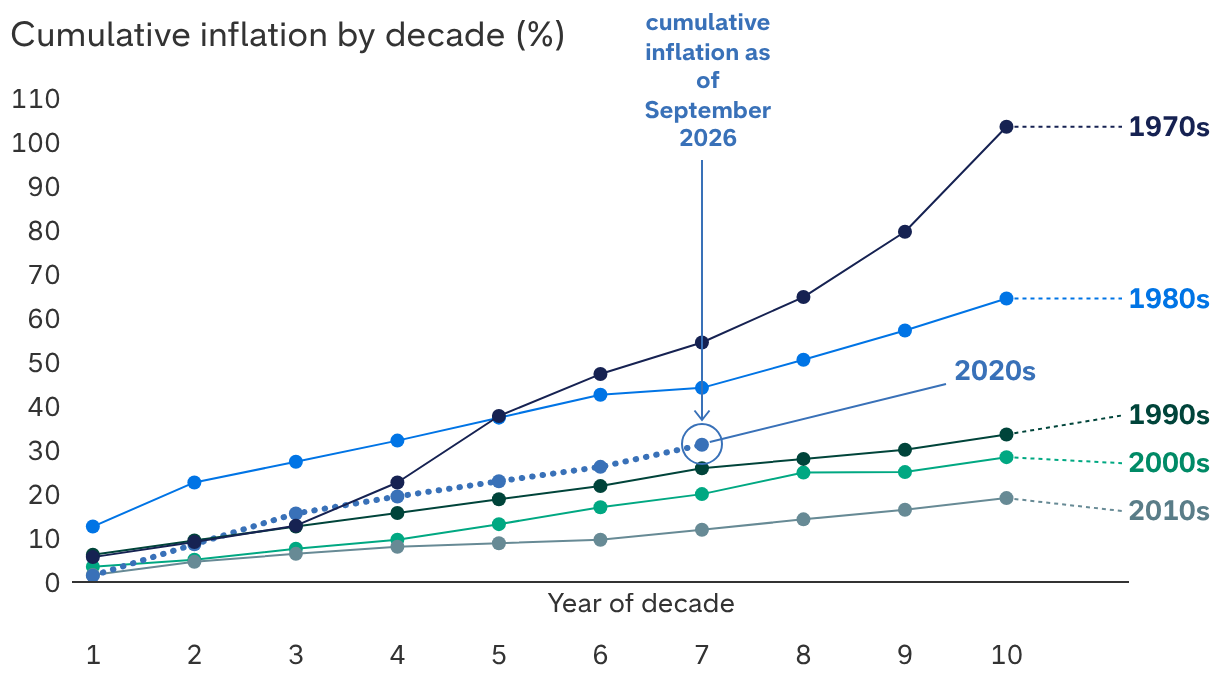
Republican candidates are frustrated because, they would argue, inflation soared above 9% when President Biden was in office, and it is much lower today at around 3.7%. But that’s not how American consumers see it. It’s not the annualized rate of inflation but the cumulative cost increases over the past few years that are exasperating voters. Since 2021, they have seen price hikes of 30% or more on key ingredients of middle-class life, including food, utilities and gasoline. Trump came into office promising to solve that problem and, in their view, it has become worse as prices continue to rise, albeit at a slower pace, partly due to the Iran war and tariffs.
Consumers are facing cumulative inflation above 30%
Sources: Capital Group, Federal Reserve Bank of St. Louis, U.S. Bureau of Labor Statistics. 2026 year-to-date data through September 30, 2026. Inflation is represented by the Consumer Price Index for All Urban Consumers: All Items in U.S. City Average, not seasonally adjusted.
Virtually all Democrats running for office today have made “the affordability crisis” their No. 1 talking point in debates, stump speeches and political advertisements. Widespread frustration over the Iran war and rising prices could result in lower turnout among Republican voters. If the GOP loses the House, this will be the reason. It could also be a recurring theme in the future. If voters feel they are not getting some relief on inflation, regardless of which party is in power, they are likely to continue demanding change in political leadership.
3. The result will be political gridlock — and political theater.
If I am right and Democrats regain control of the House only, that’s all it will take to return Congress to a state of political gridlock. We will have a divided government. That means Congress won’t be able to achieve much on the legislative front over the next two years. We should also expect debt limit and budget standoffs to rattle markets temporarily.
That said, there are some areas where bipartisan cooperation might be possible. For instance, both parties have sought to expand housing availability and rein in pharmaceutical drug pricing. There might be room for compromise on government subsidies under the Affordable Care Act. ACA subsidies were allowed to expire last year, raising health insurance costs for many. Democrats have made it a priority to restore them, and Republicans might be willing to go along with it, if for no other reason than to remove it as a sticking point in the 2028 election. In addition, both parties have vocal critics of unconstrained AI data center construction. I can see that issue playing a bigger role next year.
Beyond that, we should also expect to see some familiar political fireworks. When the new Congress convenes in January, I expect House Democrats to begin investigations of Trump, his family and various members of his administration almost immediately. I think it’s highly likely they will seek to impeach Trump again. The Senate, of course, won’t convict him, but this political theater will probably consume the final two years of Trump’s presidency.
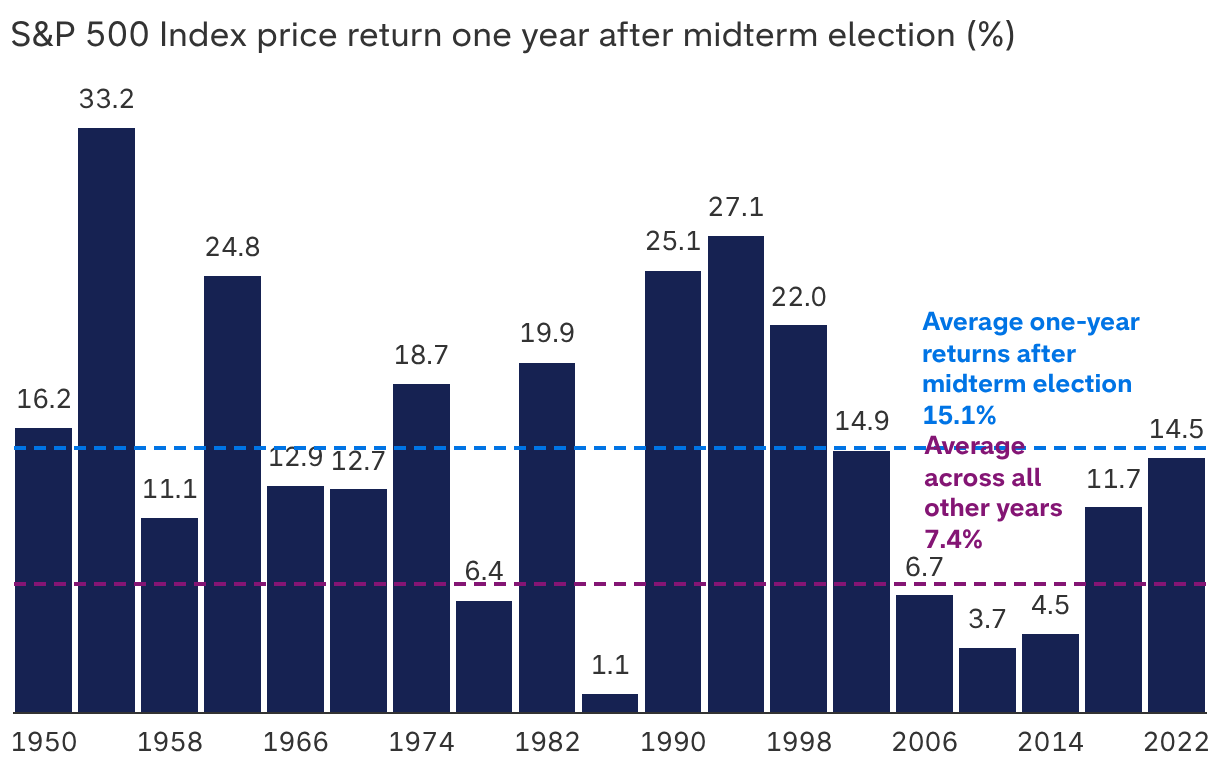
On the investment front, the good news is that U.S. stocks tend to do well once the uncertainty generated by the midterms is over. Since 1950, the S&P 500 Index has returned 15% on average during the 12 months following midterm elections. This year, the S&P is already up about 12% on a year-to-date basis, as of October 19. That doesn’t mean we won’t experience a downturn at some point, but it has proven that this year has already produced substantial returns despite the unpredictability of the election environment.
Stocks historically have had positive returns in the year following midterms
Sources: Capital Group, RIMES, S&P Global. Calculations use Election Day as the starting date in all election years, and November 5 as a proxy for the starting date in other years. Only midterm election years are shown in the chart. Price returns exclude the reinvestment of dividends and capital distributions.
Historically speaking, a divided government has not hurt U.S. stock returns. In fact, based on Capital Group’s analysis of long-term investment data between 1933 and 2025, the partisan composition of Congress appears to have had almost no impact on returns. U.S. stocks have enjoyed double-digit returns, on average, under various government power structures.
Those facts serve as an important reminder not to let political worries derail your long-term investment goals. Elections, and politics in general, can generate a lot of noise, uncertainty and angst if your preferred candidates lose. There’s nothing wrong with cheering for your side. But the reality is, investment returns are driven primarily by the earnings and perceived value of individual companies over time. Investors would be wise to look past the short-term highs and lows and maintain a long-term focus, regardless of which way the political winds may blow.
Learn more about
Past results are not predictive of results in future periods.
The indexes are unmanaged and, therefore, have no expenses. Investors cannot invest directly in an index.
Consumer Price Index for All Urban Consumers: All Items in U.S. City Average is a measure of the average change over time in the prices paid by urban consumers for a market basket of consumer goods and services. Percent changes in the price index measure the inflation rate between any two time periods.
The S&P 500 Index is a market capitalization-weighted index based on the results of approximately 500 widely held common stocks.
The S&P 500 Index is a product of S&P Dow Jones Indices LLC and/or its affiliates and has been licensed for use by Capital Group. Copyright © 2026 S&P Dow Jones Indices LLC, a division of S&P Global, and/or its affiliates. All rights reserved. Redistribution or reproduction in whole or in part is prohibited without written permission of S&P Dow Jones Indices LLC.
Our latest insights
-
-
-
Artificial Intelligence
-
Artificial Intelligence
-
Interest Rates

RELATED INSIGHTS
-
-
Economic Indicators
-
Webinar
Don’t miss out
Get the Capital Ideas newsletter in your inbox every other week
Investments are not FDIC-insured, nor are they deposits of or guaranteed by a bank or any other entity, so they may lose value.
Statements attributed to an individual represent the opinions of that individual as of the date published and do not necessarily reflect the opinions of Capital Group or its affiliates. This information is intended to highlight issues and should not be considered advice, an endorsement or a recommendation.
All Capital Group trademarks mentioned are owned by The Capital Group Companies, Inc., an affiliated company or fund. All other company and product names mentioned are the property of their respective companies.
This content, developed by Capital Group, home of American Funds, should not be used as a primary basis for investment decisions and is not intended to serve as impartial investment or fiduciary advice.
Capital Client Group, Inc.
Use of this website is intended for U.S. residents only.