World Markets Review
Categories
Active Management
4 market insights we shared with Congress
 Jody Jonsson
 Reagan Anderson
August 6, 2026
Don't miss our latest insights.
KEY TAKEAWAYS
- Capital Group Vice Chair Jody Jonsson appeared before the U.S. House Financial Services Subcommittee on Capital Markets.
- Capital regularly engages with lawmakers on matters important to financial advisors and their clients.
- Jonsson emphasized the importance of policy that preserves investor choice.
Opportunities to speak before Congress are rare. So when U.S. lawmakers invited Capital Group Vice Chair Jody Jonsson to share her perspective on aligning public policy with shifting market conditions, she welcomed the chance.
Appearing before the House Financial Services Subcommittee on Capital Markets, Jonsson urged lawmakers to preserve investor choice and spoke about the important role active management plays in maintaining healthy capital markets. The committee was exploring whether current policy keeps up with market innovations, such as the recently introduced Trump Accounts, retirement-focused savings vehicles that are required to be invested in low-cost U.S. equity index funds.
Jonsson’s testimony resulted from years of engagement and relationship building with lawmakers, staffers and regulators. Capital Group regularly engages with lawmakers on both sides of the aisle to help strengthen capital markets, reduce costs, lower friction and modernize regulations so they make sense for today's investors and their advisors.
“Our advocacy is truly focused on generating public policy that supports the best possible outcomes for investors,” says Reagan Anderson, Senior Vice President of Government and Regulatory Affairs. "When lawmakers have questions about active management, it's important that we're who they call. We've spent years building relationships and providing investors' perspectives on issues that affect retirement security and long-term financial outcomes, and we make sure they know how many investors and advisors we represent in their districts."
Here are four insights Jonsson shared in her testimony to lawmakers:
1. Investor choice is essential
Investors have different objectives, life stages and risk tolerances, and public policy should preserve their ability to choose the approach that works best for them. That’s why both active and passive strategies have an important role to play.
“No single investment approach, product or path to retirement security is right for everyone,” Jonsson told lawmakers. “Which is why investors should have access to a broad range of investment solutions, including active management, passive strategies and combinations of both.”
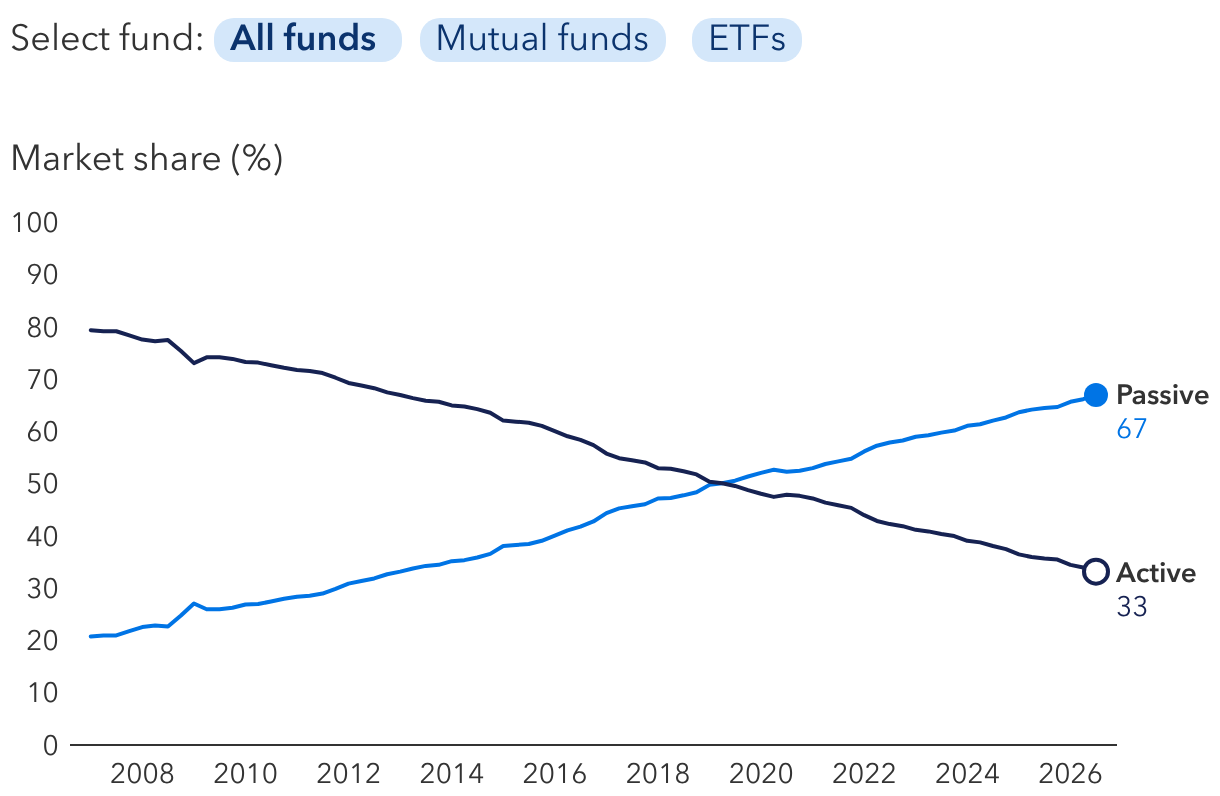
The discussion comes at a time when the landscape is being impacted by the rise of passive investing, accelerating trading activity and growing market concentration. Over the past two decades, passive investing has grown to represent about two-thirds of U.S. assets under management.
Passive equity investments account for more than half the U.S. market
Sources: Capital Group, Morningstar. U.S. equity fund market share is based on total net assets of U.S. open-end mutual funds and ETFs excluding money market funds, fund of funds, and feeder funds. Obsolete funds are included for historical consistency. Data shown is quarterly from December 31, 2006, to June 30, 2026.
Jonsson cited target date funds as an example of investments that demonstrate the power of investor choice. Since becoming retirement plan default investments two decades ago, target date offerings have been tailored to investor time horizons and risk tolerance. “Some options are passive, some are active, and some are a combination,” Jonsson explained. “This has made target date funds a convenient and widely used retirement solution for American workers.”
While Trump accounts hold great promise for investors, Jonsson noted that today they are limited to passive options. ”Similar to target date funds, these accounts could benefit investors further if there were both active and passive options.”
2. Cheaper is not necessarily safer
One common misconception is that passive investing is safer than active investing. While passive investments may be cheaper, with lower fees on average, lower fees don’t necessarily mean better outcomes.
For example, a passive fund in a declining market is guaranteed to fully participate in that decline. During the tech and telecom bubble in 2000 and the global financial crisis in 2008, passive investments fully participated in those market declines. “Passive means passive about risk, not just stock selection,” Jonsson told the committee.
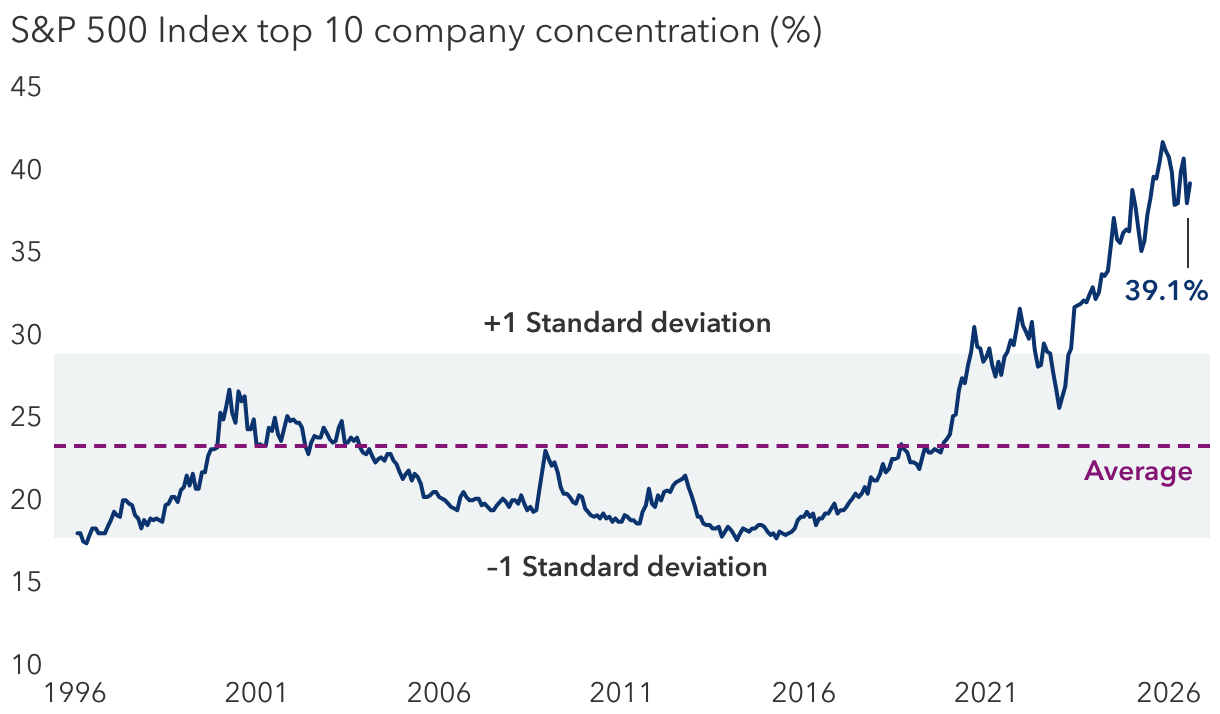
Indeed, the growth of passive has also amplified some risks. For example, because passive strategies invest based on investor cash flows, they tend to follow market cycles all the way up and all the way down and invest in companies according to their weighting in the index. As a result, they can potentially give investors the greatest exposure to companies when valuations are at or near highs. Today, the 10 largest companies in the S&P 500 represent nearly 40% of the index, a level not seen since the mid-1960s.
A handful of stocks are driving a highly concentrated market
Sources: Capital Group, FactSet, S&P Global. Figures represent the index concentration of the top 10 companies by market capitalization. Standard deviation is a statistical measure of how much values vary from their average. A higher number indicates greater variation. Data shown is monthly, from January 31, 1996, through July 31, 2026.
Unlike passive strategies, active managers can adjust portfolios in response to changing market conditions to help mitigate losses during periods of market stress.
“The case for passive investing is about cost — not risk,” Jonsson said in her testimony. “Conflating the two can mislead investors about the nature of what they’re buying. The most important measure to American investors is value: the overall return to an investor net of fees.”
3. Active management supports healthy capital markets
Active investing also plays an essential role in the healthy functioning of markets. First, active managers play a critical role in price discovery, which is the process by which markets determine the value of a security at any given time. Because active managers make buy-and-sell decisions based on their assessment of a company’s prospects, risks and valuation, they help market prices reflect underlying economic realities.
“This process improves market efficiency and reduces mispricing,” Jonsson said. With fewer active managers engaged in price discovery — evaluating companies based on their underlying fundamentals — markets can become more influenced by short-term flows. “Active management isn’t just a part of the financial system; it’s a core reason the system works,” Jonsson stated.
Active management also helps direct capital to companies that drive economic growth, innovation and job creation.
4. Financial advice remains critical to investor success
Jonsson also highlighted the important role financial advisors play in helping investors navigate uncertainty, understand their options and stay focused on long-term goals.
During periods of market volatility, advisors can help investors manage their emotions and avoid making rash decisions that could potentially derail their long-term investment plans.
Watch Jonsson’s full testimony.
Learn more about
Passive funds are not striving to outpace their benchmarks; rather, they seek to replicate the benchmark’s return pattern.
S&P 500 Index is a market capitalization-weighted index of about 500 major U.S. stocks. The market index is unmanaged and, therefore, has no expenses. Investors cannot invest directly in an index.
©2026 Morningstar, Inc. All rights reserved. The information contained herein: (1) is proprietary to Morningstar and/or its content providers; (2) may not be copied or distributed; and (3) is not warranted to be accurate, complete or timely. Neither Morningstar nor its content providers are responsible for any damages or losses arising from any use of this information. Past performance is no guarantee of future results.
The S&P 500 Index is a product of S&P Dow Jones Indices LLC and/or its affiliates and has been licensed for use by Capital Group. Copyright © 2026 S&P Dow Jones Indices LLC, a division of S&P Global, and/or its affiliates. All rights reserved. Redistribution or reproduction in whole or in part is prohibited without written permission of S&P Dow Jones Indices LLC.
Our latest insights
-
-
Economic Indicators
-
-
Interest Rates
-
Emerging Markets
RELATED INSIGHTS
-
Active Management
-
Global Equities
-
Don’t miss out
Get the Capital Ideas newsletter in your inbox every other week
Investments are not FDIC-insured, nor are they deposits of or guaranteed by a bank or any other entity, so they may lose value.
Investors should carefully consider investment objectives, risks, charges and expenses.
This and other important information is contained in the fund prospectuses and/or summary prospectuses, which can be obtained from a financial professional and should be read carefully before investing.
Statements attributed to an individual represent the opinions of that individual as of the date published and do not necessarily reflect the opinions of Capital Group or its affiliates. This information is intended to highlight issues and should not be considered advice, an endorsement or a recommendation.
All Capital Group trademarks mentioned are owned by The Capital Group Companies, Inc., an affiliated company or fund. All other company and product names mentioned are the property of their respective companies.
Use of this website is intended for U.S. residents only.
Capital Client Group, Inc.
This content, developed by Capital Group, home of American Funds, should not be used as a primary basis for investment decisions and is not intended to serve as impartial investment or fiduciary advice.