


World Markets Review
Categories
Emerging Markets
Beyond consensus: 4 dynamics beneath South Korea’s AI boom
 Chau Nguyen
September 16, 2026
South Korea has emerged as one of the biggest beneficiaries of the global AI boom. Home to some of the world’s leading memory chip producers, the country has seen exports, corporate earnings and equity markets climb alongside surging demand for semiconductors. For many investors, Korea’s investment case has become synonymous with AI.
Yet Korea's appeal extends beyond the recent enthusiasm for chip stocks. The Corporate Value-Up Program, launched in 2024, seeks to align corporate practices with global standards and improve shareholder returns through measures such as higher dividends, share buybacks, simpler group structures, and stronger board independence. The initiative has drawn attention to a market that has long traded at a discount to global peers.
While AI and corporate reform have dominated investor attention, several underappreciated forces are reshaping Korea's economic future, with potential implications for growth, monetary policy and financial markets.
1. Productivity could help offset demographic pressures
South Korea faces one of the most challenging demographic outlooks in the developed world. Exceptionally low fertility has intensified concerns about labor force growth, an aging population and long-term economic potential.
What investors may underappreciate
Productivity may ultimately prove the decisive factor in determining Korea’s growth potential. Korea’s past economic success was powered by labor force expansion, rising educational attainment and capital investment, while productivity was a less consistent source of growth. That matters because productivity becomes more important as population figures decrease.
The gains have also been uneven. Korea is home to globally competitive companies, but large conglomerates continue to command a significant share of capital and talent while many smaller businesses and service sector firms struggle. This divide can limit how labor and capital move through the wider economy. Greater productivity gains across the broader economy may be needed to offset demographic pressures and support future growth.
Future growth may rely on a productivity boost
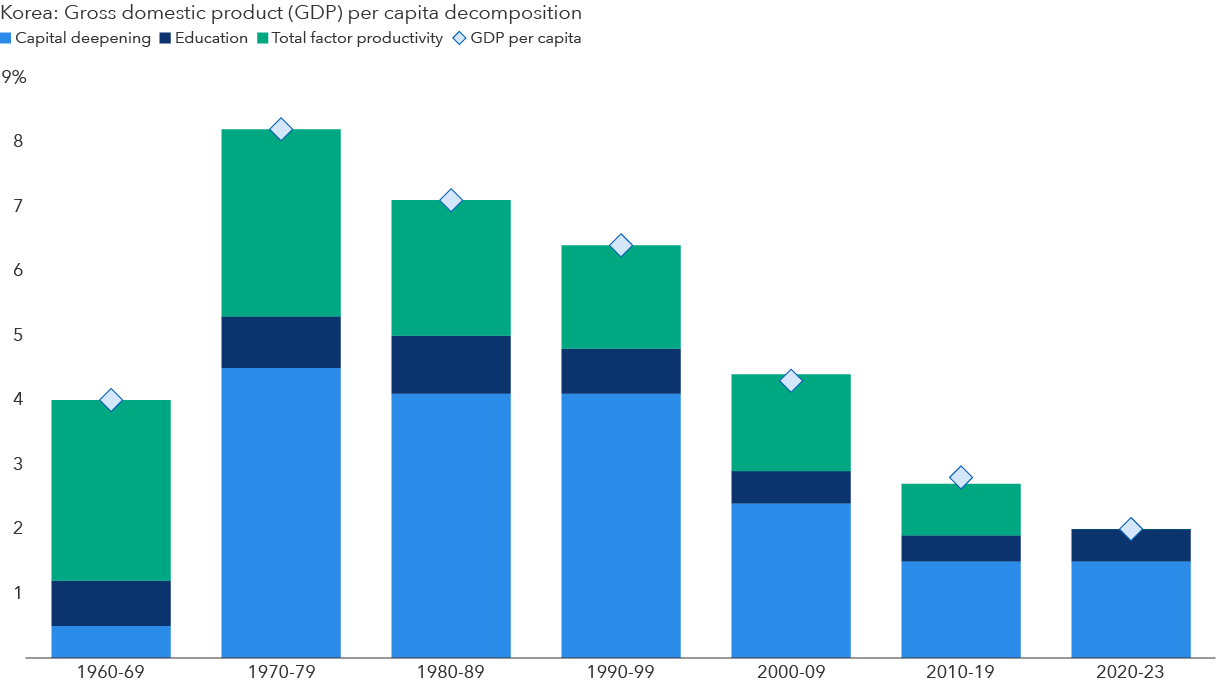
Sources: Penn World Table via University of Groningen. Chart reflects data published on October 7, 2025. Capital deepening = the increase in capital stock relative to hours worked. Total factor productivity = a measure of how efficiently labor and capital are used to produce output.
Growth near 2% may therefore be less cyclical slowdown than structural reality. For investors, low economic growth does not rule out attractive opportunities, but it may increase dispersion between globally exposed companies and businesses tied mainly to domestic demand.
2. Semiconductor strength may already be reflected in markets
Korea’s leadership in memory chips and high-bandwidth memory keeps semiconductors at the center of its economy and equity market, while providing an important point of differentiation as China moves up the manufacturing value chain.
What investors may underappreciate
The key investor question is how much optimism is already embedded in earnings forecasts and valuations. AI-related demand continues to support memory markets, yet strong fundamentals do not automatically translate into stronger future returns.
Korean equities have already benefited from a sharp improvement in earnings expectations. Semiconductor indicators still point to tight supply, but some measures suggest the pace of improvement may be moderating, while valuations are approaching levels associated with prior cycle peaks.
AI-driven gains propelled valuations higher
Source: Bloomberg Finance L.P. As of August 17, 2026. P/E = price-to-earnings
This does not weaken the long-term investment case. High-bandwidth memory remains critical to AI infrastructure, and Korea’s leading producers retain significant competitive positions. It does suggest a more balanced backdrop in which earnings remain supported, but the risk-reward profile may be less one-sided than earlier in the cycle.
3. Housing can influence the path of monetary policy
Korean households carry substantial debt, and housing affordability, particularly in Seoul, remains a critical economic and political issue.
What investors may underappreciate
The structure of Korea’s housing market, particularly the jeonse system, constrains monetary policy flexibility. Under this system, tenants provide large deposits in exchange for rent-free occupancy during the lease. Those deposits are often recycled into further property investment, adding leverage and making the financial system more sensitive to changes in house prices and interest rates.
This dynamic narrows the Bank of Korea’s room to maneuver. Cutting rates too aggressively could encourage additional leverage and speculative activity. Tightening too much could create stress for indebted households and property owners. Policy outcomes may therefore appear more constrained than inflation or growth conditions alone would imply.
Elevated leverage constrains policy flexibility
Source: International Monetary Fund via Federal Reserve Bank of St. Louis. Data updated December 8, 2025. As of August 24, 2026.
For investors, housing is not a separate domestic issue. It affects consumer demand, financial conditions and policy, all of which can shape the relative outlook for sectors and companies. It may also help explain why policy cannot respond as freely to weaker growth as headline economic data might suggest.
4. Fiscal resources might provide a new source of market support
The semiconductor boom and rising equity prices have strengthened tax collections, creating the possibility of a larger-than-expected government surplus.
What investors may underappreciate
How policymakers ultimately deploy that windfall could have implications for capital markets and long-term economic development. One possibility is a sovereign wealth fund structure that supports strategic industries, potentially absorbing domestic equity holdings from the National Pension Service. Such a vehicle could provide patient capital to the domestic market as population aging places greater pressure on the pension system.
Market gains are translating into government revenues
Sources: Capital Strategy Research, Macrobond, Korea’s Ministry of Finance and Economy. KRW trn = South Korea won trillion.
More broadly, the discussion signals a shift in policy thinking. Alongside the Value-Up Program, it suggests a growing focus on strengthening capital markets, improving corporate behavior and directing savings toward industries expected to drive Korea’s future growth. Implementation will matter, but the direction of policy creates another potential source of support beyond the semiconductor cycle.
Portfolio perspective
Korea offers a powerful way to participate in global AI infrastructure spending, but that exposure comes with concentration risk. Semiconductor leadership continues to support exports, earnings and investment, while elevated expectations and valuations make selectivity increasingly important.
The nation’s memory leaders are likely to remain central to the investment case, but opportunities extend beyond semiconductors. Productivity reform, housing market constraints, corporate governance initiatives, and the deployment of fiscal resources could create meaningful differences across sectors and businesses. In a market often defined by AI and memory cycles, these structural forces may provide a more durable source of investment insight.
Learn more about
Investing outside the United States involves risks, such as currency fluctuations, periods of illiquidity and price volatility, as more fully described in the prospectus. These risks may be heightened in connection with investments in developing countries.
Bloomberg® is a trademark and service mark of Bloomberg Finance L.P. and its affiliates (collectively “Bloomberg”). Bloomberg or Bloomberg’s licensors own all proprietary rights in the Bloomberg Indices. Neither Bloomberg nor Bloomberg’s licensors approves or endorses this material, or guarantees the accuracy or completeness of any information herein, or makes any warranty, express or implied, as to the results to be obtained therefrom and, to the maximum extent allowed by law, neither shall have any liability or responsibility for injury or damages arising in connection therewith.
The MSCI Korea Index is designed to measure the performance of the large and mid-cap segments of the South Korean market.
MSCI has not approved, reviewed or produced this report, makes no express or implied warranties or representations and is not liable whatsoever for any data in the report. You may not redistribute the MSCI data or use it as a basis for other indices or investment products.
South Korea’s Corporate Value-Up Program was launched by Korea’s Financial Services Commission to improve capital efficiency and corporate governance among listed companies, while also seeking to narrow the valuation discount of Korean equities relative to global peers.
Our latest insights
-
-
Economic Indicators
-
-
Interest Rates
-
Interest Rates
RELATED INSIGHTS
-
World Markets Review
-
-
Interest Rates
Don’t miss out
Get the Capital Ideas newsletter in your inbox every other week
Investments are not FDIC-insured, nor are they deposits of or guaranteed by a bank or any other entity, so they may lose value.
There have been periods when the results lagged the index(es) and/or average(s).
The indexes are unmanaged and, therefore, have no expenses. Investors cannot invest directly in an index.
The MSCI information may only be used for your internal use, may not be reproduced or redisseminated in any form and may not be used as a basis for or a component of any financial instruments or products or indices. None of the MSCI information is intended to constitute investment advice or a recommendation to make (or refrain from making) any kind of investment decision and may not be relied on as such. Historical data and analysis should not be taken as an indication or guarantee of any future performance analysis, forecast or prediction. The MSCI information is provided on an “as is” basis and the user of this information assumes the entire risk of any use made of this information. MSCI, each of its affiliates and each other person involved in or related to compiling, computing or creating any MSCI information (collectively, the “MSCI Parties”) expressly disclaims all warranties (including, without limitation, any warranties of originality, accuracy, completeness, timeliness, non-infringement, merchantability and fitness for a particular purpose) with respect to this information. Without limiting any of the foregoing, in no event shall any MSCI Party have any liability for any direct, indirect, special, incidental, punitive, consequential (including, without limitation, lost profits) or any other damages. Please visit the data provider's website for more information.
All Capital Group trademarks mentioned are owned by The Capital Group Companies, Inc., an affiliated company or fund. All other company and product names mentioned are the property of their respective companies.
This content, developed by Capital Group, home of American Funds, should not be used as a primary basis for investment decisions and is not intended to serve as impartial investment or fiduciary advice.
Capital Client Group, Inc.
Use of this website is intended for U.S. residents only.