
Bonds
The end of the cheap money era?
 Timothy Ng
October 28, 2026
For a generation, cheap money was one of the quiet facts of American life. Low interest rates helped propel decades of gains across financial markets, made mortgages more affordable and allowed companies and consumers to borrow at costs that, by historical standards, seemed almost unheard of. Relatively inexpensive borrowing came to feel less like an extraordinary condition than an inherent birthright.
That era is looking increasingly distant.
Bond yields have surged since March, when the war in Iran sent global energy prices spiraling. An accelerating selloff — driven partially by fear of a protracted conflict — pushed yields to their highest levels in 24 years. From a smidge below 4% the day before the war broke out, the benchmark 10-year Treasury yield jumped above 5.3%.
What makes this moment unusual is that the pressure on the bond market is coming from several directions. High oil prices have stoked fears of inflation, prompting the Federal Reserve to raise short-term rates in what may be the first of several such moves. Governments around the world are carrying sizable debt loads and issuing rafts of bonds to finance spending. And technology companies are pouring enormous sums into artificial intelligence (AI) infrastructure, adding to a ravenous appetite for capital.
For fixed income investors, rising rates are the very definition of a double-edged sword. On one hand, they’re undeniably painful. In the short term, higher rates on newly issued bonds reduce the value of older, lower-yielding securities. That was on ample display in the third quarter, as the Bloomberg U.S. Aggregate Bond Index fell 3.5%. At the same time, higher rates can mean improved payouts over time as older bonds mature and are replaced by higher-paying ones. With a long enough investment horizon, that could mean better total returns going forward.
It’s important to put the fixed income pullback in historical context. Far from an anomaly, the current environment is in many ways a return to normalcy after years of artificially low borrowing costs in the aftermath of the 2008 global financial crisis.
Higher interest rates have often accompanied a strong economy
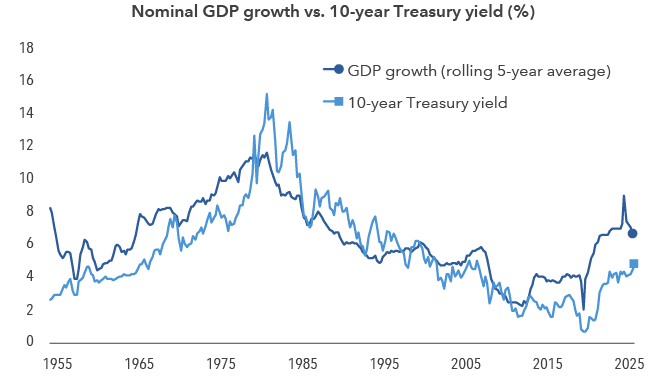
Sources: Capital Group, Federal Reserve Bank of St. Louis. Data shown is quarterly from Q1 1955 to Q2 2026. Nominal GDP is shown as a rolling 5-year average. Figures reflect latest available data as of September 15, 2026.
Higher rates alongside rising stock markets can be a positive indicator, signaling economic growth or optimism about future growth. So far, that appears to be true of this moment. Though prices for gas and groceries have streaked upward, American consumers remain their hardy selves. Corporate profits are strong. And investors are betting that the AI boom has years to run. Indeed, the S&P 500 reached a new peak early in the fourth quarter.
Nevertheless, investors are confronting a question that would have seemed inconceivable just a few months ago: Has the era of extraordinarily low interest rates drawn to a close and, if so, what might that mean for the markets?
The surge in yields doesn’t necessarily mean they’ll continue climbing at the recent pace, says Tim Ng, a Capital Group fixed income portfolio manager. But he believes investors should prepare for a new era.
“I think we should be comfortable with 10-year yields in a higher range than they’ve been in the past,” Ng said. “This is a return to some level of normalcy.”
War, government debt and AI spending are pushing rates higher.
Uncertainty over the path of inflation — driven significantly by elevated oil prices — is the most immediate factor pushing up yields. When investors become less confident about the future, they demand more compensation for the risk of their money losing purchasing power over time. (Short-term Treasury yields tend to follow Fed policy, while longer-term yields reflect investors’ expectations for the economy in future years.)
“The correlation between yields and oil prices has been very high,” Ng said.
The Iran conflict has raised global inflation expectations
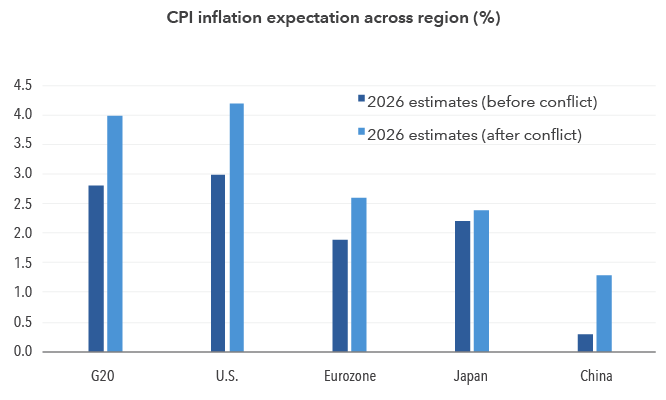
Source: Data as of September 30, 2026. Source: Organization for Economic Cooperation and Development (OECD), OECD Economic Outlook, Interim Report September 2026: Testing Resilience. OECD Economic Outlook, Volume 2026 Issue 2: Resilient Growth but with Increasing Fragilities.
But even if the Iran conflict is resolved soon, a slurry of other factors could weigh on the bond market.
Heavy government borrowing is adding pressure, as major economies, including the United States, France and the United Kingdom, run extremely high deficits. In the U.S., the federal debt surpassed $40 trillion in August.
The forces ballooning national debt are likely to persist, as aging populations strain public budgets and countries increase military spending. Even Germany, a nation long synonymous with fiscal restraint, loosened its famously restrictive debt brake in 2025 to allow for more defense financing.
“There doesn’t seem to be any appetite for austerity, globally,” Ng said.
On top of this, AI companies have been on a spending spree of epic proportions, pouring money into data centers, advanced chips and infrastructure. In 2026 alone, tech giants have collectively taken on upward of $200 billion of private debt. Fear of falling behind — and confidence in future returns — has made many companies willing to borrow at relatively high rates.
Higher rates bring risks and rewards.
All of this signals that rates may remain higher than investors are accustomed to.
“I believe that seeing 10-year yields around 5% is reasonable over the next year, particularly as governments and corporations continue to borrow,” says Ng. “But I expect core inflation to continue to decelerate, which should keep yields in this range.”
The Fed rate increase may reassure investors that policymakers will bring inflation under control, Ng added.
The bigger adjustment may be psychological, as investors who were weaned on ultra-low rates may have to adapt to a changed environment.
There may be a reward for getting comfortable with the new normal. Higher yields can make patience more valuable, particularly for long-term investors willing to look beyond the turbulence of the moment. The path may not be smooth, but bonds may once again be positioned to play a more meaningful, income-generating role in a diversified portfolio.
Explore topics
S&P 500 Index is a market capitalization-weighted index based on the results of approximately 500 widely held common stocks. This index is unmanaged, and its results include reinvested dividends and/or distributions but do not reflect the effect of sales charges, commissions, account fees, expenses or U.S. federal income taxes.
Past results are not predictive of results in future periods.
S&P 500 Index is a product of S&P Dow Jones Indices LLC and/or its affiliates and has been licensed for use by Capital Group. Copyright © 2026 S&P Dow Jones Indices LLC, a division of S&P Global, and/or its affiliates. All rights reserved. Redistribution or reproduction in whole or in part are prohibited without written permission of S&P Dow Jones Indices LLC.
Related Insights
Related Insights
-
-
-
Asset Allocation