Plan Design
Categories
Defined Contribution
Plan sponsors: 7 tips to help boost participant engagement
 John Doyle
 Gretta Hatcher
Retirement plans are one of the most important benefits employers offer. Yet for many plan sponsors, participant engagement is a persistent and frustrating challenge — even for companies with strong plan designs and generous matching formulas. Many employees still don’t fully understand how their plan works, what it offers or why it matters to them.
We believe the biggest gap in retirement success isn’t the plan design. It’s the communication behind it.
Even if your plan has automatic enrollment, automatic contribution escalation and a strong QDIA (Qualified Default Investment Alternative), communication with employees to spur engagement is still key. It’s important to highlight the value of the program so your company gets credit for offering it, strengthening the employees’ commitment to both you and your organization’s retirement plan.
As this chart shows, private sector participation rates vary by company size, based on an annual Bureau of Labor compensation report that surveys 126 million U.S. workers. Clearly, an average 50% engagement rate leaves plenty of opportunity for improvement.
With that in mind, we identified 7 tips to help boost participant engagement based on our experience working with plan sponsors.
Defined contribution: Plan participation rates vary in the U.S. private sector
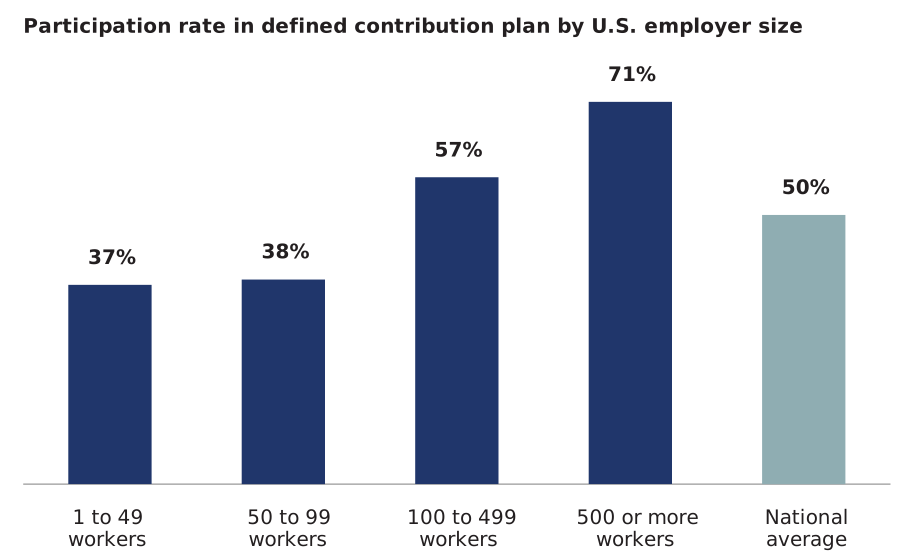
Source: Bureau of Labor Statistics’ National Compensation Survey for 2025. Survey sampled 7.2 million businesses, representing 126 million workers in the private sector. Data as of September 25, 2025.
1. Put people in position to drive their retirement savings
It’s important to encourage participants to engage with their company retirement plan and make them feel empowered and educated to make informed decisions regarding their 401(k) or similar account. As we will discuss later, employees in the plan will likely have a wide degree of financial understanding and comfort levels.
As a general guideline, plan sponsors should be mindful of the distinction between participant education and investment advice under ERISA. Depending on the facts and circumstances, certain communications could be viewed as fiduciary investment advice.
As a result, many plan sponsors focus participant communications on education, such as explaining plan features, general asset allocation concepts, diversification and the potential impact of increasing contributions on long-term savings, rather than individualized guidance. For a deeper dive on these subjects, a plan’s recordkeeper or financial professional is often a good resource.
Education vs. advice: Staying within fiduciary boundaries
Education |
Potential advice |
|---|---|
Explaining asset classes or model portfolios |
Recommend specific funds |
Diversification concepts |
Predicting returns |
Impact of higher contribution rates |
Telling employees what to buy |
Source: Capital Group. For illustrative purposes only.
2. Build engagement into your plan’s objectives
Before education comes strategy. Think about why your organization even offers a retirement plan. What are you trying to achieve? What are the objectives? The most common reason we have heard is to attract and retain talent. Starting here can help you better explain to employees the value that the plan provides — an oft-cited challenge plan sponsors have voiced in our conversations.
3. Make sure your employees know they have a retirement plan
It sounds basic. But if employees don’t know your plan exists, then they cannot get the full benefit from it. In our experience helping plan sponsors, we’ve encountered cases where employees didn’t know they were automatically enrolled in a plan or were receiving employer match contributions.
Making sure employees know they are invested in the company's 401(k) presents two opportunities: First, you can remind them about the value of the benefit the company is providing; secondly, it opens the door to educate employees who are aware of the plan but have fallen into the “set-it-and-forget-it mindset.” These are participants who haven’t reviewed or increased their contribution rate for a long time and who may be missing out on the chance to reevaluate their retirement savings.
This checklist is a good place to help assess where to start your education efforts.
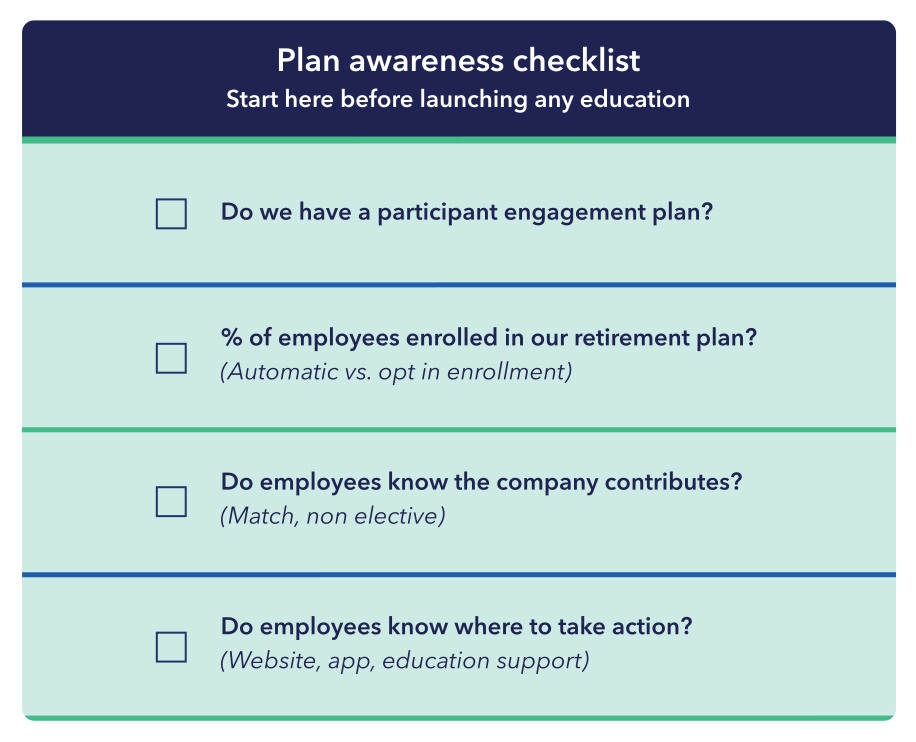
Source: Capital Group. For illustrative purposes only.
4. Reinforce basic financial and retirement terms
Here is another reality to keep in mind: Don’t assume everyone is financially fluent. Many workers from the distribution facility to the executive suite are not necessarily well-versed in financial and investment terms related to their retirement plan and investing for the future.
For instance, what is a pre-tax contribution? What is a company match and how does it work? What is a target date fund? Or dollar-cost averaging? These concepts and others are common questions employees often have and should be reinforced in clear simple terms — not HR-jargon — as part of a broader communications campaign. Here are 12 retirement-related terms that can be good to share with participants.
5. Develop relevant content to prevent message fatigue
A one-size-fits all communication strategy won’t speak to everyone. Today’s workforce is diverse, not only in age but income level, retirement savings and ethnicity. You may find better results targeting messages to specific groups from baby boomers to Generation X to millennials to Generation Z. It’s more effective to meet — and engage — them in their current stage in life.
Think about it: A person is more likely to open your email if they feel the subject line and message relates to them. Tailored content can address a Gen Zer struggling with student loans and bills, a millennial preparing to buy a house, or a soon-to-be retiring boomer wondering how best to withdraw from their 401(k) for monthly income needs.
One workforce. Different needs.
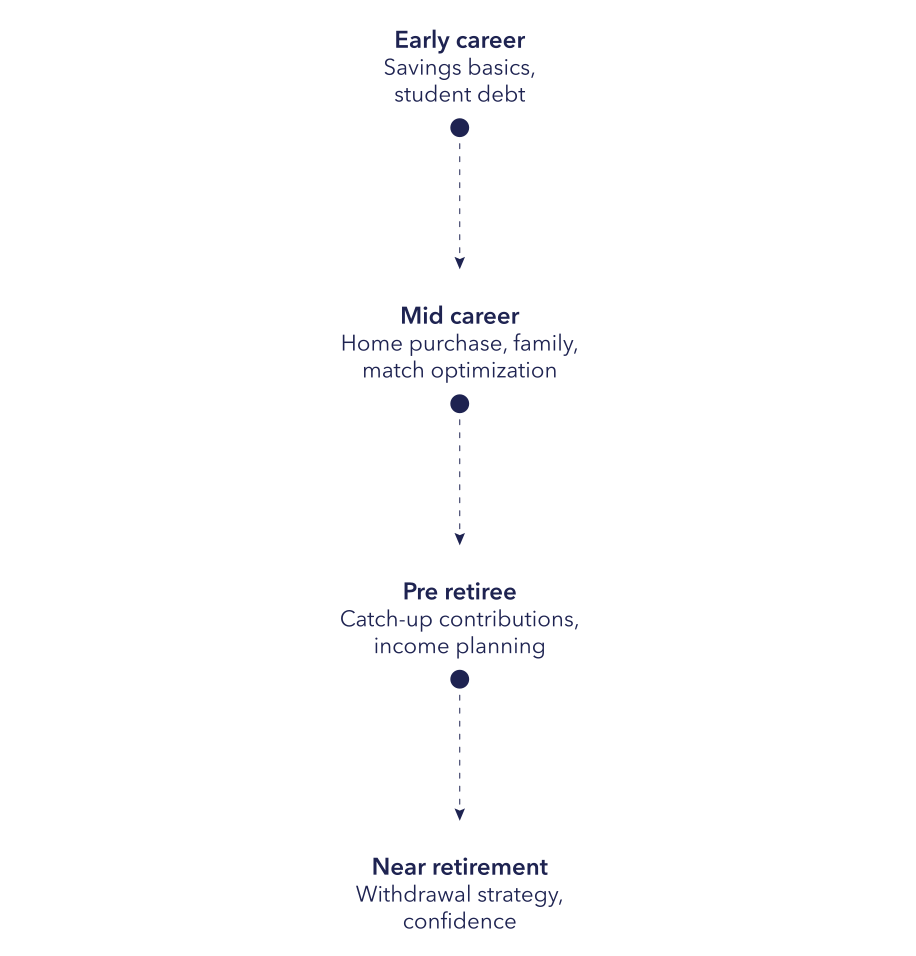
Source: Capital Group. For illustrative purposes only.
You don’t have to do all the heavy lifting yourself. Consider using technology to cultivate timely and relevant content ideas for quarterly email campaigns. AI tools (i.e., Copilot, ChatGPT, Claude) can extract information in a retirement plan database to segment participants by age group, job title, income bracket and tenure. Your recordkeeper may be able to help extract such information.
Plan sponsors should ensure that any such tools are used in accordance with their internal policies and applicable requirements, particularly with respect to privacy, confidentiality and the use of personally identifiable information.
Also consider maintaining a message database that you can draw from, reuse or refresh over time. That way, you can leverage your efforts from year-to-year without much effort. Another tip: Peers can often convey trust and be influencers. They can be sources of storytelling and testimonials.
A testimonial could be along the lines of: “Once I understood that increasing my contribution helped me make the most of the company match, the decision felt like a no‑brainer. I wasn’t just saving more. I was taking full advantage of a benefit that’s part of my total compensation and I was surprised how little difference it made to my paycheck.”
Here’s a broad overview of what a messaging strategy might look like over the course of a year.
Playbook for email campaign to keep employees engaged
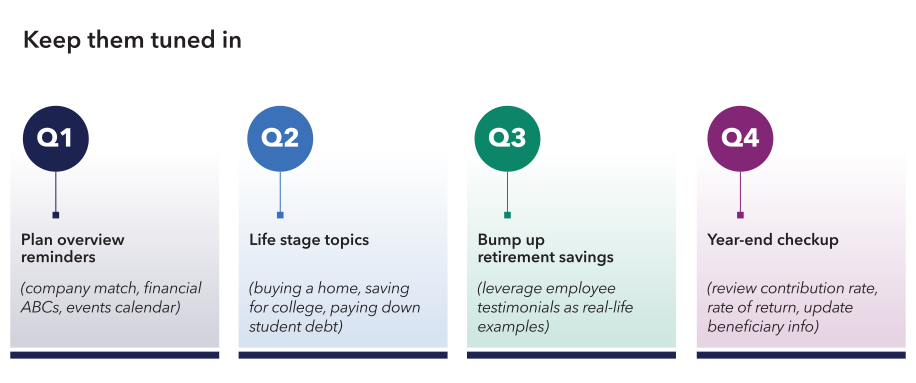
Source: Capital Group. For illustrative purposes only.
6. Leverage your recordkeeper and asset managers
Recordkeepers are often underutilized educational resources. Some can provide online, in-person or virtual education. They also may offer financial planning guidance, retirement income projections and suggest relevant content segmented by audience.
Also consider leveraging representatives from the asset manager whose funds your retirement plan offers. Or you can tap the financial professionals you worked with to select the plan’s investments. They can help explain the range of investment options, such as target date funds or model portfolios, and how they work.
7. Be consistent in your communication
Employee education isn’t a broadcast — it’s a dialogue. Consistency in your communication can lead to understanding, and understanding can be a call to action.
Here are several ways to maintain the dialogue:
- Create a dedicated email inbox for retirement questions
- Build distribution lists based on participant segmentation
- Use automated emails to follow up after educational sessions with recordkeepers, financial professionals or asset managers
- Encourage managers to remind employees about the company retirement plan
- Maintain a steady cadence of employee communications including emails, printed materials, and information sessions with recordkeepers and asset managers
Keep it simple and repeatable
A participant education program is not advanced science. Stay focused on awareness, continuous engagement and identify opportunities for personalization. In doing so, you can close the knowledge gap that prevents so many employees from pursuing their retirement goals.
A good guiding principle is: Put employees in command of their retirement by giving them the information, tools and encouragement to succeed. We believe it could result in higher participation rates and employees who feel more confident about retirement.
Learn more about
Defined Contribution
Plan Design
Retirement Income
Don't miss our latest insights.
Our latest insights
-
-
Participant Education
-
Participant Education
-
Participant Education
-
Participant Education
Don’t miss out
Get the Capital Ideas newsletter in your inbox every other week
For institutional investors only. Not for use with the public.
Investments are not FDIC-insured, nor are they deposits of or guaranteed by a bank or any other entity, so they may lose value.
Investors should carefully consider investment objectives, risks, charges and expenses.
This and other important information is contained in the fund prospectuses and/or summary prospectuses, which can be obtained from a financial professional and should be read carefully before investing.
Statements attributed to an individual represent the opinions of that individual as of the date published and do not necessarily reflect the opinions of Capital Group or its affiliates. This information is intended to highlight issues and should not be considered advice, an endorsement or a recommendation.
All Capital Group trademarks mentioned are owned by The Capital Group Companies, Inc., an affiliated company or fund. All other company and product names mentioned are the property of their respective companies.
This content, developed by Capital Group, home of American Funds, should not be used as a primary basis for investment decisions and is not intended to serve as impartial investment or fiduciary advice.
Use of this website is intended for U.S. residents only.