Participant Education
Categories
Plan Design
2026 Plan Sponsor Survey: What’s next for retirement plans?
 Lee Freitag
 Sue Walton
 John Doyle
KEY TAKEAWAYS
- Automatic features are building stronger savings habits
- Investment re-enrollment can help participants align their portfolios with their retirement goals
- Retirement income is growing as a plan design priority
- Plan sponsors identify AI, alternatives, and decumulation as key five-year trends
For the past two decades, plan sponsors of corporate defined contribution (DC) plans focused on helping employees participate and save for retirement. Today's challenge is more complex.
Participants are accumulating larger balances, retiring with greater responsibility for their own financial outcomes and looking to workplace plans for guidance beyond enrollment and through retirement.
As a result, plan sponsors are focused on three questions: Are participants saving enough? Are they invested appropriately? And can we help participants turn accumulated assets into sustainable retirement income?
In Capital Group’s 2026 Institutional Retirement Survey of Plan Sponsors, we found that sponsors are making progress across all three fronts. Here are some key findings.
Saving more: Automatic features continue to gain ground
One of the clearest findings from the survey is that automatic plan features continue to gain momentum. Today, 83% of plan sponsors report using automatic enrollment, up from 71% in our 2023 survey. Similarly, 56% of sponsors now use automatic escalation, compared with 37% previously.
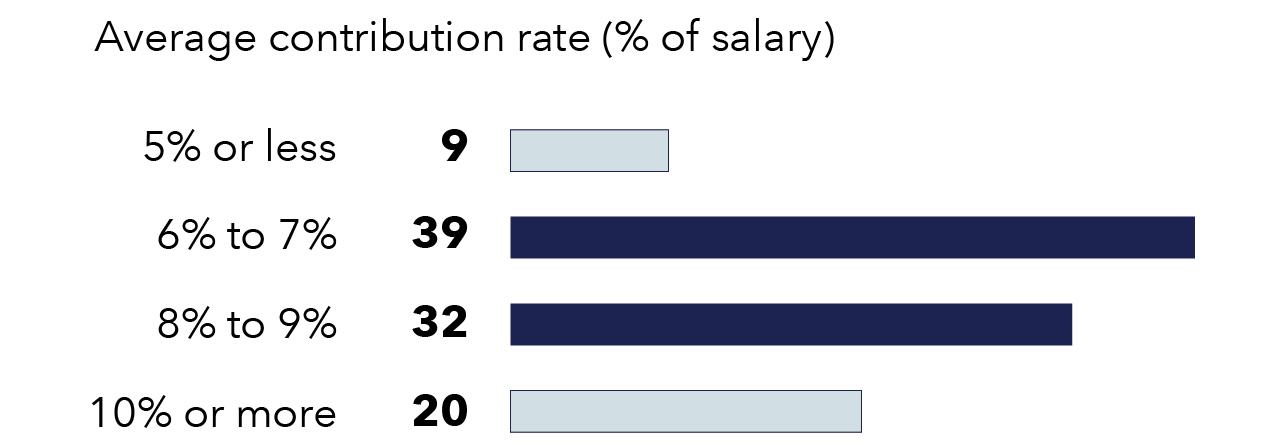
Automatic enrollment helps participants begin saving earlier, while automatic escalation steadily increases contribution rates over time. Together, these features address one of the most persistent challenges in retirement planning: insufficient savings. On average, most plan sponsors we polled said their participants contribute 6% to 9% of their salary each year to their DC plan.
In terms of auto-enrollment, many sponsors set the default contribution rate between 3% and 6% of salary, reflecting different plan philosophies and workforce needs.
Most participants contribute between 6% and 9% of salary
Source: Capital Group’s 2026 Institutional Retirement Survey of Plan Sponsors. As of May 2026.
For plan sponsors, we’d suggest reviewing whether current defaults are producing the desired retirement-readiness outcomes. Sponsors that offer automatic enrollment may want to revisit default contribution rates and escalation schedules to help participants make more effective use of employer matching contributions.
Investment re-enrollment can better position participants for retirement
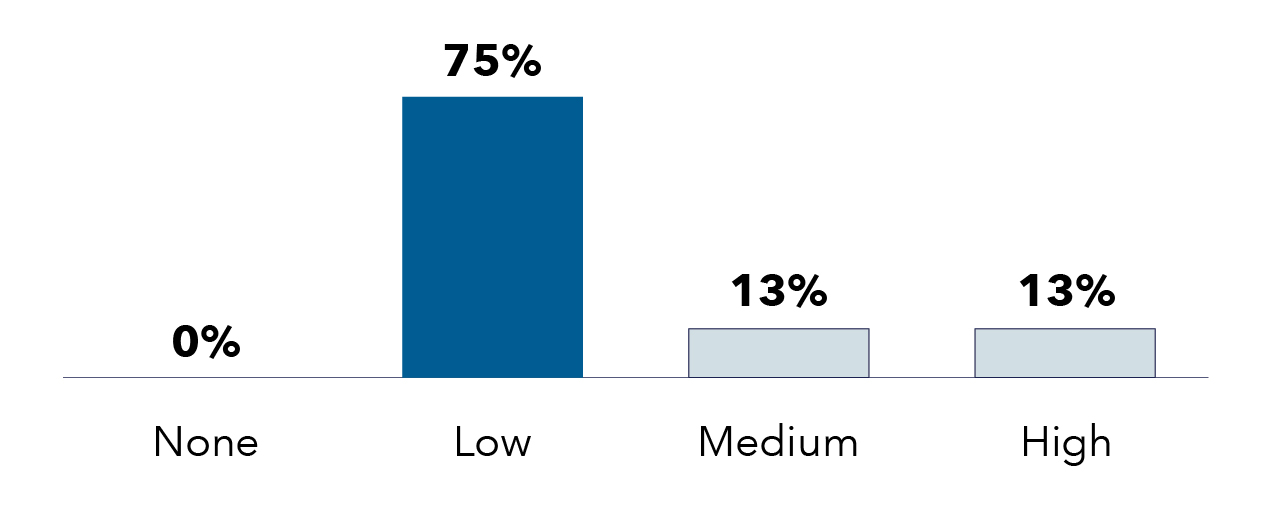
Here’s an important insight from the survey: 80% of plan sponsors have never conducted an investment re-enrollment. Yet among those who have, 75% say the process requires relatively little effort.
We believe sponsors should consider a re-enrollment program to better align participants with age-appropriate default investments while also preserving participant choice through an opt-out process.
For instance, some participants may maintain overly aggressive portfolios as they approach retirement; on the flip side, others may remain too conservative early in their careers. Re-enrollment can help address these situations and improve alignment between a person’s retirement objectives and portfolio construction.
When it comes to investment menus, the survey showed most plan sponsors continue to favor simplicity. Typical DC plans offer between 10 and 19 investment options for participants, with a target-date series generally counted as a single option. This reflects an ongoing balance between providing meaningful choice and avoiding participant confusion.
Vehicle choice is also shifting. Mutual funds remain widely used, but collective investment trusts (CITs) have gained significant traction. Survey respondents reported that 85% of plans offer mutual funds while 78% offer CITs, highlighting how sponsors increasingly view CITs as attractive institutional vehicles because of their flexibility and cost advantages.
What was the level of effort required to conduct an investment re-enrollment?
Source: Capital Group’s 2026 Institutional Retirement Survey of Plan Sponsors. As of May 2026.
Retirement income: The next frontier is decumulation
Over the past few decades, sponsors have made tremendous strides in helping participants accumulate assets in their retirement plans. Now, for those who remain in-plan after retirement, sponsors are focused on helping them draw regular income and make their money last, a process known as decumulation.
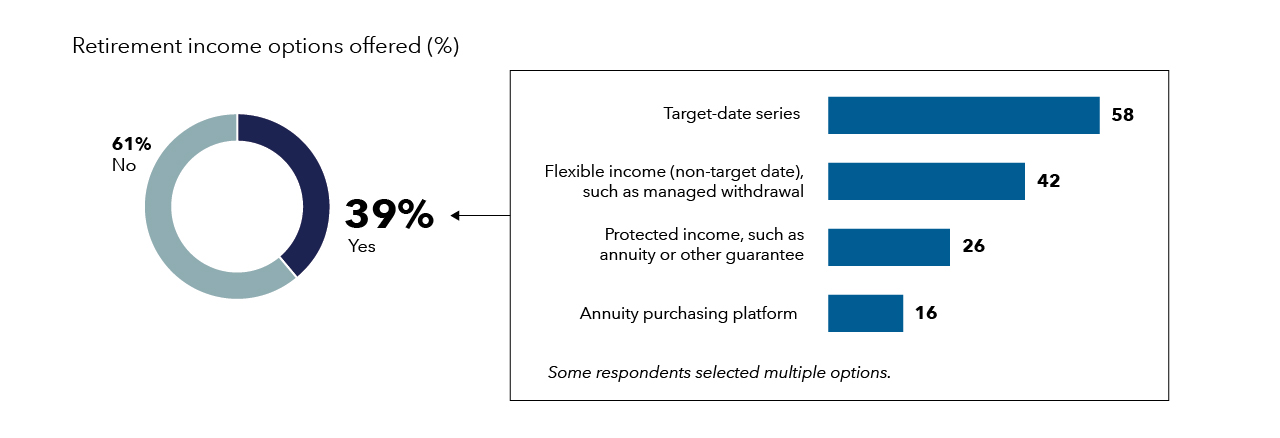
Our survey found that 61% of plans do not yet offer a specific investment product or approach to address decumulation. Of the 39% that do, they are tackling it in several ways, led by implementing a retirement income strategy within a target-date series. That said, no single solution has emerged as a clear favorite.
Most popular retirement income options
Source: Capital Group’s 2026 Institutional Retirement Survey of Plan Sponsors. As of May 2026.
Key trends reshaping defined contribution industry
We asked sponsors: What’s the biggest trend that may disrupt how you manage your DC plan in the next five years? Based on the responses, we would characterize them as follows:
- The rapid development and adoption of AI is seen as a major disruptor, influencing investment advice, participant engagement and plan management. Sponsors anticipate AI-driven tools for personalized asset allocation and participant guidance.
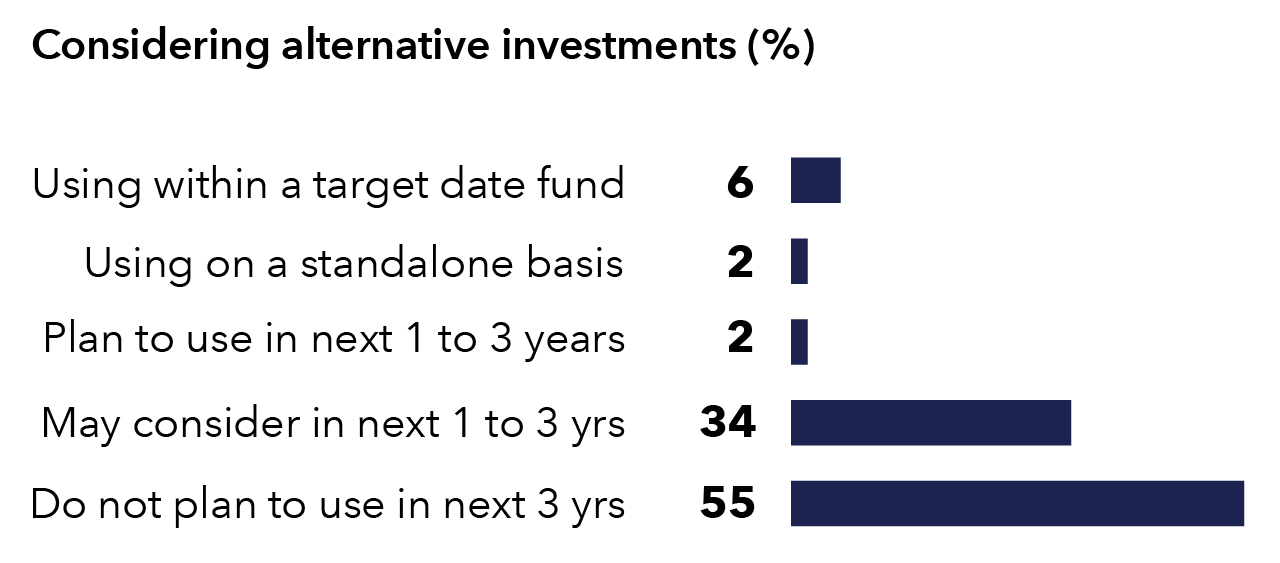
- The inclusion of alternative assets (e.g., private equity, private credit and crypto) in DC plans is a growing trend. Sponsors are concerned about education, risk and operational challenges associated with these options.
- There is a growing focus on retirement income and decumulation solutions, including guaranteed income options and new target-date fund asset classes, as participants seek to translate their savings into a sustainable paycheck in retirement.
- Increasing litigation threats and evolving regulatory/legislative changes (e.g., SECURE 2.0, state laws) are top concerns. These trends may impact plan design, fiduciary risk and compliance requirements.
Alternatives on the radar
Source: Capital Group’s 2026 Institutional Retirement Survey of Plan Sponsors. As of May 2026.
Retirement plans are moving to span the entire journey
Retirement plans are evolving from accumulation vehicles into holistic retirement solutions. Sponsors face a challenge that spans the full retirement journey, from enabling participants to save enough and invest appropriately to identifying vehicles that can convert accumulated nest eggs into sustainable income.
Our survey suggests meaningful progress. Sponsors are embracing automatic features to encourage savings rates, exploring new ways to improve investment outcomes and evaluating approaches to turn a lifetime of savings into a reliable retirement income.
Learn more about
Plan Design
Retirement Income
Retirement Planning
Don't miss our latest insights.
Our latest insights
-
-
-
Plan Design
-
Plan Design
-
Participant Education
Don’t miss out
Get the Capital Ideas newsletter in your inbox every other week
For institutional investors only. Not for use with the public.
Investments are not FDIC-insured, nor are they deposits of or guaranteed by a bank or any other entity, so they may lose value.
Although target date portfolios are managed for investors on a projected retirement date time frame, the allocation strategy does not guarantee that investors' retirement goals will be met.
All Capital Group trademarks mentioned are owned by The Capital Group Companies, Inc., an affiliated company or fund. All other company and product names mentioned are the property of their respective companies.
This content, developed by Capital Group, home of American Funds, should not be used as a primary basis for investment decisions and is not intended to serve as impartial investment or fiduciary advice.
Use of this website is intended for U.S. residents only.