Defined Contribution



Defined contribution (DC) plan investment menus are designed to help participants create an investment portfolio that can help balance growth and income in preparation for a decades-long retirement journey. While equities often potentially drive long-term asset appreciation, fixed income can play an essential role in supporting a range of participant objectives throughout the investment time horizon. Changes in the market environment, demographic shifts and evolving participant needs bring into focus the limitations of relying on a single bond strategy, warranting a fresh look at how fixed income is implemented within the DC menu.
Why now?
Among the 56 DC plan sponsors¹ that participated in a recent Capital Group survey, 96% reported offering a core bond option, most commonly benchmarked to the Bloomberg U.S. Aggregate Bond Index. Although the index provides broad exposure to the investment-grade U.S. bond market, its composition reflects the size and issuance patterns of a defined universe of government, corporate and securitized debt. As a result, an allocation closely aligned with the index may not fully address the range of objectives that participants expect fixed income to fulfill.
Rather than viewing the core bond option as a complete fixed income solution, plan sponsors may benefit from evaluating the role it is intended to play and whether active management, broader mandates or complementary strategies could help address objectives or opportunities not fully represented in the benchmark.
Fixed income through changing market environments
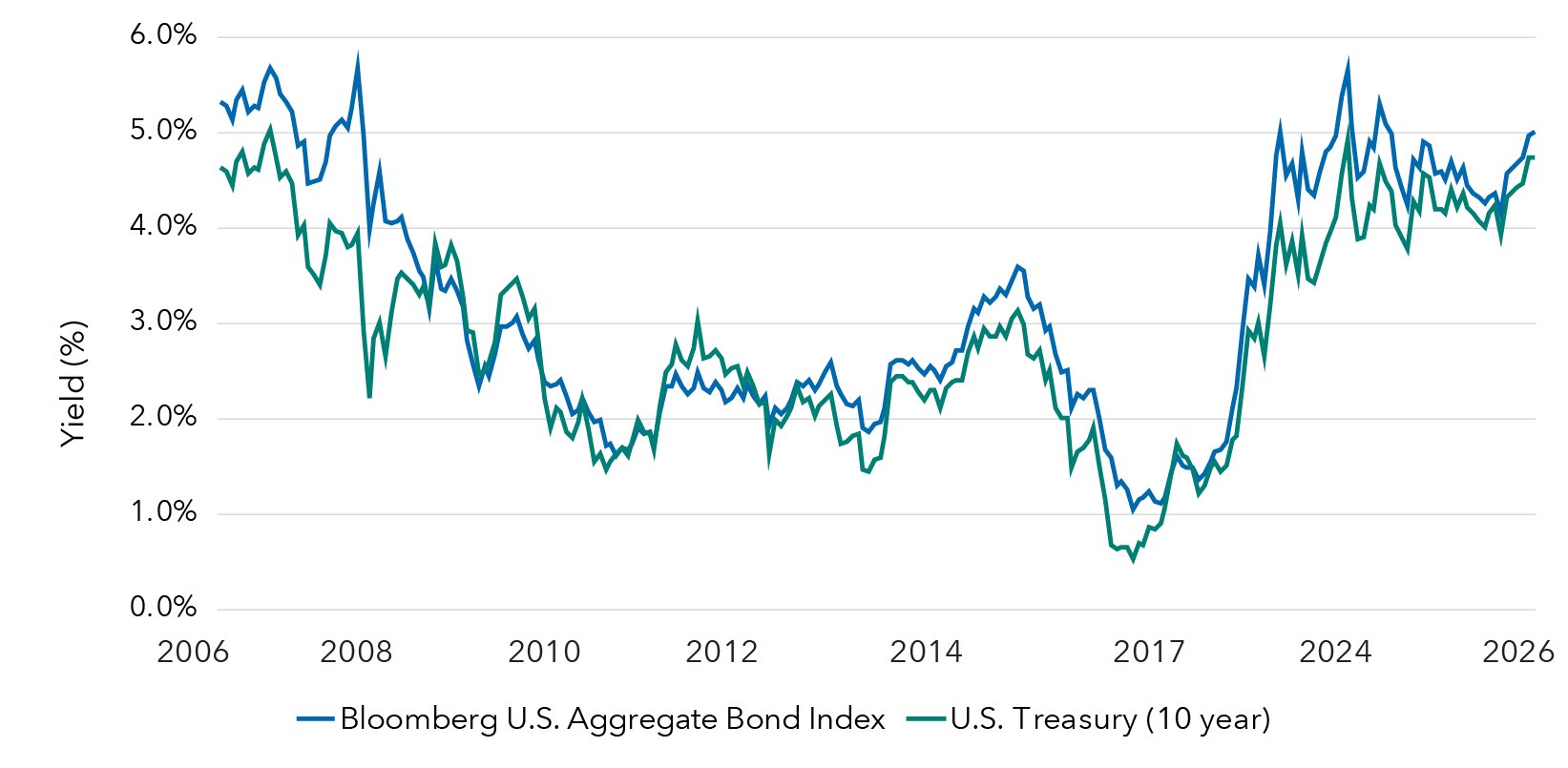
A participant's retirement journey may span multiple interest-rate cycles. The evolution of the Bloomberg Aggregate and 10-year Treasury yields over the past several decades highlights how the opportunity set for fixed income can change materially over time, creating a need for ongoing evaluation of how bonds are utilized within both DC menus and target date fund glide paths. Past results are not predictive of results in future periods.
Sources: Bloomberg, Board of Governors of the U.S. Federal Reserve. Data as of August 2026.
According to the same institutional plan sponsor survey1, 51% offered both active and passive core fixed-income options, while 20% offered only a passive option. Nearly 50% of respondents identified re-evaluating their fixed income plan options as a top priority over the next 12 months.
Timely evaluation may be increasingly important as baby boomers, one of the largest generations in history, continue to enter and move through retirement. As participants age, their investment behaviors often evolve as well. Research from the Investment Company Institute2 shows that younger defined contribution plan participants are more likely to rely on professionally managed solutions such as target date funds, while older participants tend to have lower allocations to target date funds and greater use of individual investment options available on the plan menu. Understanding how participants, particularly those nearing or in retirement, are utilizing the underlying investment options can provide valuable insight for plan sponsors as they evaluate their investment lineup and support participant outcomes.
Primary objectives of fixed income investing
Examining how fixed income is utilized within a professionally managed solution, such as a target date fund, may offer valuable insights into whether a plan's broader fixed income lineup is aligned with participant needs and retirement objectives, particularly as fixed income assumes a larger role near retirement. While fixed income investments can take many forms, they are often used to support several primary objectives within participant portfolios, including diversification from equity, capital preservation and income generation. Some plan sponsors and consultants may also look to certain fixed income-related strategies, such as Treasury Inflation-Protected Securities (TIPS), as part of a broader effort to help participants manage inflation risk and preserve purchasing power over time. As a diversifier, high-quality bonds have historically exhibited lower correlations to equities and have often provided relative stability during periods of market stress.
Historical correlations of asset classes to U.S. equities
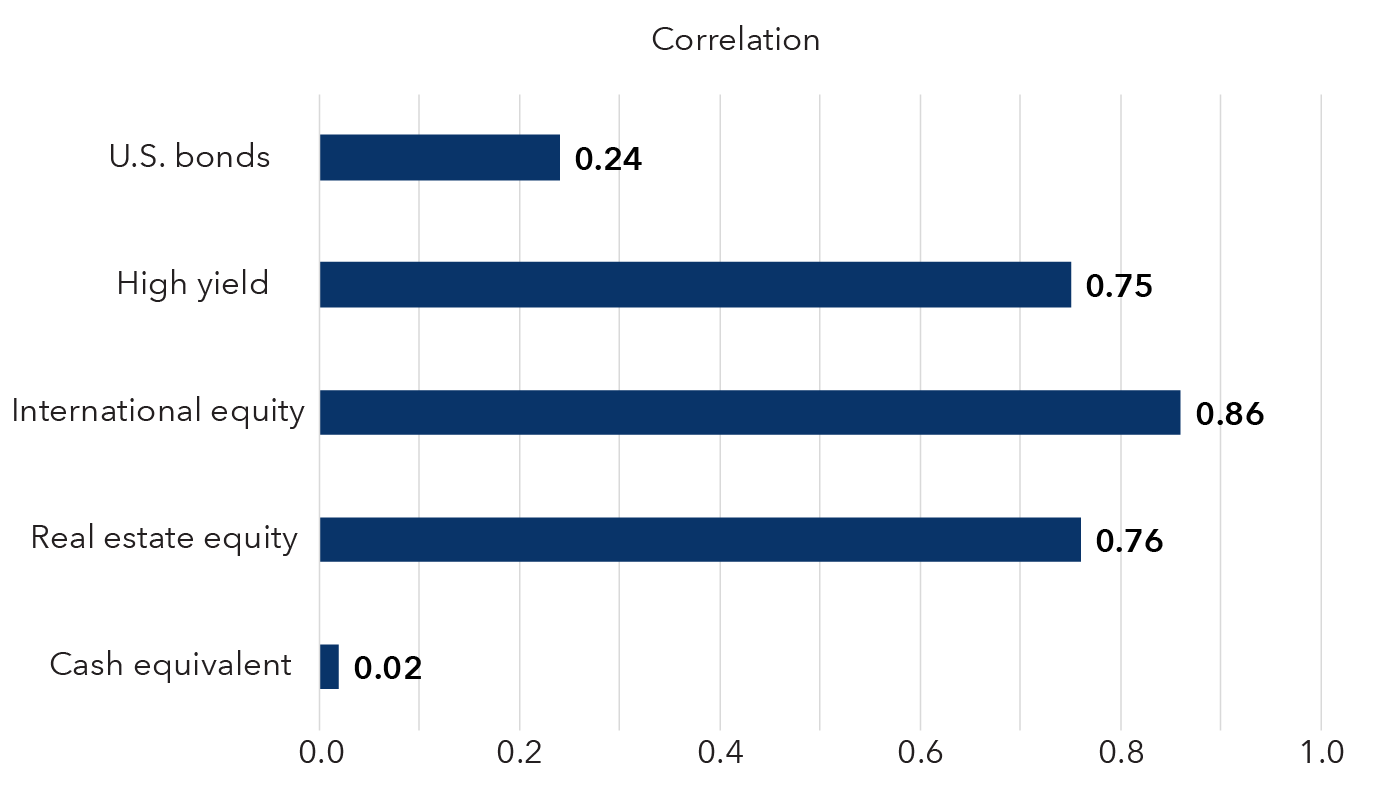
Source: Monthly data for the 20 years ending 6/30/26. Russell 3000 Index (U.S. equities), Bloomberg U.S. Aggregate Total Return Value Unhedged (U.S. bonds), Bloomberg U.S. Corporate High Yield Total Return Index (U.S. high yield), MSCI ACWI Ex USA NR USD (international equity), FTSE Nareit All Equity REITs Total Return USD (real estate equity) and 3-month U.S. Treasury bill rate (cash equivalent).
Fixed income can also help preserve capital by reducing portfolio volatility and cushioning the impact of significant market drawdowns, particularly as participants approach retirement. In addition, bonds can provide a more predictable source of income through coupon payments, making them an important tool for supporting retirement spending needs. Finally, because no single bond allocation is likely to achieve every objective simultaneously, understanding the distinct role each fixed income allocation plays within a portfolio can help fiduciaries evaluate both the construction of their fixed income menu and the design of their chosen target date fund.
This approach highlights an important consideration for fiduciaries: effective fixed income design often begins with a clear understanding of the outcome the allocation is intended to deliver. A bond allocation designed primarily to diversify equity risk may look different from one intended to generate income, preserve capital or help participants maintain purchasing power over time. While participant-directed lineups are not expected to replicate the complexity of a target date glide path, the underlying principle remains relevant. Plan sponsors may benefit from evaluating whether the fixed income options within their investment menu collectively support the range of participant objectives they seek to achieve throughout the retirement journey.
Fixed income building blocks and implementation
While fixed income can support multiple participant objectives, implementation shapes how those objectives are reflected in participant outcomes. Core bond strategies remain the foundation of many defined contribution investment lineups, but some plans also offer complementary fixed income options, such as core-plus, high-yield or inflation-protected strategies that provide exposure to additional segments of the bond market. Given the wide adoption of plan design features such as auto enrollment, plan sponsors were compelled to focus their governance budgets on the qualified default investment (typically target date funds). And in response, the market offerings also evolved to provide greater diversification while professionally managing allocations to different segments of the fixed income market.
Implementation considerations may include:
- Defining the purpose of each fixed income allocation.
- Determining whether current benchmarks and strategies remain fit for purpose.
- Evaluating whether participants have access to solutions aligned with the outcomes the plan seeks to support.
- Assessing whether fixed income exposures remain aligned with participant demographics, retirement objectives and plan design.
Ultimately, the goal is not to maximize the number of fixed income options available, but to ensure that fixed income is implemented in a manner that supports the outcomes participants need throughout their retirement journey.
How can fiduciaries influence participant outcomes?
Plan sponsors can influence participant outcomes by shaping the choices, resources and decision-making environment available to participants. Fiduciaries design the menu, structure choices, provide guidance and establish governance processes that can support more informed investment decisions. A thoughtfully designed menu can provide participants with fixed income building blocks that address distinct retirement needs and investment objectives.
For example, a plan seeking to support retirement income or provide broader fixed income diversification may choose to supplement a core bond option with strategies specifically designed to provide higher levels of income generation, such as a multi-sector income strategy. Similarly, fiduciaries seeking to address participant needs may evaluate whether their lineup includes strategies intended to diversify equity risk, preserve capital or generate income. Each one of those strategies may require a different bond allocation.
Framing fixed income options around the outcomes they are designed to deliver may help participants make more informed decisions while supporting a menu structure that is clear, diversified and aligned with long-term retirement needs.
Moving from assessment to action
The role of fixed income in a defined contribution plan is not simply a question of what options are offered, but whether those options are positioned to help participants achieve meaningful outcomes. By evaluating fixed income through the lens of participant needs, menu design and retirement objectives, fiduciaries can take a more intentional approach to lineup construction. The following questions are designed to help committees assess whether their fixed income structure remains aligned with the outcomes they seek to deliver.
- What outcomes are we expecting fixed income to deliver for participants, and does our current lineup support those objectives?
- Does each fixed income option have a clearly defined purpose within the menu, or are certain options creating overlap, redundancy or participant confusion?
- Are participant needs adequately addressed across both accumulation and retirement phases, including diversification, capital preservation or income generation?
- What lessons from target date fund construction could improve the design and effectiveness of our broader fixed income lineup?
- Have we evaluated our fixed income menu through the lens of participant outcomes and decision-making behavior, rather than solely fund-level characteristics and benchmarks?
Conclusion
Participants do not experience asset classes, they experience outcomes. Fiduciaries should refresh their view of fixed income as an intentional tool to support diverse participant investment objectives. The foundational framework for fixed income should go beyond just which strategies are offered but whether those strategies effectively deliver the outcomes that participants seek in their retirement investment journey.
Our latest insights
-
-
-
Regulation & Legislation
-
Asset Allocation
-
Portfolio Construction
¹Capital Group 2026 Institutional Retirement Survey
²2026 Investment Company Fact Book
Bloomberg U.S. Aggregate Index represents the U.S. investment-grade fixed-rate bond market. This index is unmanaged, and its results include reinvested dividends and/or distributions but do not reflect the effect of sales charges, commissions, account fees, expenses or U.S. federal income taxes.
The Bloomberg U.S. Corporate High Yield Bond Index measures the USD-denominated, high yield, fixed-rate corporate bond market. Securities are classified as high yield if the middle rating of Moody's, Fitch and S&P is Ba1/BB+/BB+ or below. Bonds from issuers with an emerging markets country of risk, based on Bloomberg EM country definition, are excluded.
BLOOMBERG® is a trademark and service mark of Bloomberg Finance L.P. and its affiliates (collectively “Bloomberg”). Bloomberg or Bloomberg’s licensors own all proprietary rights in the Bloomberg Indices. Neither Bloomberg nor Bloomberg’s licensors approves or endorses this material, or guarantees the accuracy or completeness of any information herein, or makes any warranty, express or implied, as to the results to be obtained therefrom and, to the maximum extent allowed by law, neither shall have any liability or responsibility for injury or damages arising in connection therewith.
The MSCI ACWI Ex USA NR USD is a global equity index capturing large- and mid-cap stocks across developed and emerging markets outside the United States, covering approximately 85% of the non-U.S. equity opportunity set.
The MSCI information may only be used for your internal use, may not be reproduced or redisseminated in any form and may not be used as a basis for or a component of any financial instruments or products or indices. None of the MSCI information is intended to constitute investment advice or a recommendation to make (or refrain from making) any kind of investment decision and may not be relied on as such. Historical data and analysis should not be taken as an indication or guarantee of any future performance analysis, forecast or prediction. The MSCI information is provided on an “as is” basis and the user of this information assumes the entire risk of any use made of this information. MSCI, each of its affiliates and each other person involved in or related to compiling, computing or creating any MSCI information (collectively, the “MSCI Parties”) expressly disclaims all warranties (including, without limitation, any warranties of originality, accuracy, completeness, timeliness, non-infringement, merchantability and fitness for a particular purpose) with respect to this information. Without limiting any of the foregoing, in no event shall any MSCI Party have any liability for any direct, indirect, special, incidental, punitive, consequential (including, without limitation, lost profits) or any other damages. (www.msci.com)
The Russell 3000® Index measures the results of the largest 3,000 US companies designed to represent approximately 98% of the investable US equity market. This index is unmanaged, and its results include reinvested dividends and/or distributions but do not reflect the effect of sales charges, commissions, account fees, expenses or U.S. federal income taxes.
The FTSE Nareit All Equity REITs is an index tracking all publicly traded U.S. equity REITs that primarily own and operate income-producing real estate.
London Stock Exchange Group plc and its group undertakings (collectively, the “LSE Group”). © LSE Group 2025. FTSE Russell is a trading name of certain of the LSE Group companies. FTSE® and Russell® indexes are trademarks of the relevant LSE Group companies and are used by any other LSE Group company under license. All rights in the FTSE Russell indexes or data vest in the relevant LSE Group company which owns the index or the data. Neither LSE Group nor its licensors accept any liability for any errors or omissions in the indexes or data and no party may rely on any indexes or data contained in this communication. No further distribution of data from the LSE Group is permitted without the relevant LSE Group company’s express written consent. The LSE Group does not promote, sponsor or endorse the content of this communication.