Defined Contribution
Categories
Chart in Focus
What will drive the yen’s next move?
 Anne Vandenabeele
August 19, 2026
Don't miss our latest insights.
Over the past several years, a weak yen has reflected Japan's exceptionally loose monetary policy and the wide gap between U.S. and Japanese real interest rates. Although it has provided a tailwind for Japan's export-driven companies, prolonged currency weakness is increasingly weighing on a domestic economy that depends heavily on imported energy, raw materials and industrial products.
The recent coordinated intervention by the U.S. and Japan to boost the yen serves as a reminder that policymakers can provide a short-term tailwind to currencies, but lasting appreciation typically requires a shift in underlying fundamentals.
As a reminder, Japan is the largest foreign holder of U.S. Treasuries, with holdings of roughly $1.1 trillion. In a conventional intervention, Japan could fund yen purchases by selling some of those assets. With U.S. Treasury yields already near multi-year highs, sizeable sales could add upward pressure on yields and contribute to market volatility. By coordinating directly and relying on mechanisms that reduce the need for Treasury sales, both sides are hoping to support the yen while minimizing disruption to U.S. bond markets.
For now, Japan continues to pursue an ambitious fiscal and industrial agenda, including plans for ¥370 trillion of public investment, while the Bank of Japan (BOJ) has been gradual in normalizing policy. Together, these forces should continue to weigh on the yen and place upward pressure on government bond yields.
A short-lived boost for the yen?
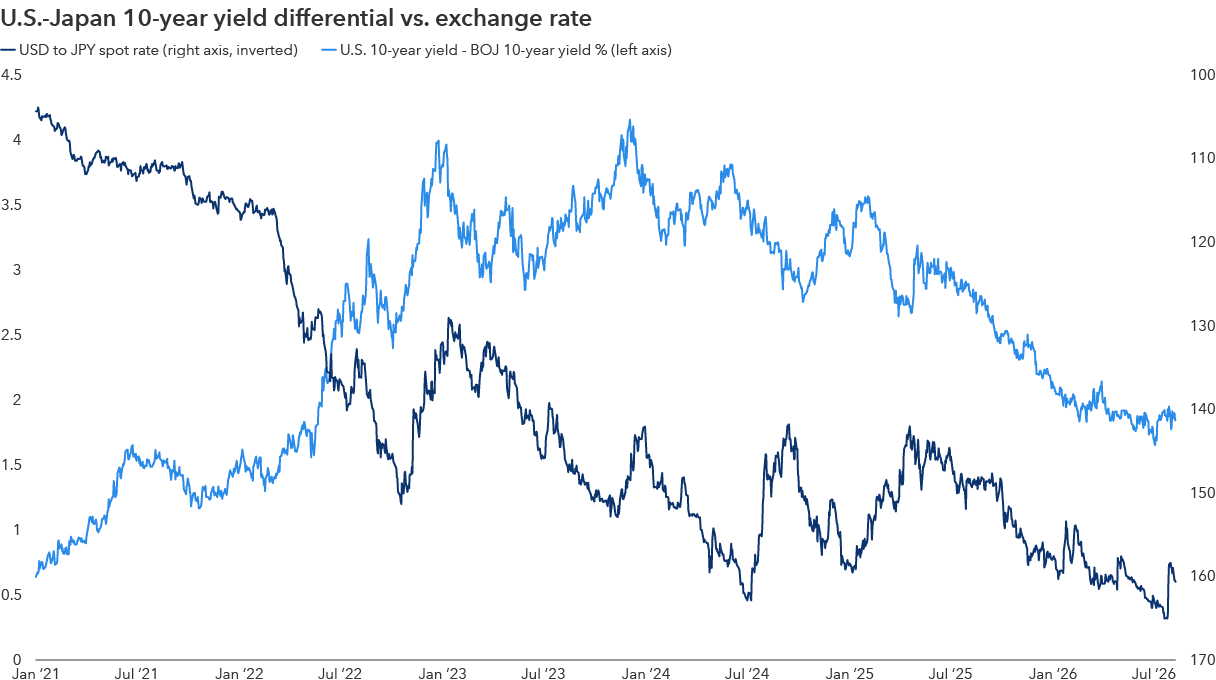
Source: Bloomberg Finance L.P. As of August 12, 2026.
U.S. involvement may give the BOJ more flexibility
The U.S. administration appears increasingly focused on addressing the causes of yen weakness rather than simply counteracting its symptoms. Concerns about trade competitiveness and the possibility of Japan selling U.S. Treasuries to fund intervention also appear to have influenced the U.S. response. This dynamic could give the BOJ greater flexibility to accelerate policy normalization.
Looking ahead, I anticipate the BOJ will raise rates once more before year-end and three times in 2027, implying a policy path that is more aggressive than markets currently expect. As a result, the terminal rate could ultimately be higher than current market pricing suggests.
Beyond rates: A broader shift in capital flows
The BOJ could take a more active role in managing longer term bond yields if financing conditions tighten too quickly. The government may also encourage large domestic institutions to invest more capital at home, helping support demand for Japanese government bonds and other domestic assets. Together, these developments suggest the implications extend well beyond the yen.
A key consideration for investors is how Japan balances stronger growth ambitions, higher interest rates, rising government financing needs and domestic capital allocation. As these priorities begin to compete with one another, volatility across currencies, rates and Japanese assets could create meaningful opportunities and risks beyond the focus on currency intervention
Investment implications
A durable yen recovery will likely require either faster BOJ policy normalization or changes to fiscal policy, both of which remain uncertain. At the same time, a weaker U.S. economy or broader dollar weakness could provide an alternative path to yen appreciation.
While some caution on Japan may be warranted in the near term, the longer term structural story remains intact. Labor shortages are encouraging companies to become more efficient, which may support returns on equity and market performance over time. Japan presents opportunities outside the dominant tech universe, while corporate restructuring initiatives are helping drive profitability.
The challenge is that policy normalization appears likely to be gradual and subject to political constraints. As a result, there is a risk that longer term bond yields could rise before stronger growth and corporate fundamentals fully justify them. With both opportunities and risks emerging beneath the surface, a selective approach to companies, valuations and timing remains key.
Learn more about
Bloomberg Index Services Limited. BLOOMBERG® is a trademark and service mark of Bloomberg Finance L.P. and its affiliates (collectively "Bloomberg"). Bloomberg or Bloomberg's licensors own all proprietary rights in the Bloomberg Indices. Neither Bloomberg nor Bloomberg's licensors approves or endorses this material, or guarantees the accuracy or completeness of any information herein, or makes any warranty, express or implied, as to the results to be obtained therefrom and, to the maximum extent allowed by law, neither shall have any liability or responsibility for injury or damages arising in connection therewith.
Our latest insights
-
-
-
Artificial Intelligence
-
Artificial Intelligence
-
Interest Rates
RELATED INSIGHTS
-
-
Artificial Intelligence
-
Interest Rates
Don’t miss out
Get the Capital Ideas newsletter in your inbox every other week
Investments are not FDIC-insured, nor are they deposits of or guaranteed by a bank or any other entity, so they may lose value.
Investors should carefully consider investment objectives, risks, charges and expenses.
This and other important information is contained in the fund prospectuses and/or summary prospectuses, which can be obtained from a financial professional and should be read carefully before investing.
Statements attributed to an individual represent the opinions of that individual as of the date published and do not necessarily reflect the opinions of Capital Group or its affiliates. This information is intended to highlight issues and should not be considered advice, an endorsement or a recommendation.
All Capital Group trademarks mentioned are owned by The Capital Group Companies, Inc., an affiliated company or fund. All other company and product names mentioned are the property of their respective companies.
This content, developed by Capital Group, home of American Funds, should not be used as a primary basis for investment decisions and is not intended to serve as impartial investment or fiduciary advice.
Capital Client Group, Inc.
Use of this website is intended for U.S. residents only.