Artificial Intelligence
 Mark Casey
 Winnie Kwan
 Sugi Widjaja
 Jared Franz
Don't miss our latest insights.
- U.S. AI models seek human-level intelligence and superintelligence
- China is focused on industrial applications
- The AI race may favor coexistence over one clear winner
Thomas Edison had George Westinghouse. Apollo had Sputnik. Today’s artificial intelligence race between the United States and China may be the latest example of rivalry acting as a catalyst for innovation.
“Competition is healthy, and I think strong rivals will push AI labs to innovate and move faster,” says Mark Casey, principal investment officer for Fundamental Investors® and portfolio manager for CGGG — Capital Group U.S. Large Growth ETF. “China’s DeepSeek, for example, advanced the efficiency of a type of AI model called ”mixture of experts” using techniques which many leading AI labs now implement.”
China’s low-price strategy, aided in part by inexpensive labor and power, has helped it gain market share, even as the U.S. continues to lead in the digital economy and cutting-edge frontier applications. We highlight each country’s approach to AI, the advantages that could help them navigate the technology, and what the next phase of AI evolution could mean for investors.
Understanding the U.S. and China AI boom
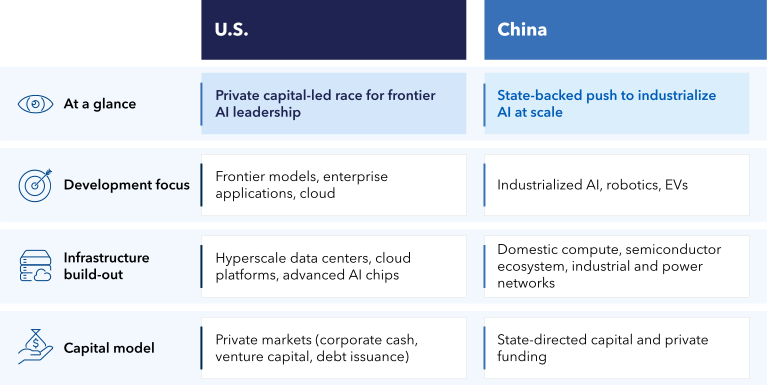
Sources: Capital Group. For illustrative purposes only. Frontier models are cutting-edge AI systems with the most advanced capabilities available today. Domestic compute refers to AI computing power located and operated within a country's borders. Hyperscale data centers are large-scale facilities that provide the computing power needed for AI and cloud services.
U.S. AI: Spending advantage
Against the backdrop of massive capital expenditures from large U.S. technology companies is the tantalizing possibility of artificial superintelligence, or ASI.
"The U.S. approach to AI is very different from China's, starting with how much they are spending to develop models to advance the frontier," says Capital Group economist Jared Franz.
“Anthropic, OpenAI and other U.S. companies are pursuing superintelligence, which could unleash transformative economic growth, accelerate scientific discovery and tackle some of humanity's hardest problems,” Franz adds. “The approach remains speculative, and while there are concerns about losing control over a superintelligent system, the U.S. is more comfortable with the risk because of the profit motive. While China has not abandoned it, the country prioritizes deploying AI for industrial applications.”
U.S. tech companies far outspend their Chinese rivals on AI
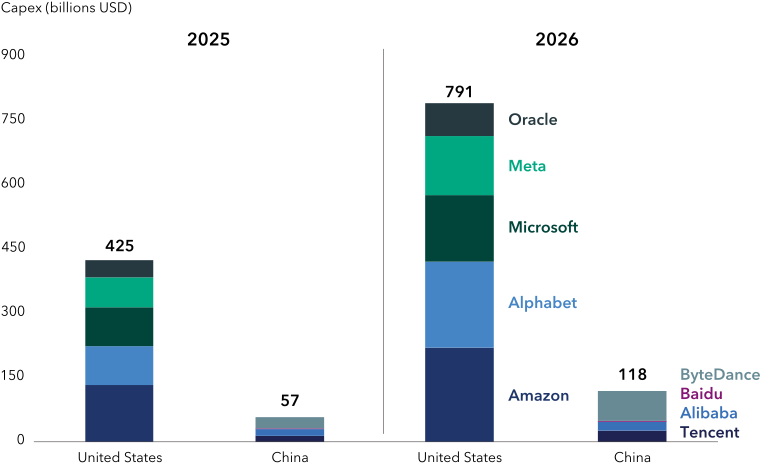
Sources: Capital Group, Bloomberg, FactSet. Estimates as of July 31, 2026. Capex is capital expenditures. Data shown is calendarized for comparability across companies with different fiscal calendars. ByteDance capex figures as reported by Bloomberg. Government spending is not included.
U.S.-based AI companies have set their sights on another acronym on their path to achieving potential superintelligence: RSI, or recursive self-improvement. “Researchers have been pursuing the ability for models to improve themselves for decades. Recently, OpenAI said their most sophisticated model improved a cheaper, entry-level model, which is a meaningful development because when RSI is achieved, there’s an explosion in efficiency, productivity and other improvements that could push model prices down,” Franz explains.
Of course, AI doesn’t have to reach superintelligence or even the lower but still lofty goal of human-level intelligence to impact the world. "Talk to anyone in Silicon Valley and they'll tell you AI is being applied to every conceivable problem or industry,” Franz notes. “Despite high failure rates and no guarantee of success, venture capital keeps flowing into AI-related start-ups that could prove transformational.”
It remains to be seen whether the billions of U.S. dollars earmarked for capital expenditure will pay off, but history suggests that rewards at the top tend to be uneven in fields where being the best matters. “The difference between the best CEO and the second might be 10 to 1, not 2 to 1," says Casey, pointing to top executives like Nick Howley at aerospace parts manufacturer TransDigm or Hock Tan at Broadcom. "You pay a lot more to get the absolute best person. There are many fields where being the best and the fastest matters, and people will pay a premium for the frontier, which is exactly why it’s hard to determine the future for AI labs.”

Megatrends: From AI to space and beyond
Thursday, September 24 | 11 AM PT / 2 PM ET
CE credit available
China AI: Industrial focus
China’s approach to AI is heavily focused on industrial applications, which plays directly to its strength of efficiently building things at massive scale.
“The U.S. is pursuing state-of-the-art models, with companies competing to develop frontier large language models (LLM) that rival human intelligence. China focuses on industrial use case intelligence such as autonomous driving and robotics instead of human-level intelligence," says Winnie Kwan, portfolio manager for New World Fund®. “The requirement for compute is different as a result, with Chinese AI applications consuming far fewer tokens to address the lack of leading-edge compute capacity in the country.”
Tokenomics: China’s AI models lead on cost
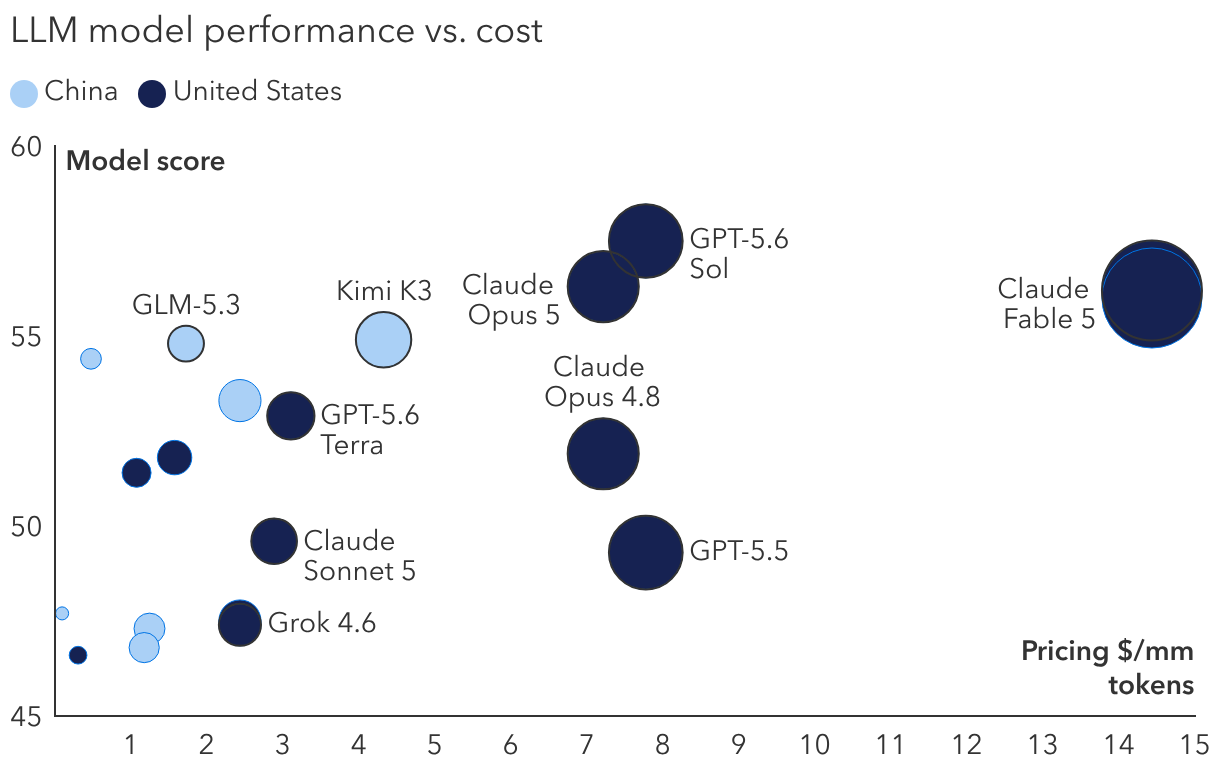
Sources: Capital Group, llm-stats. Price assumes an 8:1 input-to-output token ratio per 1 million tokens. Model score is a composite measure based on reasoning, coding, agentic, and other benchmark results. Tokens are the basic units of text processed by AI models and are commonly used to measure usage and determine pricing for AI services. As of August 14, 2026.
As a result, AI could amplify China’s already robust industrial ecosystem, turning technological advances into real world products. “Many companies are building humanoid robots used for manufacturing and logistics tasks, replicating what humans do on factory floors and in warehouses,” says equity investment analyst Sugi Widjaja, who focuses on Asian technology companies. “They’re adept at the hardware side and continue to make progress on the software side, using lessons from the country’s autonomous vehicles industry.”
In a bid to gain global influence and market share, China has adopted an open-weight model that allows customers to securely use its AI. True open-source models allow full access to training data and code, while open weight does not. "This means that U.S. companies can use cheaper Chinese open weights without sending data to China. They access them through cloud providers like Amazon Web Services or Microsoft Azure that host the models locally and keep everything compliant with U.S. data and privacy laws," he explains.
Competitive coexistence
Rather than a winner-takes-all outcome, Kwan sees the two systems coexisting, where frontier U.S. models capture the premium, high-stakes work while cheaper Chinese models handle the rest. "The best companies will likely always choose the most intelligent model for tasks where a 10% to 15% performance edge matters and becomes a competitive advantage over time. But for lower stakes jobs, if the Chinese model is good enough, they'll use the Chinese model.”
Casey agrees, noting there are already companies that route queries or projects toward the lowest overall price. “While Chinese models may be cheaper per token, they may require more tokens to complete a task accurately. Thus, companies like privately-held OpenRouter have formed to switch between models depending on the task and accuracy required.”
He adds, “It’s too early to declare who will win on productivity and innovation, but the two systems will coexist given geopolitical tension and deep mistrust. Today, for example, in the infrastructure as a service market, although Chinese internet companies such as Baidu and Tencent offer very low prices, they aren’t widely used in the U.S. and Europe.”
What does the U.S.-China AI race mean for investors?
Few events have tested investor’s confidence in the sustainability of the U.S. AI boom more than the rise of China’s open-weight models. “Given that AI spending now touches many companies in the U.S. stock markets, volatility tied to the U.S. and China AI race will continue. Their developments are important to monitor as both are advancing at a rapid clip and have major implications for companies and society,” Casey says.
“So far, Chinese models have not undercut the case for U.S. AI development, though the AI build-out cycle may be approaching the top part of the S-curve, where growth in new capacity slows even if overall demand continues to grow,” he explains. “I think at some point there will probably be a transition to companies that grow in line with the total amount of AI infrastructure already running rather than according to the new infrastructure built each year. An example is Amazon Web Services. Others like Meta could benefit if the price of AI chips declines, given it’s an input cost for the company.”
Franz concludes, “We know from prior technology cycles that leaders at the beginning are often not the leader at the end or in the middle. There's a lot of shuffling in leadership, and it's very hard to predict which companies will ultimately win. That’s why we are tracking this closely in the U.S. and with on-the-ground research in China.”
Mixture of experts (MoE) is a machine learning approach that divides an artificial intelligence (AI) model into separate sub-networks (or “experts”), each specializing in a subset of the input data, to jointly perform a task.
Bloomberg Index Services Limited. Bloomberg® is a trademark and service mark of Bloomberg Finance L.P. and its affiliates (collectively “Bloomberg”). Bloomberg or Bloomberg’s licensors own all proprietary rights in the Bloomberg Indices. Neither Bloomberg nor Bloomberg’s licensors approves or endorses this material, or guarantees the accuracy or completeness of any information herein, or makes any warranty, express or implied, as to the results to be obtained therefrom and, to the maximum extent allowed by law, neither shall have any liability or responsibility for injury or damages arising in connection therewith.
Our latest insights
-
-
Artificial Intelligence
-
Artificial Intelligence
-
Interest Rates
-
World Markets Review
RELATED INSIGHTS
-
Artificial Intelligence
-
Artificial Intelligence
-
Economic Indicators
Don’t miss out
Get the Capital Ideas newsletter in your inbox every other week