
Interest Rates
The Broad View
Equity roundtable 2026: How much is too much in an AI world?
 Brant Thompson
 Noriko Chen
 Mark Casey
 Jayme Colosimo
January 30, 2026
The past year asked investors to hold two ideas at once. On the surface, markets showed resilience. Consumers kept spending, earnings held up and enthusiasm for artificial intelligence (AI) abounded. Beneath that, uncertainty never really let up. Tariffs, geopolitical tensions, uneven hiring and shifting economic policy kept volatility close at hand.
The question for investors isn’t whether opportunity exists, but how to navigate it in a market shaped as much by policy and disruption as by fundamentals.
We invited Capital Group equity portfolio managers Brant Thompson, Noriko Chen and Mark Casey and investment director Jayme Colosimo to reflect on the past 12 months and share how they’re thinking about the forces shaping equities in the year ahead.
Last year felt like an odd mix of resilience and anxiety. The consumer kept surprising to the upside even as companies and consumers dealt with higher prices, softer hiring and volatility. From your perspective, what really shaped the backdrop for equity investors when you look back on the past 12 months?
Brant Thompson: We exited a narrow up market in 2024 into tariff and policy uncertainty that took the market down in the first quarter. From that low, AI spending forecasts started to materially outstrip expectations, companies started to demonstrate that many of them were able to navigate tariffs better than feared, and year on year growth in real consumer income remained healthy. Keep in mind that the U.S. consumer represents around 70% of the U.S. economy. The market broadened compared to 2024 which really helped portfolios as the impact of AI spending spread to other areas such as utilities and some industrials. We also saw strength in areas like aerospace and defense, as well as some pockets of consumer staples and financials.
Noriko Chen: I agree. From the beginning of the year, we’ve had an unprecedented level of market volatility and lack of clarity. That’s resulted in companies holding back on hiring and investing. People are worried about the unemployment rate, which has been trending up a little bit, but it really hasn’t gone to levels where we’re super concerned yet. Similarly, for the economy, the market has been worried that the U.S. consumer is going to be weaker due to tariffs, but it hasn’t really come through in the data yet.
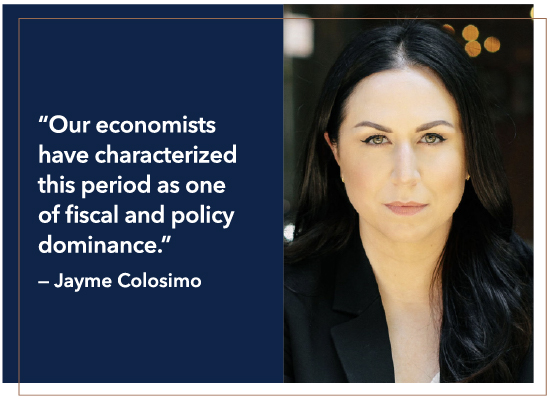
Jayme Colosimo: Our economists have characterized this period as one of fiscal and policy dominance. Tariffs are likely to be with us as a persistent policy tool of this administration, and companies are trying to find ways to navigate them. Earlier in the year, there was a concern that tariffs would put significant inflationary pressure on consumers. This has ended up looking less like a sharp disruption and perhaps could instead manifest as a smaller, persistent increase in inflation over time.
On the topic of consumer spending, it’s been strong but bifurcated. How are you thinking about that?
Thompson: I’m a big believer that real consumer income — which accounts for inflation — really matters, and it’s been strong this year. As for bifurcation, there’s lots of evidence that if you’re on the lower end, you’re struggling. If you’re in the middle of the pack and higher end, you’re likely doing fine. You’re likely benefiting from the strength of the market. You have a job, you may have gotten a raise, inflation is actually going down. As we look out to next year, one of the things I’m worried about is real consumer income decelerating substantially. And the big swing factor there is how much tariffs will impact the economy. If there was one lever that the U.S. government could pull that would make that picture much stronger, it would be to greatly reduce the tariff burden. That’s something I’m going to be watching closely.
Chen: I worry about the impact of AI on labor. It’s still early days, but we’re already seeing it in the software developer space. Companies aren’t hiring as many people both because they’re utilizing the technology and because they’re trying to understand what it means for their employee base. Although AI won’t fully replace human labor, I think it’s going to be a headwind, which will be a drag on employment and tough on consumption. But it might be very good for some companies that are leveraging this technology.

Explore what matters most.
Mark Casey: There’s an interesting debate about inflation versus deflation from AI. So far, AI has been inflationary to everything that goes into building, installing and powering up data centers, and there is a lot of talk about the potential for AI to have a deflationary impact on the price of labor. There is much less discussion about the potential for AI to have a deflationary impact on the prices of goods and services. In theory, AI won’t get adopted by businesses unless it can allow them to deliver similar or better outcomes at a lower cost. I don't know if AI’s potentially deflationary impact on the cost of goods and services will show up in 2026, but over time I think it could be a big deal.
Colosimo: Some of what’s driving that labor market weakness still seems a little bit unclear. There is some sector weakness happening outside of AI-related fields that we are keeping an eye on, like housing, non-residential investment and some other aspects of exports.
I want to ask the question that a lot of our clients are asking: Do you think we’re in an AI bubble?
Casey: When I look at the AI build-out compared to the big bubble of the internet build-out, it doesn't feel nearly as bubbly to me. For example, some of the same companies were involved with both build-outs, like Microsoft and Oracle, and they had much higher valuations then than they do now.
That said, some parts of the ecosystem do seem quite vulnerable. Less than a dozen companies are trying to stay on the frontier of building AI models. If even one or two drop their efforts to train frontier models and instead decide to use third party models for inference, the total amount spent on training models could decrease substantially, which in turn could meaningfully reduce aggregate spending on the training portion of the AI market.
Chen: I don’t think so, either. Back in 2000, a lot of the companies weren’t generating cashflow. The companies investing in AI today tend to be very profitable, and in some cases still have positive net cash flow after all their capital investments. Until recently, there hasn’t been a lot of creative financing either. For the companies that are over-investing, you might see declining returns for the next couple of years, so that might impact their valuations. It can also take some time to bring on the power required to build these systems out which is likely to slow down the cycle. And to Mark’s point, probably one or two companies are going to drop out, and that might impact the total demand for parts of the chain, including the chip makers. While this could be a short term negative drag on some companies, it is unlikely to have a significant impact that would drag down the entire market and end up in a recession.
Is there a time in history that feels like a more apt comparison to our current moment with AI than the telecom bubble?
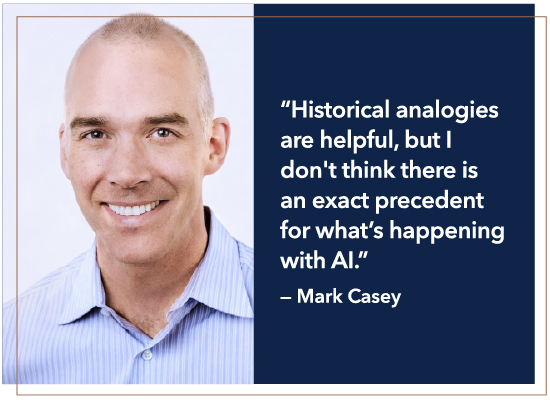
Casey: Historical analogies are helpful, but I don't think there is an exact precedent for what’s happening with AI. Before AI, the technology industry mostly created tools that made people more efficient and that automated some processes. Today, however, by building systems that approximate human intelligence, the technology industry is actually creating labor. An interesting question is how much of the labor budget will shift into the IT budget.
Today, there are something like 50 million people in the world who write software code. It’s not hard to imagine that, 10 years from now, a handful of extremely widely used AI systems will write the vast majority of the world’s new code, and the main role for humans to play in software development will be to manage these systems. I think it’s hard to predict how much revenue could flow into this AI-as-labor theme. I think it’s a new frontier.
Thompson: To add to that, if you’re a major economy with low population growth and rising costs related to health care and other things, what you really need is a huge boost in productivity. If you have a huge boost in productivity, you can grow your economy with that labor force and that can benefit everyone in the economy.
Chen: A hundred percent. I think this is exactly why China is very focused on the adoption and mass commercialization of AI and robotics.
What is your outlook on inflation and rate cuts for 2026?
Colosimo: Our economists, broadly, are aligned with market consensus in the U.S., with the potential room for growth to surprise on the upside. They expect the terminal rate to be around 3% by the end of 2026. While inflation has moderated, they do see the potential for renewed pressures in the near term, particularly if any tariffs pressures resurge through the system in the first half of next year.
Looking further out, fiscal stimulus — including the possibility of additional spending as we approach the midterm elections — could also contribute to inflationary impulses into 2026. Importantly, the final leg of progress toward the U.S. Federal Reserve’s 2% target has proven challenging. Much of the disinflation over the past 12 to 18 months has come from goods-price deflation coming down at rates that we haven’t seen historically, which is tied to the unwinding of post-COVID disruptions.
Casey: I’ll add that with the U.S. deficit around $2 trillion a year, or around 6% of GDP, and with the U.S. Federal debt at $38 trillion, or around 120% of GDP, there’s only so much the Fed can do to change interest rates. The Fed can lower short-term rates, but that might not change long term rates at all. It’ll depend on the willingness of buyers to show up and accept 10-, 20- and 30-year inflation risk at whatever the proposed long rates are.
Europe's defense sector has become an increasingly important part of the global investment conversation. How are you thinking about the opportunity there?
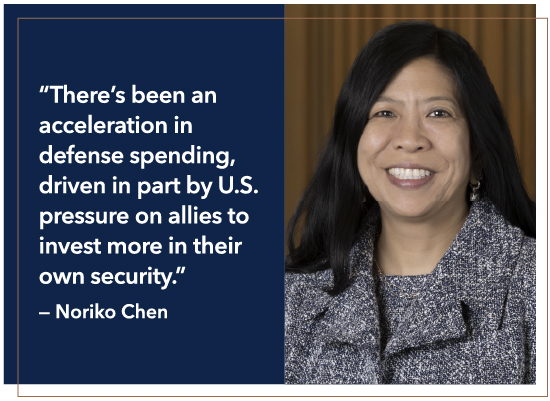
Chen: There’s been an acceleration in defense spending, driven in part by U.S. pressure on allies to invest more in their own security. Many European countries have historically spent around 1.5% of GDP on defense, but there’s now momentum toward roughly 3% over the next two to three years, which is creating a meaningful increase in demand. There are similar trends in Japan and South Korea, where years of underinvestment have left capacity tight and difficult to expand quickly. At the same time, governments are improving contract economics to secure supply, allowing for higher margins than in the past. That creates operating leverage and supports earnings growth across the sector.
Markets initially moved quickly into the most obvious defense names, so they’re trading at pretty high valuations. Our focus is on identifying companies where the benefits of rising defense budgets aren’t yet fully reflected.
Explore topics
Related insights
-
-
-
U.S. Federal Reserve