
Economic Indicators
Bonds
Fixed income roundtable: Clarity and Fed rate cuts set the stage for 2026
 Timothy Ng
 Courtney Wolf
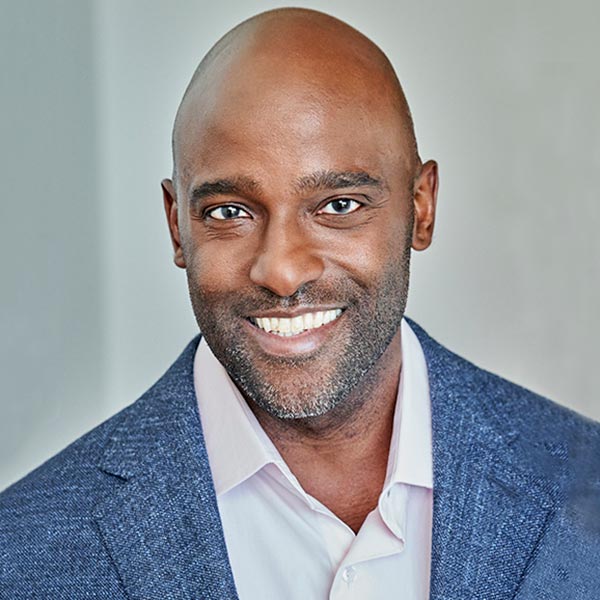 Xavier Goss
 Daniel Siegel
January 30, 2026
The past year was a dramatic one for bonds. Fixed income largely struggled in the first half amid market uncertainty before rallying to a strong year-end. There was no shortage of potential causes for this volatility: Broad tariffs, a federal government shutdown, dramatic changes in artificial intelligence (AI) technology and Federal Reserve interest rate cuts all made their mark in 2025.
We asked four fixed income investment professionals to discuss everything that happened and where the bond market might go from here. Capital Group portfolio managers Tim Ng, Xavier Goss and Courtney Wolf were joined by Capital Group analyst Daniel Siegel in a wide-ranging discussion.
It’s been a choppy year for fixed income. What’s been driving that and where are we now?
Tim Ng: It really was a tale of two halves for fixed income. The first half of the year we had a lot of market volatility due to the tariff announcement and the uncertainties it posed to the outlook. As a result, we saw 10-year yields trade in a 0.6%–0.8% range in the first couple of months. In the second half of the year, when tariff rates were reduced and we had a bit more clarity on its impact on the economy, volatility subsided considerably with 10-year yields trading between 4.0% to 4.2% over the last four months of the year.
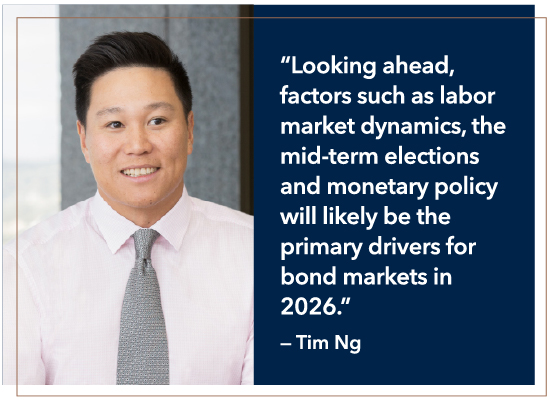
Now, trade policy has become a smaller focus for the outlook and fixed income. Looking ahead, other factors such as labor market dynamics, the mid-term elections and monetary policy will likely be the primary drivers for markets in 2026.
Courtney Wolf: The municipal bond market has been an interesting one in the last year. Tim did a great job outlining the U.S. rates market, and munis tend to take their cues from the rates market.
Munis underperformed the taxable bond market, but caught up a little bit in September, October and November. However, for the year through early December, the muni aggregate index returned about 4% versus the taxable agg at about 7%. The taxable equivalent yields for those in the highest tax bracket in many of our funds were 6% or higher.
It’s not that there were fundamental concerns with munis — tariffs didn’t necessarily directly impact munis, but they added uncertainty that muni investors tend not to like. We also had a lot of muni issuance, so supply put some pressure on the muni market as well.
Xavier Goss: In addition to broader macro and economic policy uncertainty, bond markets saw an increase in idiosyncratic credit events across the various sectors. Given this uptick in bankruptcies and restructurings, investors began to question the stability of the economic cycle and if markets were poised for a correction. A few of the concerns were focused on the strength of lower income consumers and high yield corporate fundamentals.
Market discussions about potential contagion risk to higher quality segments of the market persisted early in the year but later subsided as more favorable economic and corporate data were released. It is astonishing to see spreads largely unchanged from the beginning to the end of 2025 despite significant volatility along the way. I think the 2025 price action in bond markets highlights the balancing act between solid fundamentals, tight valuations and the potential for more idiosyncratic credit headwinds to come.
Daniel Siegel: There was significant uncertainty at the beginning of the year around tariffs and policy in the leadup to Liberation Day. In high yield, which is where I invest, yields rose from about 7.25% in February to over 8.5% at the April peak. Over the course of the year, the market got more comfortable with each leg of policy uncertainty and we’ve seen yields come all the way down to 6.6% at year-end.
Tariffs have been less impactful than feared in April 2025. Companies are creative and the consumer is resilient. Companies have largely figured out how to deal with the uncertainty. They have figured out how to pass on costs. And they’ve figured how to get their supply chains working in this new environment.

Explore what matters most.
Courtney, as you noted, municipals perked up at the end of the year. What drove that?
Wolf: I think it was driven by less supply and more demand for muni bonds. The year-to-date dispersion between taxable and munis was fairly striking and I think that helped bring additional demand into the muni market. Additionally, supply started to taper off, and that supported the market.
What’s everyone’s sense of where we’re going?
Ng: As I look ahead to 2026, I see a policy landscape that is very supportive to the economic outlook and asset prices.
The Fed delivered three cuts in 2025 and has signaled more cuts this year. We will likely get an even more dovish Federal Reserve chair in 2026, one that is aligned with President Trump’s “low rate” view, which will likely add additional pressure for rates to fall. The central bank also announced the end of quantitative tightening (QT), which means it will stop taking steps to limit liquidity, and hinted at potentially expanding the balance sheet again soon. Lower rates and more liquidity in the banking system should ease financial conditions further.
The federal government is running a large fiscal deficit which is also bolstering the economy. The government is also pursuing a deregulatory agenda in impactful areas such as banking and housing. Collectively, these actions loosen the regulatory burden for businesses and households, helping to boost activity in the process.
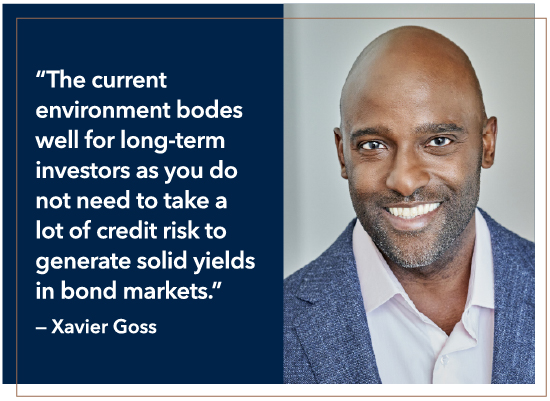
Goss: I expect security selection to drive returns, at least in credit markets and in securitized assets, going forward in 2026 — though absolute spread levels might not be super attractive, all-in yields are compelling and materially higher than the past couple decades. The current environment bodes well for long-term investors as you do not need to take a lot of credit risk to generate solid yields in bond markets. I can envision a scenario where bonds generate a competitive rate of return in the coming years relative to equities given the starting point of high all-in yields versus high equity valuations.
Another thing before we move on — uncertainty around policy creates a ton of opportunity in the market. I really do feel like it’s been, and will continue to be, a good time to be an investor. Obviously, it would be great if everything was notably cheaper. But I can’t remember another time, other than maybe the global financial crisis in 2008, where there was so much policy uncertainty. And it’s global, it’s not just in the U.S.
I feel that caters well to Capital Group’s process. If you can get on the right side of policy more often than not, even though spreads are tight, I feel like there’s a ton of relative value opportunities out there.
Policy hasn’t been the only source of uncertainty this year. We recently wrapped up the longest federal government shutdown on record. How has that affected markets?
Ng: The government shutdown didn’t have a material or lasting impact on fixed income markets for several reasons. This is not the first time the government has shut down, and so market participants have become somewhat numb to the whole process; it has become a normal part of the political process in the United States. Second, the shutdown has had a limited impact on economic activity, labor markets and inflation.
However, we did have a void of economic data for two months, during a time when Fed policy was active and reliant on data to make policy. It left market participants guessing how the Fed might perceive the economy. That added some noise but, ultimately, we still got the cuts that it outlined in the beginning of the year.
And, of course, the inescapable story of 2025 — AI applications. That’s been treated as more of an equity story, but has it leaked into fixed income?
Goss: The consensus is that the amount of money that’s being invested in AI infrastructure and the build-out should be supportive of broader productivity and economic growth in the coming years. Within the fixed income market, AI has presented itself in many different ways, similar to equities. The amount of investment needed to support the AI build-out will be massive and I expect companies to raise money in various markets to diversify their funding. One area of focus has been data centers, which have already issued bonds in multiple markets. We’ve seen an increase in issuance in the securitized credit markets, which are my focus. I would expect data centers to become a larger component of the commercial real estate market and to eventually become a benchmark sector with increasing issuance and trading activity in the future.
Siegel: The vast majority of the borrowing for AI/data center buildout has been in the investment-grade market (BBB/Baa and above) so far. It’s the hyperscalers — companies like Oracle, Amazon, Meta and Google — that have dominated the borrowing. These four borrowed about $90 billion in a span of approximately two months to end the year. And if you add in the Blue Owl data center, which was a Meta-linked deal, that was another almost $30 billion.
There have also been several newer issuers borrowing to build out single-site data centers in the high yield market. This is an example of where security selection is critical. Our analyst team spends a lot of time going through indentures and understanding covenants — that is, rules regarding the loan — in these deals.
Some high yield issuances are guaranteed by investment grade–rated parents like Google, but some don’t have any guarantees or structural protections. The risks are very different in each deal and you can get into a lot of trouble lending money to inaugural bond issuers with poor covenant protections. In high yield, we are being very selective on lending to companies without guarantees from the hyperscalers.
Goss: The market isn’t priced for perfection, but it’s pretty close, and AI is in everything. Every call, every conversation, every sector, it’s AI, AI, AI. The devil’s advocate in me is saying that any hiccup could be detrimental to the broader market. Many questions still exist around what success looks like in the space and whether the large financial investments will generate a good return on capital. I plan on closely monitoring the build-out of data center and AI infrastructure to see if there will be any contagion or spill-over risk into other unrelated segments of the market.
Switching gears a little — where are you seeing areas of promise or excitement?
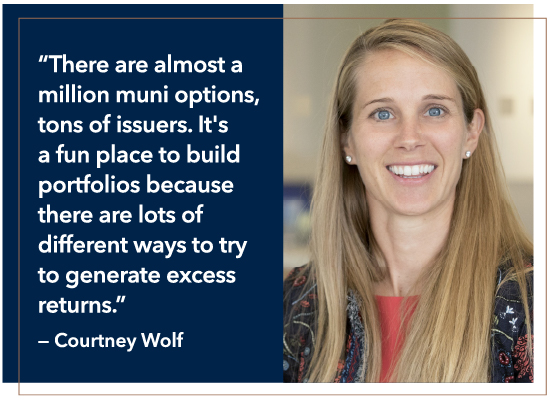
Wolf: The opportunities in munis are substantial. There are almost a million options, tons of issuers. It’s a fun place to build portfolios because there are lots of different ways to try to generate excess returns.
The muni team consistently talks about some of the structured products in our market. Single-family housing bonds are effectively a pool of mortgages with pretty strong prepayment protections. You can find very high-quality bonds that can have yields about a percentage point above a comparable traditional AAA bond. I think these are super interesting, and they feature very prominently in many of our portfolios. There’s a lot of conviction there.
Goss: We’ve had a decent-size allocation to securitized credit for a couple years now, but it’s even more pronounced this year. And I think when you’re at the spreads where we are today in corporate credit, allocating a bit more to securitized assets could potentially be beneficial to portfolios. Securitized assets are a great way to diversify risk, shorten the duration — that is, sensitivity to interest rates — and increase current cash flow in a portfolio when compared to corporate credit.
Adding to that: My focus is on mezzanine debt, which is typically paid off after other, senior debt. That makes it a bit more risky compared to AAA-rated debt. But I haven’t been buying lower rated bonds as much, even when valuations look cheap. Given how flat credit curves are between senior risk and mezzanine risk, I’ve gradually shifted my focus on purchasing higher up in the capital structure in general. As of today, my portfolios are higher quality in nature and recent purchases in the high yield segments of the securitized market have been bonds backed by higher quality, larger companies with established track records through various market cycles.
Siegel: In my coverage area, which includes autos, we have had a bias for auto dealers over auto manufacturers or suppliers for almost five years. The auto industry is cyclical: At its peak it might sell 18 million cars a year, and at a trough around 12 million. It’s a pretty massive difference, so you have these boom-and-bust cycles.
The reason we like the auto dealers is that over half of their earnings are driven by aftermarket parts in repair. As long as people drive their cars, they’re going to need oil filters, air filters, brake pads, realignments. Yet a large part of the market viewed dealers as having a risk profile akin to the more cyclical manufactures. This mispricing has persisted and we have been paid above-market yields for what I believe to be below-market risk.
Ng: In the rates, the yield curve steepener remains a high-conviction investment view of the team. This means we think the spread between short- and long-term rates will widen further.
We continue to see significant value in the position over the long term due to subdued valuations and supportive fundamentals. The Fed is cutting policy rates and, historically, the yield curve tends to steepen as front-end rates fall. Second, debt levels are extremely elevated relative to history and the federal government continues to run large fiscal deficits with no plans to reverse those trends. This implies more Treasury issuance — that is, more debt — and therefore higher term premium and yields.
Explore topics
The return of principal for bond portfolios and for portfolios with significant underlying bond holdings is not guaranteed. Investments are subject to the same interest rate, inflation and credit risks associated with the underlying bond holdings.
Bond ratings, which typically range from AAA/Aaa (highest) to D (lowest), are assigned by credit rating agencies such as Standard & Poor's, Moody's and/or Fitch, as an indication of an issuer's creditworthiness.
Bloomberg Municipal Bond Index is a market-value-weighted index designed to represent the long-term investment-grade tax-exempt bond market. This index is unmanaged, and its results include reinvested distributions but do not reflect the effect of sales charges, commissions, account fees, expenses or U.S. federal income taxes.
Bloomberg U.S. Aggregate Index represents the U.S. investment-grade fixed-rate bond market. This index is unmanaged, and its results include reinvested dividends and/or distributions but do not reflect the effect of sales charges, commissions, account fees, expenses or U.S. federal income taxes.
Bloomberg U.S. Corporate High Yield Index covers the universe of fixed-rate, non-investment-grade debt. This index is unmanaged, and its results include reinvested distributions but do not reflect the effect of sales charges, commissions, account fees, expenses or U.S. federal income taxes.
Source: Bloomberg Index Services Limited. BLOOMBERG® is a trademark and service mark of Bloomberg Finance L.P. and its affiliates (collectively “Bloomberg”). Bloomberg or Bloomberg's licensors own all proprietary rights in the Bloomberg Indices. Neither Bloomberg nor Bloomberg's licensors approves or endorses this material, or guarantees the accuracy or completeness of any information herein, or makes any warranty, express or implied, as to the results to be obtained therefrom and, to the maximum extent allowed by law, neither shall have any liability or responsibility for injury or damages arising in connection therewith.