Portfolio Construction
Categories
Artificial Intelligence
AI whiplash: 3 ways to counter disruption
 Mark Casey
 Brittain Ezzes
April 1, 2026
The debate over artificial intelligence has taken a turn so sharp that it could strain your neck. Initial exuberance over AI’s transformative potential sparked investor fears of an AI bubble. But that concern has now been overshadowed by anxiety that the AI juggernaut will steamroll large segments of the global economy.
The evolving narrative has driven starkly divergent outcomes for companies. Investors have fled so-called "AI roadkill" — business models such as software that are expected to be rendered obsolete by AI — favouring old economy companies that produce physical goods. Although overall returns for the S&P 500 Index have been negative this year, the energy, materials and industrials sectors have generated solid gains while software and other capital-light industries have suffered sharp declines. Since the start of the Iran war, energy has continued to soar while gains in other asset-heavy industries have moderated.
How should long-term investors think about investing amid these shifts?
“We’re in the early stages of understanding AI’s impact on business models,” explains equity portfolio manager Brittain Ezzes, "For some it will be highly disruptive. For others it will have a more neutral or even a positive impact. But it would be a mistake to underestimate AI’s potential to reshape the economy.”
As the AI narrative evolves, here are three strategies Ezzes and other members of our investment team are pursuing amid the twists and turns.
1. AI-immune businesses
Sectors tied to real assets and physical production — coined by Ritholtz Wealth Management CEO Josh Brown as HALO stocks (heavy assets, low obsolescence) — are perceived to have AI immunity. AI cannot, for example, make hamburgers, replace copper wiring, or “vibe code” jet engines.
“We are seeing a renaissance of the physical economy,” Ezzes says. “There are a number of factors that I believe can perpetuate the rally in capital intensive value stocks.”
Tech stocks have trailed asset-heavy sectors and the broader market
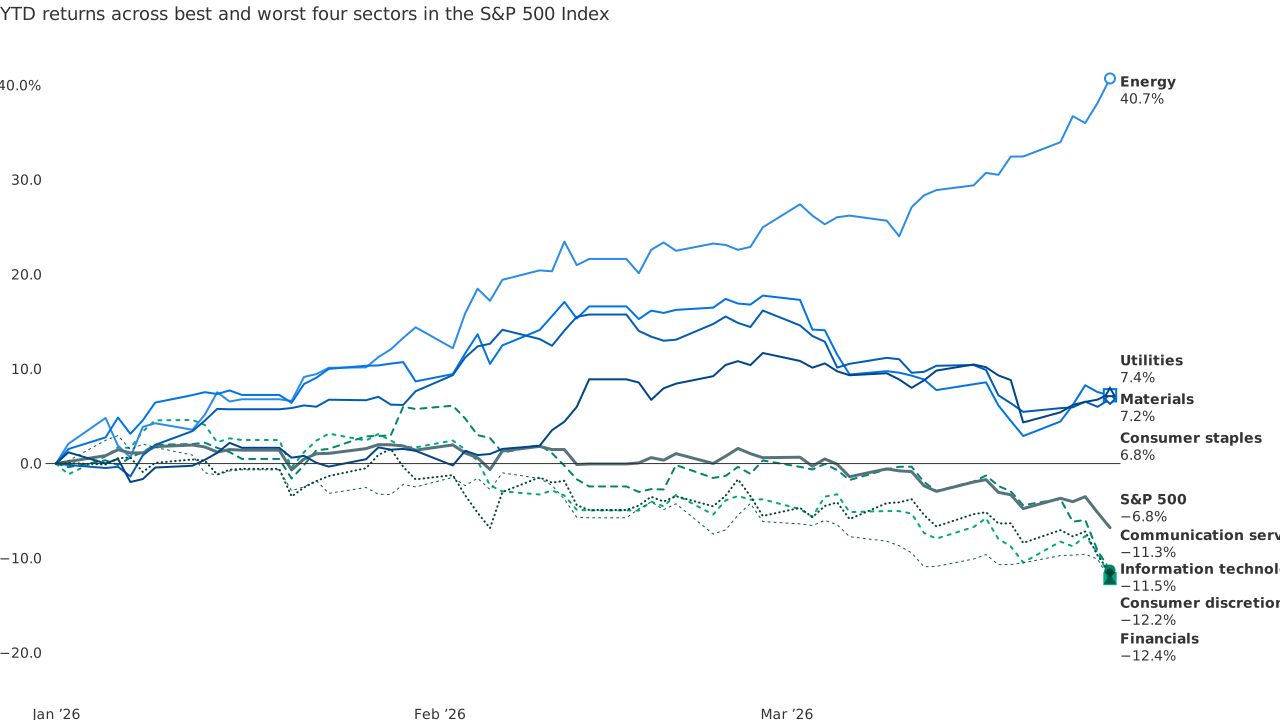
Sources: Capital Group, RIMES, S&P Global. Figures shown reflect total returns. Data as of March 27, 2026.
For starters, industrial and manufacturing companies appear to be emerging from a long slump. Some companies took steps during the slump to streamline operations and cut costs so they would be better positioned to participate in broader growth. For example, within the transportation industry, Union Pacific has disclosed plans to acquire rival Norfolk Southern Railway, creating a transcontinental line that would connect stops across the U.S. and Canada. “This could help reduce transit times, boost competitiveness with trucking and lower costs for customers,” Ezzes explains. Rival CSX similarly has taken steps to cut costs and boost efficiency.
Among industrials, soaring demand for air travel and rising defence budgets around the world have created strong tailwinds in the aerospace and defence industries. For example, GE Aerospace saw the order backlog for its jet engines rise to $190 billion at the start of the year. U.S. defence contractor RTX, known for its sophisticated radar and missile defence systems, has seen orders climb as European and Middle Eastern nations seek to modernize their militaries. “I believe we are in the middle of a supercycle for aerospace,” Ezzes says.
Within the restaurant industry, consumers are still likely to go to restaurants to have humans serve them. Take coffee chain Starbucks, for example, which emphasizes the customer experience. CEO Brian Niccol who has a strong track record of turnarounds in the industry, has demonstrated a detailed knowledge of company operations.
The health care sector has come under pressure because of regulatory and pricing changes, but it includes manufacturers of heavily regulated products that are hard to replicate. For example, Medtronic, a maker of surgical devices, operates more than 70 manufacturing plants globally. The company has taken steps to cut costs, including consolidating distribution centres and spinning off its diabetes division. “Their businesses have high barriers to entry, and with populations getting older, demand for medical procedures is likely to rise,” Ezzes adds.
2. Babies in the AI bathwater
Companies considered highly vulnerable to AI disruption, referred to earlier as AI roadkill, include a wide range of software, financial and consulting industries. After AI developer Anthropic said in February that its agentic AI tool Claude could automate a range of research and legal tasks, providers LegalZoom.com, Thomson Reuters and FactSet Research Systems suffered steep declines.
“The market appears to have concluded that many software as a service (SaaS) companies will go into perpetual decline as a result of AI-enabled competition,” says equity portfolio manager Mark Casey. “Probably some of them will, but others seem well insulated from AI risks, and still others seem set to benefit from AI. I am looking closely at many of these companies in search of the proverbial babies that have been thrown out with the bathwater.”
For example, Salesforce, a customer relationship management platform, has been a focal point of disruption fears, and its share price has declined sharply this year over concerns that AI tools make it easier for customers and competitors to replicate its functionality. At the same time, the company is taking aggressive steps to integrate AI features into its offerings. The company’s status as a “system of record” and deep integration with key business workflows may provide it with sufficient advantages to fend off AI-powered competition.
IT consulting businesses, such as Gartner and Accenture, which offer research and advice to businesses about technology decisions, have also come under fire.
"Both companies have launched initiatives to help clients identify use cases for generative AI, adopt AI tools and integrate them into organizations," Casey explains. “What's more, the complexity of IT decision-making is not getting simpler in the age of AI."
3. AI picks and shovels
You can’t build a new economy without old economy companies. It is well known that the AI build-out relies heavily on makers of power generation and cooling equipment, utilities and mining companies. These are the proverbial picks and shovels supplying AI infrastructure.
The hyperscaler companies driving the AI revolution have committed to investing US$650 billion in capital expenditures, primarily to build out AI data centres. “To put this in context, it is more than 2.5 times the amount spent in 2025,” notes Ezzes. The historic spending could account for an estimated 2% of GDP, far larger than other major capital projects in U.S. history, including the Manhattan Project and the Apollo space mission. Those projects led to innovations that reshaped industries for decades and led to the creation of new companies.
AI spending dwarfs history’s biggest moon shots
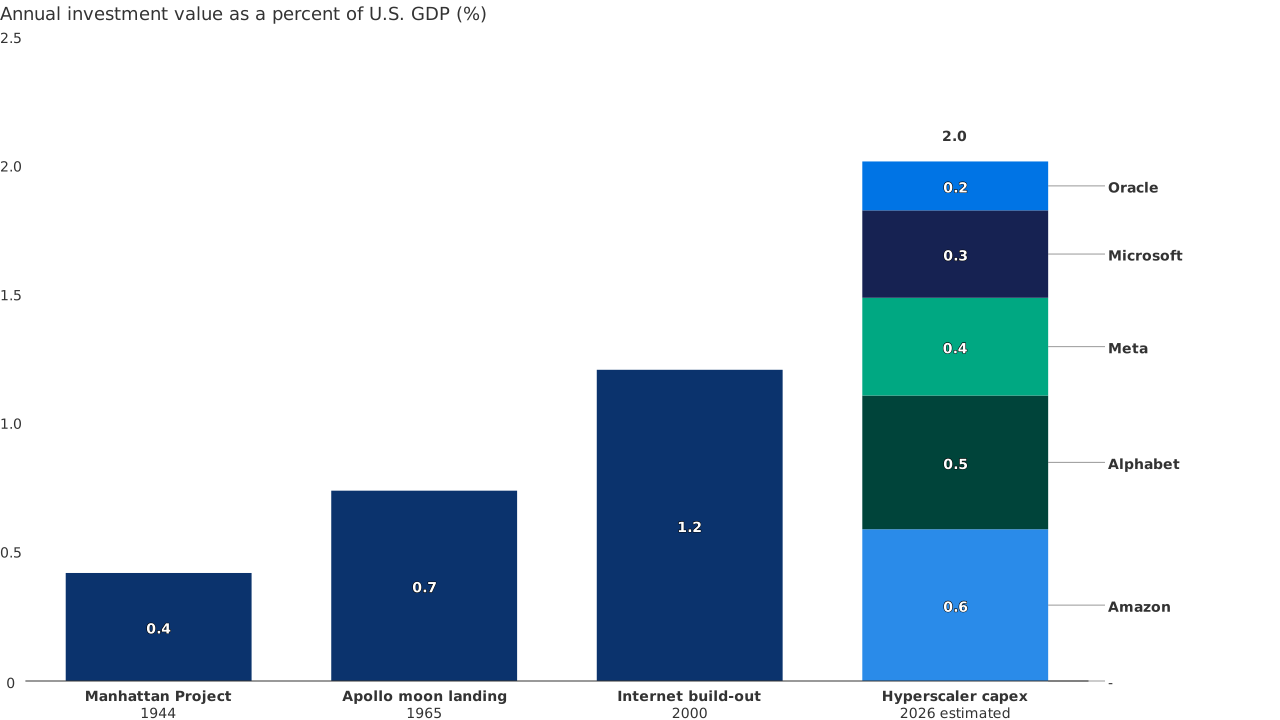
Sources: Capital Group, Brookings, U.S. Congressional Budget Office (CBO), FactSet, Federal Reserve Board of St. Louis, The Planetary Society, U.S. Census Bureau. Project costs for the Manhattan Project and the Apollo moon landing reflect peak annual spending during each project’s lifetime. Hyperscalers represented by Google, Amazon, Microsoft, Oracle and Meta. Hyperscaler capex 2026 estimates calculated by taking sell-side estimates divided by CBO GDP estimates. As of February 28, 2026.
At the heart of the AI infrastructure build-out are semiconductors, and the flood of investment by the hyperscalers has created historic opportunities for companies across the semiconductor complex. Examples include Nvidia, which makes graphic processing unit chips essential for AI’s large language models, and Broadcom, a maker of networking chips. Both have reported record sales growth in recent quarters. In addition, Applied Materials has seen soaring demand for its equipment as chip manufacturers look to expand and upgrade facilities.
The AI spending boom is also generating growth opportunities for power generation and capital equipment companies. For example, heavy equipment maker GE Vernova has reported a multiyear backlog for its gas turbines and extended lead times for electrical equipment orders. Demand for HVAC (heating, ventilation and air conditioning) equipment has also outpaced supply, prompting manufacturers like Carrier Global and AAON to boost manufacturing capacity.
A stock picker’s market
AI technology remains in the early stages of both development and adoption. Yet it is already emerging as a powerful force in the economy that should not be underestimated, according to Ezzes. As the AI narrative evolves, it will be beneficial for some companies and serve as a disruptive force for others.
Investing in leading and beaten-down sectors calls for selectivity
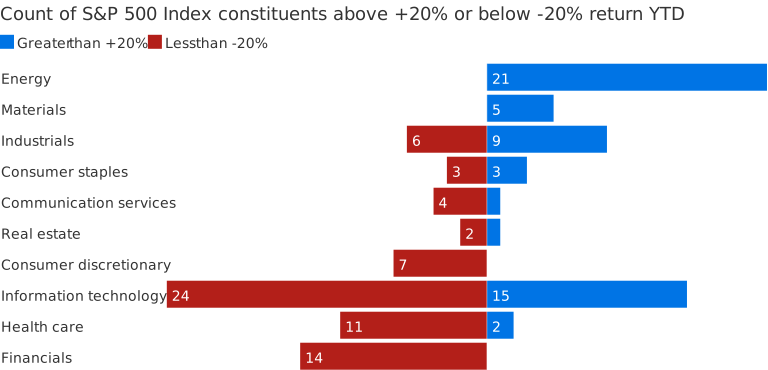
Sources: Capital Group, FactSet, RIMES, Standard & Poor's. Figures reflect total returns. Data as of March 27, 2026.
But AI’s impact won’t be uniform. Both the soaring industrials sector and the beaten-down tech sector have included stocks with 20% gains as well as stocks with 20% declines in the first two months of the year. “Whether an investor looks for opportunities among those companies whose shares have soared or software and consulting companies whose shares have plummeted,” Ezzes adds, “the key for long-term success will be selective investing supported by intensive research.”
Learn more about
Capital expenditure (capex) is money invested for acquisitions, upgrades, renovations and adaption. It can be tangible (i.e., real estate) or intangible (i.e., licecses, software).
Hyperscalers are large-scale cloud service providers that offer computing power and storage to organizations and individuals globally.
Vibe coding refers to the practice of prompting AI tools to generate code rather than writing code manually.
S&P 500 Index is a market capitalization-weighted index based on the results of approximately 500 widely held common stocks. The index is unmanaged and, therefore, has no expenses. Investors cannot invest directly in an index.
Our latest insights
-
-
Technology & Innovation
-
Objective-Based Investing
-
-
Active Management
RELATED INSIGHTS
-
-
-
Technology & Innovation
Commissions, trailing commissions, management fees and expenses all may be associated with investments in investment funds. Please read the prospectus before investing. Investment funds are not guaranteed or covered by the Canada Deposit Insurance Corporation or by any other government deposit insurer. For investment funds other than money market funds, their values change frequently. For money market funds, there can be no assurances that the fund will be able to maintain its net asset value per security at a constant amount or that the full amount of your investment in the fund will be returned to you. Past performance may not be repeated.
Unless otherwise indicated, the investment professionals featured do not manage Capital Group‘s Canadian investment funds.
References to particular companies or securities, if any, are included for informational or illustrative purposes only and should not be considered as an endorsement by Capital Group. Views expressed regarding a particular company, security, industry or market sector should not be considered an indication of trading intent of any investment funds or current holdings of any investment funds. These views should not be considered as investment advice nor should they be considered a recommendation to buy or sell.
Statements attributed to an individual represent the opinions of that individual as of the date published and do not necessarily reflect the opinions of Capital Group or its affiliates. This information is intended to highlight issues and not be comprehensive or to provide advice. For informational purposes only; not intended to provide tax, legal or financial advice. Capital Group funds are available in Canada through registered dealers. For more information, please consult your financial and tax advisors for your individual situation.
Forward-looking statements are not guarantees of future performance, and actual events and results could differ materially from those expressed or implied in any forward-looking statements made herein. We encourage you to consider these and other factors carefully before making any investment decisions and we urge you to avoid placing undue reliance on forward-looking statements.
The S&P 500 Composite Index (“Index”) is a product of S&P Dow Jones Indices LLC and/or its affiliates and has been licensed for use by Capital Group. Copyright © 2026 S&P Dow Jones Indices LLC, a division of S&P Global, and/or its affiliates. All rights reserved. Redistribution or reproduction in whole or in part are prohibited without written permission of S&P Dow Jones Indices LLC.
FTSE source: London Stock Exchange Group plc and its group undertakings (collectively, the "LSE Group"). © LSE Group 2026. FTSE Russell is a trading name of certain of the LSE Group companies. "FTSE®" is a trade mark of the relevant LSE Group companies and is used by any other LSE Group company under licence. All rights in the FTSE Russell indices or data vest in the relevant LSE Group company which owns the index or the data. Neither LSE Group nor its licensors accept any liability for any errors or omissions in the indices or data and no party may rely on any indices or data contained in this communication. No further distribution of data from the LSE Group is permitted without the relevant LSE Group company's express written consent. The LSE Group does not promote, sponsor or endorse the content of this communication. The index is unmanaged and cannot be invested in directly.
BLOOMBERG® is a trademark and service mark of Bloomberg Finance L.P. and its affiliates (collectively “Bloomberg”). Bloomberg or Bloomberg’s licensors own all proprietary rights in the Bloomberg Indices. Neither Bloomberg nor Bloomberg’s licensors approves or endorses this material, or guarantees the accuracy or completeness of any information herein, or makes any warranty, express or implied, as to the results to be obtained therefrom and, to the maximum extent allowed by law, neither shall have any liability or responsibility for injury or damages arising in connection therewith.
The MSCI information may only be used for your internal use, may not be reproduced or redisseminated in any form and may not be used as a basis for or a component of any financial instruments or products or indices. None of the MSCI information is intended to constitute investment advice or a recommendation to make (or refrain from making) any kind of investment decision and may not be relied on as such. Historical data and analysis should not be taken as an indication or guarantee of any future performance analysis, forecast or prediction. The MSCI information is provided on an “as is” basis and the user of this information assumes the entire risk of any use made of this information. MSCI, each of its affiliates and each other person involved in or related to compiling, computing or creating any MSCI information (collectively, the “MSCI Parties”) expressly disclaims all warranties (including, without limitation, any warranties of originality, accuracy, completeness, timeliness, non-infringement, merchantability and fitness for a particular purpose) with respect to this information. Without limiting any of the foregoing, in no event shall any MSCI Party have any liability for any direct, indirect, special, incidental, punitive, consequential (including, without limitation, lost profits) or any other damages. (www.msci.com)
Capital believes the software and information from FactSet to be reliable. However, Capital cannot be responsible for inaccuracies, incomplete information or updating of the information furnished by FactSet. The information provided in this report is meant to give you an approximate account of the fund/manager's characteristics for the specified date. This information is not indicative of future Capital investment decisions and is not used as part of our investment decision-making process.
Indices are unmanaged and cannot be invested in directly. Returns represent past performance, are not a guarantee of future performance, and are not indicative of any specific investment.
All Capital Group trademarks are owned by The Capital Group Companies, Inc. or an affiliated company in Canada, the U.S. and other countries. All other company names mentioned are the property of their respective companies.
Capital Group funds are offered in Canada by Capital International Asset Management (Canada), Inc., part of Capital Group, a global investment management firm originating in Los Angeles, California in 1931. Capital Group manages equity assets through three investment groups. These groups make investment and proxy voting decisions independently. Fixed income investment professionals provide fixed income research and investment management across the Capital organization; however, for securities with equity characteristics, they act solely on behalf of one of the three equity investment groups.
The Capital Group funds offered on this website are available only to Canadian residents.