
Interest Rates
The financial world is adjusting to higher interest rates
For many years, the bond market has functioned like a weighted blanket for the financial world, providing a layer of comfort to investors and consumers alike. Exceptionally low interest rates seemed to become a fixture of the economy that could warm everything from retail spending to tourist travel to homebuying.
That dynamic has been jostled of late as bond yields have surged. The jump in oil prices following the Iran war has raised fear that global central banks might sharply ratchet up rates to parry inflation. Indeed, in September, the Federal Reserve hoisted rates for the first time in three years, with another move expected before the year is out. Inflationary fears took the biggest toll on the bond market. The yield on the benchmark 10-year Treasury note swelled to its highest level in 24 years, briefly topping 5.3% before easing slightly.
Higher interest rates can sting in several ways. They push up borrowing costs for consumers and businesses, potentially dampening economic growth, squeezing equity valuations and weighing on investment returns.
However, it’s essential to put the recent twists in perspective. As the accompanying chart shows, a 10-year Treasury yield in the 3% to 6% range has been far from unusual over the long run. In fact, an analysis stretching back to 1870 found that yields were within that band roughly 62% of the time.
Bond yields in the 3% to 6% are common over the long term
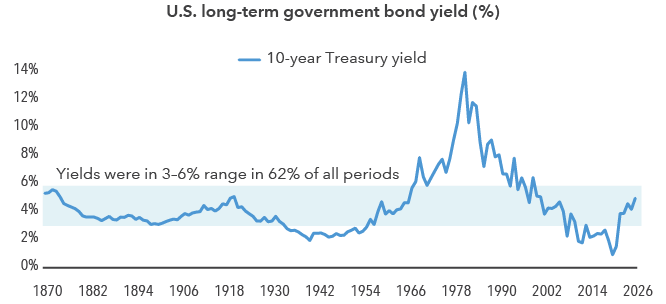
Sources: Capital Group, Federal Reserve Bank of St. Louis, Robert Shiller. Data for 1870 to 1961 represent average monthly U.S. long-term government bond yields compiled by Robert Shiller. Data for 1962 to 2026 represent 10-year Treasury yields, as of December 31 each year within the period. Data for 2026 is as of September 14, 2026.
In other words, today’s yields look less like a historical outlier than a return to more familiar territory before central bankers undertook extraordinary steps to nurse the economy through the 2008 global financial crisis and later the pandemic. The bottom line is that while higher interest rates carry distinct risks, they can also spotlight a healthy economy in which financial markets can advance.
The most obvious impact of rising rates is they can drag down short-term fixed income returns, as happened in the third quarter. But there’s a potential silver lining for investors. As higher-yielding securities make their way into portfolios, that can mean improved returns for those with longer-term investment horizons. For anyone who has been underweight fixed income, the rise in yields presents a more attractive launch point for adding to allocations.
Most notably, the shakiness in the bond market appears to have had limited spillover to the U.S. economy and stock market. Corporate earnings have been stellar, with another round of exceptional gains foreseen next year. Investors are taking solace in forecasts predicting global GDP to continue expanding solidly. As depicted in the accompanying chart, U.S. GDP is projected to expand more than 2% next year. Capital Group economist Jared Franz believes the actual rate could be closer to 2.5% to 3%.
Forecasts for GDP growth are positive
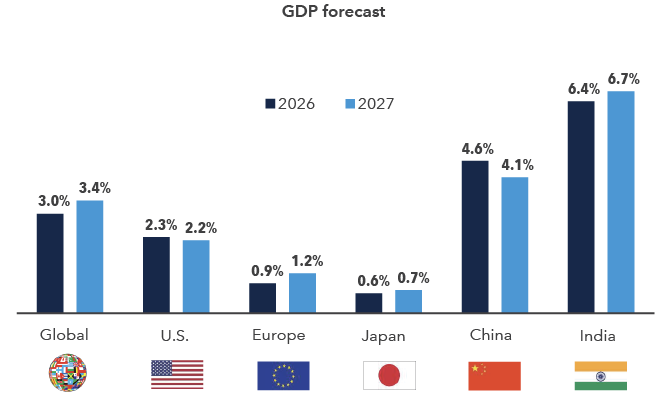
Source: IMF, World Economic Outlook Updates. GDP is gross domestic product and measures the total value of all finished goods and services produced or provided in a country or region during a specific time period. As of July 2026.
That has fed optimism that the economy is stronger than the image painted by elevated gas and grocery prices. After a bout in indigestion last year, the labor market has steadied, with unemployment near recent lows. Consumers remain unbowed. And the artificial intelligence (AI) boom keeps attracting eye-watering sums of investment.
AI spending is driving the economy.
More than lifting the fortunes of a handful of technology giants, the geyser of AI spending is propelling the economy as it radiates through a sprawling network of industries. Utilities must supply the electricity. Industrial companies provide equipment and materials. Construction firms build facilities, while manufacturers produce cooling systems, electrical components and other essentials that keep the machinery running. As AI continues to spread into health care, financial services, manufacturing and other industries, the economic dividends could extend far beyond the tech companies at the center of the boom.
With AI usage projected to catapult far higher in coming years, investors have visions of a multiyear transformation that boosts productivity and reshapes how businesses operate. The spending itself is clearly providing an economic lift, even if the scale and timing of the eventual payoff remain open questions.
The path of the Iran conflict and resolve of U.S. consumers are big questions.
Still, the upbeat picture has some complications.
Given the uneven trajectory of the Iran war and energy prices, the path of inflation is one of the biggest question marks. Fear of protracted military action — and uncertainty over long-term control of the strategic Strait of Hormuz shipping lane — have kept oil prices elevated.
Other factors are compounding inflationary concerns, including federal debt that just topped $40 trillion, the lack of political determination to address budget deficits, broad geopolitical tensions and the staggering amount of borrowing by tech companies to finance the AI build-out.
The resilience of consumer spending also masks some underlying strain. Inflation-adjusted wage gains have lost momentum, with real income growth now at zero. Consumer confidence measures suggest that many Americans feel considerably less secure about their prospects than their spending habits might imply.
To this point, rising rates have hit lower-income consumers the hardest, with wealthier Americans reluctant to rein in their spending. The exception may be mortgage rates, which have pierced 7% and have the potential to impact a wider swath of people.
The stock market faces specific challenges, including the outsize role of AI stocks in pushing up major indexes. Though the S&P 500 index rose modestly in the third quarter, that came on the back of its 10 biggest stocks, which rose a collective 10.3%. The other 490 declined 1.2%. Rising rates also could dull some of the relative appeal of equities if investors begin to favor bonds that now carry higher yields over the risk of owning stocks.
Looking forward, the challenge for investors is to capture opportunities without becoming too dependent on any one source of market gains. AI may continue to drive growth, but international stocks, dividend-paying companies and bonds can spread risk across different markets and sources of potential return. With interest rates, inflation and geopolitics all in flux, a portfolio built around long-term goals is better positioned to weather uncertainty than one reliant on a single market outcome.
Explore topics
Past results are not predictive of results in future periods.
Related Insights
Related Insights
-
-
-
Asset Allocation