
Economic Indicators
U.S. Equities
The AI boom brings opportunity and unease
Normally, the stock market and the world of sports don’t have much overlap. Lately, however, U.S. equities have had lots in common with the world champion New York Knicks. Both overcame what seemed at times to be severely long odds. Both reached unexpected heights. And for better or worse, both now face towering expectations about where they go from here.
Just as the Knicks weathered repeated early-game setbacks in their spine-tingling championship win, stocks have shaken off a war-driven oil-price shock, gnawing inflation and angst over the cyclone-force boom in artificial intelligence. The market is even staging its own versions of a victory parade, with the frenzied initial public offering of SpaceX in June and the expected debuts of AI behemoths Anthropic and OpenAI.
The AI fireworks helped equity markets around the world shoot higher in the second quarter, as investors shrugged off concerns ranging from the war with Iran to the Federal Reserve and the outlook for inflation and interest rates.
AI opportunities expand across sectors and industries
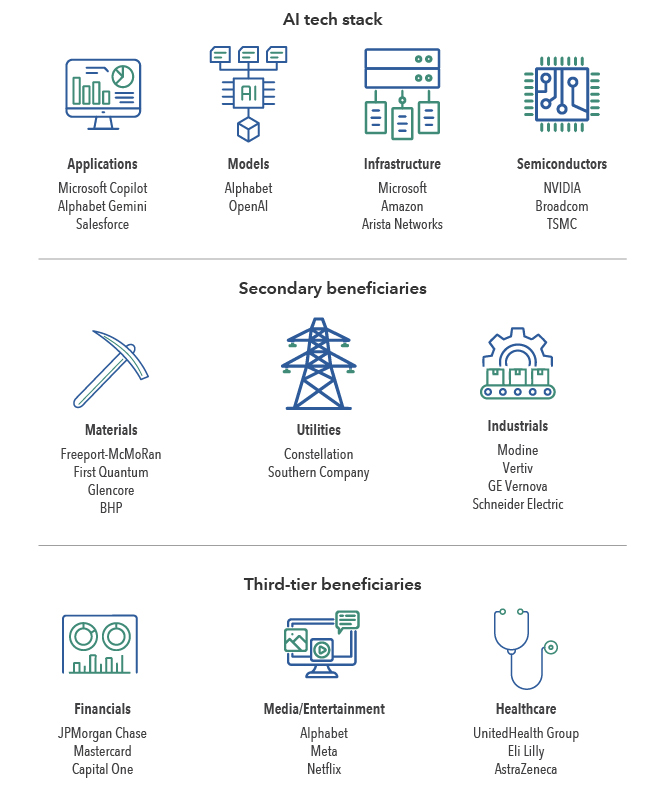
Source: Capital Group. AI tech stack represents Capital Group’s interpretation of four layers of technology that enable AI to operate. Companies listed are examples of businesses that are among leaders of market share in each segment. TSMC is Taiwan Semiconductor Manufacturing Company. As of December 31, 2025.
To put it mildly, AI has dominated, with spending on data centers and related infrastructure becoming a major force in the economy and the market. Measured as a percentage of U.S. GDP, capital spending by AI giants exceeds the Manhattan Project, the Apollo moon landing and the dot-com buildout. As for investors, they’ve oscillated between starry-eyed optimism over the potential for AI to transform global commerce and boost productivity ― and periodic spasms of fear that the gobs of money companies are spending on infrastructure might not pay off anytime soon.
In reality, of course, it’s possible for both scenarios to contain elements of truth. The market has become extremely top-heavy, sparking talk of an emerging AI bubble. The big risk is that unmet productivity projections or anything less than earsplitting earnings growth could set off a backlash that rips through the entire market.
AI earnings are keeping up with share prices
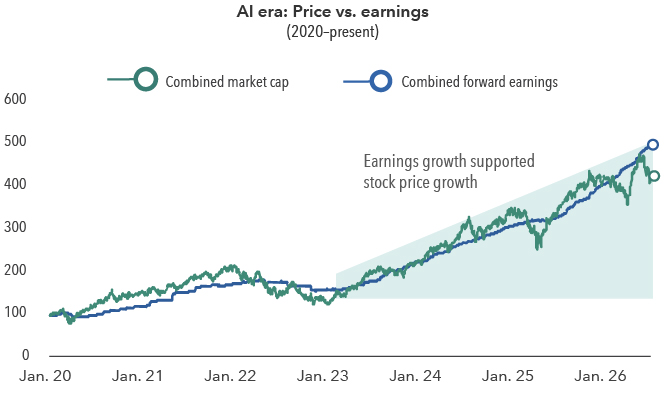
Sources: Capital Group, Bloomberg. Data aggregates forward 12-month net income ("forward earnings") and market capitalization ("market cap") for Nvidia, Microsoft, Apple, Amazon, Meta, Broadcom, Alphabet, seven of the largest AI-exposed companies. Data indexed to 100 on January 1, 2020. As of June 30, 2026.
Not to be forgotten, however, is that the industry’s ferocious capital spending is boosting demand for real products supplied by many other sectors ― materials companies providing copper and other metals for data centers; utilities generating electrical power; and industrial giants piecing together the cooling, electrical and other building blocks. And though the share prices of AI juggernauts have vaulted upward, so have the companies’ projected earnings. That contrasts with the dot-com bubble in the late-1990s, when equity values far outdistanced underlying earnings.
The bottom line is that it’s possible to partake in the AI cycle while still trying to limit the inherent risks. The key is to maintain a balanced portfolio marked by diversification and asset allocation. In other words, a portfolio that is poised to take advantage of opportunities while remaining attuned to the dangers.
Diversification by asset class, geography and style is essential. Attractive risk-adjusted opportunities exist in businesses that are benefiting from the boom, either by assisting with the buildout or by harnessing the evolving technology to refashion their own operations.
The economy remains a bright spot.
Underlying the AI saga is an economy that continues to defy easy characterization. On one hand, consumer agitation over inflation-swollen food and gas prices is showing up in downcast sentiment readings. On the other hand, overall consumer spending remains strong, thanks partly to higher-income households buoyed by rising stock prices and embedded home values.
The upbeat vibe has been aided by a firmer job market, robust corporate earnings, expected global growth and, until recently, oil prices that fell back toward pre-war levels at start of the now-failed ceasefire between the U.S. and Iran. And though AI stocks have whizzed upward, market leadership has broadened as gains have extended to other sectors.
Of course, lots of uncertainty remains, including the clouded outlook for a durable truce with Iran after the most recent ceasefire devolved into further hostilities and a fierce clash over commerce in the Strait of Hormuz. Oil prices, tariffs and geopolitics all remain pressure points.
The trajectory of interest rates is also up in the air as the Federal Reserve has become notably more hawkish. Inflation is stickier than hoped, and the market is now pricing in a rate hike this year rather than the cuts expected a few months ago. Near-term global growth may hinge on the pace of the AI rollout and the contours of geopolitics.
A new wave of IPOs is generating buzz.
The incipient boom in initial public offerings presents a microcosm of risk and opportunity. After a dead patch in 2022 and 2023, the IPO window has swung open and is on track for its biggest year since 2021. Besides AI leviathans, that includes many adjacent companies that are trying to capitalize on the momentum but that are burdened with uncertain prospects and little in the way of profits.
There’s a natural temptation to thirst after newcomers bathed in hype. But a fair number of those stocks underperform ― not only because their business prospects don’t pan out but also because they’re overpriced at the start when investor ardor is at its most sizzling. Even debuts of profitable businesses often underperform the market. The best strategy is to avoid chasing the shiny object of the moment in favor of a strategy centered on diversification and reasonable valuations.
Explore topics
S&P 500 Index is a market capitalization-weighted index based on the results of approximately 500 widely held common stocks. This index is unmanaged, and its results include reinvested dividends and/or distributions but do not reflect the effect of sales charges, commissions, account fees, expenses or U.S. federal income taxes.