
Economic Indicators
Interest Rates
Fed rate hike: 3 views on what's next
 Hilda Applbaum
 Pramod Atluri
 Darrell Spence
September 17, 2026
The U.S. Federal Reserve’s decision to raise interest rates by a quarter percentage point this week marks a significant shift in monetary policy as the central bank seeks to dampen war-induced inflationary pressures. Although it’s the first time the Fed has hiked rates since July 2023, in some respects it represents a return to normal after many years of artificially low borrowing costs. To put the Fed’s move in perspective, three Capital Group investment professionals offer their assessment of the current rate environment and its potential impact on the economy and markets.
The U.S. economy can handle higher rates
Darrell Spence, U.S. economist
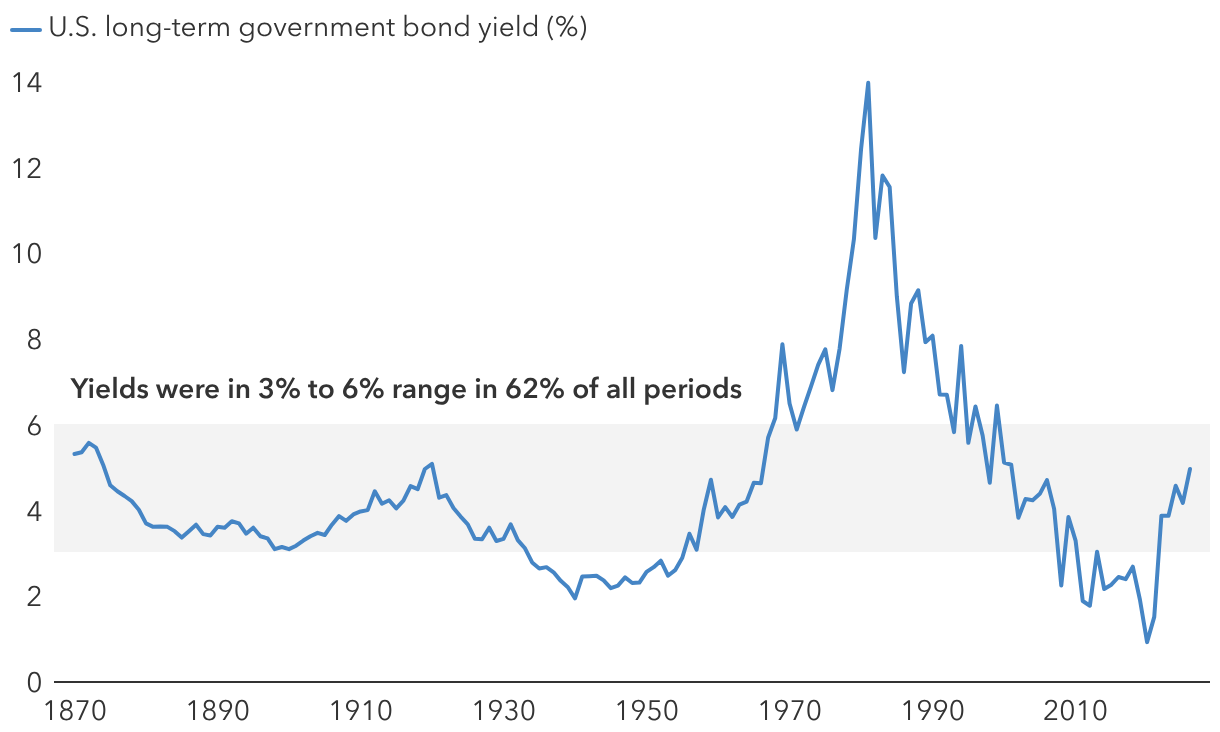
The U.S. economy, supported by a healthy labor market and rising productivity, can absorb modestly higher interest rates without derailing GDP growth. Viewed over a longer historical period, today’s rate levels are not unusual. What was unusual was the ultra-low rate environment we experienced post-global financial crisis and the government bond buying programs that held borrowing costs exceptionally low. In some respects, we appear to be on the path to normalcy after years of unorthodox monetary policy.
Almost by definition, when the Fed decides to raise rates, it means the U.S. economy is in relatively good shape. This year, AI-related investments are providing enormous support to U.S. economic growth and, despite elevated inflation, consumer spending is rising about 2% on an annualized basis. Renewed strength in the labor market makes it easier for Fed officials to refocus their attention on fighting consumer inflation, which is running about 150 basis points ahead of their 2% target.
Bond yields in the 3% to 6% range are common over the long term
Sources: Capital Group, Federal Reserve Bank of St. Louis, Robert Shiller. Data for 1870 to 1961 represents average monthly U.S. long-term government bond yields compiled by Robert Shiller. Data for 1962 to 2025 represents 10-year Treasury yields, as of December 31 each year within the period. Data for 2026 is as of September 14, 2026.
In my view, this rate hike makes sense, and I think we are likely to see three or four more by the end of 2027. The Fed rarely increases rates just once and stops. I expect this move to be the beginning of a rate-hiking cycle that will take the federal funds rate from the current range of 3.75% to 4.00% today up to the neighborhood of 5%. Whether that will be enough to tame inflation remains to be seen. But encouragingly, current levels of U.S. wage and productivity growth are consistent with 2% inflation, so the Fed’s target looks achievable from that perspective.
Two areas of the economy that may be hurt by higher rates are U.S. home sales, which have been flatlining in recent years, and business investment outside the AI data-center boom. Adding up the pluses and minuses, I think U.S. GDP will remain in positive territory this year, growing at a rate of 1.5% to 2% annualized. That may not seem like impressive growth, but given the headwinds from the Iran war, higher energy prices, renewed trade friction and rising interest rates, it will be a remarkable achievement. It illustrates how resilient the U.S. economy can be in the face of adversity.
Dividend paying stocks have done well when rates rise
Hilda Applbaum, principal investment officer, The Income Fund of America®
I often tell younger colleagues my first mortgage was at 17%, and I felt a huge amount of relief when I was able to refinance at 13%. What often affects the psyche of investors is not so much the level of interest rates but the rate of change. So, if you grew up in a near zero interest rate environment, seeing rates climb toward 5% is jarring. It may take a while for expectations to reset, but I do believe additional rate hikes from the Fed are reasonable. A few more hikes will emphasize the Fed’s independence and send a clear message that it is determined to bring inflation under control.
In this environment, I feel quite comfortable with higher dividend-yielding stocks. In a rising rate environment, shorter duration assets tend to do well, and many dividend-paying and value-oriented companies fit that description. By contrast, growth stocks that rely more heavily on future earnings can be more volatile when rates are rising. I am finding some of the most attractive opportunities in businesses with predictable cash flows that rely less on debt.
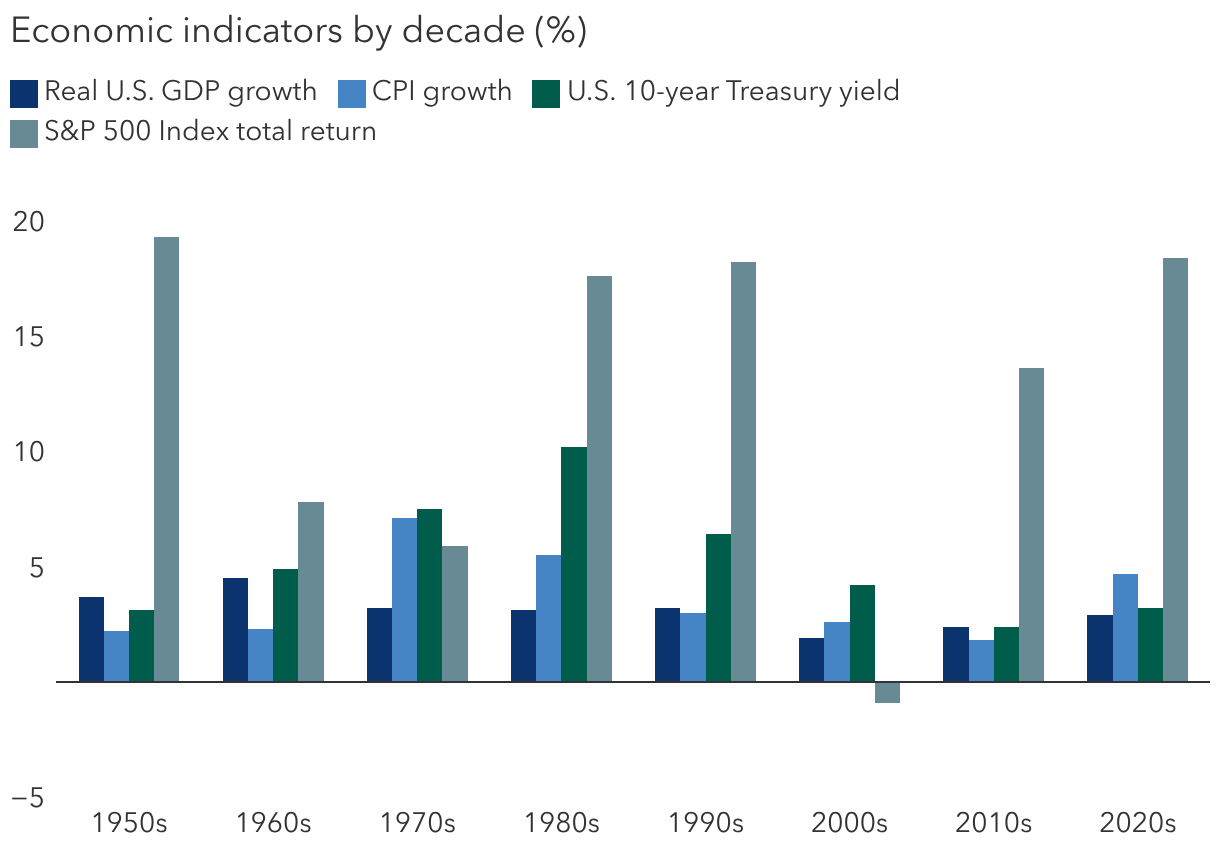
High inflation hasn’t held back equity returns in past decades (%)
Sources: Capital Group, Bureau of Economic Analysis, Bureau of Labor Statistics, Federal Reserve, Robert Shiller, S&P Global. Decade results are calculated by Capital Group and are shown as annualized growth rates for real GDP, CPI and S&P 500 Index total returns. CPI is based on the Consumer Price Index for All Urban Consumers. Average U.S. 10-year Treasury yields are shown for each decade. Total returns reflect the impact of reinvested dividends. Data as of December 31, 2025.
For example, many companies in the healthcare sector — whether pharmaceuticals, medical technology firms or health management businesses — are less sensitive to the economic cycle. I have discovered several healthcare companies that can largely fund themselves that are less vulnerable to rising rates and energy costs. I also see opportunities in select financial companies. As long as economic growth remains positive, banks, credit card companies and other lenders can benefit from higher rates.
Overall, I am focusing on quality, resilience and income. Even if growth moderates, I believe well-positioned dividend-paying companies can continue to offer attractive value and a measure of stability should markets become more volatile.
Fed hikes may help stabilize long-term interest rates
Pramod Atluri, principal investment officer, The Bond Fund of America®
As rising energy prices from the war in Iran threaten to feed into inflation over the next six months, the Federal Reserve must convince markets that it is serious about returning inflation to its 2% target. If investors believe that commitment, there’s a reasonable chance long-term Treasury yields will stabilize. The 30-year Treasury has done just that following Wednesday’s hike and is down slightly to yield 5.35%, even as short-term Treasury yields rose.
There’s plenty of evidence the U.S. economy is healthy and financial conditions are not strained. Employment is near full, equity prices are close to all-time highs, credit spreads remain tight, and deficits are elevated in the U.S. and across much of the world. The economy has absorbed higher rates without much pain.
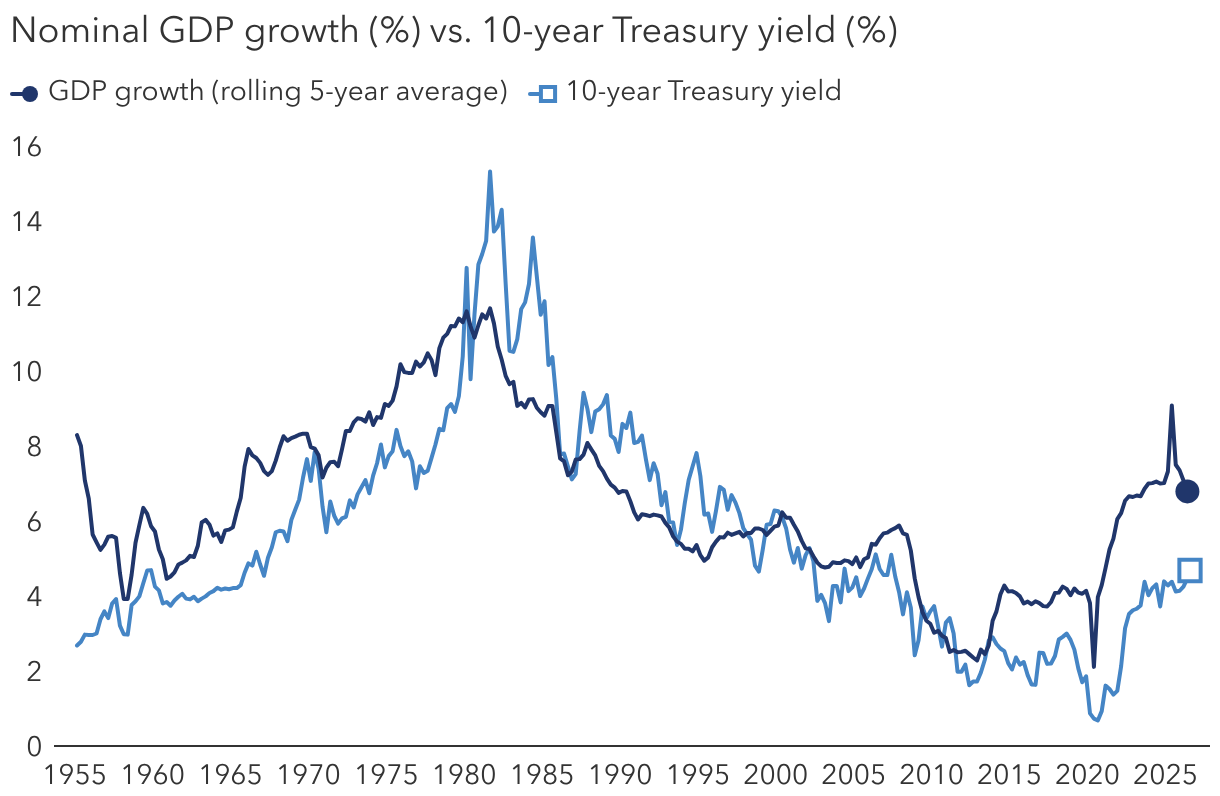
Higher interest rates have often accompanied a strong economy
Sources: Capital Group, Federal Reserve Bank of St. Louis. Data shown is quarterly from Q1 1955 to Q2 2026. Nominal GDP is shown as a rolling five-year average. Figures reflect latest available data as of September 15, 2026.
That’s why it’s hard to know where interest rates need to be to actually slow growth. We keep reaching levels many investors and economists thought would be restrictive, but the economy continues to hum along. One explanation is that the AI build-out is driving spending and creating demand for capital that keeps borrowing costs elevated. Historically, periods of heavy investment have tended to coincide with higher interest rates. Thus, a 10-year Treasury yield around 5% is not unusual and may be appropriate given the current outlook for growth and inflation.
At some point, that investment boom will slow, and I believe AI will ultimately deliver productivity gains that bring interest rates lower. However, that may be several years away, and there’s considerable uncertainty in the meantime. Nevertheless, today’s yield of roughly 5.3% for the Bloomberg U.S. Aggregate Index means investors may earn a relatively attractive income. Even if the Fed ends up hiking more than the two or three times currently priced into markets, those starting yields could provide a significant cushion. And if the Fed ends up hiking less than what is priced, investors have potential for further upside on top of the high starting yields.
Explore topics
Investors should carefully consider investment objectives, risks, charges and expenses. This and other important information is contained in the fund prospectuses and/or summary prospectuses, which can be obtained from a financial professional and should be read carefully before investing.
CPI (consumer price index) is a measure of the average change over time in the prices paid by urban consumers for a market basket of consumer goods and services.
GDP refers to gross domestic product.
Past results are not predictive of results in future periods.
The market indexes are unmanaged and, therefore, have no expenses. Investors cannot invest directly in an index.
Bloomberg U.S. Aggregate Index represents the U.S. investment-grade fixed-rate bond market.
S&P 500 Index tracks the stocks of around 500 primarily large-cap, U.S. based companies.
Bloomberg Index Services Limited. Bloomberg® is a trademark and service mark of Bloomberg Finance L.P. and its affiliates (collectively “Bloomberg”). Bloomberg or Bloomberg’s licensors own all proprietary rights in the Bloomberg Indices. Neither Bloomberg nor Bloomberg’s licensors approves or endorses this material, or guarantees the accuracy or completeness of any information herein, or makes any warranty, express or implied, as to the results to be obtained therefrom and, to the maximum extent allowed by law, neither shall have any liability or responsibility for injury or damages arising in connection therewith.
The S&P 500 Index is a product of S&P Dow Jones Indices LLC and/or its affiliates and has been licensed for use by Capital Group. Copyright © 2026 S&P Dow Jones Indices LLC, a division of S&P Global, and/or its affiliates. All rights reserved. Redistribution or reproduction in whole or in part is prohibited without written permission of S&P Dow Jones Indices LLC.