Important Information

THIS WEBSITE IS INTENDED FOR INSTITUTIONAL INVESTORS who are U.S. residents ONLY; not intended for access or distribution to retail investors.


In order to access the Capital Group U.S. Institutional website (the “Site”), please read the following information and affirm by clicking the accept button that you have read and understand the information provided.


You must attest that you meet the qualifications of an institutional investor as described herein and accept these Terms and Conditions in order to access the Site. Some content may require additional registration for access.


The Site is solely intended for U.S. residents who are institutional investors or are acting on behalf of an institutional investor who has agreed to these Terms and Conditions. Institutional investors include, but are not limited to any person acting on behalf of/any pension fund, financial intermediary, consultant, endowment and foundation, bank, savings and loan association, insurance company, investment company registered under the Investment Company Act of 1940, investment adviser registered with the U.S. Securities and Exchange Commission or under applicable state law, government entity, entity with total assets of at least $50 million, employee benefit or qualified retirement plan with at least 100 participants, defined contribution/benefit plan, and qualified client or purchaser as defined by the U.S. Securities and Exchange Commission. By agreeing to these Terms and Conditions you are affirming your understanding that the Site is not intended for retail investors, individual plan participants or others who may not possess the financial sophistication to independently understand the content nor should it be redistributed to such persons.


You understand that the Site does not constitute advice of any nature, including fiduciary investment advice by Capital Group or its associates.


The reference to “Capital Group” used herein includes The Capital Group Companies, Inc., and its affiliates.

Environmental Social Governance European construction: Green shoots of growth?

KEY TAKEAWAYS

  • Prospects for European cement and steel industries are mostly brighter on expectations of higher infrastructure-, energy- and defense-related spending.
  • Emissions rules are evolving, but our investment professionals believe that the direction of travel toward tighter European regulations is unchanged.
  • Low-carbon cement is commercially available in Europe and met with strong demand in the early stage, while demand for low-carbon steel has been relatively muted.
  • Cement producers and steelmakers with a thoughtful and well-planned approach to decarbonization could establish a long-term competitive advantage.

Construction activity in Europe is poised for a gradual recovery at a time when evolving European Union (EU) policies could boost demand for locally produced low-carbon steel and cement. Here, we lay out three key considerations when investing in European cement and steel industries.


1. Optimism is cautiously building


Europe’s construction output had its worst two years since the pandemic, but expectations for infrastructure spending are driving hopes for a gradual upturn over coming years.1 Germany is leading the region with a 12-year, €500 billion infrastructure fund for investing in transport infrastructure, climate change, digitalization and energy infrastructure, among other key areas.2 The whole region’s infrastructure requires significant modernization and upgrades. For example, the EU has estimated that €1.2 trillion in grid investments is needed to modernize its electricity grids.


This bodes well for the demand outlook for essential building materials, such as cement and steel. In the EU, more than one-third of cement is used in civil engineering.3 Similarly, construction is the largest consumer of steel in the region, taking up over one-third of steel demand.4


Electrification is also a driver of cement and steel demand. Many steel products are essential for building renewable energy systems, such as advanced stainless steel for solar panels. And a wind turbine is comprised of between 84% and 90% iron and steel materials, according to the World Steel Association.5


Cement and steel demand may also increase from the rearmament drive in the region, from building barracks to producing weapons. 

Germany is building big

Planned government infrastructure spending in Germany through 2029

Source: Federal Ministry of Finance, Germany. “German government intensifies its investment drive: 2026 federal budget and fiscal plan to 2029 adopted,” published on July 30, 2025. The graphic shows estimated planned spending on each category. “Others” include three categories: research and development, education and childcare infrastructure, and housing construction. 

2. EU climate and industrial policies are influencing the outlook


The built environment is one of the largest contributors to global emissions.6 Many European governments have implemented policies to tighten energy efficiency requirements, to support production of low-carbon building materials and to create a market for these materials.

These policies and regulations create both risks and opportunities for a wide range of companies — including those offering products that improve energy efficiency, innovators in manufactured housing and firms that are developing low-carbon building materials.


The EU has been a global leader in climate policy. Its 2050 climate target anchors the region’s decarbonization pathway. Meanwhile, economic competitiveness has emerged as a key issue, underlining the importance of pragmatism in climate policies.


Take the EU Emissions Trading System (ETS). The centerpiece of the region’s climate policy, the ETS sets a limit on greenhouse gas (GHG) emissions for certain high-emission sectors. It also requires firms to purchase “allowances” (one allowance is the right to emit one tonne of CO2 equivalent) to cover their emissions. The limit is reduced annually in line with the EU’s climate target, and allowances can be traded or stored for future use. 


Sectors deemed at higher risk of losing production to countries with weaker emissions regulations, such as steel and cement, have received free allowances. But these free allowances are getting gradually phased out starting this year, as the EU has launched the Carbon Border Adjustment Mechanism (CBAM) which requires importers to pay the same carbon prices as EU producers, effectively creating a level playing field.


Some European countries have called to scrap the ETS or limit the steep rise in carbon prices amid energy market volatility in recent months, fearing that carbon costs will damage their competitiveness. Rather than moving away from its flagship policy, in response, the EU is in the process of making adjustments to protect the most vulnerable industries, such as mitigating carbon price spikes. Meanwhile, the EU has launched industrial and trade policies that aim to simultaneously address multiple strategic priorities, including economic competitiveness and decarbonization. The recently proposed Industrial Accelerator Act, for example, would introduce “Made in EU” and low-carbon requirements in public procurement, as well as measures to streamline and speed up permitting. Policymakers have also agreed on a significant reduction of import quotas and higher duties for imports exceeding those quotas. See a list of key policies below.


“We have seen the EU take small steps to help EU producers, by imposing import duties on steel and carbon taxes on imports of steel, cement and other materials,” says Wahid Butt, equity investment analyst. 

Policy inertia no more

Select EU industrial, trade and climate-related policies and regulations

 Policy

Goals/Key measures

EU ETS – phase 4

(2021-2030)

  • Outlines mechanisms for reducing free allowance allocations
  • Makes adjustments to Market Stability Reserve (a tool to address surplus allowances)
  • Extends coverage to shipping emissions

Net Zero Industrial Act

(June 2024)

  • Aims to scale up the manufacturing of clean technologies in the EU

Competitiveness Compass

(January 2025)

  • Lays out how the EU can boost innovation, decarbonize the economy and reduce dependencies

Clean Industrial Deal

(February 2025)

  • Outlines actions to turn decarbonization into a driver of growth for European industries
  • Presents measures to boost every stage of production, with a focus on energy-intensive industries and the clean-tech sector

European Grids Package

(proposed in December 2025)

  • Includes legislative proposals to enhance trans-European energy infrastructure and to accelerate permitting
  • Proposes guidance on efficient and timely grid connections

Carbon Border Adjustment Mechanism (January 2026)

  • Requires importers to pay a carbon price equivalent to what EU manufacturers pay under the EU ETS

Industrial Accelerator Act
(proposed in March 2026)

  • Streamlines and speeds up permitting
  • Introduces “Made in EU” and low-carbon requirements for national and public procurement
  • Proposes foreign direct investment conditions for strategic sectors

Measures to protect EU steel market (approved by Members of the European Parliament in May 2026)

  • Reduce steel import reliance
  • Reduces tariff-free steel imports by 47%
  • Doubles tariff to 50% on excess shipment

Sources: European Union, EY.

3. Decarbonization trailblazers may build longer term advantage


Iron and steel production account for about 8% of global GHG emissions, and cement and concrete production adds another 6%.7 Given the sheer volume of cement and steel consumption, decarbonizing their production at scale could significantly reduce global emissions.


Potential approaches to decarbonizing production include replacing fossil fuels with lower or zero-emission fuels, energy and material efficiency measures, carbon capture, as well as entirely new manufacturing processes. Commercializing these technologies requires significant investment. 


There has been progress. The world’s first commercially available carbon captured near-zero cement was produced last year in Europe from a plant equipped with carbon capture.8 Early-stage demand for its output has been strong. Several other cement projects with carbon capture are also under development. 


Speculation on the weakening of EU ETS has hurt sentiment on European cement stocks in recent months. But some of our investment team think the market may be overreacting, after EU leaders reaffirmed their commitment to the ETS, which underpins rising carbon prices over time. “With reduced free allowances, higher carbon prices will take up a larger share of total production costs and drive a steepening of the cost curve,” said Anna Zandi, equity investment analyst. “Combined with CBAM, this scenario will underpin the cement industry’s pricing power and drive consolidation as the dirtiest plants exit. Decarbonization leaders will likely benefit from both the structurally improved market and their relatively low costs.”


In contrast, decarbonization progress in steel is nascent. There is no commercially viable near-zero-emission steel today, and demand for lower emissions steel is muted. Carbon capture, green hydrogen and other innovative solutions hold promise, but it’s early days. And, unlike European cement producers who have gained pricing power in recent years through capex discipline in a highly localized market, European steelmakers have faced weak demand as well as threats from chronic global overcapacity and reliance on imports. Unsurprisingly, some steelmakers have delayed or paused green steel projects, citing policy uncertainties and high costs.


Without higher carbon prices, capital allocation to green steel initiatives will remain less attractive. However, lower emission alternatives are available commercially, such as electric arc furnaces (EAFs). Policies supporting local industries as well as their decarbonization efforts, such as those discouraging steel imports and creating demand for low-carbon steel, could help turn the tide. 

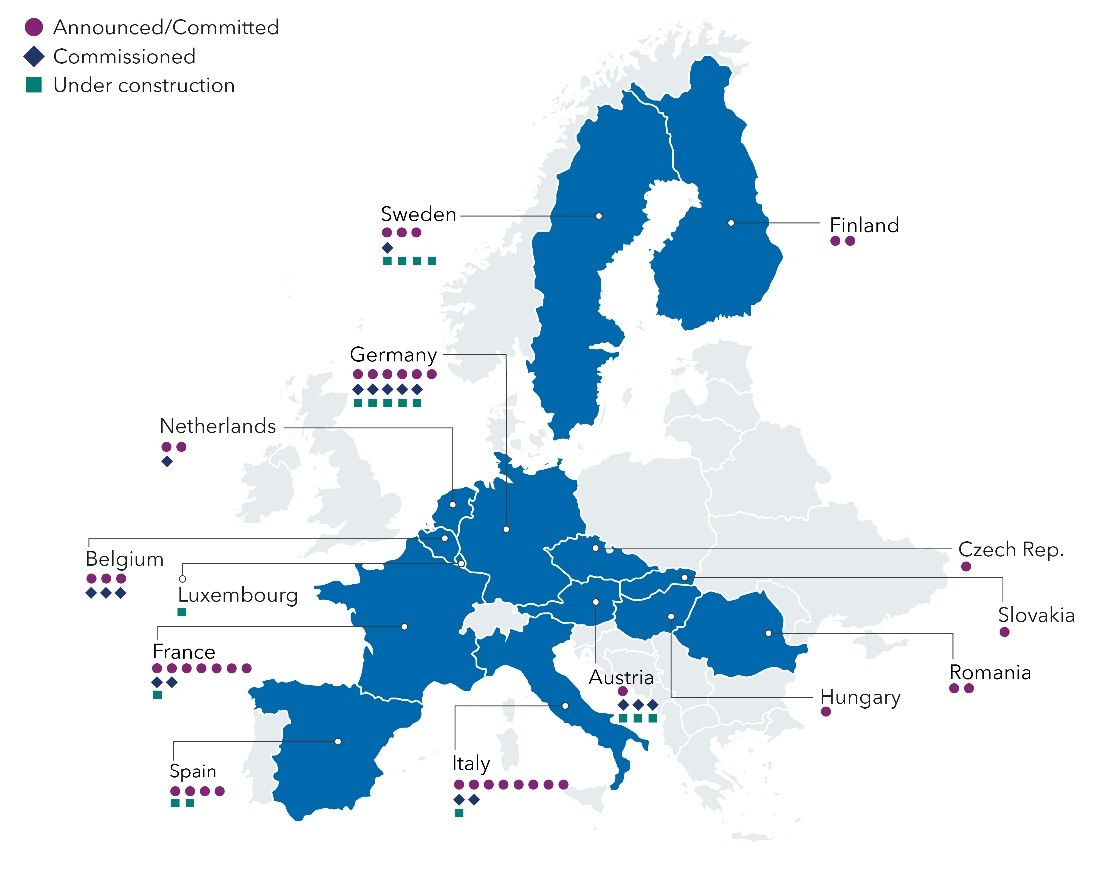
Green shoots for green steel

Steel decarbonization projects in the European Union

The map shows the 14 European Union countries with steel decarbonization projects. The projects are in three categories: announced/committed, under construction and commissioned. Germany has five projects under construction, the most in the region, followed by Sweden with four projects. Italy has announced or committed eight projects, the most in the region, followed by seven in France and six in Germany.

Source: BNEF, as of May 2026. Note: “Announced” refers to when a project is announced with no further update. “Committed” refers to the status when a financial decision has been made on the project or when equipment has been ordered but construction has not officially started. “Under construction” means that the project has officially broken ground. “Commissioned” includes partial commission, full commission and when commission status cannot be determined. Partial commission refers to trial production, and full commission refers to stable and continuous operation.

Final thoughts


Heightened geopolitical uncertainties, volatile energy markets and growing macroeconomic uncertainty may lead to some softening of EU’s emissions regulations. This may well reduce near-term incentives for the region’s cement and steel producers to prioritize decarbonization. For long-term investors, however, the linked goals of energy security, industrial competitiveness and emissions reductions mean that the companies with a thoughtful approach to decarbonization early on may build a longer term competitive advantage. 

Explore the latest research and insights in our ESG perspectives library

Seema Suchak is an ESG sector research director with 22 years of industry experience (as of 12/31/2025). She holds a master’s degree in international business from Birkbeck, University of London and a bachelor's degree in international relations with French from the University of Birmingham.

Matthieu Chateau is an ESG analyst with nine years of industry experience (as of 12/31/2025). He holds a master's degree in carbon management from the University of Edinburgh and a bachelor's degree in political science and geography from Trinity College Dublin.

Your gateway to all things ESG at Capital Group

Want more on energy transition?

Footnotes/Important information:
1EUROCONSTRUCT. “100th EUROCONSTRUCT-Conference - EUROCONSTRUCT.” December 2025.
2German Federal Ministry of Finance. “Special Fund for Infrastructure and Climate Neutrality - Federal Ministry of Finance - Issues.” Accessed June 10, 2026.
3The European Cement Association (CEMBUREAU). “CEMBUREAU Key Facts & Figures.” June 2025.
4The European Steel Association. “European steel in figures 2025.” Accessed June 10, 2026.
5The World Steel Association. “#steelFacts.” Accessed June 10, 2026.
6International Energy Agency. “Buildings - Energy System.” Accessed June 10, 2026.
7World Trade Organization. “WTO | Steel Standards Principles.” 2023; National Institute of Building Sciences. “Reducing CO2 Emissions with Green Cement and Concrete.” March 2024.
8Heidelberg Materials. “EvoZero® Hits the Market: World’s First Carbon Captured Cement Delivered to Customers across Europe.” October 2025.

Investments are not FDIC-insured, nor are they deposits of or guaranteed by a bank or any other entity, so they may lose value.
Investors should carefully consider investment objectives, risks, charges and expenses. This and other important information is contained in the fund prospectuses and/or summary prospectuses, which can be obtained from a financial professional and should be read carefully before investing.
Investing outside the United States involves risks, such as currency fluctuations, periods of illiquidity and price volatility. These risks may be heightened in connection with investments in developing countries.
Statements attributed to an individual represent the opinions of that individual as of the date published and do not necessarily reflect the opinions of Capital Group or its affiliates. This information is intended to highlight issues and should not be considered advice, an endorsement or a recommendation.
All Capital Group trademarks mentioned are owned by The Capital Group Companies, Inc., an affiliated company or fund. All other company and product names mentioned are the property of their respective companies.
Use of this website is intended for U.S. residents only. Use of this website and materials is also subject to approval by your home office.
Advisory services offered through Capital Research and Management Company (CRMC) and its RIA affiliates. Capital Client Group, Inc., member FINRA.
This content, developed by Capital Group, home of American Funds, should not be used as a primary basis for investment decisions and is not intended to serve as impartial investment or fiduciary advice.