Portfolio Construction
Categories
U.S. Equities
Investing in unstoppable trends
 Mark Casey
October 23, 2025
Early in my career as an equity analyst covering newspapers and the internet, I learned a valuable lesson.
I got an up close view of how newspapers — a once dominant media business — lost their edge to online advertising platforms like Craigslist and Zillow. A good chunk of the industry overlooked the looming disruption. I quickly learned the importance of identifying unstoppable trends that could transform industries and investing in companies that seemed best positioned to benefit.
I define an unstoppable trend as one in which a new product or service offers so many advantages over the incumbent it can be expected to take market share year after year for as long as they both exist. For example, while paper money, coin money and checks still have their use, digital money is so much more convenient it appears set to take market share of all payments for many years to come.
Consumer adoption of tech trends is accelerating
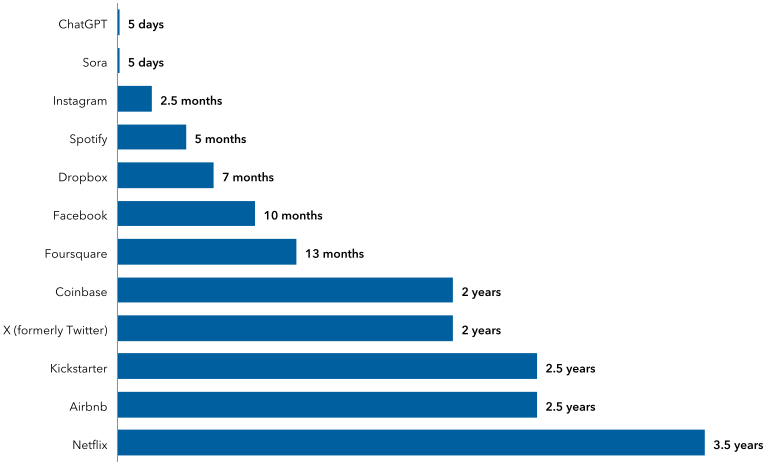
Sources: Capital Group, Statista. As of September 30, 2025. Kickstarter statistic refers to the number of backers. Airbnb figure refers to the number of nights booked. Foursquare and Instagram figures refer to number of nights booked. Coinbase refers to number of consumer wallets.
Throughout my 25-year career, I have sought to construct my portfolios based on unstoppable trends. They include the transition from landed retail to e-commerce; the shift from on-premise computing to the cloud; and the shift from appointment-based traditional television networks to on-demand streaming services. Each of these market share shifts has been in progress for at least 20 years and is likely to continue for the foreseeable future.
Unstoppable trends can provide powerful tailwinds to growth-oriented investments and equally powerful headwinds to investments on the wrong side of the trends. Two things to get right are successfully discerning the disruptors from the disrupted and not overpaying for growth opportunities. As a portfolio manager, I rely on these two questions as I pursue long-term investment opportunities.
Here are three emerging trends that I consider to be unstoppable:
From unintelligent to intelligent systems
The introduction of ChatGPT in the fall of 2022 was a monumental step in the transition from unintelligent systems to intelligent systems. This change was recognizable almost immediately, as ChatGPT attracted one million users in a mere five days.
Before the AI chatbot was released, a user couldn’t have a quality chat with a computer or server farm. Two and a half years later, I believe the chats have improved to the point that useful responses have become common.
To ensure that progress continues, U.S. based technology giants like OpenAI, Microsoft, Google, Meta Platforms and Oracle have committed hundreds of billions of dollars to building AI infrastructure. Fueled by such investment, global semiconductor sales could exceed US$1 trillion by 2030. More broadly, investment in data centres accounted for 5.5% of private non-residential construction spending as of June 2025.
U.S. data centre construction is soaring
Source: U.S. Census Bureau. Latest data through July 31, 2025, as of October 17, 2025. Figures are not seasonally adjusted.
Companies are also in the early innings of AI deployment to end users. Consider autonomous vehicles, which basically are intelligent car-robots. Waymo, the autonomous vehicle subsidiary of Alphabet, operates in a handful of U.S. cities including Phoenix, San Francisco, Los Angeles and Atlanta. Waymo has a strong safety record in those cities but has a long runway ahead as they launch in places like Miami and New Orleans.
Over the next decade I expect AI technologies will become pervasive in most software and hardware products, and we will be using all sorts of robots. The ride from here to there will be bumpy, and while investors can expect alternating bouts of disappointment and euphoria along the way, I do expect intelligent systems to become ubiquitous throughout our economy.
From cold hard cash to digital payments
The transition from the use of paper money, coins and checks to digital payment technology has been ongoing for several decades. PayPal, for example, introduced an online version of its payment technology in 1999 and released its mobile app nine years later.
The pandemic in 2020 acted as a powerful accelerant of this trend toward digital payments in the U.S. With physical distancing and lockdowns limiting in-person commerce, consumers and businesses rapidly embraced contactless and remote payment options. More recently, 90% of U.S. and European consumers said they used some form of digital payment in 2024, according to a McKinsey survey.
The trend toward digital payments is something I expect to continue for much of the rest of our lives. Today, the digital payment ecosystem includes a broad range of offerings, from mobile wallets that integrate with other systems like Apple Pay and Alphabet’s Google Pay, to consumer and merchant platforms like PayPal, Square and Stripe. Legacy financial firms Visa and Mastercard have evolved from credit card networks into digital payment giants that provide the infrastructure enabling secure transactions.
Cryptocurrencies like Bitcoin remain controversial in many corners of the investing universe, but the rapid rise of Bitcoin’s value in recent years is a sign of its growing acceptance and popularity with investors. In March, the U.S. administration said it would establish a Bitcoin strategic reserve, and other major central banks were exploring or developing their own digital currencies. I have been studying cryptocurrencies for years, with a focus on Bitcoin, which has been the best-performing asset class over the last five-, 10- and 15-year periods. Gold holds value because it is scarce, but Bitcoin is even scarcer as it never increases in supply.
From harmful tobacco to reduced harm nicotine
Not all unstoppable trends are based on digital innovation. According to the World Health Organization, about 1.3 billion people still smoke tobacco. They light tobacco leaves on fire and inhale the smoke to consume nicotine. But that nicotine comes with a payload of carbon monoxide and tar, which can cause cancer and other diseases that may shorten your life.
We’re now seeing a transition from harmful smoke inhalation products to what may be less harmful ways to consume nicotine because you are not inhaling smoke. These include products that heat tobacco but don’t burn it, vaping products that cause you to inhale vapor rather than smoke, and oral nicotine pouches like Zyn that are placed between your cheek and gum.
While the number of smokers in the world has declined, the number of people using vape pens and pouches has increased. I believe this is also an unstoppable trend that will continue for years. If so, e-nicotine producing companies could benefit.
Lessons learned
When I consider the unstoppable trends I have observed over my career, I have learned the key to investment success is to understand each new trend and how it will change the competitive landscape. After that, I try to identify the likely winners and losers.
Each of these shifts featured disruptors, the disrupted and adapters. For example, within the retail industry, Amazon rose to be a giant in e-commerce while the Borders bookstore chain filed for bankruptcy before being acquired by Barnes & Noble, but other retailers like Target were able to adapt by shifting to a multichannel business mixing e-commerce and in-store shopping. Within media, Netflix has grown from a business renting DVDs by mail to a streaming powerhouse while the Blockbuster video rental chain went out of business. In the years since, a number of streaming services have emerged, some offered by traditional networks.
It’s no easy task, but the key to determining the likely winners and losers is fundamental research. Gain a deep understanding of a company’s business plan. Assess whether management has the wherewithal to execute the plan. Evaluate the competitive landscape with an emphasis on companies that are poised to take market share. Use all of this information to separate the disruptors from the disrupted. And remember, it is possible to overpay for growth, so it’s always important to keep valuations top of mind rather than an afterthought.
Learn more about
Our latest insights
-
-
Technology & Innovation
-
Objective-Based Investing
-
-
Active Management
RELATED INSIGHTS
Commissions, trailing commissions, management fees and expenses all may be associated with investments in investment funds. Please read the prospectus before investing. Investment funds are not guaranteed or covered by the Canada Deposit Insurance Corporation or by any other government deposit insurer. For investment funds other than money market funds, their values change frequently. For money market funds, there can be no assurances that the fund will be able to maintain its net asset value per security at a constant amount or that the full amount of your investment in the fund will be returned to you. Past performance may not be repeated.
Unless otherwise indicated, the investment professionals featured do not manage Capital Group‘s Canadian investment funds.
References to particular companies or securities, if any, are included for informational or illustrative purposes only and should not be considered as an endorsement by Capital Group. Views expressed regarding a particular company, security, industry or market sector should not be considered an indication of trading intent of any investment funds or current holdings of any investment funds. These views should not be considered as investment advice nor should they be considered a recommendation to buy or sell.
Statements attributed to an individual represent the opinions of that individual as of the date published and do not necessarily reflect the opinions of Capital Group or its affiliates. This information is intended to highlight issues and not be comprehensive or to provide advice. For informational purposes only; not intended to provide tax, legal or financial advice. Capital Group funds are available in Canada through registered dealers. For more information, please consult your financial and tax advisors for your individual situation.
Forward-looking statements are not guarantees of future performance, and actual events and results could differ materially from those expressed or implied in any forward-looking statements made herein. We encourage you to consider these and other factors carefully before making any investment decisions and we urge you to avoid placing undue reliance on forward-looking statements.
The S&P 500 Composite Index (“Index”) is a product of S&P Dow Jones Indices LLC and/or its affiliates and has been licensed for use by Capital Group. Copyright © 2026 S&P Dow Jones Indices LLC, a division of S&P Global, and/or its affiliates. All rights reserved. Redistribution or reproduction in whole or in part are prohibited without written permission of S&P Dow Jones Indices LLC.
FTSE source: London Stock Exchange Group plc and its group undertakings (collectively, the "LSE Group"). © LSE Group 2026. FTSE Russell is a trading name of certain of the LSE Group companies. "FTSE®" is a trade mark of the relevant LSE Group companies and is used by any other LSE Group company under licence. All rights in the FTSE Russell indices or data vest in the relevant LSE Group company which owns the index or the data. Neither LSE Group nor its licensors accept any liability for any errors or omissions in the indices or data and no party may rely on any indices or data contained in this communication. No further distribution of data from the LSE Group is permitted without the relevant LSE Group company's express written consent. The LSE Group does not promote, sponsor or endorse the content of this communication. The index is unmanaged and cannot be invested in directly.
BLOOMBERG® is a trademark and service mark of Bloomberg Finance L.P. and its affiliates (collectively “Bloomberg”). Bloomberg or Bloomberg’s licensors own all proprietary rights in the Bloomberg Indices. Neither Bloomberg nor Bloomberg’s licensors approves or endorses this material, or guarantees the accuracy or completeness of any information herein, or makes any warranty, express or implied, as to the results to be obtained therefrom and, to the maximum extent allowed by law, neither shall have any liability or responsibility for injury or damages arising in connection therewith.
The MSCI information may only be used for your internal use, may not be reproduced or redisseminated in any form and may not be used as a basis for or a component of any financial instruments or products or indices. None of the MSCI information is intended to constitute investment advice or a recommendation to make (or refrain from making) any kind of investment decision and may not be relied on as such. Historical data and analysis should not be taken as an indication or guarantee of any future performance analysis, forecast or prediction. The MSCI information is provided on an “as is” basis and the user of this information assumes the entire risk of any use made of this information. MSCI, each of its affiliates and each other person involved in or related to compiling, computing or creating any MSCI information (collectively, the “MSCI Parties”) expressly disclaims all warranties (including, without limitation, any warranties of originality, accuracy, completeness, timeliness, non-infringement, merchantability and fitness for a particular purpose) with respect to this information. Without limiting any of the foregoing, in no event shall any MSCI Party have any liability for any direct, indirect, special, incidental, punitive, consequential (including, without limitation, lost profits) or any other damages. (www.msci.com)
Capital believes the software and information from FactSet to be reliable. However, Capital cannot be responsible for inaccuracies, incomplete information or updating of the information furnished by FactSet. The information provided in this report is meant to give you an approximate account of the fund/manager's characteristics for the specified date. This information is not indicative of future Capital investment decisions and is not used as part of our investment decision-making process.
Indices are unmanaged and cannot be invested in directly. Returns represent past performance, are not a guarantee of future performance, and are not indicative of any specific investment.
All Capital Group trademarks are owned by The Capital Group Companies, Inc. or an affiliated company in Canada, the U.S. and other countries. All other company names mentioned are the property of their respective companies.
Capital Group funds are offered in Canada by Capital International Asset Management (Canada), Inc., part of Capital Group, a global investment management firm originating in Los Angeles, California in 1931. Capital Group manages equity assets through three investment groups. These groups make investment and proxy voting decisions independently. Fixed income investment professionals provide fixed income research and investment management across the Capital organization; however, for securities with equity characteristics, they act solely on behalf of one of the three equity investment groups.
The Capital Group funds offered on this website are available only to Canadian residents.