Portfolio Construction
Categories
Active Management
3 things to consider when investing in concentrated markets
 Kathrin Forrest
July 23, 2026
Market concentration across global equity benchmarks has become a key topic of conversation over the past several years.
First, it was the dominance of U.S. stocks in the MSCI All Country World Index (MSCI ACWI), which was accompanied by rising prominence of the information technology (IT) sector and Magnificent Seven in the S&P 500 Index. Attention has now shifted to another group of companies in IT tied to artificial intelligence (AI), particularly in the semiconductors and semiconductor equipment industry.
As of June 30, 2026, this industry represented 19.2% of the S&P 500, up from just 2.8% as of June 30, 2016. The trend extends beyond the U.S., with the industry representing 17.0% of the MSCI ACWI, up from 2.4% over the same 10-year time period, while semiconductors and semiconductor equipment now account for 27.3% of the MSCI Emerging Markets Index.
Markets increasingly powered by chips
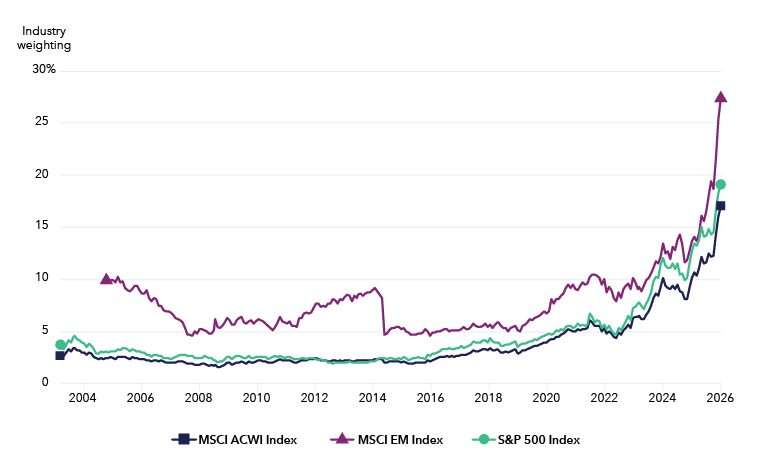
Source: Capital Group.
“For investors, the question is not whether AI and semiconductor companies are important, as many are exceptional businesses helping to drive innovation, productivity and earnings growth. Instead, the key question is how to think about concentration when building a portfolio for long-term goals,” says equity investment director Kathrin Forrest.
Here are three things investors should consider when investing in concentrated markets:
1. Concentration and certainty are not the same thing
Today’s concentration reflects investor enthusiasm around AI and the infrastructure required to support it. Recent earnings growth helps explain why. According to FactSet, the IT sector is expected to deliver one of the strongest earnings growth rates in the S&P 500, with semiconductors and semiconductor equipment companies contributing a significant portion of that growth.
“There are valid reasons for this optimism, but concentration and certainty are not the same thing,” says Forrest.
According to her, today’s benchmark weights and valuations increasingly reflect a single set of assumptions about how the future will unfold. That does not mean those assumptions are wrong, but it does mean investors should recognize how much market leadership is tied to a relatively narrow group of companies and outcomes.
History also reminds us that market leadership evolves. The companies that dominate one era do not always lead the next. Technological change creates opportunities, but it also introduces competition, disruption and shifting expectations. Even powerful long-term trends require ongoing analysis and disciplined investment decisions.
Some of the questions investors should be asking: Is current AI spending sustainable? How much demand growth reflects lasting business rationale versus competitive necessity? And can margins remain strong as more capacity comes online?
“These are not arguments against AI. They are reminders that great themes still require careful research,” she says.
2. Revisit your objectives
The rise in benchmark concentration also creates an opportunity for investors to revisit what they are trying to achieve.
For some investors, matching the return pattern of a market index may be entirely appropriate. For others, objectives may include generating income, preserving capital, funding retirement, supporting future beneficiaries or building long-term wealth with a different risk profile.
“Equities remain a core building block in many investors’ portfolios,” says Forrest. “But not everyone is solving for the same thing.”
This distinction matters because a highly concentrated benchmark may not necessarily align with every investor’s goals. The most heavily weighted companies are often associated with high growth expectations, but long-term returns can come from many sources.
“Earnings growth is one driver. Valuation expansion, dividend income and share buybacks can also contribute meaningfully to shareholder returns. In some cases, these characteristics are more prevalent outside the most crowded parts of the market,” she says.
“This highlights an important difference between a great company and a great stock. A company can be successful and widely admired while its future return potential is constrained by already-high expectations embedded in its share price,” Forrest says.
By focusing first on objectives rather than benchmarks, investors can make more informed decisions about where they may want to deploy their capital.
3. Look beyond the spotlight
Despite the attention focused on AI semiconductors and semiconductor equipment leaders, the global opportunity set remains far broader than benchmark weights suggest.
Compelling opportunities can often be found in less visible areas of the market. These may include turnaround stories, companies benefiting indirectly from AI adoption, or businesses that have been overlooked because they are perceived as being on the wrong side of technological change.
Finding these opportunities requires investors to look beyond a narrow set of themes and consider a wider range of return drivers. This means zooming out to look beyond the next quarter or two, digging into research across a broad range of companies both inside and outside the spotlight, and inviting diverse perspectives to avoid a single point of failure.
This is where active management can play an important role. Active strategies can move beyond benchmark concentrations, balancing conviction with diversification and seeking opportunities across a broader investment universe.
The AI ecosystem remains a powerful long-term growth opportunity, and investors may be wise not to avoid it. But investors may also benefit from ensuring that portfolios are not overly dependent on a single theme, industry or set of assumptions.
Forrest notes, “In concentrated markets, diversification requires intentionality. By combining exposure to powerful secular trends with a broader range of opportunities, investors can build portfolios that are better-positioned to navigate an uncertain future while remaining focused on their long-term goals.”
Learn more about
MSCI All Country World Index is a free-float-adjusted market-capitalization-weighted index that is designed to measure equity market results in the global developed and emerging markets, consisting of more than 40 developed- and emerging-market country indices.
MSCI Emerging Markets Index is a free float-adjusted market capitalization weighted index that is designed to measure equity market results in the global emerging markets, consisting of more than 20 emerging market country indices.
S&P 500 Index is a market capitalization-weighted index based on the results of approximately 500 widely held common stocks.
Our latest insights
-
-
Technology & Innovation
-
Objective-Based Investing
-
-
Demographics & Culture
RELATED INSIGHTS
-
-
Interest Rates
-
Commissions, trailing commissions, management fees and expenses all may be associated with investments in investment funds. Please read the prospectus before investing. Investment funds are not guaranteed or covered by the Canada Deposit Insurance Corporation or by any other government deposit insurer. For investment funds other than money market funds, their values change frequently. For money market funds, there can be no assurances that the fund will be able to maintain its net asset value per security at a constant amount or that the full amount of your investment in the fund will be returned to you. Past performance may not be repeated.
Unless otherwise indicated, the investment professionals featured do not manage Capital Group‘s Canadian investment funds.
References to particular companies or securities, if any, are included for informational or illustrative purposes only and should not be considered as an endorsement by Capital Group. Views expressed regarding a particular company, security, industry or market sector should not be considered an indication of trading intent of any investment funds or current holdings of any investment funds. These views should not be considered as investment advice nor should they be considered a recommendation to buy or sell.
Statements attributed to an individual represent the opinions of that individual as of the date published and do not necessarily reflect the opinions of Capital Group or its affiliates. This information is intended to highlight issues and not be comprehensive or to provide advice. For informational purposes only; not intended to provide tax, legal or financial advice. Capital Group funds are available in Canada through registered dealers. For more information, please consult your financial and tax advisors for your individual situation.
Forward-looking statements are not guarantees of future performance, and actual events and results could differ materially from those expressed or implied in any forward-looking statements made herein. We encourage you to consider these and other factors carefully before making any investment decisions and we urge you to avoid placing undue reliance on forward-looking statements.
The S&P 500 Composite Index (“Index”) is a product of S&P Dow Jones Indices LLC and/or its affiliates and has been licensed for use by Capital Group. Copyright © 2026 S&P Dow Jones Indices LLC, a division of S&P Global, and/or its affiliates. All rights reserved. Redistribution or reproduction in whole or in part are prohibited without written permission of S&P Dow Jones Indices LLC.
FTSE source: London Stock Exchange Group plc and its group undertakings (collectively, the "LSE Group"). © LSE Group 2026. FTSE Russell is a trading name of certain of the LSE Group companies. "FTSE®" is a trade mark of the relevant LSE Group companies and is used by any other LSE Group company under licence. All rights in the FTSE Russell indices or data vest in the relevant LSE Group company which owns the index or the data. Neither LSE Group nor its licensors accept any liability for any errors or omissions in the indices or data and no party may rely on any indices or data contained in this communication. No further distribution of data from the LSE Group is permitted without the relevant LSE Group company's express written consent. The LSE Group does not promote, sponsor or endorse the content of this communication. The index is unmanaged and cannot be invested in directly.
BLOOMBERG® is a trademark and service mark of Bloomberg Finance L.P. and its affiliates (collectively “Bloomberg”). Bloomberg or Bloomberg’s licensors own all proprietary rights in the Bloomberg Indices. Neither Bloomberg nor Bloomberg’s licensors approves or endorses this material, or guarantees the accuracy or completeness of any information herein, or makes any warranty, express or implied, as to the results to be obtained therefrom and, to the maximum extent allowed by law, neither shall have any liability or responsibility for injury or damages arising in connection therewith.
The MSCI information may only be used for your internal use, may not be reproduced or redisseminated in any form and may not be used as a basis for or a component of any financial instruments or products or indices. None of the MSCI information is intended to constitute investment advice or a recommendation to make (or refrain from making) any kind of investment decision and may not be relied on as such. Historical data and analysis should not be taken as an indication or guarantee of any future performance analysis, forecast or prediction. The MSCI information is provided on an “as is” basis and the user of this information assumes the entire risk of any use made of this information. MSCI, each of its affiliates and each other person involved in or related to compiling, computing or creating any MSCI information (collectively, the “MSCI Parties”) expressly disclaims all warranties (including, without limitation, any warranties of originality, accuracy, completeness, timeliness, non-infringement, merchantability and fitness for a particular purpose) with respect to this information. Without limiting any of the foregoing, in no event shall any MSCI Party have any liability for any direct, indirect, special, incidental, punitive, consequential (including, without limitation, lost profits) or any other damages. (www.msci.com)
Capital believes the software and information from FactSet to be reliable. However, Capital cannot be responsible for inaccuracies, incomplete information or updating of the information furnished by FactSet. The information provided in this report is meant to give you an approximate account of the fund/manager's characteristics for the specified date. This information is not indicative of future Capital investment decisions and is not used as part of our investment decision-making process.
Indices are unmanaged and cannot be invested in directly. Returns represent past performance, are not a guarantee of future performance, and are not indicative of any specific investment.
All Capital Group trademarks are owned by The Capital Group Companies, Inc. or an affiliated company in Canada, the U.S. and other countries. All other company names mentioned are the property of their respective companies.
Capital Group funds are offered in Canada by Capital International Asset Management (Canada), Inc., part of Capital Group, a global investment management firm originating in Los Angeles, California in 1931. Capital Group manages equity assets through three investment groups. These groups make investment and proxy voting decisions independently. Fixed income investment professionals provide fixed income research and investment management across the Capital organization; however, for securities with equity characteristics, they act solely on behalf of one of the three equity investment groups.
The Capital Group funds offered on this website are available only to Canadian residents.