Portfolio Construction
Categories
Interest Rates
Investing in a new global rate regime
 Philip Chitty
 Jason Davis
 Harry Phinney
September 16, 2026
KEY TAKEAWAYS
- Global bond yields are likely to remain elevated even as cyclical forces still drive meaningful swings, supporting a selective view on rates.
- Higher yields may partly reflect stronger nominal growth and investment demand, not simply weaker bond fundamentals.
- High debt burdens and larger financing needs point to upward pressure on long-end yields, but policy intervention and financial repression may limit repricing.
- These dynamics argue for selective portfolio positioning rather than broad bond market beta.
Higher bond yields are not solely a U.S. story. Across Europe, Japan and other major economies, governments are borrowing heavily to fund defence, energy security and infrastructure. Together, these pressures suggest global rates may settle above levels seen following the global financial crisis (GFC) and remain more volatile, creating a market environment that could reward active investing.
Against this backdrop, long-duration government bonds may no longer provide the same diversification benefits they once did. Instead, investors will likely need to be more selective across markets, maturities and issuers, and prioritize building portfolios that can adapt to a wider distribution of rate outcomes. The next decade may be defined by the tension between market forces pushing the cost of capital higher — including stronger investment demand, larger fiscal deficits and scarcer capital — and policy-related constraints, including financial repression, that may limit how far yields can rise.
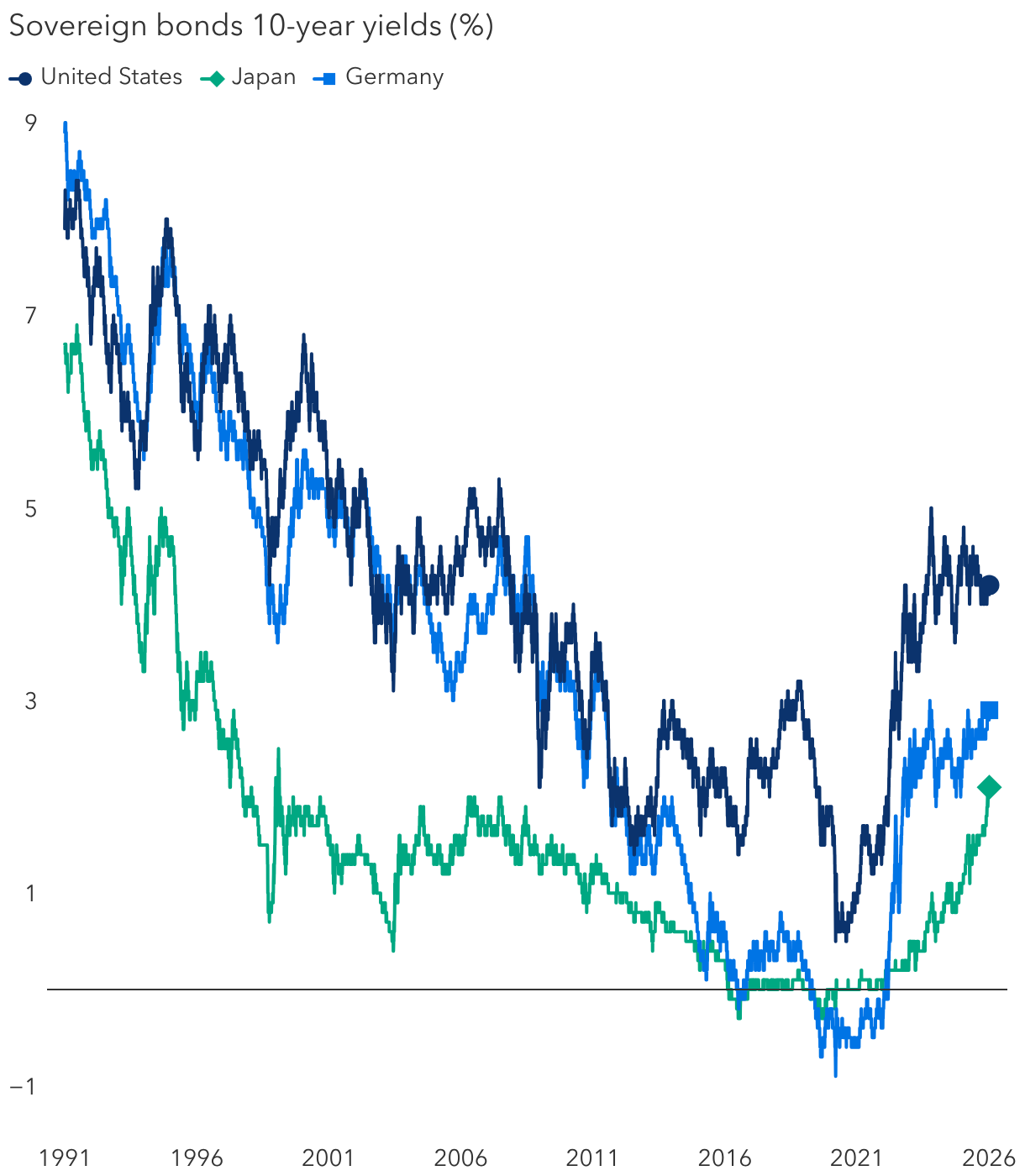
Yields for many global government bonds have surged but remain below pre-GFC levels
Sources: Capital Group, Bloomberg Finance L.P. As of September 11, 2026.
Higher rates create a new investing landscape
Global bond markets face a structurally higher cost of capital than during the long post-GFC era of low inflation, quantitative easing and abundant global savings. In the U.S., 10-year Treasury yields recently crossed 5% and remain near a two-decade high. Reasonably strong forward growth projections, flexible policy tools and the breadth of U.S. Treasury bond ownership across domestic and global institutions may limit the upward potential for yields. But it is still likely that the U.S. will need to pay a higher premium to attract capital over time.
Yields in Japanese government bonds have also recently surged to 30-year highs, driven by shifts in monetary policy, inflation fears and concerns around the country’s fiscal deficit. Looking ahead, repatriation of overseas assets to support domestic debt markets could strengthen the yen and alter long-standing carry trades, with spillover effects for global markets.
Canada’s 10-year government bond yield has risen throughout 2026 as well. It started the year at 3.4% reaching a three-year high of 3.9% by mid-September driven by inflation worries stemming from the crude oil rally. Still, underlying Canadian price pressures showed no broad acceleration as core gauges tracked by the Bank of Canada (BoC) were unchanged near the 2% target. The BoC held its key rate at 2.25% at its latest meeting, but Governor Tiff Macklem said policymakers were prepared to raise rates if inflation remained elevated.
Europe presents a more mixed picture. Greater fiscal integration and joint issuance could support the eurozone as a whole, but individual sovereigns with high debt burdens or heavy reliance on foreign buyers may face renewed scrutiny. France and the U.K. look more exposed on that front, while Italy’s large domestic savings base may offer some buffer despite elevated debt ratios.
Yields reflect higher neutral rates, not just higher term premium
Understanding the upward shift in yields requires separating higher neutral rates from a higher term premium. In developed markets including the U.S., Europe, the U.K. and Japan, much of the recent move in 10-year real yields stems from the market reassessing the neutral rate rather than simply demanding more compensation for bond supply. That matters because higher neutral rates have different asset implications than higher term premium. If yields are rising because the economy can sustain stronger productivity growth, the signal is not necessarily bearish for risk assets; it may reflect stronger nominal growth, investment demand and corporate cash-flow prospects.
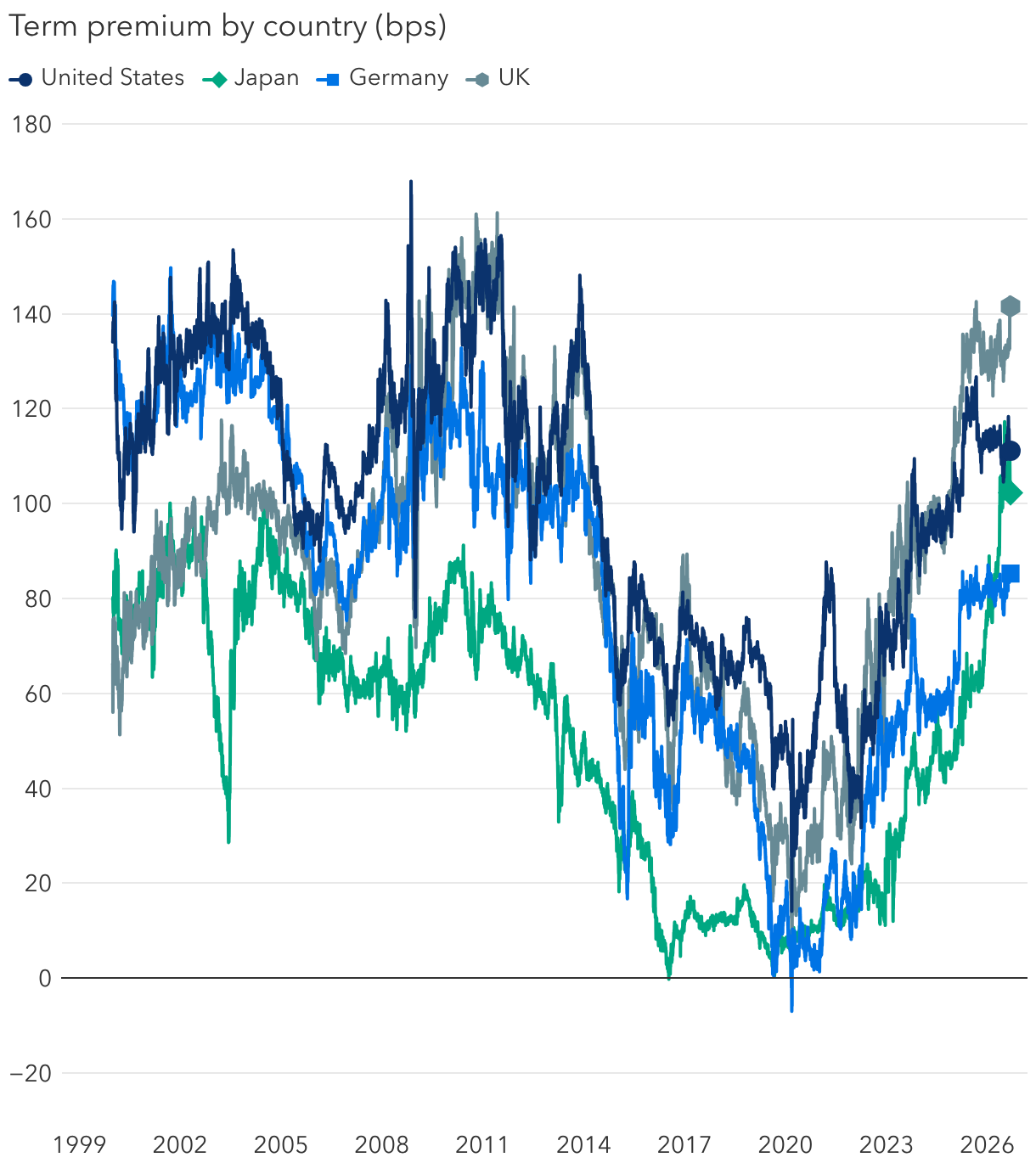
Term premium — which reflects the extra compensation investors require to own longer duration bonds rather than continually reinvesting in shorter term bonds — is different. Term premium has already increased materially since 2020 and now sits within a pre-GFC range, but not necessarily at a level that signals excess. The post-QE world has fewer natural absorbers of duration. Central banks have retreated from balance sheet expansion, pension demand is less structurally sticky in places, government debt burdens are high, and corporate issuance linked to the AI and infrastructure cycle is rising. That argues against assuming term premium can sustainably return to the compressed levels of the mid-2010s through the early 2020s.
Term premium has already risen materially since 2020
Real term premium now sits within the broad pre-GFC range
Sources: Capital Group, Bloomberg Finance L.P. As of September 11, 2026. Term premium = 10Y yield − 5Y yield + 20% of the 2Y yield. Term premium is the extra yield investors demand for the risks associated with holding longer term bonds.
High debt raises resistance to market-driven borrowing costs
The tension is that high public debt makes governments less willing to accept borrowing costs that markets might otherwise demand. This increases the probability of explicit or implicit financial repression through debt-management strategies — such as shorter weighted-average maturity issuance, regulatory encouragement for domestic institutions to own sovereign debt, central bank balance sheet flexibility or yield-curve management — as well as greater tolerance for inflation that reduces real debt burdens over time. Governments are already trying to ease long-end pressure through issuance choices, and financial repression becomes more tempting as interest expense approaches nominal growth capacity.
This creates a two-sided risk for bond markets. Persistent inflation, larger funding needs, reduced central bank demand and more price-sensitive buyers can push term premium higher. But policymakers may also suppress long-end supply, mitigate disorderly rises in yields or allow inflation to handle some of the adjustment. The adjustment may therefore appear through currencies, inflation-linked assets, curve shape, swap spreads and cross-country relative value.
Investment implications: Owning the right risks
The central asset allocation implication is that broad index exposure may be less attractive than careful security selection. The 2010s rewarded exposure to long duration, U.S. growth leadership, falling discount rates and broad spread compression. The next phase may reward a more active mix of carry, curve discipline, inflation-aware positioning, relative value across countries and currencies, and bottom-up selection more than broad beta. In rates, that argues for curve expressions that isolate term-premium risk more precisely than outright duration.
For sovereign duration, the focus is on being selective. Starting yields are higher, carry is more meaningful, and duration could still help balance portfolios in a genuine demand shock. But duration should be owned deliberately, in markets where real yields compensate investors for inflation and fiscal risk, central banks have room to cut, and issuance or external balance dynamics are manageable. Curve exposure may be more attractive than outright duration where fiscal risk is concentrated at the long end.
We favour approaching credit through carry and idiosyncratic selection rather than relying on broad moves in credit spreads. Stronger nominal growth and investment spending can support corporate fundamentals, but tight spreads leave less margin for error. The most attractive credit opportunities are likely to be those where income is visible, refinancing risk is manageable and the issuer is relatively well positioned for a higher cost-of-capital environment. The riskier parts of credit markets are more vulnerable if term premium shocks tighten financial conditions abruptly.
Foreign exchange and regional allocations become more important. If U.S. exceptionalism fades at the margin and opportunities outside the U.S. broaden, non-dollar opportunities should improve. We favour a selective approach focused on exposures to undervalued developed-market currencies, select EM local markets, and countries where valuations, real yields and policy credibility are compelling.
The next cycle may look very different from the last
There is growing evidence that the world is leaving behind the post-GFC regime of abundant capital, weak investment demand and ultra-low real yields. Should the recent massive and simultaneous growth in demand for public and private financing continue, it will likely expose the limits of capital availability, meaning its cost could face persistent upward pressure.
For bond investors, the defining challenge of the next decade may not be predicting the next move in yields, but instead identifying where capital is scarce, policy is credible and compensation for risk remains attractive. In a world of higher rates and greater dispersion, a focus on fundamentals and selectivity will be key.
Learn more about
Phillip Chitty is a portfolio manager for Capital Group World Bond Fund (Canada), Capital Group Monthly Income Portfolio (Canada), Capital Group Global Balanced Fund (Canada) and Capital Group World Bond Select ETF (Canada)
The value of fixed income securities may be affected by changing interest rates and changes in credit ratings of the securities.
Duration measures a bond’s sensitivity to changes in interest rates. Generally speaking, a bond's price will go up 1% for every year of duration if interest rates fall by 1% or down 1% for every year of duration if interest rates rise by 1%. When an investor talks about “owning duration,” this means that they have exposure to interest rate risk.
Neutral rate is the theoretical level for a central bank's policy interest rate where monetary policy is trying neither to stimulate nor to restrict economic activity.
Quantitative easing (QE): The Fed’s purchases of large quantities of Treasury securities and mortgage-backed securities issued by government-sponsored enterprises and federal agencies to achieve its monetary policy objectives.
Real yield refers to the return on an investment after accounting for inflation — it is the nominal yield adjusted to reflect the erosion of purchasing power due to inflation.
Yield curve is a measure of the difference between the yields of bonds of different maturities. A yield curve is said to be inverted when shorter term bonds provide higher yields than longer term bonds. Yield curve steepening occurs when long-term rates rise more than short-term rates, or short-term rates fall more than long-term rates.
Our latest insights
-
-
Technology & Innovation
-
Objective-Based Investing
-
-
Active Management
RELATED INSIGHTS
-
Objective-Based Investing
-
Active Management
-
Trade
Commissions, trailing commissions, management fees and expenses all may be associated with investments in investment funds. Please read the prospectus before investing. Investment funds are not guaranteed or covered by the Canada Deposit Insurance Corporation or by any other government deposit insurer. For investment funds other than money market funds, their values change frequently. For money market funds, there can be no assurances that the fund will be able to maintain its net asset value per security at a constant amount or that the full amount of your investment in the fund will be returned to you. Past performance may not be repeated.
Unless otherwise indicated, the investment professionals featured do not manage Capital Group‘s Canadian investment funds.
References to particular companies or securities, if any, are included for informational or illustrative purposes only and should not be considered as an endorsement by Capital Group. Views expressed regarding a particular company, security, industry or market sector should not be considered an indication of trading intent of any investment funds or current holdings of any investment funds. These views should not be considered as investment advice nor should they be considered a recommendation to buy or sell.
Statements attributed to an individual represent the opinions of that individual as of the date published and do not necessarily reflect the opinions of Capital Group or its affiliates. This information is intended to highlight issues and not be comprehensive or to provide advice. For informational purposes only; not intended to provide tax, legal or financial advice. Capital Group funds are available in Canada through registered dealers. For more information, please consult your financial and tax advisors for your individual situation.
Forward-looking statements are not guarantees of future performance, and actual events and results could differ materially from those expressed or implied in any forward-looking statements made herein. We encourage you to consider these and other factors carefully before making any investment decisions and we urge you to avoid placing undue reliance on forward-looking statements.
The S&P 500 Composite Index (“Index”) is a product of S&P Dow Jones Indices LLC and/or its affiliates and has been licensed for use by Capital Group. Copyright © 2026 S&P Dow Jones Indices LLC, a division of S&P Global, and/or its affiliates. All rights reserved. Redistribution or reproduction in whole or in part are prohibited without written permission of S&P Dow Jones Indices LLC.
FTSE source: London Stock Exchange Group plc and its group undertakings (collectively, the "LSE Group"). © LSE Group 2026. FTSE Russell is a trading name of certain of the LSE Group companies. "FTSE®" is a trade mark of the relevant LSE Group companies and is used by any other LSE Group company under licence. All rights in the FTSE Russell indices or data vest in the relevant LSE Group company which owns the index or the data. Neither LSE Group nor its licensors accept any liability for any errors or omissions in the indices or data and no party may rely on any indices or data contained in this communication. No further distribution of data from the LSE Group is permitted without the relevant LSE Group company's express written consent. The LSE Group does not promote, sponsor or endorse the content of this communication. The index is unmanaged and cannot be invested in directly.
BLOOMBERG® is a trademark and service mark of Bloomberg Finance L.P. and its affiliates (collectively “Bloomberg”). Bloomberg or Bloomberg’s licensors own all proprietary rights in the Bloomberg Indices. Neither Bloomberg nor Bloomberg’s licensors approves or endorses this material, or guarantees the accuracy or completeness of any information herein, or makes any warranty, express or implied, as to the results to be obtained therefrom and, to the maximum extent allowed by law, neither shall have any liability or responsibility for injury or damages arising in connection therewith.
The MSCI information may only be used for your internal use, may not be reproduced or redisseminated in any form and may not be used as a basis for or a component of any financial instruments or products or indices. None of the MSCI information is intended to constitute investment advice or a recommendation to make (or refrain from making) any kind of investment decision and may not be relied on as such. Historical data and analysis should not be taken as an indication or guarantee of any future performance analysis, forecast or prediction. The MSCI information is provided on an “as is” basis and the user of this information assumes the entire risk of any use made of this information. MSCI, each of its affiliates and each other person involved in or related to compiling, computing or creating any MSCI information (collectively, the “MSCI Parties”) expressly disclaims all warranties (including, without limitation, any warranties of originality, accuracy, completeness, timeliness, non-infringement, merchantability and fitness for a particular purpose) with respect to this information. Without limiting any of the foregoing, in no event shall any MSCI Party have any liability for any direct, indirect, special, incidental, punitive, consequential (including, without limitation, lost profits) or any other damages. (www.msci.com)
Capital believes the software and information from FactSet to be reliable. However, Capital cannot be responsible for inaccuracies, incomplete information or updating of the information furnished by FactSet. The information provided in this report is meant to give you an approximate account of the fund/manager's characteristics for the specified date. This information is not indicative of future Capital investment decisions and is not used as part of our investment decision-making process.
Indices are unmanaged and cannot be invested in directly. Returns represent past performance, are not a guarantee of future performance, and are not indicative of any specific investment.
All Capital Group trademarks are owned by The Capital Group Companies, Inc. or an affiliated company in Canada, the U.S. and other countries. All other company names mentioned are the property of their respective companies.
Capital Group funds are offered in Canada by Capital International Asset Management (Canada), Inc., part of Capital Group, a global investment management firm originating in Los Angeles, California in 1931. Capital Group manages equity assets through three investment groups. These groups make investment and proxy voting decisions independently. Fixed income investment professionals provide fixed income research and investment management across the Capital organization; however, for securities with equity characteristics, they act solely on behalf of one of the three equity investment groups.
The Capital Group funds offered on this website are available only to Canadian residents.