Markets & Economy
 Matt Miller
 Diana Wagner
 Tom Hollenberg
 Cheryl Frank
- Political volatility is likely to persist.
- Healthcare could face renewed policy pressure.
- Large U.S. deficits aren’t going away.
With Democrats about to seize control of U.S. Congress following a sweeping midterm election victory, profound change is coming to the balance of power in Washington, D.C. In a stunning rebuke, U.S. voters unseated Republicans in traditionally conservative strongholds across the country, giving Democrats a powerful check on President Donald Trump’s agenda during his final two years in office.
Ahead of this seismic shift in U.S. political leadership, Capital Group professionals share their views on what the outcome could mean for markets and investors.
Key policy deadlines ahead of 2028
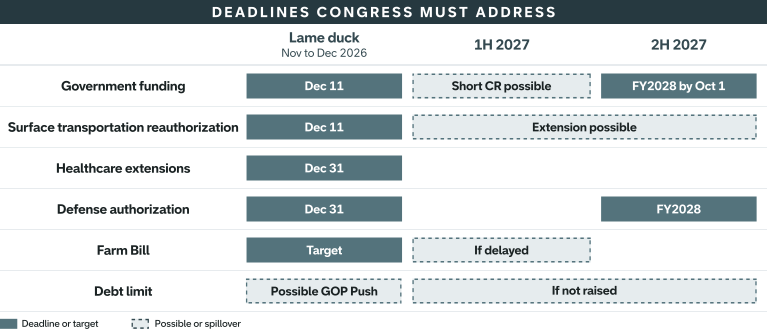
Sources: Capital Group, Congress.gov, Holland & Knight, Legis1, WilmerHale. “CR” refers to a continuing resolution. Timing and priorities reflect public reporting as of October 2026 and are not forecasts.
Trump lost his coalition, but don’t assume a 2028 Democratic trifecta
Matt Miller, political economist
The midterm result was an epic repudiation of President Trump’s policies on tariffs and the Iran War, which voters blamed for higher gas prices and other costs. Voters also took aim at what they viewed as self-dealing and self-enrichment, along with distractions like the White House ballroom and Trump’s triumphal arch. The main takeaway for me is the ongoing volatility we are seeing from U.S. election to U.S. election. People are persistently unhappy with the status quo, which has resulted in changes in power in 10 of the last 11 elections. That’s why it would be a mistake to assume a Democratic trifecta in 2028. This election showed how quickly a party can squander the coalition that put it in power.
So what should investors expect now? We will likely see plenty of investigations of the Trump administration, including alleged pay-to-play deals. However, Democrats can’t run in 2028 on investigations alone. They will almost certainly work on a big healthcare bill, potential caps to credit card fees and increasing the federal minimum wage. The war in Iran may emerge as a point of negotiation, with Democrats agreeing to fund some of the U.S. administration’s defence priorities in exchange for concessions.
The party may also move to strip Trump of his claimed tariff authority. Tariffs on foods and materials used in housing construction, both of which have driven prices higher, may also be repealed. Republicans looking to repair their standing with voters may join to achieve a veto-proof majority on some of these issues.
AI and data centres will also be on the agenda. The cost of building AI data centres could increase, but my expectation is that the rhetoric will be charged, but common ground will be found. I’d expect Democrats to scale back federal tax incentives for new projects and ameliorate power and water consumption costs. I think the coalition behind data centres will work aggressively to repair the relationships they’ve damaged at the state level with more community outreach and local buy-ins.
In the immediate future, things will be hectic as Trump is now a lame-duck president. He will want to address the debt ceiling and boost defence spending while Republicans still control Congress. This won’t be easy to accomplish with Republicans feeling less cooperative and blaming Trump for their losses.
Looking ahead to 2028, the messy debate about to unfold ahead of the next presidential election reflects the fact that neither major political party has found a way to address Americans’ anxieties about their economic prospects in ways that permit a durable governing coalition to emerge. Until that happens, we should expect the political pendulum to keep swinging.
Healthcare in the crosshairs
Diana Wagner, portfolio manager
Healthcare is coming into focus as Democrats take control of Congress. With several centrists in power on the Democratic side, forthcoming bills may be more moderate and aimed at expanding the Affordable Care Act, lowering prescription drug costs and rolling back changes to Medicaid enacted under the One Big Beautiful Bill Act of 2025.
However, “Medicare for All” may also return as a talking point, particularly for progressive Democrats. It’s important to understand that we’ve been talking about Medicare for All for nearly my entire 26-year career at Capital Group, and so far, it has been more of a slogan than a policy. Still, a renewed debate around this issue could put downward pressure on healthcare stocks, including insurers, pharmaceutical companies and hospitals.
Meanwhile, fundamentals for Medicare Advantage health insurers such as UnitedHealthcare have been improving and are expected to remain stable, given that the pricing environment over the next couple of years is unlikely to change. That’s because the Centres for Medicare & Medicaid Services, which sets Medicare Advantage payment rates, falls under the control of the White House. Over the long run, the healthcare sector has multiple tailwinds as the aging U.S. population fuels demand for healthcare innovation. Between its accelerating GLP-1 franchise and ongoing Alzheimer’s drug trial, Eli Lilly is among the industry’s most innovative companies addressing these structural trends.
Election outcome won’t curb U.S. government spending
Tom Hollenberg, portfolio manager
Most election outcomes have less impact on the fiscal outlook than you might expect. Even after Democrats’ sweeping election gains, the president’s veto power makes any major new tax or spending legislation harder to pass. The outcome of the midterms also won’t address the deficits that we’re already running. That is, the government will likely continue to spend more money than it collects in revenue. And the outgoing Congress could still approve additional spending during the lame-duck session before the new Congress takes office in January.
Deficit spending is a bipartisan problem
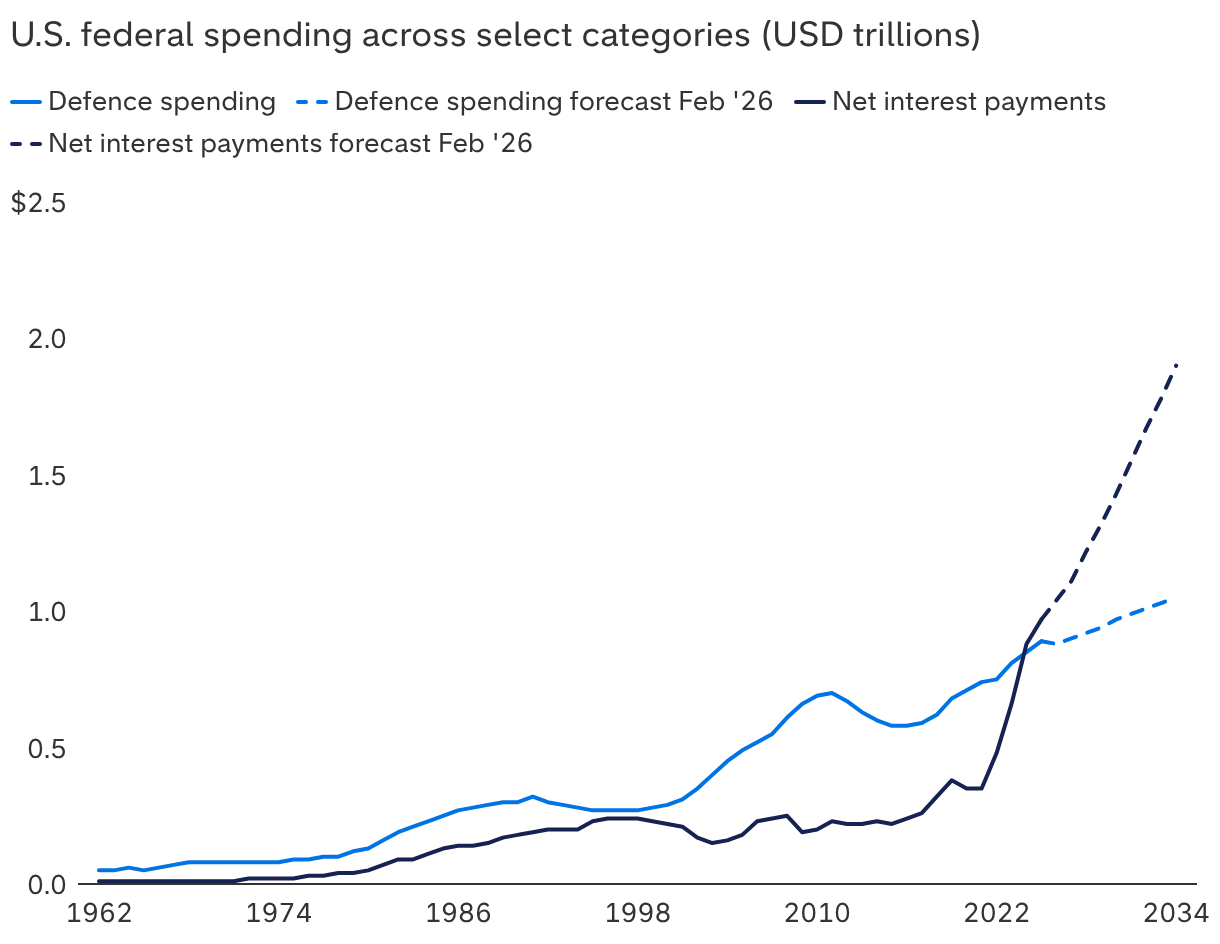
Sources: Capital Group, Congressional Budget Office (CBO). Dashed lines indicate forecasted values from the CBO as of February 2026.
The U.S. government ran a roughly $2 trillion deficit in fiscal year 2026, and my base case is that it will continue to run deficits around the same size for the next several years. I generally think owning longer-dated U.S. Treasuries makes sense for portfolios, with 10-year yields around 5% that offer some compensation for the fiscal risks that remain. Democratic control of Congress also makes additional tax cuts and proposals such as Trump’s $5,000 checks to households much less likely in 2027 and 2028.
The election result may constrain Trump’s domestic agenda, but it doesn’t eliminate the possibility of further military escalation with Iran. A prolonged war represents an upside risk to inflation and yields.
The U.S. economy can stay resilient
Cheryl Frank, portfolio manager
The U.S. economy should be able to navigate heightened political and policy uncertainty over the next two years. Labour markets remain resilient, corporate profits remain solid and business investments have picked up. Consumers also remain a source of strength and continue to spend on cruises, travel and other experiences.
Stocks historically have had positive returns in the year following midterms
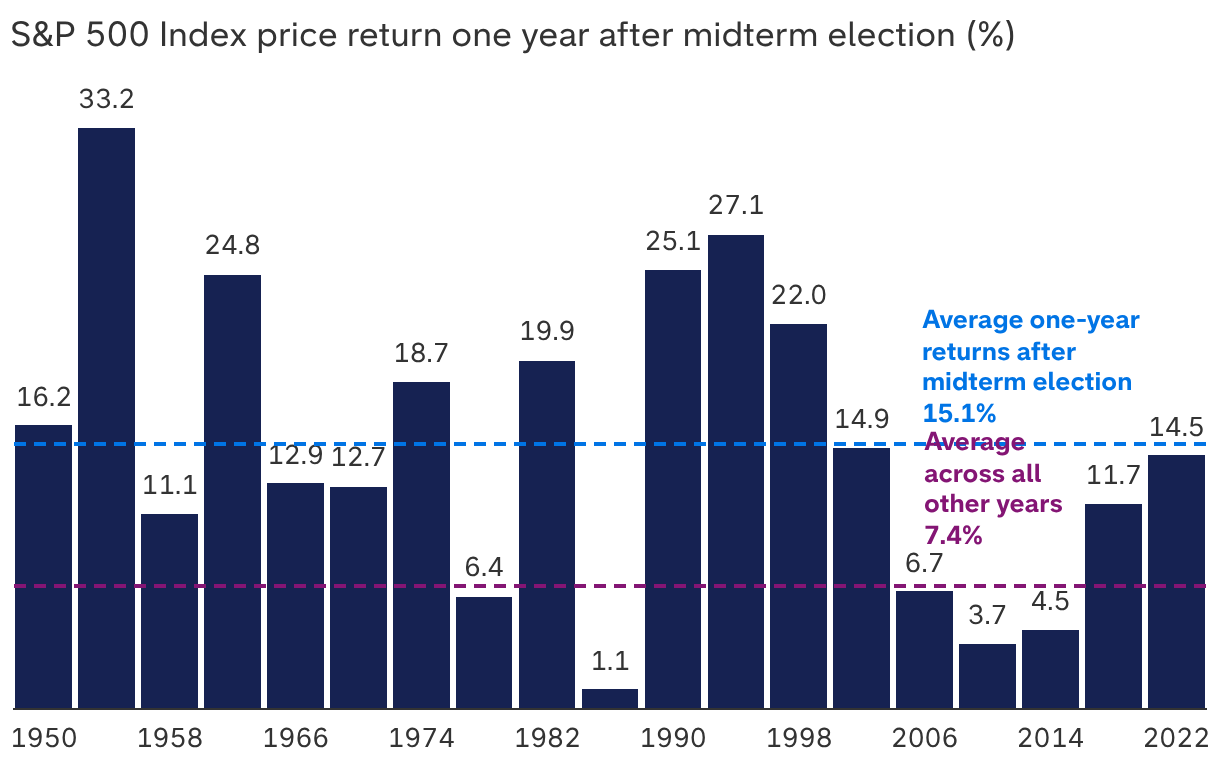
Sources: Capital Group, RIMES, S&P Global. Calculations use Election Day as the starting date in all election years, and November 5 as a proxy for the starting date in other years. Only midterm election years are shown in the chart. Price returns exclude the reinvestment of dividends and capital distributions.
Enterprise adoption of AI feels like an unstoppable freight train that could last as long as 20 years, although there may be bumps along the way. I think the 2028 election could be about data centre NIMBYism among both Democrats and Republicans, which could slow the buildout. That’s one reason why there’s such a big push to get as much built as possible ahead of the presidential election.
I am constructive about the future of AI and the resilience of the U.S. economy. There will be periods of uncertainty and volatility, but the underlying economy and investment trends remain healthy. In my experience, election results are rarely the driver of long-term investment outcomes.
Past results are not predictive of results in future periods.
The indices are unmanaged and, therefore, have no expenses. Investors cannot invest directly in an index.
The S&P 500 Index is a market capitalization-weighted index based on the results of approximately 500 widely held common stocks.
The S&P 500 Index is a product of S&P Dow Jones Indices LLC and/or its affiliates and has been licensed for use by Capital Group. Copyright © 2026 S&P Dow Jones Indices LLC, a division of S&P Global, and/or its affiliates. All rights reserved. Redistribution or reproduction in whole or in part is prohibited without written permission of S&P Dow Jones Indices LLC.
Our latest insights
-
-
Portfolio Construction
-
Technology & Innovation
-
Objective-Based Investing
-
RELATED INSIGHTS
-
-
Artificial Intelligence
-
Portfolio Construction
Commissions, trailing commissions, management fees and expenses all may be associated with investments in investment funds. Please read the prospectus before investing. Investment funds are not guaranteed or covered by the Canada Deposit Insurance Corporation or by any other government deposit insurer. For investment funds other than money market funds, their values change frequently. For money market funds, there can be no assurances that the fund will be able to maintain its net asset value per security at a constant amount or that the full amount of your investment in the fund will be returned to you. Past performance may not be repeated.
Unless otherwise indicated, the investment professionals featured do not manage Capital Group‘s Canadian investment funds.
References to particular companies or securities, if any, are included for informational or illustrative purposes only and should not be considered as an endorsement by Capital Group. Views expressed regarding a particular company, security, industry or market sector should not be considered an indication of trading intent of any investment funds or current holdings of any investment funds. These views should not be considered as investment advice nor should they be considered a recommendation to buy or sell.
Statements attributed to an individual represent the opinions of that individual as of the date published and do not necessarily reflect the opinions of Capital Group or its affiliates. This information is intended to highlight issues and not be comprehensive or to provide advice. For informational purposes only; not intended to provide tax, legal or financial advice. Capital Group funds are available in Canada through registered dealers. For more information, please consult your financial and tax advisors for your individual situation.
Forward-looking statements are not guarantees of future performance, and actual events and results could differ materially from those expressed or implied in any forward-looking statements made herein. We encourage you to consider these and other factors carefully before making any investment decisions and we urge you to avoid placing undue reliance on forward-looking statements.
The S&P 500 Composite Index (“Index”) is a product of S&P Dow Jones Indices LLC and/or its affiliates and has been licensed for use by Capital Group. Copyright © 2026 S&P Dow Jones Indices LLC, a division of S&P Global, and/or its affiliates. All rights reserved. Redistribution or reproduction in whole or in part are prohibited without written permission of S&P Dow Jones Indices LLC.
FTSE source: London Stock Exchange Group plc and its group undertakings (collectively, the "LSE Group"). © LSE Group 2026. FTSE Russell is a trading name of certain of the LSE Group companies. "FTSE®" is a trade mark of the relevant LSE Group companies and is used by any other LSE Group company under licence. All rights in the FTSE Russell indices or data vest in the relevant LSE Group company which owns the index or the data. Neither LSE Group nor its licensors accept any liability for any errors or omissions in the indices or data and no party may rely on any indices or data contained in this communication. No further distribution of data from the LSE Group is permitted without the relevant LSE Group company's express written consent. The LSE Group does not promote, sponsor or endorse the content of this communication. The index is unmanaged and cannot be invested in directly.
BLOOMBERG® is a trademark and service mark of Bloomberg Finance L.P. and its affiliates (collectively “Bloomberg”). Bloomberg or Bloomberg’s licensors own all proprietary rights in the Bloomberg Indices. Neither Bloomberg nor Bloomberg’s licensors approves or endorses this material, or guarantees the accuracy or completeness of any information herein, or makes any warranty, express or implied, as to the results to be obtained therefrom and, to the maximum extent allowed by law, neither shall have any liability or responsibility for injury or damages arising in connection therewith.
The MSCI information may only be used for your internal use, may not be reproduced or redisseminated in any form and may not be used as a basis for or a component of any financial instruments or products or indices. None of the MSCI information is intended to constitute investment advice or a recommendation to make (or refrain from making) any kind of investment decision and may not be relied on as such. Historical data and analysis should not be taken as an indication or guarantee of any future performance analysis, forecast or prediction. The MSCI information is provided on an “as is” basis and the user of this information assumes the entire risk of any use made of this information. MSCI, each of its affiliates and each other person involved in or related to compiling, computing or creating any MSCI information (collectively, the “MSCI Parties”) expressly disclaims all warranties (including, without limitation, any warranties of originality, accuracy, completeness, timeliness, non-infringement, merchantability and fitness for a particular purpose) with respect to this information. Without limiting any of the foregoing, in no event shall any MSCI Party have any liability for any direct, indirect, special, incidental, punitive, consequential (including, without limitation, lost profits) or any other damages. (www.msci.com)
Capital believes the software and information from FactSet to be reliable. However, Capital cannot be responsible for inaccuracies, incomplete information or updating of the information furnished by FactSet. The information provided in this report is meant to give you an approximate account of the fund/manager's characteristics for the specified date. This information is not indicative of future Capital investment decisions and is not used as part of our investment decision-making process.
Indices are unmanaged and cannot be invested in directly. Returns represent past performance, are not a guarantee of future performance, and are not indicative of any specific investment.
All Capital Group trademarks are owned by The Capital Group Companies, Inc. or an affiliated company in Canada, the U.S. and other countries. All other company names mentioned are the property of their respective companies.
Capital Group funds are offered in Canada by Capital International Asset Management (Canada), Inc., part of Capital Group, a global investment management firm originating in Los Angeles, California in 1931. Capital Group manages equity assets through three investment groups. These groups make investment and proxy voting decisions independently. Fixed income investment professionals provide fixed income research and investment management across the Capital organization; however, for securities with equity characteristics, they act solely on behalf of one of the three equity investment groups.
The Capital Group funds offered on this website are available only to Canadian residents.