Portfolio Construction
Categories
International
Why developed international equity ETFs deserve consideration
 Warner Wen
July 23, 2026
For investors seeking a smoother ride when investing internationally, the answer may lie in a developed international equity fund.
Unlike many broader international equity mandates that combine developed and developing markets into a single fund, developed international equity funds focus on established economies such as Japan, the U.K., Switzerland, France and Germany with limited emerging markets exposure.
"Developed market–focused funds provide access to world-class businesses and established economies while offering less potential volatility than broader international mandates," says product manager Warner Wen.
There’s an additional consideration, though: For investors accessing the asset class through an ETF, these benefits can be further enhanced by the convenience and flexibility of an exchange-traded vehicle.
Expanding the opportunity set
One of the fundamental benefits of developed international equity ETFs is access to a vast investment universe through a single, cost-effective vehicle.
The U.S. represented 1,559 constituents in the FTSE Global All Cap Index as of May 31, 2026. But outside the U.S. there were 10,137 constituents, highlighting the breadth of opportunity available beyond a single market.
Put simply, diversification across geographies is not just about owning more stocks; it’s about owning different drivers of return. And because global markets move in different cycles, this broader exposure can improve risk-adjusted outcomes over time.
Importantly, developed international markets also provide exposure to different sector leadership. While the U.S. market is heavily concentrated in technology, developed international markets tend to have greater representation in sectors such as financials, industrials, consumer staples and healthcare.
Different weights, different outcomes
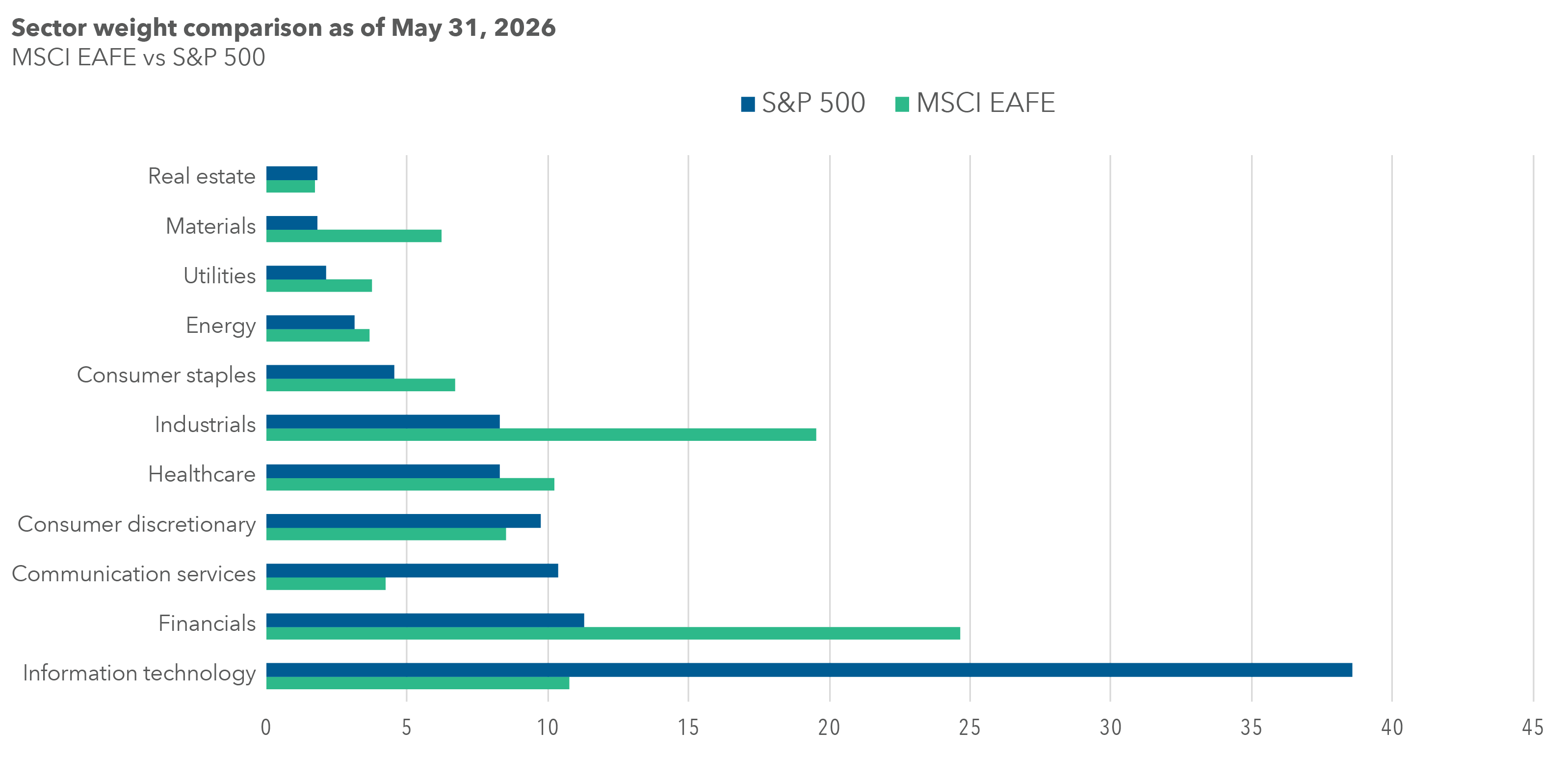
Sources: MSCI and S&P Dow Jones Indices LLC.
Relative attractiveness: Income and valuation support
Beyond diversification, international developed equities currently offer a compelling valuation and income advantage. After years of U.S. outperformance, the valuation gap between U.S. and international markets remains meaningful, with non-U.S. equities trading at a discount across many sectors. Historically, such discounts have often preceded periods of relative outperformance for international equities.
Sectors are historically discounted outside the U.S.
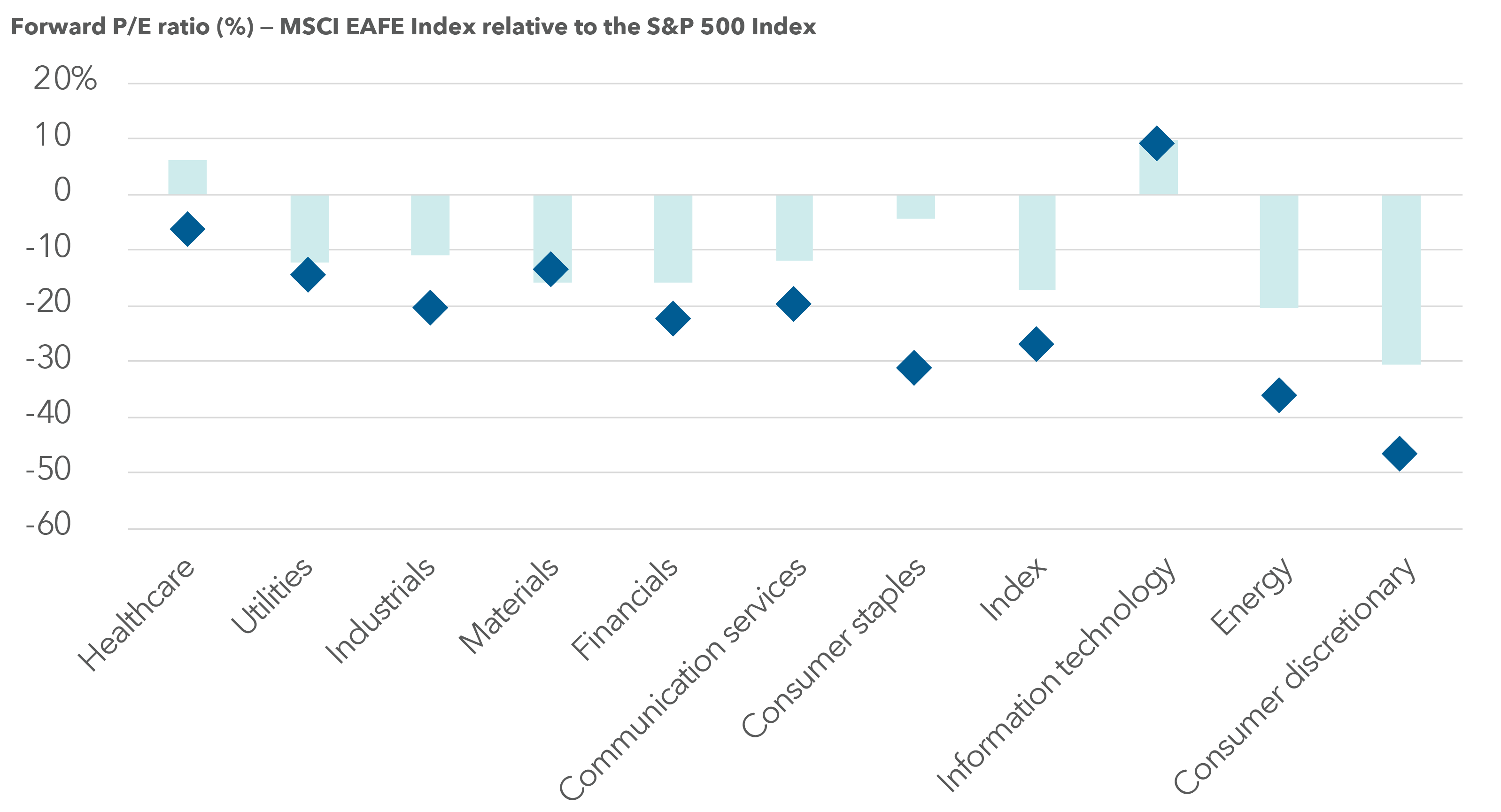
Sources: Capital Group, FactSet. As of March 31, 2026 . Relative forward P/E (price-to-earnings ratio) is calculated by dividing the forward P/E ratio for the MSCI EAFE Index by the forward P/E ratio for the S&P 500 Index. Valuation: An estimate of a company's worth based on metrics including earnings, revenue or assets.
In addition, developed international markets tend to exhibit higher dividend yields than the U.S., supported by a stronger shareholder payout culture and sector composition. This combination of higher income and lower starting valuations provides investors with a built-in margin of safety that can cushion against potential downside risk and serve as a foundation for long-term return generation.
Developed international dividend yields sit near 20-year relative highs
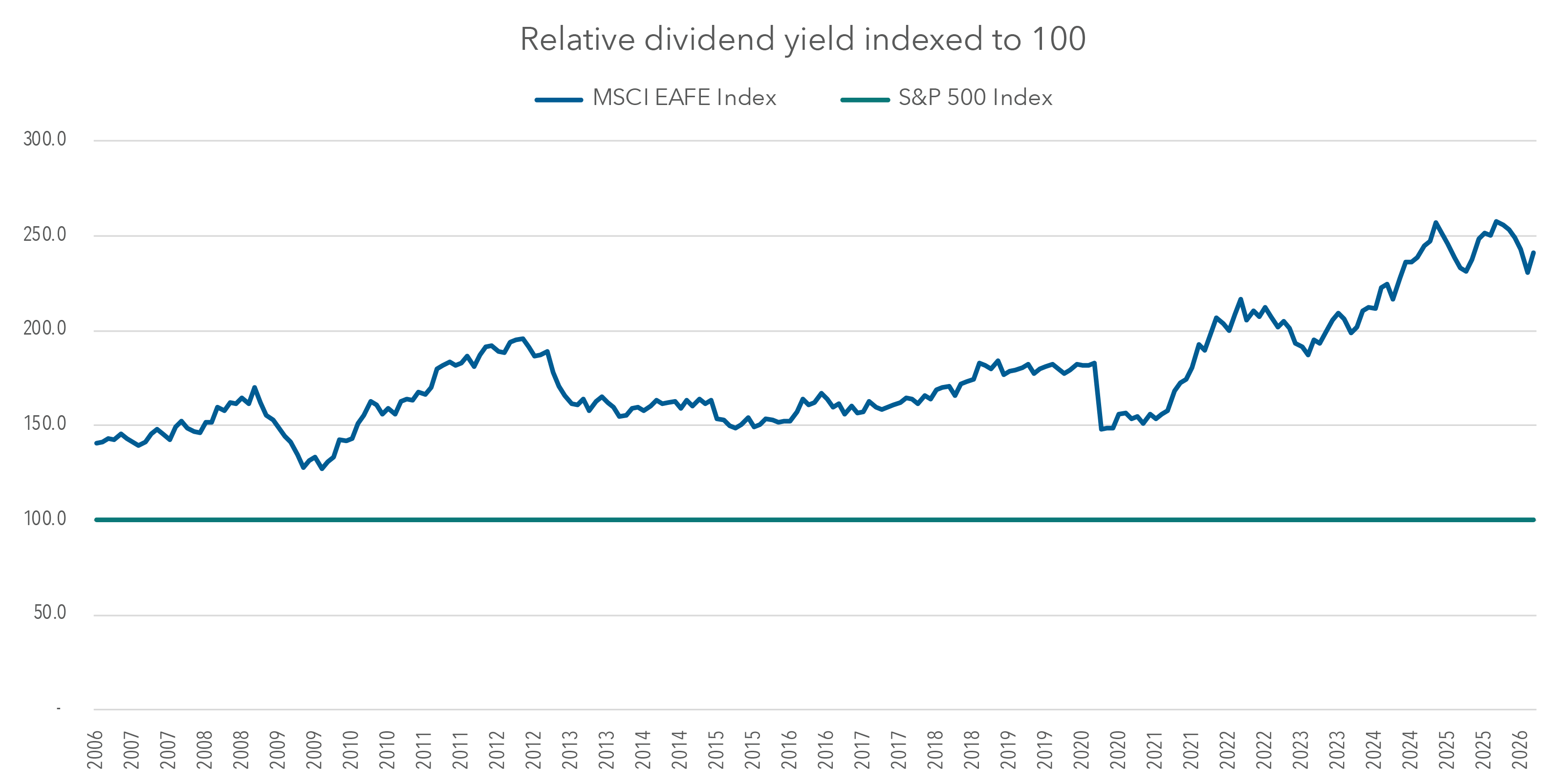
Source: FactSet. As of March 31.2026. Relative dividend yield is calculated by dividing the dividend yield of the MSCI EAFE Index by the dividend yield of the S&P 500 Index. Dividend yields are based on the last 12 months. Past results are not predictive of results in future periods.
“Despite this very attractive backdrop, passive exposure to developed international equities alone may not be enough. The real opportunity lies in distinguishing signal from noise — finding the right companies, sidestepping value traps, and recognizing turning points early. These are the areas where active management can potentially deliver its greatest value,” says Wen.
Resilience in a higher-inflation world
The case for developed international equities appears even more attractive in a higher-inflation environment.
Many sectors that are well represented within developed international markets — including utilities, energy, industrials and consumer staples — often have pricing power that helps them pass rising costs on to consumers. This ability can support margins and earnings during periods of elevated inflation.
At the same time, many developed international companies pay meaningful dividends, which can provide investors with a tangible source of return when market conditions become more uncertain.
"Dividend-paying companies can offer both income and a measure of stability when capital appreciation becomes more difficult to achieve," says Wen.
Building a more balanced portfolio
Developed international equity ETFs are more than a diversification tool. They can serve as a strategic core portfolio allocation, helping investors broaden opportunity, reduce concentration risk and gain exposure to mature economies around the world.
By focusing on developed markets, investors can access global companies, attractive valuations and income-oriented businesses while potentially avoiding some of the additional volatility associated with emerging markets. Combined with the cost efficiency, transparency and flexibility of the ETF structure, developed international equity ETFs can provide a simple and effective way to diversify beyond North America.
"In a world where inflation, interest rates and market concentration continue to create uncertainty, an actively managed developed international equity ETF can play an important role in helping investors build more resilient portfolios," says Wen.
Learn more about
MSCI EAFE® (Europe, Australasia, Far East) Index is a free float-adjusted market capitalization weighted index that is designed to measure developed equity market results, excluding the United States and Canada.
S&P 500 Index tracks the stocks of around 500 primarily large-cap, U.S.-based companies.
Our latest insights
-
-
Technology & Innovation
-
Objective-Based Investing
-
-
Active Management
RELATED INSIGHTS
-
Global Equities
-
International Equities
-
International
Commissions, trailing commissions, management fees and expenses all may be associated with investments in investment funds. Please read the prospectus before investing. Investment funds are not guaranteed or covered by the Canada Deposit Insurance Corporation or by any other government deposit insurer. For investment funds other than money market funds, their values change frequently. For money market funds, there can be no assurances that the fund will be able to maintain its net asset value per security at a constant amount or that the full amount of your investment in the fund will be returned to you. Past performance may not be repeated.
Unless otherwise indicated, the investment professionals featured do not manage Capital Group‘s Canadian investment funds.
References to particular companies or securities, if any, are included for informational or illustrative purposes only and should not be considered as an endorsement by Capital Group. Views expressed regarding a particular company, security, industry or market sector should not be considered an indication of trading intent of any investment funds or current holdings of any investment funds. These views should not be considered as investment advice nor should they be considered a recommendation to buy or sell.
Statements attributed to an individual represent the opinions of that individual as of the date published and do not necessarily reflect the opinions of Capital Group or its affiliates. This information is intended to highlight issues and not be comprehensive or to provide advice. For informational purposes only; not intended to provide tax, legal or financial advice. Capital Group funds are available in Canada through registered dealers. For more information, please consult your financial and tax advisors for your individual situation.
Forward-looking statements are not guarantees of future performance, and actual events and results could differ materially from those expressed or implied in any forward-looking statements made herein. We encourage you to consider these and other factors carefully before making any investment decisions and we urge you to avoid placing undue reliance on forward-looking statements.
The S&P 500 Composite Index (“Index”) is a product of S&P Dow Jones Indices LLC and/or its affiliates and has been licensed for use by Capital Group. Copyright © 2026 S&P Dow Jones Indices LLC, a division of S&P Global, and/or its affiliates. All rights reserved. Redistribution or reproduction in whole or in part are prohibited without written permission of S&P Dow Jones Indices LLC.
FTSE source: London Stock Exchange Group plc and its group undertakings (collectively, the "LSE Group"). © LSE Group 2026. FTSE Russell is a trading name of certain of the LSE Group companies. "FTSE®" is a trade mark of the relevant LSE Group companies and is used by any other LSE Group company under licence. All rights in the FTSE Russell indices or data vest in the relevant LSE Group company which owns the index or the data. Neither LSE Group nor its licensors accept any liability for any errors or omissions in the indices or data and no party may rely on any indices or data contained in this communication. No further distribution of data from the LSE Group is permitted without the relevant LSE Group company's express written consent. The LSE Group does not promote, sponsor or endorse the content of this communication. The index is unmanaged and cannot be invested in directly.
BLOOMBERG® is a trademark and service mark of Bloomberg Finance L.P. and its affiliates (collectively “Bloomberg”). Bloomberg or Bloomberg’s licensors own all proprietary rights in the Bloomberg Indices. Neither Bloomberg nor Bloomberg’s licensors approves or endorses this material, or guarantees the accuracy or completeness of any information herein, or makes any warranty, express or implied, as to the results to be obtained therefrom and, to the maximum extent allowed by law, neither shall have any liability or responsibility for injury or damages arising in connection therewith.
The MSCI information may only be used for your internal use, may not be reproduced or redisseminated in any form and may not be used as a basis for or a component of any financial instruments or products or indices. None of the MSCI information is intended to constitute investment advice or a recommendation to make (or refrain from making) any kind of investment decision and may not be relied on as such. Historical data and analysis should not be taken as an indication or guarantee of any future performance analysis, forecast or prediction. The MSCI information is provided on an “as is” basis and the user of this information assumes the entire risk of any use made of this information. MSCI, each of its affiliates and each other person involved in or related to compiling, computing or creating any MSCI information (collectively, the “MSCI Parties”) expressly disclaims all warranties (including, without limitation, any warranties of originality, accuracy, completeness, timeliness, non-infringement, merchantability and fitness for a particular purpose) with respect to this information. Without limiting any of the foregoing, in no event shall any MSCI Party have any liability for any direct, indirect, special, incidental, punitive, consequential (including, without limitation, lost profits) or any other damages. (www.msci.com)
Capital believes the software and information from FactSet to be reliable. However, Capital cannot be responsible for inaccuracies, incomplete information or updating of the information furnished by FactSet. The information provided in this report is meant to give you an approximate account of the fund/manager's characteristics for the specified date. This information is not indicative of future Capital investment decisions and is not used as part of our investment decision-making process.
Indices are unmanaged and cannot be invested in directly. Returns represent past performance, are not a guarantee of future performance, and are not indicative of any specific investment.
All Capital Group trademarks are owned by The Capital Group Companies, Inc. or an affiliated company in Canada, the U.S. and other countries. All other company names mentioned are the property of their respective companies.
Capital Group funds are offered in Canada by Capital International Asset Management (Canada), Inc., part of Capital Group, a global investment management firm originating in Los Angeles, California in 1931. Capital Group manages equity assets through three investment groups. These groups make investment and proxy voting decisions independently. Fixed income investment professionals provide fixed income research and investment management across the Capital organization; however, for securities with equity characteristics, they act solely on behalf of one of the three equity investment groups.
The Capital Group funds offered on this website are available only to Canadian residents.